
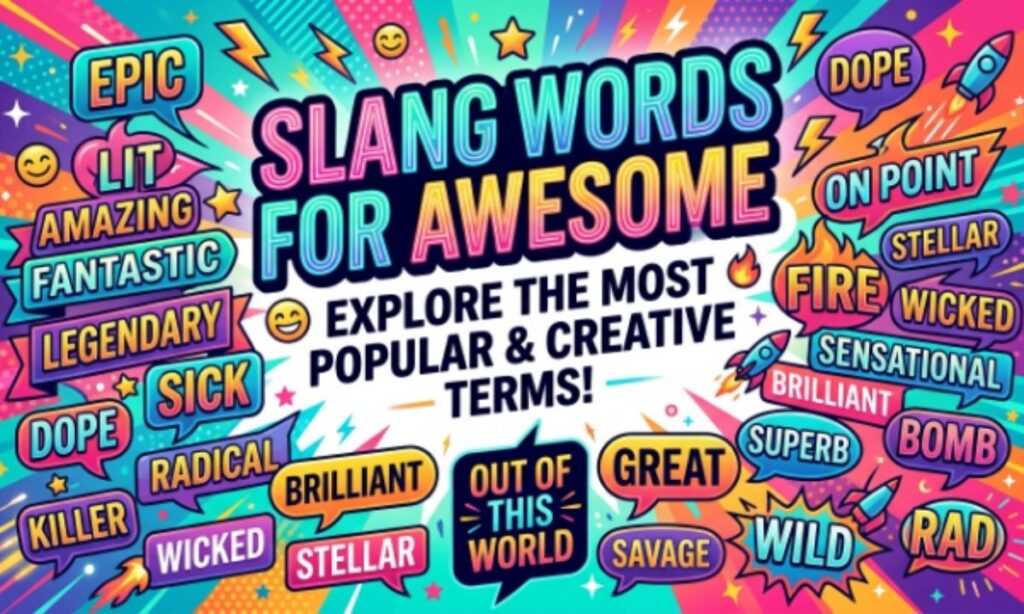
“Awesome” gets the job done, but after the hundredth time you’ve typed it in a group chat, it starts to feel a little flat. The good news: English (and plenty of other languages) has no shortage of punchier ways to say the same thing.
Below is a working list of 50+ slang words for awesome — sorted by how people actually use them today, from TikTok comment sections to British pubs to Spanish-speaking group chats — so you can swap in something fresher without sounding like you’re trying too hard.
Quick Reference Table
| Slang Word | Meaning | Vibe/Origin | Example |
| Fire | Really good, impressive | Hip-hop, social media | “That new track is fire.” |
| Lit | Exciting, amazing | Party/social media culture | “The concert was lit.” |
| Dope | Cool, excellent | Hip-hop | “Dope sneakers, man.” |
| Sick | Impressively good | Skate/sports culture | “That trick was sick.” |
| Epic | Grand, remarkable | Gaming | “Epic comeback in that match.” |
| GOAT | Best ever (Greatest Of All Time) | Sports | “She’s the GOAT of gymnastics.” |
| Slaps | Really good, especially music | Gen Z | “This song slaps.” |
| Bussin’ | Extremely good, usually food | Gen Z/TikTok | “This pizza is bussin’.” |
| Solid | Reliably good | General/casual | “That’s a solid plan.” |
| Clutch | Great in a crucial moment | Sports | “That clutch play won the game.” |
| Killer | Impressively great | General | “You gave a killer presentation.” |
| Legit | Genuinely impressive | Gen Z/millennial | “That’s a legit setup.” |
| Bomb | Excellent, especially food | 90s/2000s | “This taco is the bomb.” |
| Peak | The best of something | Gen Z | “That episode was peak.” |
| Unreal | Almost unbelievably good | General | “The view was unreal.” |
| Smooth | Effortlessly impressive | General | “That was a smooth move.” |
| Next-Level | Beyond expectations | Millennial/Gen Z | “Their service was next-level.” |
50+ Slang Terms That Mean “Awesome”
Fire
“Fire” describes anything impressively good, from a new song to a killer outfit. It exploded out of hip-hop culture and now shows up everywhere from Instagram captions to product reviews. “Bro, this playlist is fire.”
Lit
“Lit” leans toward excitement and energy — think a great party, a hyped-up crowd, or a genuinely fun night. It’s been a mainstay of youth slang for over a decade and still holds up. “The concert last night was lit.”
Dope
“Dope” is an older term (rooted in 80s and 90s hip-hop) that’s aged remarkably well. It works for anything from sneakers to ideas. “That’s a dope concept for the campaign.”
Sick
“Sick” flips a negative word into high praise — common in skate, snowboard, and gaming circles. “Did you see that sick 360 he landed?”
Epic
“Epic” started as a gaming and internet-culture word for anything grand or over-the-top impressive, and it’s stuck around for describing big wins, huge moments, or dramatic fails (usually said sarcastically). “That was an epic road trip.”
GOAT
Short for “Greatest Of All Time,” GOAT is used to crown the best version of something — an athlete, a meal, even a meme. “That burger place is the GOAT of this city.”
Slaps
When a song “slaps,” it hits hard — a favorite in music-related slang, especially on TikTok and in group chats. “This beat slaps.”
Bussin’
“Bussin'” (sometimes “bussin’ bussin'” for emphasis) almost always describes food that’s exceptionally good. It’s one of the more recent Gen Z additions to food slang. “The mac and cheese at that spot is bussin’.”
Solid
“Solid” is understated praise — dependable, well-made, or genuinely good without needing to shout about it. “That was a solid effort.”
Clutch
“Clutch” praises something (or someone) that comes through exactly when needed, especially under pressure. Rooted in sports commentary, it now applies to everyday wins too. “Thanks for the ride, that was clutch.”
Killer
“Killer” is classic slang for something seriously impressive — a killer smile, a killer resume, a killer playlist. “You did a killer job on that presentation.”
Legit
Short for “legitimate,” this word signals that something is the real deal — genuinely good, not just hype. “That’s a legit skill you’ve got.”
Bomb
“The bomb” (or just “bomb”) is 90s and 2000s slang for something excellent, especially food or experiences. It’s had a resurgence thanks to nostalgia trends. “This sauce is the bomb.”
Peak
“Peak” describes the high point of something — the best version, the funniest moment, the top of the curve. It’s especially common among Gen Z online. “That was peak comedy.”
Unreal
“Unreal” suggests something so good it’s hard to believe — often used for scenery, performances, or surprising achievements. “The sunset over the mountains was unreal.”
Smooth
“Smooth” praises effortless skill or style — a smooth talker, a smooth move, a smooth transition. “That was a smooth save.”
Next-Level
“Next-level” signals something that goes beyond the expected standard — a next-level meal, a next-level performance. “Their customer service is next-level.”
More Slang Words That Mean Awesome
- Banger – an excellent song, moment, or item (“That’s a banger of a track”)
- Iconic – memorably impressive, often used playfully (“That outfit is iconic”)
- Elite – top-tier, excellent (“Elite gameplay tonight”)
- Stellar – outstanding, exceptional (“Stellar performance from the whole team”)
- Immaculate – flawlessly good (“Immaculate vibes at that party”)
- A whole vibe – something that captures an appealing feeling or mood (“This café is a whole vibe”)
- Hits different – notably better than expected in the moment (“This coffee hits different today”)
- Straight fire – emphatic version of “fire” (“That verse was straight fire”)
- No notes – flawless, nothing to critique (“That performance? No notes.”)
- Chef’s kiss – perfect execution (“The ending was chef’s kiss”)
- Certified – officially good, approved by consensus (“Certified banger”)
- Top tier – among the best available (“Top tier customer service”)
- W (short for “win”) – something that’s a success or a good outcome (“Big W on that deal”)
- Goated – verb form of GOAT, meaning exceptionally skilled (“He’s goated at chess”)
- Insane – impressively extreme (in a good way) (“Insane comeback”)
- Cracked – exceptionally skilled, especially in gaming (“He’s cracked at that game”)
- Built different – uniquely impressive or capable (“She’s built different”)
- Rizz-worthy – impressive enough to earn admiration (playful extension of “rizz”)
- Vibing – enjoying something in a relaxed, positive way (“Just vibing to this album”)
- Send it – used to hype up doing something bold or impressive
- Mind-blowing – astonishingly good or surprising (“The plot twist was mind-blowing”)
- Off the charts – exceeding normal levels of quality (“The energy was off the charts”)
- Top-notch – excellent, high quality (“Top-notch service”)
- Boss – excellent, impressive (often as an adjective) (“That’s a boss move”)
- Money – reliably excellent (older slang, still used) (“That play was money”)
- Wicked (US usage) – very good, intensifier (“Wicked good pizza”)
- Sublime – exceptionally excellent, almost transcendent (“The dessert was sublime”)
- Phenomenal – remarkably impressive (“A phenomenal show”)
- A banger – (see above) commonly used for songs, meals, or moments
- Class act – impressively excellent in conduct or quality (“That was a class act”)
- Fresh – stylish, impressively new or good (“Fresh kicks”)
- Slick – impressively smooth or well-executed (“Slick presentation”)
- Boujee/Bougie – impressively upscale or fancy (“That hotel was bougie”)
- Standing on business – performing impressively and with confidence
- No cap – added for emphasis to confirm a compliment is genuine, not exaggerated (“That was awesome, no cap”)
- It’s giving [something] – a sentence pattern used to describe a strong, specific vibe of excellence (“It’s giving five-star restaurant”)
- Hits different – describes something uniquely satisfying in a specific moment or context (“This coffee hits different at 6am”)
Current Slang for “Awesome”
Right now, the terms getting the most everyday use skew toward fire, bussin’, slaps, peak, no notes, goated, hits different, and chef’s kiss — all of which show up constantly across TikTok comments, Instagram captions, and group chats. “No cap” often gets paired with these words for extra emphasis, as in “This is fire, no cap,” and the sentence pattern “it’s giving [something]” (e.g., “it’s giving main character energy”) has become one of the most common ways to describe a specific, impressive vibe rather than just saying something is good. Meanwhile, a few older favorites — “on fleek,” “totes,” “swag” — have mostly faded and can read as dated if used unironically.
Gen Z Slang for Awesome
Gen Z tends to favor short, punchy, often visual-culture-driven terms: bussin’, slaps, peak, goated, cracked, built different, hits different, and rizz-worthy. Many of these terms originate on TikTok or in gaming communities before spreading to everyday conversation. A defining feature of Gen Z slang is how quickly it turns over — a term can be everywhere one month and feel dated the next, so context (who you’re talking to, and where) matters more than ever.
Spanish Slang for Awesome
Spanish has strong regional variation for “awesome,” and using the right one for the right country matters:
- ¡Qué padre! / Chido – Mexico (“That’s awesome!”)
- Chingón – Mexico (more intense, casual-only)
- ¡Qué chévere! – widely used across Latin America, especially Colombia and Venezuela
- Bacano/Bacán – Colombia, Peru, Chile
- Guay – Spain
- ¡Qué pasada! – Spain (also means “amazing”)
- Copado – Argentina
- Buena onda – Latin America broadly, describing something (or someone) with a great vibe
- ¡Qué chimba! – Colombia (informal, use with peers)
British Slang for Awesome
British English tends to favor its own set of enthusiastic adjectives over “awesome” itself:
- Brilliant – the most common British go-to for “awesome” or “excellent”
- Ace – something that’s genuinely great, or someone skilled at something
- Wicked – enthusiastic, especially among younger speakers
- Smashing – wonderful, excellent
- Blinding – fantastic, superb
- Lush – enjoyable, great (especially food or experiences)
- Gobsmacked – used for something so impressive it’s almost shocking
- Legend/Legendary – used for someone (or something) impressively cool
- Buzzing – excited and pleased about something great happening
90s Slang for Awesome
Nineties slang leaned playful and exaggerated, and a few terms are enjoying nostalgic comebacks:
- Da bomb – something seriously excellent
- Phat – amazing, super cool
- Fly – stylish and impressive
- Tight – cool, well done
- All that and a bag of chips – exceptionally impressive, the total package
- Radical/Rad – excellent (technically more 80s, but carried into the 90s)
- Tubular – excellent (surf culture origin)
- Cowabunga – an exclamation of excitement, popularized by Teenage Mutant Ninja Turtles
- Wicked awesome – New England-specific intensifier
10 Slang Words for Awesome (Quick List)
- Fire
- Bussin’
- Slaps
- Peak
- No notes
- Chef’s kiss
- Goated
- Iconic
- Elite
- Cracked
How Different Generations Use Slang
Slang doesn’t just change over time — it changes in function. Baby Boomers and Gen X often stuck with words like “groovy,” “far out,” or “rad,” many rooted in music and counterculture. Millennials leaned on internet-born terms like “epic,” “legit,” and “the bomb,” shaped by early social media and gaming forums. Gen Z’s slang moves faster than any generation before it, largely because platforms like TikTok can turn a single video into a nationwide catchphrase within days — and just as quickly retire it. Understanding this pattern helps explain why some slang (like “brilliant” or “fire”) has real staying power, while other terms are more like trends that pass through quickly.
How to Use Slang Naturally Without Sounding Awkward
- Match your audience. Slang that works in a text to a close friend can feel forced in a work Slack message or a formal caption.
- Don’t overload a sentence. One slang word usually lands better than stacking three in a row.
- Listen before you use it. If you’re unsure how a term is used, watch how it appears in real conversations or captions first.
- Let context do the work. Tone, punctuation, and even emojis affect how a slang word reads — “fire 🔥” hits differently than “fire” on its own.
- Accept that some terms have a shelf life. Using last year’s trending phrase past its moment can feel more dated than helpful.
Common Slang Mistakes
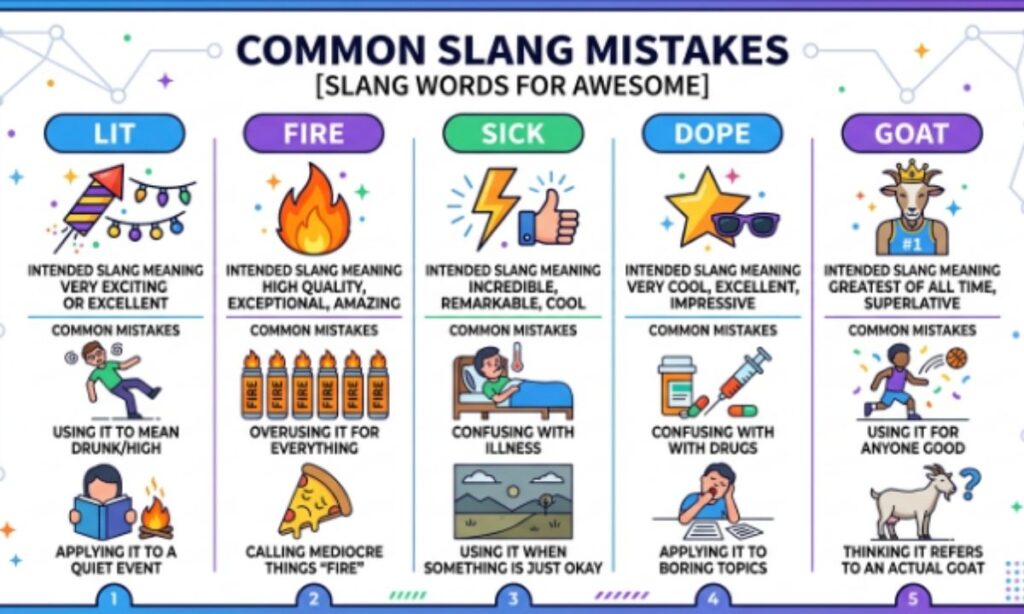
- Using outdated terms as if they’re current (e.g., leading with “tubular” in a 2026 conversation) can come across as ironic or out of touch unless that’s the intent.
- Overusing intensifiers (“literally the most insane fire thing ever”) can dilute the impact instead of adding to it.
- Misapplying regional slang — using British “brilliant” in a way that doesn’t match its natural rhythm, or applying Mexican Spanish slang in a context where a different country’s term is expected.
- Forcing slang into professional writing where a plain, clear word would communicate better.
- Assuming all slang is universal — a term huge on TikTok in the US might be unfamiliar or mean something different elsewhere.
Practice Section
Fill in the Blanks
- “That new burger place is absolutely ______.” (hint: food-related Gen Z slang)
- “Her presentation was ______, no notes.” (hint: British-inspired praise)
- “He’s ______ at that video game.” (hint: skill-related Gen Z slang)
Choose the Correct Slang
Q: Which word best fits: “This song ______ so hard.” A) Solid B) Slaps C) Legit D) Smooth
Rewrite Into Slang
Rewrite this sentence using at least one slang term from this guide: “The trip was really enjoyable and everything went better than expected.”
Frequently Asked Questions
What are popular slang words for awesome used in social media apps?
On platforms like TikTok and Instagram, the most common terms are fire, bussin’, slaps, peak, no notes, and chef’s kiss, often paired with emojis for extra emphasis.
How do young people express extreme approval in casual conversation?
Younger speakers often combine intensity words with slang, like “that’s actually fire” or “no cap, that’s peak,” to signal genuine, emphatic approval rather than mild agreement.
What are some contemporary alternatives to saying “that’s great”?
Contemporary alternatives include “that’s fire,” “that slaps,” “no notes,” “chef’s kiss,” and “that’s elite” — all of which carry more energy than a plain “great.”
What slang words for awesome are commonly used in online gaming communities?
Gamers frequently use epic, cracked, goated, insane, and clutch to describe impressive plays, skilled players, or exciting moments.
How do you say “awesome” in slang?
There’s no single answer — common choices include “fire,” “sick,” “dope,” “bussin’,” and “slaps,” depending on your audience and the situation.
What is Gen Z slang for “that’s amazing”?
Gen Z commonly says “that’s fire,” “that’s peak,” “no notes,” or “that slaps” to mean “that’s amazing.”
What do people say instead of “cool” now?
Beyond “cool,” people commonly reach for “fire,” “sick,” “legit,” “solid,” or “elite” depending on tone and context.
What does “hits different” actually mean?
It describes something that feels especially good in a particular moment or setting, rather than being generically excellent — the same coffee can taste fine most days but “hit different” on one specific morning.
Is slang like “no cap” or “goated” only used by younger people?
These terms started with younger, online-first communities, but both have crossed over enough that people of many ages now recognize and use them, especially in casual texting or social captions.
What’s the difference between “it’s giving [something]” and just saying something is awesome?
“It’s giving [something]” points to a specific feeling or vibe (like “it’s giving cozy cabin energy”), while “awesome” is a flat, general compliment — the phrase does more descriptive work in fewer words.
Final Thoughts
“Awesome” isn’t going anywhere, but the words people reach for to express the same enthusiasm keep shifting — from surf-culture throwbacks like “tubular,” to Gen Z staples like “bussin'” and “no notes,” to regional favorites like Britain’s “brilliant” or Mexico’s “qué padre.” The real skill isn’t memorizing every term on this list; it’s picking the one or two that fit your voice and your audience, then using them naturally instead of forcing them into every sentence. Slang works best when it sounds like you — so borrow what fits, skip what doesn’t, and let the rest evolve on its own.

The author is a professional content writer specializing in word meanings, definitions, and English vocabulary. With over 6 years of experience in language research and educational content creation, they produce accurate, well-researched, and reader-friendly articles.