
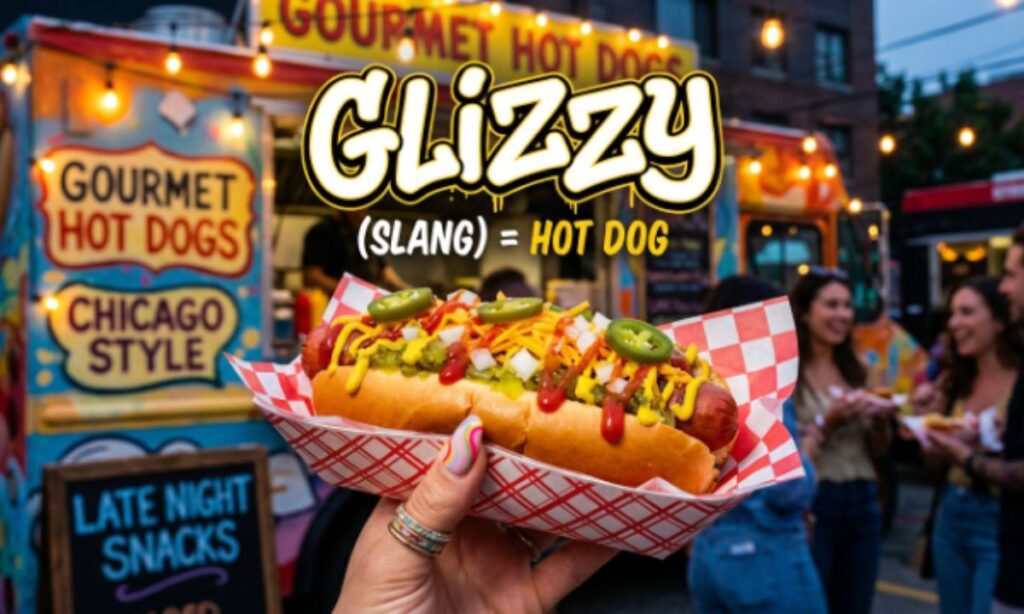
If you’ve seen “glizzy” in a TikTok comment, a rap lyric, or a group chat and had no idea what it meant, you’re not alone. The short answer: glizzy is internet slang that most commonly means “hot dog,” though it started out meaning something very different — a gun. Both meanings are still floating around today, and figuring out which one someone means depends entirely on context.
This guide breaks down where “glizzy” actually came from, how it’s used now, and 30 other slang terms that show up in the same conversations. By the end, you’ll be able to spot the difference between a “glizzy” joke and a “glizzy” warning — and use slang like this without sounding like you’re trying too hard.
Quick Reference Table
| Term | Meaning | Example |
| Glizzy | Hot dog (originally slang for a Glock handgun) | “He ate three glizzies at the cookout.” |
| Glizzy Gobbler | Someone who eats hot dogs enthusiastically | “Bro is a certified glizzy gobbler.” |
| Bussin | Really good, especially food | “This pizza is bussin.” |
| Cap | A lie | “Stop capping, that’s not true.” |
| No Cap | No lie, for real | “That movie was amazing, no cap.” |
| Drip | Stylish clothing or accessories | “New sneakers? That’s some serious drip.” |
| Bet | Agreement, “okay” or “deal” | “Wanna hang out later? Bet.” |
| Mid | Average, unimpressive | “The concert was kind of mid.” |
| Fire | Excellent, impressive | “This new song is fire.” |
| Snack | An attractive person | “He’s a total snack.” |
| Low-key | Somewhat, secretly | “I’m low-key nervous about this.” |
| High-key | Very obviously, openly | “I’m high-key obsessed with this show.” |
| Vibe | A mood or overall feeling | “This coffee shop has a good vibe.” |
| Sus | Suspicious | “That excuse sounds kind of sus.” |
| Flex | To show off | “He’s flexing his new car on Instagram.” |
| Lit | Exciting, fun | “The party last night was lit.” |
| W | A win | “That’s a W for the team.” |
| L | A loss | “Missing the bus was a big L.” |
| Fierce | Bold, confident, impressive | “Her outfit was fierce.” |
| Slaps | Sounds really good (usually music) | “This beat slaps.” |
30 Slang Terms Related to Modern Youth Conversations
Slang moves fast, and most of it clusters around the same handful of platforms — TikTok, X (Twitter), and group chats. Below are 30 terms that regularly show up alongside “glizzy” in casual online conversation, with a plain-English definition and a real-world style example for each.
Glizzy
Originally West Coast and DC street slang for a Glock handgun, “glizzy” is now used far more often to mean a hot dog, thanks to memes and TikTok food content.
Example: “Costco glizzies are still only $1.50.”
Glizzy Gobbler
A humorous nickname for someone who eats a lot of hot dogs, often used as a joking compliment or an insult in meme culture.
Example: “He ate five hot dogs at the barbecue — total glizzy gobbler behavior.”
Bussin
Describes food (or occasionally anything else) that’s extremely good.
Example: “My mom’s mac and cheese is always bussin.”
Cap
Slang for a lie or exaggeration, borrowed from older street slang.
Example: “You didn’t really meet him, quit the cap.”
No Cap
The opposite of “cap” — used to emphasize that you’re being 100% honest.
Example: “That test was so hard, no cap.”
Drip
Refers to someone’s stylish outfit, shoes, or overall look.
Example: “New jacket is dripped out.”
Bet
A quick way to agree to something or confirm plans.
Example: “Meet at 6? Bet.”
Mid
Used to describe something that’s just okay — not bad, but not good either. Example: “The new season was honestly mid.”
Fire
Means something is really good or impressive, most often used for music, food, or outfits.
Example: “That new album is fire.”
Snack
A playful compliment for someone who’s very attractive.
Example: “Her new boyfriend is a snack.”
Low-key
Means “somewhat” or “kind of,” often used to downplay a feeling.
Example: “I low-key want to skip class today.”
High-key
The opposite of low-key — used when you want to openly emphasize something.
Example: “I’m high-key excited for this trip.”
Vibe
Refers to the mood or energy of a place, song, or situation.
Example: “This song just has a good vibe.”
Sus
Short for “suspicious,” used when something feels off or untrustworthy.
Example: “He canceled last minute again — kind of sus.”
Flex
To show off something, whether it’s money, clothes, or an achievement. Example: “She’s flexing her new job on LinkedIn.”
Lit
Describes something exciting, fun, or high-energy, usually an event.
Example: “That concert was lit.”
W
Short for “win,” used to celebrate a good outcome.
Example: “Passing that exam is a huge W.”
L
Short for “loss,” used when something goes badly.
Example: “Losing my phone charger is such an L.”
Fierce
Used to describe someone who looks bold, confident, or impressively styled.
Example: “That runway look was fierce.”
Slaps
Means something (usually a song) sounds really good.
Example: “This new track slaps.”
Rizz
Short for “charisma,” referring to someone’s ability to flirt or charm others.
Example: “He’s got serious rizz.”
Skibidi
A nonsensical term popularized by a viral animated series, now used mostly as a joke word with no fixed meaning.
Example: “That’s so skibidi” (used ironically).
Gyat
An exclamation used to react to someone’s attractive appearance, popularized on TikTok.
Example: A surprised reaction shared as a caption under a photo.
Sigma
Describes someone seen as independent and self-reliant, often used ironically online.
Example: “He left the party early, very sigma of him.”
NPC
Borrowed from video games (“non-player character”), used to describe someone acting robotic or unoriginal.
Example: “Stop being an NPC and make your own decision.”
Ghost
To suddenly stop responding to someone without explanation.
Example: “She ghosted me after the first date.”
Salty
Being upset or bitter, often over something small.
Example: “He’s still salty about losing the game.”
Extra
Describes someone who’s overly dramatic or over-the-top.
Example: “You didn’t need to cry, that’s so extra.”
Simp
Someone who goes out of their way to please a person they’re attracted to.
Example: “He bought her flowers on day one — total simp move.”
Based
Used to praise someone for being unapologetically themselves, regardless of popular opinion.
Example: “That was a based response to a tough question.”
Generational Slang Comparison
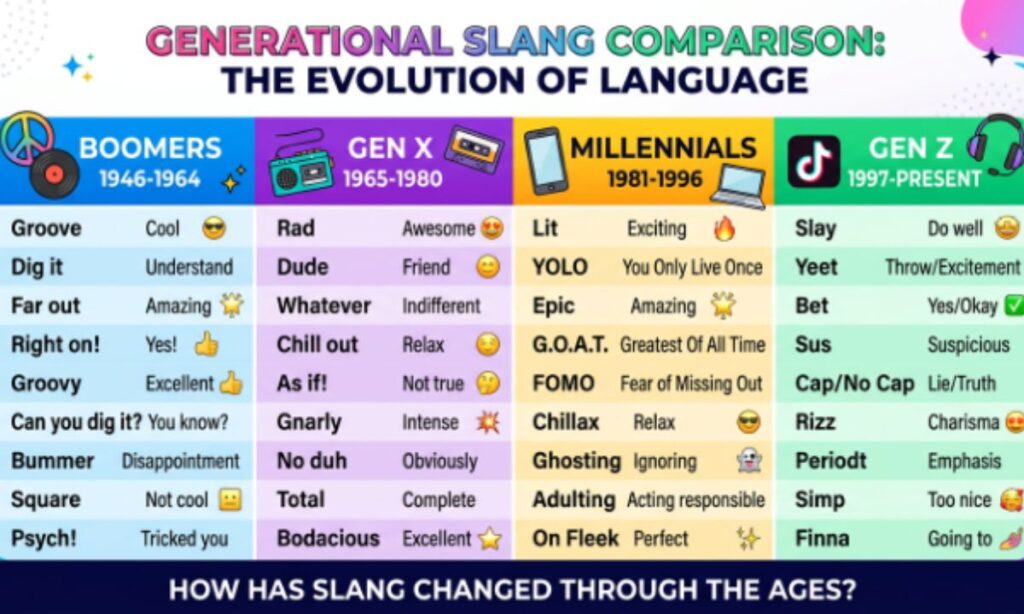
Slang doesn’t disappear — it evolves. Each generation has its own version of “cool,” and comparing them shows how quickly online culture moves.
Gen Z
Gen Z slang spreads mainly through TikTok, gaming Discord servers, and meme pages. Words like glizzy, bussin, mid, sus, and rizz dominate this group’s everyday texting and comments, and terms often burn out within a year or two.
Millennials
Millennials popularized terms like lit, fierce, low-key, vibe, and flex — many of which are still used today, just at a slower pace than newer Gen Z terms. Millennial slang tends to stick around longer because it spread through blogs, early Twitter, and reality TV rather than short-form video.
Older Generations
Earlier generations had their own versions of the same idea — words like “cool,” “groovy,” “rad,” and “far out” served the same social function that “fire” or “bussin” serves today. The core purpose of slang hasn’t changed: it signals belonging to a specific time and group, only the vocabulary and the speed of change are different.
Other Meanings of Glizzy Slang
“Glizzy” isn’t a one-definition word. Depending on where you see it and who’s using it, the meaning shifts. Here’s a breakdown of the most common variations, explained with real examples.
Glizzy Eater Meaning Slang
A “glizzy eater” simply refers to someone who eats hot dogs, and it’s almost always used as a lighthearted joke rather than a literal description. Example: In a TikTok comment section under a hot-dog-eating contest video, someone might write, “The world’s greatest glizzy eater right here.”
What Does the Slang Word Glizzy Mean
At its core, “glizzy” is a slang word with two competing meanings: a hot dog (the far more common modern use) and a handgun, specifically a Glock (the older, original meaning). Example: On a cooking or food TikTok, “glizzy” almost always means hot dog, but in older hip-hop lyrics from the 2000s and 2010s, it usually refers to a gun.
Glizzy Gobbler Slang Meaning
As covered above, a “glizzy gobbler” is someone known for eating a lot of hot dogs, often used as a nickname at cookouts, tailgates, or in meme captions. Example: “Every Fourth of July, my uncle turns into a full glizzy gobbler.”
Glizzy Slang Meaning Urban Dictionary
Urban Dictionary entries for “glizzy” reflect the same split seen everywhere else online: top-voted definitions describe it as a hot dog, while older entries reference its origin as slang for a Glock pistol, and a small number of crude, joking entries use it in other contexts entirely. Example: If you search “glizzy” on Urban Dictionary, you’ll usually see the hot dog definition ranked highest, since that’s the meaning most people are searching for today.
How to Use Slang Naturally Without Sounding Awkward
- Match the tone of the conversation. Slang works in casual texts, comments, and hangouts — not in emails to your boss or a school essay.
- Know your audience. A term like “glizzy” lands fine with friends but can confuse (or worry) someone unfamiliar with the food meaning.
- Don’t overuse it. Dropping one or two slang words naturally reads better than stacking five in a single sentence.
- Pay attention to context clues. If a word is trending in food videos, it probably means something different than the same word used in an older song.
- Let usage guide you, not definitions alone. Watching how real people use a term in comments or videos teaches you the tone faster than a dictionary entry does.
Common Slang Mistakes
- Using outdated slang meanings. Calling a gun a “glizzy” today will likely confuse people who only know the hot dog meaning.
- Forcing slang into formal writing. Slang in a resume, work email, or academic paper reads as unprofessional.
- Mixing up similar terms. Confusing “low-key” and “high-key,” or “cap” and “no cap,” flips the meaning of your sentence entirely.
- Overusing trendy words. Repeating “fire,” “bussin,” or “no cap” in every sentence makes speech feel unnatural rather than casual.
- Assuming slang means the same thing everywhere. Regional and generational differences mean the same word can carry different weight depending on who’s using it.
Practice Section
Fill in the Blanks
- “This burger is absolutely _____ (really good).”
- “I’m _____ (secretly) nervous about the interview.”
- “He’s not lying, that’s _____ (no lie).”
(Answers: 1. bussin/fire, 2. low-key, 3. no cap)
Choose the Correct Slang
- Someone shows off their new car online. Is that a flex or a ghost?
- A friend cancels plans without a good reason. Is that sus or fierce?
- Your team wins a game. Is that a W or an L?
(Answers: 1. flex, 2. sus, 3. W)
Rewrite the Sentence Using Slang
- Original: “That song is really good and I’m obviously obsessed with it.”
- Slang version: “That song slaps, I’m high-key obsessed.”
- Original: “I think he’s lying about where he was last night.”
- Slang version: “I think he’s capping about last night.”
Frequently Asked Questions
Why do people call it glizzy?
The term likely spread from DC-area street slang and hip-hop culture, and it stuck as a catchy, easy-to-say word that later got reused for hot dogs because of the visual similarity between a hot dog and a gun’s magazine.
What is a glizzy girl?
“Glizzy girl” is internet slang with several different, inconsistent meanings depending on the platform and context, so it’s not a term with one clear, agreed-upon definition — it’s best understood only from the specific conversation it appears in.
What does the slang term “glizzy” mean in urban culture?
In urban culture, “glizzy” originally referred to a Glock handgun before evolving into a much more common, lighthearted slang term for a hot dog.
What is the slang meaning of “glizzy”?
The most widely used slang meaning of “glizzy” today is a hot dog, especially in TikTok and meme content, though the older meaning of “handgun” is still recognized in some music and regional slang.
Origin and etymology of the term “glizzy”
“Glizzy” is believed to have originated in Washington, D.C. street slang in the early 2000s as a term for a Glock pistol, popularized further by rapper Shy Glizzy, before the food meaning took over online years later.
How is “glizzy” used in internet culture?
Online, “glizzy” is almost always used playfully to refer to hot dogs — in eating-contest videos, cookout posts, and food memes — rather than in its older, more serious firearm sense.
Can you explain the origin of the slang word “glizzy”?
Yes — “glizzy” started as slang for a Glock handgun in DC-area street culture, and over time, especially after gaining traction on YouTube and TikTok, it shifted to mean hot dog for most everyday users.
Common contexts for using the word “glizzy”?
You’ll most often see “glizzy” in food-related posts (cookouts, hot dog eating contests, Costco food court jokes), though it can still appear in older rap lyrics with its original firearm meaning.
Is “glizzy” appropriate to use in casual conversation?
Yes, in most casual settings “glizzy” is understood as a lighthearted way to say hot dog, but it’s worth reading the room since the word can carry its older, more serious meaning in certain contexts.
What’s the difference between “glizzy” and “hot dog” in slang usage?
There’s no real difference in meaning — “glizzy” is simply the slang, meme-friendly version of “hot dog,” used mostly in casual online and social contexts rather than formal speech.
Final Thoughts
“Glizzy” is a perfect example of how internet slang can completely flip meaning over time — starting as street slang for a gun and ending up as one of the internet’s favorite joking words for a hot dog. Understanding both meanings (and the context clues that separate them) helps you avoid confusion whether you’re scrolling TikTok, reading old song lyrics, or just trying to keep up with a younger sibling’s texts.
Slang like “glizzy,” “bussin,” and “no cap” isn’t going anywhere anytime soon — it just keeps reinventing itself. The more you pay attention to context, the easier it becomes to use these words naturally, without sounding like you’re trying too hard.

The author is a professional content writer specializing in word meanings, definitions, and English vocabulary. With over 6 years of experience in language research and educational content creation, they produce accurate, well-researched, and reader-friendly articles.