
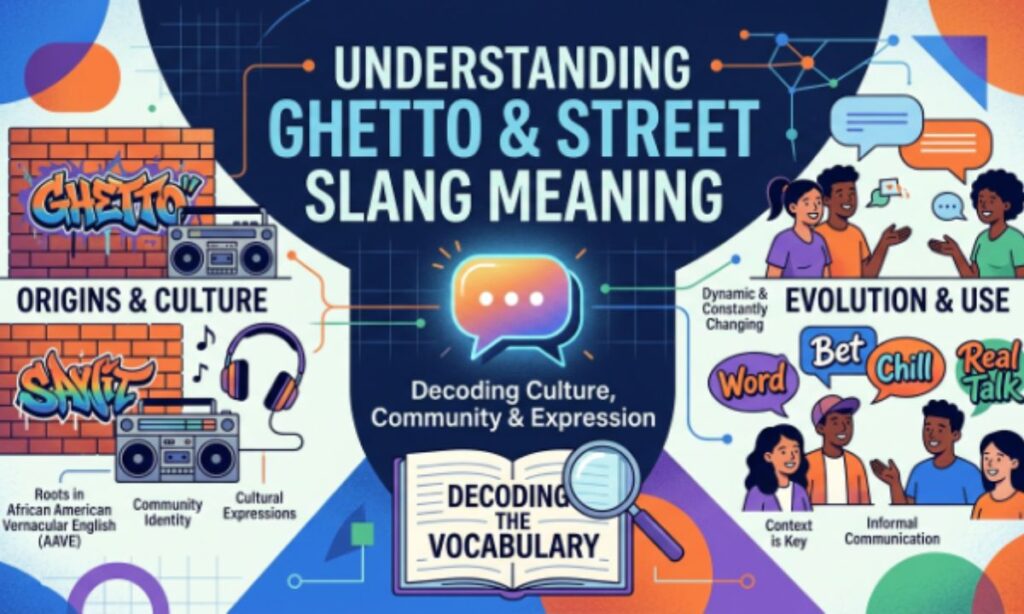
If you’ve scrolled TikTok, YouTube, or a group chat lately and felt one step behind, you’re not alone. Words like bussin, no cap, and goated move fast, and “ghetto slang” is the label a lot of people search for when they’re trying to catch up. This guide breaks down where the phrase “ghetto slang” actually comes from, what it means today, and defines 33 of the most-used terms in plain English — with real examples you can actually use.
One thing worth saying upfront: “ghetto” is a loaded word. It has a real, documented history, and calling someone’s speech “ghetto” can come across as dismissive or even offensive, depending on tone and context. This guide treats the topic honestly — covering both the history and the everyday slang meanings — so you understand not just what these words mean, but where they came from and how to use them respectfully.
Quick Reference Table
| Term | Meaning | Example |
| Lit | Exciting, amazing | “That party was lit!” |
| Drip | Stylish outfit/look | “His drip is unmatched.” |
| Flex | Show off | “Stop flexing your new car.” |
| Cap | A lie | “That story is cap.” |
| No Cap | No lie, seriously | “No cap, this is the best burger ever.” |
| OG | Original, respected veteran | “He’s an OG in this game.” |
| Bussin | Really good (usually food) | “This pizza is bussin.” |
| Slaps | Really good (usually music) | “This song slaps.” |
| Glow Up | A major positive transformation | “She had such a glow up this year.” |
| Bet | Agreement, “okay” | “Bet, I’ll see you at 6.” |
| Lowkey | Somewhat, secretly | “I’m lowkey tired.” |
| Highkey | Very obviously, openly | “I’m highkey obsessed with this show.” |
| Woke | Socially aware | “He’s very woke about politics.” |
| Throwing Shade | Subtle insult | “She was throwing shade at the meeting.” |
| Squad | Close friend group | “My squad is going out tonight.” |
| Hype | Excitement/energy | “The crowd was so hyped.” |
| Dead | Extremely funny | “I’m dead, that meme killed me.” |
| Brutal | Harsh or unpleasant | “That loss was brutal.” |
| Snatched | Looking great, fitted | “Her outfit is snatched.” |
| Fire | Excellent, impressive | “Those sneakers are fire.” |
| Clout | Social influence/status | “He’s just chasing clout.” |
| Mood | Relatable feeling | “That photo is such a mood.” |
| Big Mad | Extremely angry | “He’s big mad over nothing.” |
| Goated | The greatest of all time | “She’s goated at chess.” |
| Chill | Relaxed, calm | “Let’s just chill tonight.” |
| Vibe | Atmosphere, feeling | “This café has a great vibe.” |
| Salty | Bitter, upset | “Don’t be salty you lost.” |
| Ghost | Suddenly stop responding | “He ghosted me after one date.” |
| Extra | Over-the-top, dramatic | “She’s so extra about everything.” |
| Dope | Cool, great | “That’s a dope idea.” |
33 Popular Ghetto Slang Terms With Examples
Lit
“Lit” describes something exciting, high-energy, or excellent — most often a party, event, or moment. It grew out of hip-hop culture in the 2010s, originally implying something was “lit up” or on fire with energy. Example: “The concert last night was absolutely lit.”
Drip
“Drip” refers to an impressive, stylish outfit or overall look — clothes, jewelry, shoes, the whole aesthetic. Having “drip” means you’re dressed sharp and it shows. Example: “New kicks, new fit — his drip is elite right now.”
Flex
To “flex” is to show off, usually about money, possessions, achievements, or status. It can be genuine bragging or playful, depending on the tone. Example: “He’s always flexing his new watch on Instagram.”
Cap
“Cap” means a lie or an exaggeration. If someone says something untrue, you can call it “cap.” Example: “You said you ran a marathon? That’s cap.”
No Cap
The opposite of “cap” — “no cap” means “no lie” or “I’m being serious.” It’s used to emphasize honesty or sincerity. Example: “No cap, that was the best meal I’ve had all year.”
OG
Short for “Original Gangster,” “OG” now broadly means someone who’s the original, most respected, or most experienced person in a group or scene. Example: “She’s been playing this game since day one — total OG.”
Bussin
“Bussin” (sometimes “bussin bussin”) describes food that tastes really, really good. It exploded in popularity through TikTok food reviews. Example: “This mac and cheese is bussin.”
Slaps
When a song “slaps,” it means it’s really good — catchy, well-produced, and enjoyable to listen to, often with a strong beat. Example: “This new album slaps from start to finish.”
Glow Up
A “glow up” is a dramatic positive transformation, usually referring to someone’s appearance, confidence, or overall life situation improving over time. Example: “She had a serious glow up between freshman and senior year.”
Bet
“Bet” is used to express agreement, confirmation, or acceptance — similar to saying “okay,” “deal,” or “for sure.” Example: “Meet me at 7?” “Bet.”
Lowkey
“Lowkey” means something is happening quietly, subtly, or to a moderate degree. It softens a statement, often revealing a mild or slightly secret feeling. Example: “I’m lowkey nervous about the interview.”
Highkey
The opposite of “lowkey” — “highkey” means something is obvious, intense, or openly true, with no attempt to hide it. Example: “I’m highkey excited for this trip.”
Woke
“Woke” originally described being alert to racial injustice and social inequality within Black communities. It has since broadened (and become politically contested) to describe general social or political awareness — and is sometimes used sarcastically or critically depending on the speaker’s viewpoint. Example: “He became really woke after taking that sociology class.”
Throwing Shade
“Throwing shade” means making a subtle, indirect insult or criticism — often through a sly comment, look, or tone rather than a direct confrontation. Example: “Did you catch her throwing shade at dinner?”
Squad
“Squad” simply means a close-knit group of friends — the people you hang out with and trust. Example: “My squad is meeting up this weekend.”
Hype
“Hype” refers to excitement, anticipation, or high energy around something — a person, event, or piece of news. Example: “There’s so much hype around the new game release.”
Dead
“Dead” (or “I’m dead”) is used to express that something is extremely funny — so funny it “killed” you. Example: “That video has me dead, I can’t stop laughing.”
Brutal
“Brutal” describes something harsh, painful, or difficult — a tough loss, a rough day, or an unforgiving situation. Example: “That exam was brutal.”
Snatched
“Snatched” means looking exceptionally good — a tight, well-fitted outfit, sharp makeup, or an overall polished appearance. Example: “Her makeup is snatched today.”
Fire
“Fire” describes something impressive, excellent, or highly desirable — closely related to “lit” but usable for almost anything, from food to fashion to music. Example: “Those new sneakers are fire.”
Clout
“Clout” means social influence, fame, or status — often within a specific community or online platform. Example: “He only did it for the clout.”
Mood
“Mood” (often “big mood” or “that’s a mood”) is used to express strong relatability to a feeling, photo, or situation. Example: “Staying in bed all day? That’s a mood.”
Big Mad
“Big mad” is an intensified version of “mad,” meaning extremely or disproportionately angry, often used a bit sarcastically. Example: “He’s big mad because he lost the game.”
Goated
“Goated” comes from the acronym G.O.A.T. (Greatest Of All Time) and describes someone or something considered the best in its category. Example: “That chef is goated — every dish is perfect.”
Chill
“Chill” describes something relaxed and low-pressure, or a person who is easygoing and calm. Example: “Let’s keep tonight chill, just a movie at home.”
Vibe
“Vibe” refers to the atmosphere or emotional feeling of a place, person, or moment. “Vibing” means enjoying that feeling in the moment. Example: “This restaurant has such a good vibe.”
Salty
“Salty” means being bitter, annoyed, or upset — usually about something relatively minor. Example: “Don’t get salty just because you lost the game.”
Ghost
To “ghost” someone means to suddenly and completely stop responding to them — no explanation, no closure. Example: “We were texting for weeks and then he just ghosted me.”
Extra
“Extra” describes someone or something that’s over-the-top, dramatic, or doing more than necessary for the situation. Example: “She cried over a lost sock — she’s so extra.”
Dope
“Dope” is a long-running slang term meaning cool, excellent, or impressive — used for people, ideas, objects, or experiences. Example: “That’s a dope mural on the side of the building.”
Other Meanings of “Ghetto”
Ghetto: Original Meaning
The word “ghetto” dates back to 1516 in Venice, Italy, where Jewish residents were confined to a walled district near an old copper foundry, and the term likely came from the Venetian word for that foundry. Over time it came to describe any legally enforced or socially compelled residence area for a minority group. The most infamous historical use came during World War II, when Nazi authorities used the word to describe designated sections of cities where Jewish populations were forcibly concentrated. After World War Two, the word moved away from its Jewish origins in public usage and became more commonly associated with segregated Black American neighborhoods in the United States.
Ghetto Slang Meaning Dictionary
In casual, modern usage, “ghetto” as slang describes something seen as low-quality, improvised, rough-around-the-edges, or associated with poor, urban, often Black or Latino communities in the U.S. It can describe an object (“a ghetto fix”), a place, a style of speech, or a behavior. It’s frequently used informally and can carry either a neutral/humorous tone or a genuinely disrespectful one, depending on who’s using it and how.
Ghetto Slang Meaning in English
In standard English slang, “ghetto” functions as an adjective meaning cheap, makeshift, low quality, or unrefined — for example, calling a duct-taped fix “a ghetto solution.” It’s also used to describe a person’s mannerisms, accent, or attitude as stereotypically associated with low-income urban neighborhoods.
Ghetto Slang Meaning in Spanish
In Spanish-speaking communities, “ghetto” (sometimes spelled “gueto”) is often borrowed directly from English slang with a similar meaning — low-income, urban, or improvised — and is also used in some Latin American hip-hop and reggaetón scenes to describe street culture or working-class neighborhood identity, similarly to its use in English-language hip-hop.
Ghetto Slang Meaning in Urdu
In Urdu and South Asian online slang, “ghetto” is typically borrowed from English pop culture (largely through American hip-hop and social media) and used the same way — to describe something cheap, improvised, or associated with rough, low-income urban areas, rather than having a distinct local meaning.
Ghetto Slang Meaning: “Mack”
“Mack” is a related but separate slang term, most often meaning a smooth talker — someone skilled at flirting or charming others, especially romantically. It comes from “mack daddy,” a term with roots in Black American vernacular associated with confidence and charisma rather than the neighborhood-based meaning of “ghetto.”
Ghetto Slang Meaning in the UK
In UK slang, “ghetto” carries a similar meaning to its American use — describing a low-income, often ethnically diverse urban area, or informally describing something as rough, cheap, or improvised. British usage has also absorbed the word through American hip-hop and grime culture, sometimes referencing UK council estates in a comparable way to how “the hood” is used in the U.S.
Link Ghetto Slang Meaning
“Link” (as in “let’s link” or “we linked up”) is a separate, commonly searched slang term meaning to meet up with someone in person. It’s especially common in UK and U.S. urban slang and isn’t directly related to the word “ghetto,” though the two terms often appear in the same slang glossaries. Example: “We linked up after work and grabbed food.”
Meaning of “Ghetto Person”
Calling someone a “ghetto person” typically means the speaker is describing them (fairly or unfairly) as loud, unrefined, low-income, or matching a stereotype associated with poor urban neighborhoods. This usage is widely considered insensitive or offensive, since it reduces a person’s identity to a negative stereotype rather than an accurate description of who they are.
Ghetto Behavior Meaning
“Ghetto behavior” is a phrase used — often critically — to describe loud, aggressive, or “unrefined” conduct that the speaker associates with poor, urban communities. Because this framing leans heavily on racial and class stereotypes, many people consider the phrase offensive, and it’s worth using with real caution, if at all.
Ghetto Wedding Meaning
“Ghetto wedding” is a slang phrase (sometimes used self-deprecatingly by couples on social media) to describe a low-budget, informal, or unconventional wedding — as opposed to a lavish, traditionally styled one. Some use it affectionately to describe a fun, no-frills celebration; others avoid it because of the stereotype it references.
Generational Slang Comparison
Slang doesn’t stay still — each generation adapts old words or invents new ones.
| Concept | Boomer/Gen X | Millennial | Gen Z |
| Something is great | “Groovy” / “Awesome” | “Sick” / “Dope” | “Fire” / “Bussin” / “Goated” |
| Showing off | “Bragging” | “Showing off” | “Flexing” |
| Lying | “Fibbing” | “BS-ing” | “Capping” |
| Attractive style | “Sharp dressed” | “Stylish” | “Drip” |
| Agreement | “Sure thing” | “For sure” | “Bet” |
| Relaxed | “Laid back” | “Chill” | “Chill” / “Vibing” |
The pattern is clear: each generation reinvents the same handful of ideas — excitement, style, honesty, agreement — with new packaging. Gen Z slang moves faster than previous generations’ largely because of social media, where a word can go from unknown to overused in a matter of weeks.
How to Use Slang Naturally Without Sounding Awkward
- Match the context. Slang works in casual conversations, texts, and social posts — not in job applications or professional emails.
- Don’t force it into every sentence. Overusing slang, especially several terms in one sentence, tends to sound try-hard rather than natural.
- Use tone, not just words. A lot of slang (like “big mad” or “throwing shade”) relies on a playful or sarcastic tone. Reading it flat can make it feel off.
- Know your audience. Slang that’s normal among close friends can feel out of place with coworkers, older relatives, or people you don’t know well.
- Watch how it’s actually used before adopting it. Slang terms shift meaning fast — a word that meant one thing a year ago might mean something slightly different now.
Common Slang Mistakes
- Mixing up opposite terms — like confusing “cap” (a lie) with “no cap” (the truth).
- Using outdated slang as if it’s current — nothing feels more forced than slang that’s already faded out of use.
- Overloading a sentence — stacking five slang words together rarely sounds natural; one or two per sentence is usually enough.
- Using slang in the wrong setting — dropping “bussin” or “goated” into a formal email or interview reads as unprofessional.
- Misjudging tone — some slang (like calling someone or something “ghetto”) can come across as disrespectful even if that’s not the intent.
Practice Section
Fill in the Blanks
- “This burger is so ______, I need the recipe.” (bussin)
- “I’m ______ excited for the concert this weekend.” (highkey)
- “He’s the ______ of basketball — nobody’s better.” (goated)
- “Stop ______, you weren’t even there.” (capping)
- “That new song really ______.” (slaps)
Choose the Correct Slang
Which word means “to show off”? a) Chill b) Flex c) Ghost d) Mood (Answer: b — Flex)
Which word means “to stop responding to someone”? a) Ghost b) Bet c) Drip d) Salty (Answer: a — Ghost)
Which word means “extremely angry”? a) Lowkey b) Big Mad c) Chill d) Vibe (Answer: b — Big Mad)
Rewrite in Slang
Try rewriting these plain sentences using slang from this guide:
- “That outfit looks really good.” → “That outfit is fire / has drip.”
- “I’m not going to respond to his texts anymore.” → “I’m going to ghost him.”
- “This is genuinely the best pizza I’ve had.” → “No cap, this pizza is bussin.”
Frequently Asked Questions
What does “you’re so ghetto” mean?
It means the speaker thinks someone’s behavior, speech, or style matches a stereotype associated with poor, urban neighborhoods. It’s often intended as an insult and can come across as offensive.
What does “ghetto” mean in slang on TikTok?
On TikTok, “ghetto” is usually used casually to describe something cheap, improvised, or unpolished — like a DIY hack or a makeshift fix — though it’s still rooted in the same stereotype-based meaning.
Is it offensive to say the word “ghetto”?
It can be, depending on context. Using it to describe a historical neighborhood or housing policy is generally neutral; using it to describe a person’s behavior or appearance is widely seen as disrespectful.
Where did most modern slang like “no cap” and “bet” actually come from?
Most of today’s popular slang — including “no cap,” “bet,” “drip,” and “lit” — originated in African American Vernacular English (AAVE) and hip-hop culture before spreading into mainstream use through music and social media.
Does slang mean the same thing everywhere?
No. Slang can vary by region, age group, and platform — a term popular on TikTok might mean something slightly different (or be unknown) in another country or community.
How fast does slang change?
Very fast, especially online. A word can go viral and become common within weeks, and just as quickly get replaced or feel outdated within a year or two.
Is it okay for anyone to use AAVE-rooted slang like “bussin” or “finna”?
This is genuinely debated. Many people use these words casually online, but some consider it disrespectful — sometimes called “linguistic appropriation” — when the slang’s cultural origin isn’t acknowledged, especially by public figures profiting from it.
What’s the difference between “hood” and “ghetto”?
Both terms are used to describe low-income, often Black or Latino urban neighborhoods, and both carry racial and socioeconomic connotations. “Hood” is more often used affectionately or as an in-group term (short for “neighborhood”), while “ghetto” more frequently carries a negative or judgmental tone when used to describe people or behavior.
Final Thoughts
Slang is a living record of culture — it shows what people find funny, exciting, or worth naming right now. Most of the terms in this guide, from “no cap” to “bussin” to “drip,” come out of Black American culture and have spread widely through music, TikTok, and everyday conversation. The word “ghetto” itself carries a much older and heavier history — starting in 16th-century Venice, passing through the horror of Nazi-era Europe, and eventually becoming attached to segregated American neighborhoods and, informally, to a whole vocabulary of urban slang.
Understanding where these words come from doesn’t just help you keep up — it helps you use them thoughtfully, know when they fit, and recognize when a word (like “ghetto” applied to a person) might land as an insult rather than casual conversation. Use this guide as your reference, and keep an eye on how these terms evolve, because slang never really stops moving.

The author is a professional content writer specializing in word meanings, definitions, and English vocabulary. With over 6 years of experience in language research and educational content creation, they produce accurate, well-researched, and reader-friendly articles.