
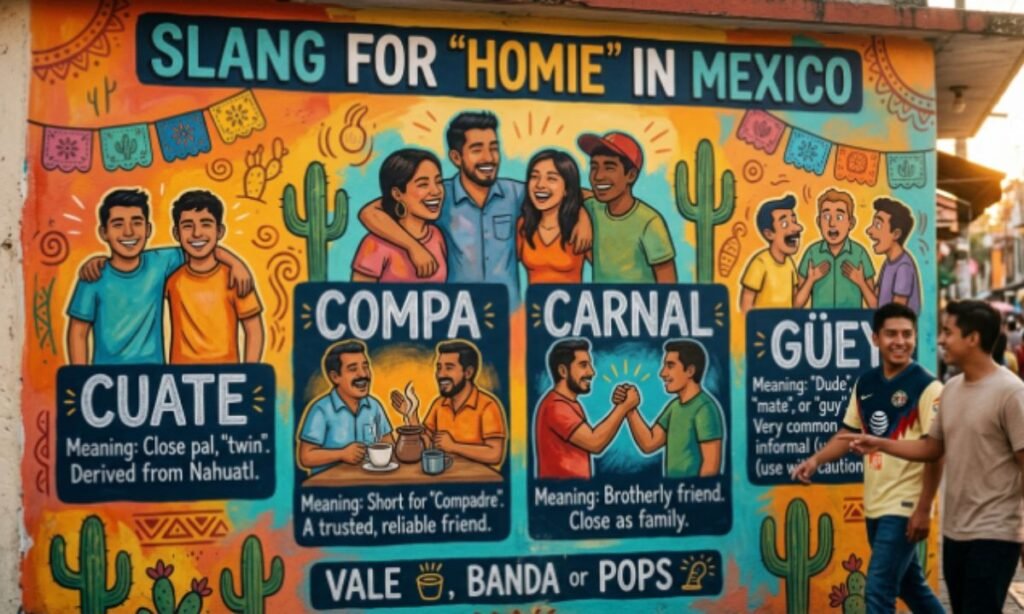
Short answer: güey, carnal, compa, and cuate are the four you’ll hear most. But none of them are interchangeable, and picking the wrong one is how learners accidentally announce they’ve been studying from a list.
Mexican Spanish has so many words for “homie” because a friend is never just a friend — the word you choose broadcasts exactly how close you are. Getting it right isn’t about vocabulary. It’s about reading the room.
This guide gives you 21 terms with pronunciation, region, and the part most articles skip: who you can actually say each one to.
Quick Reference: Safe vs. Earned vs. Risky
| Term | Say it like | Means | Safe for a learner? |
| Amigo | ah-MEE-go | Friend | ✅ Always |
| Compa | KOM-pah | Buddy, pal | ✅ Almost always |
| Cuate | KWAH-teh | Buddy | ✅ Yes (central Mexico) |
| Manito | mah-NEE-toh | Bro (affectionate) | ✅ Yes |
| Güey / wey | way | Dude | ⚠️ Mirror it first |
| Carnal | kar-NAHL | Brother, real one | ⚠️ Must be earned |
| Hermano | er-MAH-no | Brother | ⚠️ Close friends only |
| Vato | BAH-toh | Guy, dude | ❌ Street register |
| Cabrón | kah-BROHN | Bastard / bro | ❌ Very close friends only |
21 Mexican Slang Terms for Homie
Güey
Written güey, said “way,” and usually spelled wey online. It’s the most common word in casual Mexican speech — closer to “dude” than to “homie.” It started as an insult (from buey, an ox) and softened into near-punctuation: “Güey, no manches.” Said sharply, it flips straight back to meaning “idiot.” Safe once friends use it on you; still too casual for elders, bosses, or strangers.
Carnal
From carne — flesh. A carnal is chosen family: the person you’d call at 3 a.m. It’s the warmest word here and the one learners misuse most, deploying it on someone they met that afternoon. Wait until somebody calls you carnal first.
Compa
Short for compadre, with northern roots. The workhorse word — warm without pretending to be intimate. “Gracias, compa” works with a friend, a coworker you like, or the guy who helped push your car. If you learn one term from this list, make it this one.
Compadre
The full version, and in its original sense a serious social bond: your child’s godfather. Used loosely among adult men it means a trusted friend, but it carries more formality than compa and now reads as slightly older-generation.
Cuate
Literally a fraternal twin. Strongest in Mexico City and central Mexico, much rarer up north. Friendly, unthreatening, no street edge — a good default if you’re in CDMX.
Mano / Manito
Clipped from hermano and hermanito. “¿Qué onda, mano?” Affectionate and soft-edged, common across Mexico and much of Central America. Manito is the warmer diminutive.
Hermano
“Brother,” used the way English speakers say it to someone who isn’t blood. It carries emotional weight — save it for gratitude or real closeness, not for a barista.
Compita
Diminutive of compa, especially common in northern Mexico. The nickname version of a nickname: smaller, friendlier, more familiar.
Banda
“The crew.” Refers to a group, never one person: “Ando con la banda.” Popular with younger speakers and in the north. Using it for an individual is an instant giveaway you learned it from a list.
Broder
Straight English “brother” run through Spanish phonetics. Border regions, bilingual speakers, Gen Z. Casual and low-risk.
Primo
“Cousin,” used for a friend who feels like family — the Mexican counterpart to “cuz.” Warm, playful, works across ages.
Colega
“Colleague,” used loosely for a peer or friend. Urban, neutral, mildly formal. Also very common in Spain.
Camarada
Same root as “comrade.” Loyal but old-school — you’ll hear it from Gen X and older far more than from anyone under 25.
Socio
“Partner” or “associate.” Implies the two of you are in something together. Casual, more common among adult men.
Viejo
“Old man,” used affectionately — same energy as calling a friend “old man” in English. Note that mi viejo / mi vieja also means husband/wife, so context does real work here.
Jefe
“Boss,” used as friendly respect rather than hierarchy. Common toward vendors, drivers, and tradespeople: “Gracias, jefe.” Polite and safe.
Loco
“Crazy” — affectionate in banter, as in “llegaste tarde otra vez, loco.” Used across Latin America, not uniquely Mexican, and only works when the tone is clearly playful.
Morro / Morra
“Kid,” “young guy,” “young woman.” Also slang for boyfriend/girlfriend. Casual and common, but it can read as dismissive toward someone in a service role — use la chica or la señora there instead.
Chavo / Chava
Another word for a young person, roughly “guy”/”gal,” and also used for boyfriend/girlfriend. Slightly softer and more neutral than morro.
Hombre
Literally “man,” used as address exactly the way English uses it: “Hombre, you can’t keep doing this.” Plain, widely understood, zero risk.
Paisa
Short for paisano, “countryman.” Especially common in Baja California, and notably non-vulgar — a friendly option in northern regions where vato carries an edge.
Spanish Slang for Homie Outside Mexico
If you’ve seen these on a “Mexican slang” list, they’re actually from elsewhere. Using them in Mexico won’t offend anyone, but it will sound imported:
- Colombia: parce, parcero
- Venezuela / Puerto Rico: pana, chamo
- Argentina / Uruguay: boludo, che, bo
- Ecuador: ñaño
- Spain: tío/tía, colega
- Dominican Republic: manín, tíguere
Mexican Slang for Gangster
This is a separate register from friend-slang, worth knowing mainly so you don’t misuse it. Vato means “guy” with a northern and Chicano street flavor, and depending on who’s saying it, it sits close to vulgar. Ese works as direct address in Chicano and cholo speech, tied more to Mexican-American barrio culture than to Mexico itself. Cholo names that subculture directly. Firme vato is a compliment inside it — a solid, reliable guy.
These words carry real social coding. Used by an outsider, they land as costume rather than fluency.
Mexican Slang Insults (and the Ones That Are Both)
The trap here is that several insults double as terms of affection, decided entirely by tone and relationship:
- Pendejo — “idiot.” A joke between close friends; genuinely offensive from anyone else.
- Cabrón — literally a male goat, used as “bastard” and as a warm nickname between very close friends. The highest-variance word on this page.
- Pinche — an intensifier, roughly “damn”/”fucking,” attached to almost any noun.
- Naco — a classist jab meaning “tacky.” Rude in nearly every context.
- Güey, said coldly — the same word that means “dude” means “dumbass” with the wrong delivery.
Rule of thumb: if a word can insult, don’t be the one who introduces it into a friendship.
Mexican Slang for Bro
| Word | Closest to | Use with |
| Güey | Dude | Peers, after they use it first |
| Compa | Bro / pal | Nearly anyone, casually |
| Broder | Bro | Younger, bilingual speakers |
| Mano / Manito | Bro | Friends, warmly |
| Carnal | Bro (deep) | Chosen family only |
Generational Slang Comparison
| Generation | Goes for | Sounds like |
| Gen Z | güey, banda, broder | Short, flexible, heavy English-Spanish mixing from social media |
| Millennials | cuate, carnal, compa | Classic slang blended with internet expressions |
| Gen X and older | compadre, camarada, paisa | More traditional, carries a note of respect |
None of these is “correct” — each cohort’s vocabulary was shaped by its own media, the same way groovy gave way to cool and then to based in English.
The Part Most Guides Miss: These Words Are Earned
Friend words in Mexico work as a quiet ladder. Someone introduces you as “él es mi compa” and something just happened — you got claimed, out loud. The move is to answer at the level you were given, not above it. Reply compa, not carnal. Months later one of you upgrades it, and that upgrade actually means something.
This is why “gracias, compa” is one of the safest warm phrases in Mexican Spanish, while “gracias, carnal” to a stranger reads as performance. The noun isn’t doing the work. The relationship is.
What About Women?
Most slang lists write as though only men talk. In practice, güey is fully unisex among younger speakers and extremely common between women. Amiga, cuata, morra, chava, and comadre (the female counterpart to compadre) all circulate normally. Compa and carnal skew male but are used by and toward women in plenty of friend groups.
Just match the ending to the person: cuata, prima, amiga.
Regional Differences Across Mexico
- North (Sonora, Chihuahua, border cities): compa, compita, carnal, broder, banda. Vato is common but carries edge; Baja favors the gentler paisa.
- Central (CDMX, Puebla, Guanajuato): cuate, colega, and near-universal güey.
- South (Oaxaca, Chiapas, Yucatán): manito and traditional terms like compadre hold on longer, with less border-slang influence.
How to Use Slang Naturally Without Sounding Awkward
- Start at the safe end. Amigo and compa never misfire.
- Mirror, don’t initiate. Use the word someone used on you.
- Fix pronunciation first. Güey is “way.” Cuate is “KWAH-teh.” Mangled slang is worse than no slang.
- One per sentence. Real speech is far less slang-dense than TikTok makes it look.
- Watch tone, not just words. Half this list flips meaning with delivery.
Common Slang Mistakes
- Calling a new acquaintance carnal or hermano.
- Using banda for one person.
- Assuming one word covers all of Mexico — cuate barely registers in Sonora.
- Trying cabrón or pendejo “the way friends do” before you’re actually those friends.
- Copying music and film slang verbatim; it’s stylized, often regional, sometimes dated.
- Using pana or parcero in Mexico and expecting it to land as local.
Frequently Asked Questions
What are popular Mexican slang words for “homie” used in casual conversations?
Güey, compa, carnal, and cuate — you’ll hear all four daily in informal Mexican Spanish.
What are some common Mexican slang words for a close friend?
Carnal, hermano, cuate, and compadre specifically signal closeness and loyalty, unlike the neutral amigo.
How do you use “carnal” correctly in Mexican Spanish?
Use it only with someone who already treats you like family — ideally after they’ve called you carnal first, since it claims a closeness you can’t assign yourself.
How do you pronounce “güey”?
It’s pronounced “way,” which is exactly why it’s so often written wey in texts and online.
What’s the difference between “compa” and “carnal”?
Compa is everyday warmth you can use widely; carnal is brotherhood reserved for a much smaller circle.
Is “güey” rude?
Not between friends, where it simply means “dude” — but with a hard tone, or used on elders and strangers, it reads as “dumbass” or as far too familiar.
Do women use Mexican slang for “homie”?
Yes — güey is fully unisex among younger speakers, and amiga, cuata, morra, and comadre are common between women.
What is Mexican slang for a gangster or tough guy?
Vato, ese, and cholo belong to street and Chicano subculture rather than everyday friend-slang, and outsiders usually misread their coding.
Can foreigners use Mexican slang?
Yes, and it’s generally welcomed — as long as you start with low-risk words like compa, mirror what locals use on you, and get the pronunciation right.
Final Thoughts
There’s no single Mexican word for “homie” because the language does something English mostly doesn’t: it makes you name the distance. Amigo is anyone. Compa is someone you like. Carnal is someone who’d show up at 3 a.m.
Learn the safe end of the list, say it correctly, and let the closer words arrive on their own. When a Mexican friend calls you carnal for the first time, you’ll know you never had to reach for it.

The author is a professional content writer specializing in word meanings, definitions, and English vocabulary. With over 6 years of experience in language research and educational content creation, they produce accurate, well-researched, and reader-friendly articles.