
You get a text back: “I fw you.” No punctuation, no emoji, no clue. Is that a compliment? A flirt? A polite way of saying no? If you’ve landed here typing “fw meaning in text” into Google mid-conversation, you’re not alone — this three-letter combo confuses more people than almost any other piece of texting slang, precisely because it can mean four completely different things depending on where it shows up.
This guide breaks down every real meaning of FW, how to read the tone correctly, and — something no other guide covers — exactly how to decode it when it shows up in a chat from a girl, a guy, a friend, or a coworker.
What Does “FW” Mean in Text?
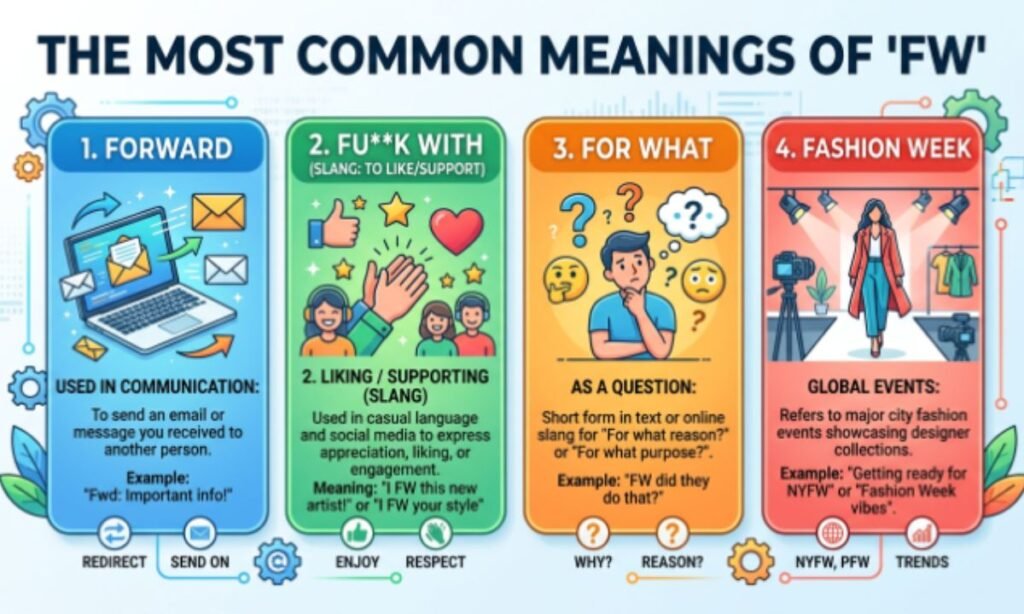
FW most commonly means “f*** with” — slang for liking, supporting, or vibing with someone or something. In email and professional messaging, FW means “forward.” Less commonly, it can mean “friends with,” and in fashion or lifestyle content, it sometimes stands for “Fashion Week.”
The four interpretations, ranked by how often you’ll actually see them:
- F*** with — “I like this,” “I’m into you,” “I support this” (most common in texting and social media)
- Forward — passing along an email or message (most common in professional and WhatsApp chats)
- Friends with — “Are you still fw her?” (occasional, informal)
- Fashion Week — mostly in fashion and lifestyle content on Instagram/TikTok
Context — who sent it, on what app, and what you were just talking about — decides which one you’re looking at.
The Most Common Meanings of “FW”
1. FW = “F*** With” (Most Common Meaning)
This is the slang meaning behind almost every confusing “fw” text you’ll receive from a friend, crush, or stranger online. It means:
- I like this
- I vibe with this
- I support you
- I’m cool with you
Examples:
- “I fw your music” → I like your music
- “She fw him heavy” → She really likes him
- “Do you fw this idea?” → Do you like this idea?
Mostly positive, almost always casual.
2. FW = “Forward”
The older, formal usage — still alive and well in email and WhatsApp.
Examples:
- “Fw: Meeting details”
- “Please fw this to the team”
- “Can you fw me that PDF?”
Neutral, professional, zero ambiguity.
3. FW = Negative / “Don’t Like”
Add “don’t” and the entire meaning flips.
Examples:
- “I don’t fw him” → I don’t like or trust him
- “We don’t fw that group” → We avoid them
One small word changes everything, which is exactly why tone-reading matters more than the acronym itself.
4. FW = General Vibe / Interest
A softer, lower-stakes version of the slang meaning — closer to “I relate to this” than “I actively support this.”
Examples:
- “I fw this vibe”
- “I fw your energy”
Where Did “FW” Come From?
“FW” as an abbreviation for “forward” has existed since early email, decades before texting slang adopted it. The slang meaning — “f*** with,” used to mean liking or vibing with someone — grew out of African American Vernacular English (AAVE) and hip-hop culture, where “to f*** with” something has long meant to genuinely be into it or associate with it. Once texting and social media apps shortened everything to save characters, “f*** with” naturally compressed to “fw” — the same way “for real” became “fr” and “for the win” became “ftw.”
It’s worth understanding this history for one practical reason: because the slang meaning comes from a specific cultural and linguistic tradition, using it casually and accurately (rather than performatively) tends to land better than trying too hard to sound trendy.
How “FW” Is Used in Real Conversations
Friends & Casual Texting
Among friends, “fw” is relaxed, quick, and low-stakes.
- “I fw your drip today”
- “Bro I fw that idea”
It signals approval without needing a whole sentence.
Instagram & Snapchat
On these apps, “fw” shows up constantly in captions, comments, and DMs.
- “If you fw this aesthetic, follow me”
- “Who fw this song?”
It’s often used to invite engagement, not just express a personal opinion.
TikTok and WhatsApp
TikTok comment sections use “fw” the same way Instagram does — as quick, public approval. WhatsApp is different: because WhatsApp auto-labels forwarded messages, “fw” typed manually there is usually someone informally flagging that they’re sending something along, or, among younger users in group chats, the slang meaning creeping in the same way it does everywhere else.
Dating Apps
In dating chats, “fw” often carries a flirty undertone.
- “I fw your vibe”
- “Do you fw me?”
It lets someone express interest without committing to anything more direct — which is also exactly why it causes so much second-guessing.
Gaming & Online Communities
Gamers use it to give fast opinions mid-match or in Discord chats.
- “I fw this player’s skills”
- “I don’t fw campers”
Work or Professional Chat
In professional settings, “fw” almost always means “forward” and nothing else.
- “Can you fw this report to HR?”
- “I fw the file to you”
Using the slang meaning here risks real confusion — or worse, looking unprofessional.
Is “FW” Rude, Flirty, or Offensive?
By itself, FW is not rude or offensive — it’s genuinely flexible, and the same three letters can read three different ways.
Positive Tone
“I fw you” = I like you. Friendly, supportive, casual.
Flirty Tone
“I fw your vibe” = possible romantic interest. Soft flirting without being direct.
Negative Tone
“I don’t fw him” = dislike or distrust. Can land cold depending on delivery.
Key Psychology
People read “fw” based on:
- The existing relationship between the two people
- The platform (a public comment reads differently than a private DM)
- Emojis or tone words nearby
- What was said earlier in the conversation
Strip away all four of those signals — like in a single out-of-context screenshot — and even native speakers genuinely disagree on what a message meant. That’s not you misunderstanding slang; that’s the slang being ambiguous by design.
How to Respond When Someone Says “FW”
Casual Replies
- “I fw you too”
- “Bet, same”
- “That’s real”
Funny Replies
- “Of course you fw me, I’m a vibe”
- “Took you long enough to fw this”
Neutral Replies
- “Got it”
- “Makes sense”
- “Okay cool”
Professional Replies (Forward Meaning)
- “Forwarding now”
- “Sent it ahead”
- “Done”
FW Meaning Slang: Quick Glossary
A fast reference for every way “fw” shows up as slang, since the meaning shifts slightly depending on phrasing:
| Phrase | What It Means |
| “I fw you” | I like / vibe with you |
| “I fw you heavy” | I really like / trust you a lot |
| “I fw this” | I support or enjoy this |
| “I don’t fw that” | I don’t like or trust that |
| “Still fw them?” | Are you still friends with / interested in them? |
| “Big fw” | Strong approval or support |
The pattern: FW alone or with an intensifier (“heavy,” “hard”) is positive. Add “don’t,” and it flips completely.
FW Meaning in Chat From a Girl
This is the single most-searched real-world version of this question — and for good reason, since tone here genuinely matters more than the word itself.
“I fw you” from a girl in a casual conversation usually means she likes you as a person, enjoys talking to you, or respects your vibe — not necessarily romantic interest on its own. Paired with flirty context — compliments beforehand, quick replies, question marks that invite more conversation — it can signal she’s open to something more. “I don’t fw that” or “I don’t fw him” is a clear, fairly final signal of disinterest or distrust, and pushing back on it rarely helps.
A few practical signs to separate friendly-fw from flirty-fw:
- Speed and effort of her replies — fast, detailed responses lean flirty; short, delayed ones lean friendly.
- What came right before it — “You’re actually really funny, I fw you” reads differently than a flat “yeah I fw you” mid-group-chat.
- Whether she asks follow-up questions — genuine curiosity about you usually signals more than casual approval does.
If it’s genuinely unclear after reading the tone, asking directly (“wait what do you mean by that 😅”) almost always lands better than guessing — and it tends to make the other person more comfortable being direct back.
Common Misunderstandings About “FW”
1. Thinking It Only Means “Forward”
Older users often assume it’s always email-related, while younger texters default to the slang meaning first.
2. Thinking It Is Always Positive
“I don’t fw you” is negative, not friendly — the “don’t” is easy to miss when skimming.
3. Confusing Tone in Text
Without a voice or facial expression, the exact same message can be read two completely different ways by two different people.
4. Mixing It With Other Slang
People often confuse “fw” with:
- “fwb” (friends with benefits)
- “fr” (for real)
- “fyp” (for you page)
Similar Slang Terms You Should Know
- vibe → energy or feeling
- bet → agreement or yes
- fr → for real
- cap → lie
- no cap → truth
- lowkey → secretly or slightly
- highkey → openly
- sus → suspicious
- based → strong, unapologetic opinion
- ngl → not gonna lie
Regional & Cultural Usage: USA vs. India
“FW” isn’t equally common everywhere, which matters if you’re texting across cultures.
In the USA, the slang meaning (“f*** with”) is deeply embedded in everyday Gen Z and younger-millennial texting, especially in group chats, Instagram comments, and TikTok captions. Most young American texters will read “fw” as slang by default unless the context is clearly professional.
In India, “FW” is far more likely to be read as “forward” first — a holdover from email culture and, notably, from WhatsApp, where forwarded messages are extremely common and the word “forward” is already part of everyday vocabulary. The slang meaning is spreading through English-language social media and Western content consumption, particularly among younger, urban, social-media-heavy users, but it’s not yet the default assumption the way it is in the US.
Practical takeaway: if you’re texting someone from a different English-speaking context and they seem confused by “fw,” it’s often not that they don’t know slang — it’s that their default assumption for the same three letters is different from yours.
When You Should Avoid Using “FW”
Professional Settings
Avoid slang in emails, office chats, and formal communication. Use “forward” or “forwarding” instead.
Cross-Cultural Chats
Not everyone shares the same default meaning — as the USA-vs-India comparison above shows, the same message can genuinely confuse someone from a different texting culture.
Sensitive Situations
Avoid “fw” when discussing serious topics, conflict, or emotional issues — clarity matters far more than sounding casual.
Frequently Asked Questions
What does FW mean in a text message?
It most commonly means “f*** with,” slang for liking, supporting, or vibing with someone or something; it can also mean “forward” in emails or WhatsApp.
Is FW a bad word?
Not on its own — FW can be positive, neutral, or negative depending entirely on context and whether “don’t” is attached.
Does FW mean forward on WhatsApp?
Yes — on WhatsApp and in email, “fw” almost always means someone is forwarding a message, since WhatsApp already auto-labels forwarded content.
What does “I fw you” mean from a girl?
It usually means she likes or respects you, and whether it’s romantic or purely friendly depends on the tone and context of the rest of the conversation.
What does “I don’t fw you” mean?
It’s a fairly direct way of saying someone doesn’t like, trust, or want to be associated with you.
Is FW flirty on dating apps?
It can be — “I fw your vibe” is a common, low-pressure way to show interest without being overly direct.
What’s the difference between FW and FWB?
“FW” means liking or vibing with someone; “FWB” stands for “friends with benefits” and refers to a specific type of relationship — they’re unrelated despite looking similar.
Final Thoughts
“FW” is one of those texting abbreviations that seems simple until it isn’t — three letters that can mean forwarding an email, genuinely liking someone, or quietly rejecting them, all depending on where it shows up and who sent it. Once you know the difference between the slang meaning and the professional one, and once you know to read the tone around it rather than the word alone, the confusion mostly disappears.
The next time someone texts you “I fw you,” you won’t need to Google it mid-conversation — you’ll already know exactly what they mean.

The author is a professional content writer specializing in word meanings, definitions, and English vocabulary. With over 6 years of experience in language research and educational content creation, they produce accurate, well-researched, and reader-friendly articles.