
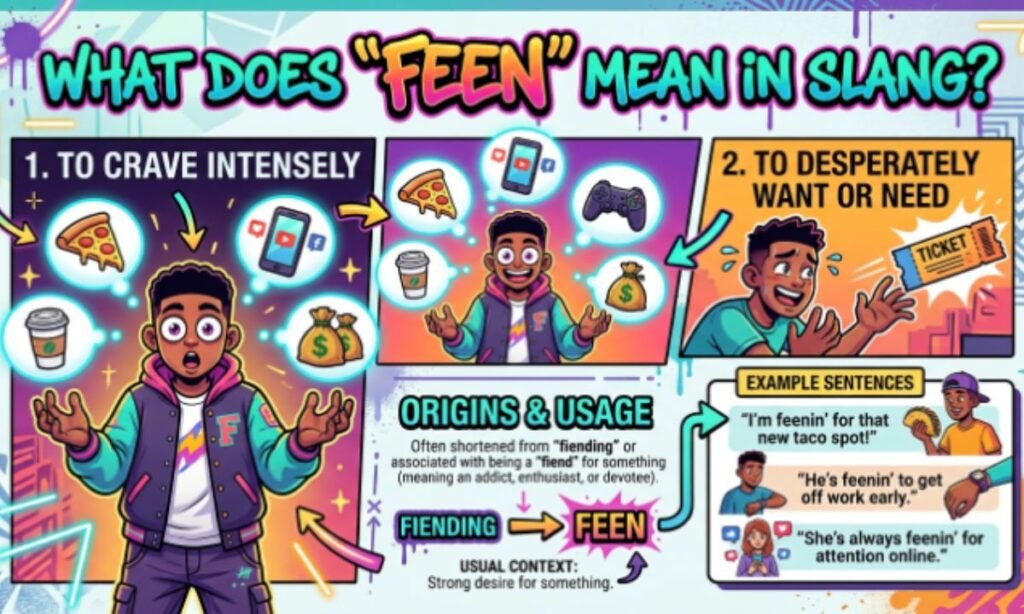
If someone just called you a “feen,” here’s the short answer: it means you want something so badly you look a little obsessed about it — a game, a snack, a crush, anything. It’s almost always said as a joke between friends, not a real insult.
“Feen” shows up constantly in texts, gaming lobbies, and comment sections, and it’s easy to mistake for a typo the first time you see it. It isn’t one. It’s a real, actively-used slang term with a longer and more interesting history than most quick definitions give it credit for — and understanding that history is actually the key to using the word correctly.
Feen: Meaning, Definition and Explanation
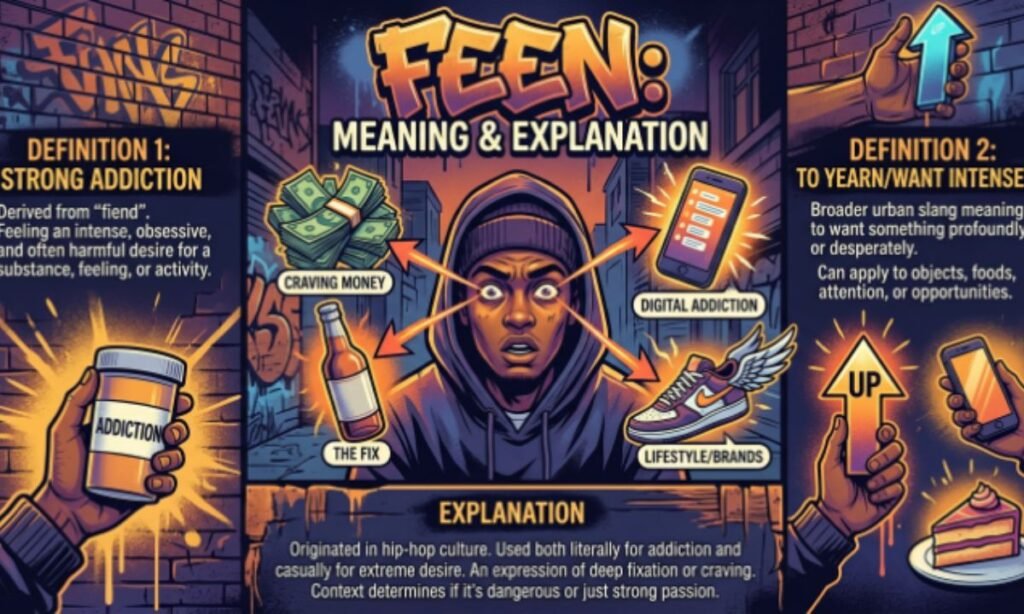
“Feen” is slang for someone who craves or wants something intensely — to the point where their desire is obvious, funny, or a little embarrassing. It’s most often used as a noun (“you’re such a feen”) or folded into the verb form “feening” (“I’m feening for tacos right now”).
There are actually two separate word histories that collide in modern “feen,” and mixing them up is why so many explanations online are incomplete:
- “Feen” from “fiend.” This is the meaning almost everyone means today. “Fiend” has long been used in phrases like “dope fiend” to describe someone with an intense, compulsive craving, especially for a drug. Over time, casual speech and text-message spelling clipped “fiend” down to “feen,” and the meaning loosened from “addicted” to “really, really into something.” This is the version that dominates TikTok, gaming Discords, and everyday texting.
- “Feen” as its own older word. Separately, “feen” is a genuine word in Shelta (the language of Irish Travellers), borrowed from Irish fiann, where it simply means “man” or “guy.” This usage still shows up in Irish English, particularly in Cork and Limerick slang, where “that feen” just means “that guy” — no craving involved.
Unless the context is specifically Irish slang, “that guy over there,” modern internet “feen” is the fiend-derived version — someone visibly, humorously obsessed with something.
Feen
Meaning: Someone who wants or craves something so much it’s noticeable — usually said as light teasing, not a real accusation. Use it when: A friend is clearly overdoing it with a hobby, food, game, or crush, and you want to call it out playfully. Skip it when: You’re talking to or about someone with an actual substance use disorder — the joke doesn’t land, and it can come across as dismissive of a real struggle. Example: “You’ve refreshed your order tracking five times today — you’re a feen for that package.”
Feenin
Meaning: The verb form of feen — actively craving something right now. Use it when: Describing an in-the-moment urge. “I’m feenin for pizza” hits differently than “I want pizza” — it signals the craving is strong and a bit dramatic on purpose. Skip it when: Writing anything formal; it’s purely conversational. Example: “I’m feenin for AC — it’s way too hot in here.”
Fiend
Meaning: The original word “feen” comes from. Historically tied to drug addiction (“dope fiend”), but in casual modern speech it’s softened into “someone who loves something a lot” — a “coffee fiend,” a “true-crime fiend.” Use it when: Being a bit more old-school or literary about describing obsession. Skip it when: The context involves real addiction — the word’s darker root is still close to the surface. Example: “She’s a total dessert fiend — never skips it.”
Simp
Meaning: Someone (usually a guy) who goes overboard trying to impress a romantic interest, often at the expense of their own dignity. How it differs from feen: A simp’s obsession is specifically romantic and about one person; a feen’s craving can be about literally anything — food, a game, a purchase. Example: “He bought her concert tickets on day one? Simp behavior.”
Thirsty
Meaning: Visibly seeking attention or validation, often romantic or sexual, usually online. How it differs from feen: “Thirsty” is almost always about seeking attention from others; “feen” is about wanting a thing, not necessarily attention. Example: “Liking her posts from three years ago is thirsty.”
Glazing
Meaning: Praising or hyping someone up to an excessive, almost cringeworthy degree. How it differs from feen: Glazing is directed outward — praise you’re giving someone else — while feening is about your own craving. Example: “Every comment on his page says he’s the GOAT — y’all are glazing.”
Down Bad
Meaning: Acting embarrassingly desperate, almost always in a romantic context. How it differs from feen: “Down bad” is specifically about a love interest and often implies emotional desperation, not just a strong want. Example: “He drove forty minutes because she said she was hungry — he’s down bad.”
Tryhard
Meaning: Someone putting in way more effort than a casual situation calls for, often in games. How it differs from feen: A tryhard’s problem is excess effort; a feen’s is excess craving. Different flaw, similar teasing tone. Example: “It’s a friendly match, stop sweating — quit being a tryhard.”
Stan
Meaning: An extremely dedicated fan of a celebrity, artist, or franchise (from the Eminem song “Stan”). How it differs from feen: Stanning is fandom-specific and usually has a positive, proud connotation; feening is more about immediate craving than long-term devotion. Example: “I’ve followed every tour date — yeah, I stan.”
Clout Chasing
Meaning: Doing things purely to gain attention, followers, or online popularity. How it differs from feen: Clout chasing is about social status; feening is about wanting a thing or experience, with no audience required. Example: “He only posted that for the views — pure clout chasing.”
Addicted
Meaning: Neutral, widely understood word for being unable to stop doing or consuming something. How it differs from feen: “Addicted” is the plain, non-slang version. “Feen” is its more playful, internet-native cousin. Example: “I’m addicted to this show — three seasons in two days.”
Hooked
Meaning: Quickly and strongly interested in something, often after just one exposure to it. How it differs from feen: “Hooked” describes the moment interest starts; “feening” describes an ongoing craving. Example: “One bite and I was hooked.”
Fanboy / Fangirl
Meaning: Someone enthusiastically devoted to a brand, franchise, or celebrity, often defending it strongly. How it differs from feen: Fanboy/fangirl energy is about loyalty and defense; feening is about desire in the moment. Example: “He’ll argue for an hour about why that console is the best — total fanboy.”
Obsessed
Meaning: A common, mostly neutral or positive word for loving something intensely. How it differs from feen: “Obsessed” works in almost any setting, including semi-formal ones; “feen” is strictly casual slang. Example: “I’m obsessed with this playlist right now.”
Tweaking
Meaning: Acting strangely, erratically, or overly hyper — sometimes literally, sometimes as an exaggeration. How it differs from feen: Tweaking describes behavior that seems off; feening describes a craving, not erratic behavior. Example: “Why are you sprinting around the house — you’re tweaking.”
Grinding
Meaning: Putting in sustained, hard effort toward a goal, especially in gaming or hustle culture. How it differs from feen: Grinding is about effort over time; feening is about wanting something right now. Example: “Been grinding ranked matches all week trying to hit the next tier.”
Generational Slang Comparison
| Generation | How they use “feen”-type slang | Typical origin |
| Gen Z | Remixes spelling (“feen” instead of “fiend”), spreads it through TikTok, Discord, and gaming chat, and often pairs it with irony | Social media, gaming culture, memes |
| Millennials | Popularized the source term “fiend” in casual speech (“coffee fiend,” “gym fiend”) before Gen Z shortened it | Early internet forums, hip-hop and R&B culture |
| Older generations / regional usage | May know “feen” only as the older Irish/Traveller word for “man,” unrelated to the craving sense | Regional dialect (Shelta/Hiberno-English) |
The overlap between these generations is exactly why “feen” confuses people: two unrelated words with the same spelling are both still in active use, just in different communities.
How to Use Slang Naturally Without Sounding Awkward
- Match the room’s tone. “Feen” works in a group chat or between friends. It reads oddly in an email, a cover letter, or a customer service message.
- Keep it light. The word only works as gentle teasing. Used seriously or aimed at someone with an actual dependency, it stops being funny.
- Don’t force it. Slang that’s clearly bolted onto a sentence for effect (“I am currently feening, as the youth say”) reads as trying too hard — which, fittingly, is its own slang term (tryhard).
- Let context do the work. You rarely need to explain “feen” when you use it correctly — the sentence around it should already make the meaning obvious.
Common Slang Mistakes
- Using it in formal writing. Slang like “feen” has no place in essays, resumes, or professional messages — swap in “obsessed with” or “craving.”
- Confusing the two “feen”s. Calling someone “a feen” meaning “a guy” (the Irish usage) outside of that dialect context will just confuse most English speakers who only know the “craving” sense.
- Using it about real addiction casually. Because the word’s root is genuinely tied to substance dependency, using it flippantly around someone dealing with addiction can land badly.
- Overusing it. Like most slang, “feen” loses its punch — and starts to sound try-hard — if it’s in every other sentence.
Frequently Asked Questions
What does “feen” mean in slang?
“Feen” means someone who wants or craves something so much it’s obvious — usually said as a joke, not a serious criticism.
Is “feen” the same as “fiend”?
Yes — “feen” is a shortened, casual spelling of “fiend,” used the same way but with a lighter, more playful tone.
Is “feen” a real word, or is it just internet slang?
Both. “Feen” is genuinely derived from “fiend” in slang usage, and separately it’s an older, real word in Shelta/Hiberno-English meaning “man.”
Is “feen” offensive or rude?
Generally no — it’s mostly affectionate teasing. It can feel insensitive if used carelessly around real substance addiction, so read the room.
What is “feenin” or “feening”?
“Feenin'” (or “feening”) is the verb form — it describes actively craving something in the moment, like “I’m feenin for a burger.”
Where did the word “feen” come from?
It’s a shortened, phonetic spelling of “fiend,” a word historically tied to phrases like “dope fiend” describing intense craving or addiction.
Is “feen” still used in 2026, or is it outdated?
It’s still actively used, especially in gaming chats, texting, and social media comments, though slang trends shift quickly year to year.
How do you use “feen” in a sentence?
As a noun (“you’re such a feen for that game”) or as a verb (“I’m feening for coffee”) — both are correct depending on tone.
What’s the difference between “feen” and “fiend”?
They mean essentially the same thing — “feen” is just the casual, texting-friendly spelling that softens the word’s tone.
Final Thoughts
“Feen” is a good example of how slang recycles old words for new moods: a term once tied strictly to addiction has been reshaped by texting and internet culture into something closer to affectionate teasing. Knowing where it came from — and that there’s a second, unrelated “feen” floating around in Irish English — is what separates a quick definition from actually understanding the word.
Used correctly, “feen” is harmless fun between friends. Used carelessly, especially around real dependency, it can miss the mark. Like most slang, the safest rule is simple: keep it casual, keep it kind, and read the room before you say it.

The author is a professional content writer specializing in word meanings, definitions, and English vocabulary. With over 6 years of experience in language research and educational content creation, they produce accurate, well-researched, and reader-friendly articles.