
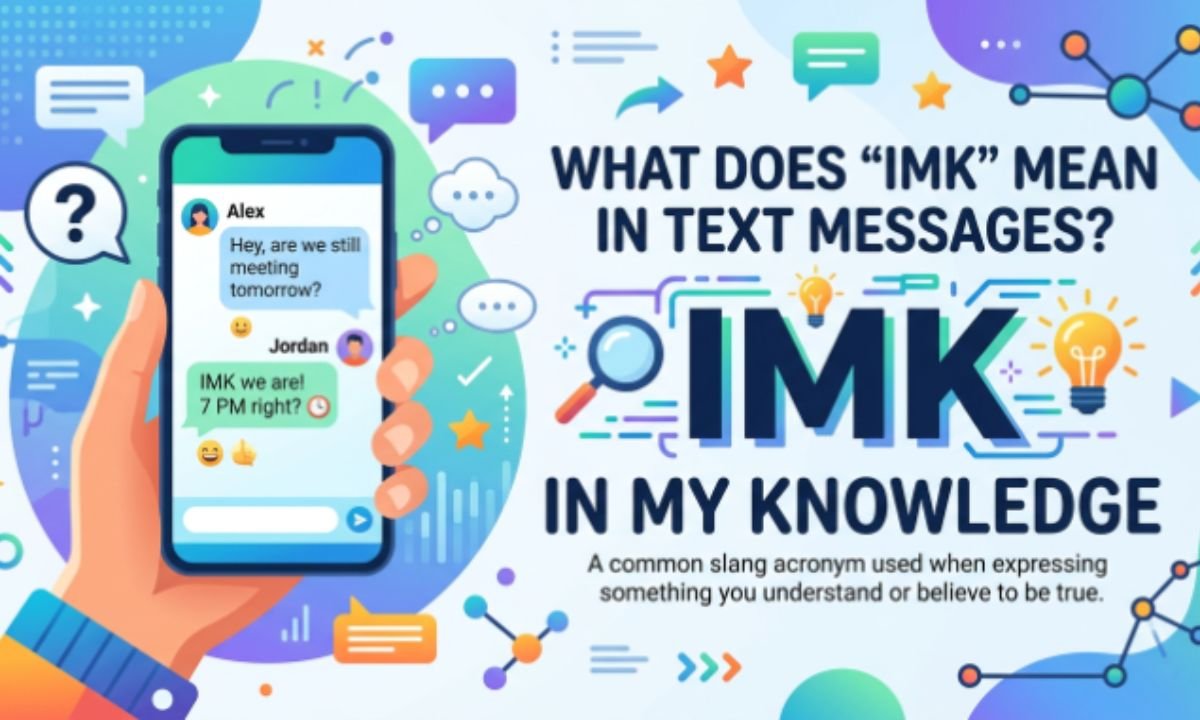
Come across “IMK” in a text and pause for a second? You’re not the only one — it’s one of the less common members of the “In My…” acronym family, which makes it easy to misread. This guide gives you the exact meaning, real examples, and the context you need to use it (or understand it) correctly.
IMK isn’t inherently confusing once you see it in action — it’s just less mainstream than cousins like IMO or IMHO, so it trips people up the first time they see it. Once you know what it stands for and where it fits in a sentence, it becomes second nature to spot and use.IMK Mean in Texting explained!
IMK – Quick Meaning
IMK stands for “In My Knowledge.” It’s used to preface a statement with a note that the information is based on the sender’s own understanding, not confirmed fact. It signals honesty about uncertainty — a quick way to say “this is what I believe, but I could be wrong.”
Simple Breakdown:
- I — In
- M — My
- K — Knowledge
- Function: qualifies a statement as personal understanding, not verified fact
- Tone: neutral, informative, low-key
Example Messages:
- “IMK the store closes at 9, but double-check online.”
- “IMK he already left the group chat.”
- “That restaurant’s still open IMK, last I heard.”
Origin & Background
IMK grew out of the same texting culture that produced acronyms like IMO (“in my opinion”) and AFAIK (“as far as I know”). As messaging apps pushed people toward shorter, faster exchanges, acronyms that could soften or qualify a statement in three or four letters became popular — especially useful for texters who wanted to share information quickly without sounding overly certain.
Cultural Influence:
IMK reflects a broader shift in digital communication toward hedged, informal honesty. Rather than stating something as fact, texters increasingly qualify claims on the fly — IMK, AFAIK, and similar acronyms let people share information casually while leaving room to be wrong, which fits naturally into fast-paced group chats and social platforms.
IMK Mean in Texting From a Girl
Used by a girl, IMK typically functions the same as it does for anyone else — a quick qualifier before sharing info she’s not 100% sure about, often in casual group chats about plans, gossip, or logistics (“IMK the party got moved to Sam’s house”).
IMK Meaning in Text From a Guy
From a guy, IMK shows up in similar contexts — passing along secondhand info, sports scores, or plans — and is just as likely to appear in a group chat as a one-on-one conversation. There’s no meaningful gendered difference in how the acronym is used; context (what’s being discussed) matters far more than who’s texting.
IMK Meaning Gen Z
Among Gen Z texters, IMK sits alongside more popular acronyms like “fr” (for real) and “ngl” (not gonna lie) as a way to soften a statement without over-explaining. It’s less common than IMO but shows up in fast, informal exchanges — especially when someone’s sharing a rumor, plan, or piece of info they picked up secondhand.
Real-Life Conversations
1. WhatsApp Chat
Priya: does the gym close early on Sundays?
Dev: IMK it’s 6pm but I haven’t been in a while
2. Instagram DMs
Sender: is the drop still happening today?
Receiver: IMK yeah, saw it on their story earlier
3. TikTok Comments
User1: wait is this sound getting banned?
User2: IMK it’s just being demonetized, not banned
4. Text Message
Jake: did they reschedule practice?
Liam: IMK it’s still on for 5, but coach hasn’t confirmed
Emotional & Psychological Meaning
What It Expresses:
IMK expresses cautious honesty — the sender wants to be helpful and share what they know, while clearly signaling they’re not fully certain. It’s a small but meaningful trust signal in casual conversation.
Real-Life Scenario
Imagine a friend asks what time an event starts. Instead of guessing confidently and being wrong, saying “IMK it starts at 7” communicates the info while managing expectations — if it turns out to be 7:30, nobody feels misled, because the qualifier was there from the start.
Usage in Different Contexts
Social Media
Appears in comments and DMs when someone’s sharing info they picked up secondhand — rumors, drops, schedule changes.
Friends & Relationships
Common in group chats for logistics — plans, locations, timing — where certainty isn’t guaranteed but sharing what you know still helps.
Work / Professional Settings
Rare, but not off-limits in casual internal chats (like Slack) among coworkers who already text informally; still best avoided in client-facing or formal communication.
Casual vs Serious Tone
| Tone | Meaning | Example |
| Casual | Quick, low-stakes info share | “IMK it’s this weekend” |
| Slightly serious | Genuine uncertainty about something important | “IMK the flight got delayed, check the app” |
When NOT to Use It
Avoid Using It When:
- Communicating in professional emails or formal documents
- Sharing information that needs to be 100% verified (medical, legal, financial details)
- Talking with someone unfamiliar with texting slang
- The stakes of being wrong are high
Why?
IMK signals uncertainty, which is fine for casual plans but risky for anything where the other person needs a confirmed, reliable answer — using it in the wrong setting can come across as vague or unprepared rather than honest.
Common Misunderstandings
1. Confusing It With “IM”
Some readers mistake IMK for a typo of “IM” (instant message) rather than recognizing it as a standalone acronym.
2. Assuming It Means “I Might Know”
A common misread — IMK isn’t expressing possibility about whether the sender knows something; it’s qualifying information they’re already sharing.
3. Misreading the Tone
Because it’s short, IMK can occasionally be read as dismissive (“I dunno, whatever”) when the sender actually means it sincerely as a helpful disclaimer.
4. Taking It as a Fact
The entire point of IMK is that the information isn’t guaranteed — treating it as confirmed fact defeats the purpose of the qualifier.
Comparison Table
| Acronym | Full Form | Purpose |
| IMK | In My Knowledge | Qualifies info as personal understanding |
| IMO | In My Opinion | Shares a personal view/opinion |
| IMHO | In My Humble Opinion | Softer, more modest version of IMO |
| AFAIK | As Far As I Know | Very similar to IMK; slightly more common |
| LMK | Let Me Know | Requests info back from the recipient |
| IIRC | If I Recall Correctly | Qualifies a memory-based statement |
Key Insight
IMK and AFAIK function almost identically — both flag that a statement is based on personal knowledge rather than confirmed fact — but AFAIK is more widely recognized, so IMK can occasionally cause confusion with readers who haven’t seen it before.
Variations / Types
- IMK — base form, “In My Knowledge”
- AFAIK — “As Far As I Know,” near-synonym
- IMKU — “In My Knowledge, You…” (less common, used to address someone directly)
- IMO/IMHO — opinion-based cousins, not interchangeable with IMK’s fact-qualifying function
How to Respond When Someone Uses It
Casual Replies
“Got it, thanks for the heads-up” acknowledges the info without treating it as fully confirmed.
Funny Replies
“IMK is doing a lot of heavy lifting here lol” — playfully calls out the uncertainty.
Mature Replies
“Good to know — I’ll double-check just in case” keeps things practical.
Respectful Replies
“Appreciate you letting me know what you’ve heard” acknowledges the effort without pressuring them for certainty they don’t have.
Regional & Cultural Usage
Western Culture
Most common in US and UK informal texting circles, particularly among younger texters comfortable with acronym-heavy shorthand.
Asian Culture
Less common organically, though it appears in English-language messaging among younger, internet-fluent users influenced by Western texting trends.
Middle Eastern Culture
Primarily seen in English-language chats among younger, social-media-active users rather than everyday texting.
Global Internet Usage
As with most short-form acronyms, IMK has spread through global messaging platforms, though recognition varies — it’s still far less universally known than IMO or LMK.
Generational Differences
Older texters may not recognize IMK at all, while younger, Gen Z and younger-millennial texters are more likely to use it fluently alongside similar hedging acronyms.
Is It Safe for Kids?
IMK is entirely harmless — it carries no vulgar or concerning meaning, and simply reflects normal texting shorthand. Parents don’t need to be concerned if they see it in a child’s messages; it’s a good, low-stakes example of casual digital literacy.
Frequently Asked Questions
What does IMK mean in texting?
IMK stands for “In My Knowledge” and is used to share information the sender believes to be true without claiming it as confirmed fact.
Is IMK the same as IMO?
No — IMO shares a personal opinion, while IMK qualifies factual information as based on the sender’s own understanding.
What’s the difference between IMK and AFAIK?
They’re nearly identical in meaning, but AFAIK (“as far as I know”) is more widely recognized and commonly used.
Is IMK used on Snapchat and Instagram?
Yes, IMK appears across texting and social platforms, most often in casual DMs and comments where someone is sharing secondhand info.
Is IMK appropriate for professional messages?
No — it’s best kept to casual, informal conversations and avoided in emails or formal work communication.
What does IMK mean from a girl or guy?
The meaning doesn’t change by gender; it’s used the same way by anyone sharing information they’re not fully certain about.
Is IMK common among Gen Z?
It’s used occasionally among Gen Z texters, though less frequently than more mainstream acronyms like IMO or ngl.
Can IMK be confused with other acronyms?
Yes, it’s sometimes mistaken for “IM” (instant message) or misread as expressing possibility rather than qualified knowledge.
Is IMK safe for kids to use?
Yes, it’s a harmless acronym with no vulgar or concerning meaning, making it a normal part of casual texting.
Final Thoughts
IMK is a small but useful acronym — a way to share what you know while being upfront that it isn’t guaranteed. It won’t replace more common terms like IMO or LMK anytime soon, but understanding it means one less confusing moment the next time it shows up in your messages. When in doubt, treat it as a friendly heads-up rather than a confirmed fact, and you’ll never misread it again.

The author is a professional content writer specializing in word meanings, definitions, and English vocabulary. With over 6 years of experience in language research and educational content creation, they produce accurate, well-researched, and reader-friendly articles.