
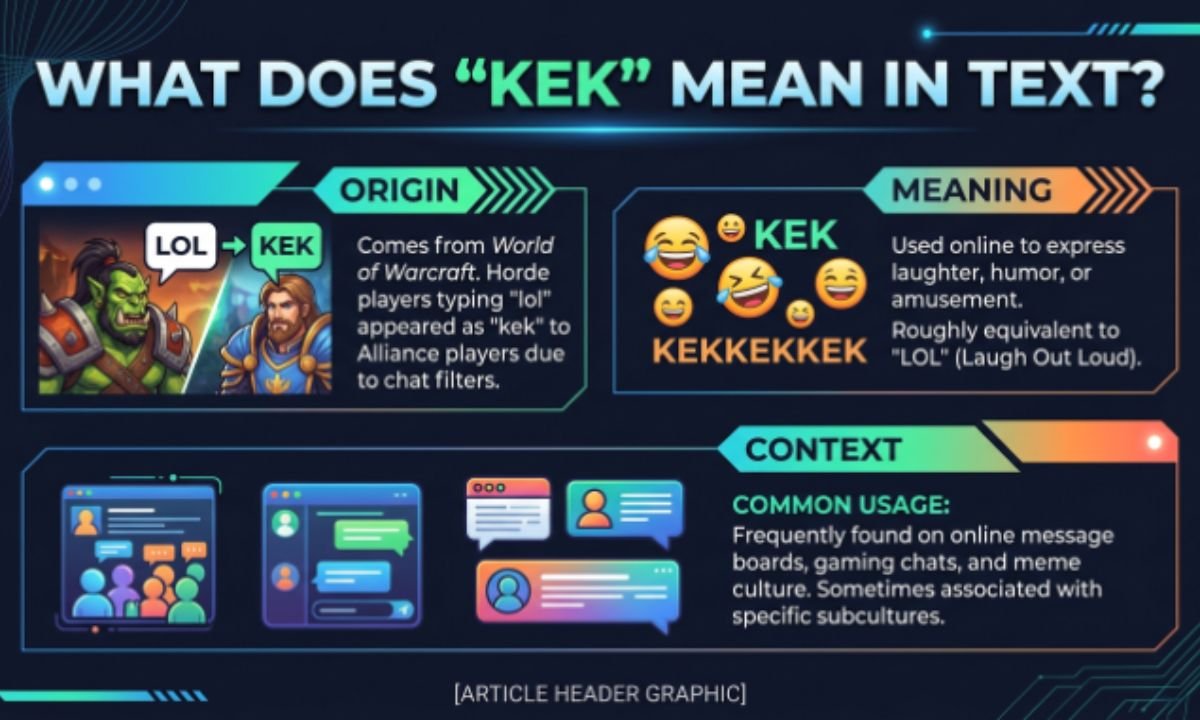
If you’ve spotted “kek” in a Discord server, a gaming chat, or a random comment and had no clue what it meant, you’re in the right place. Kek meaning in text is simple on the surface — it’s internet slang for laughter, similar to “lol” — but it carries a genuinely interesting backstory involving a Korean chat filter, a World of Warcraft glitch, and a much more complicated internet-culture history you’ll want to know about before using it yourself.
Unlike most texting abbreviations, “kek” isn’t something you can decode by expanding letters into words — it’s a laughter sound that traveled through several very different online communities before landing in everyday gaming chat. That journey is exactly why the same three letters can mean casual laughter in one conversation and something more loaded in another. This guide walks through every version, so you’ll know precisely what it means and whether it’s the right word to use.
What Does KEK Mean in Text?
In its most common form, “kek” is used the same way people use “lol” or “haha” — as a reaction to something funny. It’s especially popular among gamers, on Discord, and in Twitch chat, where it often signals that the person typing it is familiar with internet and gaming culture rather than just casually laughing.
KEK Meaning in Text – Quick Meaning
Kek is internet slang used to express laughter or amusement, functioning as a direct substitute for “lol.” It originated from Korean onomatopoeia for laughter and later became tied to World of Warcraft’s cross-faction chat system, eventually spreading across gaming forums and mainstream internet culture.
What Does It Mean When Someone Texts You “KEK”?
If a friend texts you “kek” after you say something funny, they’re simply laughing — nothing more complicated than that in most everyday contexts. The tone is usually light, a little ironic, and signals that the sender spends time in gaming or forum communities where the term is common.
Origin & Background of KEK
World of Warcraft and “KEK”
The most widely cited origin traces back to Blizzard’s World of Warcraft. In the game, the Horde and Alliance factions can’t read each other’s chat directly — messages get run through a language filter. When a Horde player types “lol,” Alliance players see it rendered as “kek” instead, a quirk Blizzard built in as a nod to Starcraft-era gamer culture.
Korean “Kekeke” Connection
Before WoW picked it up, the sound itself came from Korean internet slang. Koreans commonly write “ㅋㅋㅋ” (romanized as “kekeke”) to represent laughter, similar to how English speakers type “hahaha.” This usage was especially common among Korean StarCraft players in the late 1990s, and it’s widely believed Blizzard referenced this when building WoW’s chat filter.
From Gaming to Wider Internet Culture
From there, “kek” spread through gaming forums, 4chan, and Reddit as a knowing alternative to “lol.” Around 2013, it briefly crossed over with “Topkek,” a Turkish cupcake brand whose name coincidentally combined “top” (a meme intensifier) with “kek,” which happens to mean “cake” in Turkish. A few years later, the term picked up a very different association: some online communities connected it to Kek, an ancient Egyptian deity sometimes depicted with a frog’s head, which got tangled up with the Pepe the Frog meme during the 2016 U.S. election cycle. That connection led to satirical online communities built around a fictional “Cult of Kek,” and the term picked up associations with alt-right internet culture that persist for some audiences today. It’s worth knowing this history exists, even though most everyday uses of “kek” in gaming and texting have nothing to do with it.
what does kek mean in a text message
In a plain text message, outside of gaming or meme-heavy platforms, “kek” almost always just means the sender is laughing — a quicker, slightly more niche alternative to “lol” or “haha.” If it shows up out of nowhere in a conversation with someone unfamiliar with gaming slang, it can come across as confusing rather than funny, since the word doesn’t look like an obvious laughter sound the way “haha” does.
Kek meaning German
In German, there are two separate words that sound alike but mean very different things, and mixing them up is an easy mistake. “Keks” (with an s) is the standard German word for cookie or biscuit. “Kek” without the s, however, is a piece of German youth slang — popularized through German rap in the early 2000s — used to call someone a loser, idiot, or fool, with the tone ranging from genuinely insulting to lightly teasing depending on delivery. It’s unrelated to the English gaming slang “kek,” though some language writers suspect the German slang version may have also been influenced by WoW chat culture.
Real-Life Conversations Using KEK
WhatsApp Conversation
Friend: “I tripped in front of my whole class today” You: “kek, I’m sorry but that’s hilarious”
Instagram DMs
Them: “bro really thought that fit was good 💀” You: “kek fr, no notes needed on that one”
Discord Gaming Chat
Player 1: “just got outplayed by a level 3 bot” Player 2: “kekw that’s rough”
Text Between Friends
Text: “just remembered I called my teacher ‘mom’ today, kek”
Emotional & Psychological Meaning of KEK
It Can Signal Internet-Culture Familiarity
Using “kek” instead of “lol” often functions as a small signal that someone spends time in gaming, forum, or streaming spaces, similar to using any niche community slang.
KEK Can Sound More Ironic Than “Haha”
Because it’s less common in everyday speech, “kek” tends to read as drier and slightly more detached than “haha,” which can come across as warmer and more genuine.
It Can Be Playful Teasing
In gaming chats especially, “kek” is frequently used to laugh at someone’s mistake in a friendly way, rather than at something objectively funny.
A Personal-Style Scenario
Picture a Discord voice call where a teammate accidentally walks their character off a cliff mid-fight. The chat immediately fills with “kek” and “kekw” — not because anyone is being cruel, but because it’s the fastest, most familiar way that group expresses shared, in-the-moment laughter.
KEK Meaning in Different Contexts
KEK in Text Messages
Casual, occasional use between friends who already understand gaming or internet slang.
KEK on Discord
Extremely common, often paired with “KEKW” as a reaction to something funny happening in voice or game chat.
KEK in Gaming
Used constantly across multiplayer games as a quick laughter reaction, especially after a funny death, mistake, or unexpected play.
KEK on Instagram
Shows up in comments and captions, usually among younger, gaming-adjacent audiences.
KEK on TikTok
Appears in comment sections reacting to gaming clips or meme-style videos, though “lol” and “💀” remain more common overall on the platform.
When NOT to Use KEK
Professional Communication
Avoid it entirely in work emails, meetings, or client messages — it reads as unclear at best and unprofessional at worst.
Academic Writing
Slang like “kek” has no place in essays, reports, or formal academic communication.
When the Audience May Not Understand It
If you’re texting someone outside gaming or internet-forum culture, “kek” is likely to just confuse them rather than land as a joke.
Sensitive Conversations
Given the term’s more controversial associations in some corners of the internet, it’s worth avoiding in any conversation touching on politics or identity, where it could be misread.
Common Misunderstandings About KEK
KEK Is Not an Acronym for a Standard Phrase
Unlike “lol” or “brb,” kek doesn’t stand for specific words — it’s an onomatopoeia-turned-slang term, not an abbreviation.
KEK Doesn’t Always Mean Sarcasm
While it can sound dry or ironic, plenty of everyday uses are completely sincere reactions to something genuinely funny.
KEK Isn’t Automatically an Insult
In gaming and casual chat, it’s overwhelmingly used as harmless laughter, not mockery — context and tone decide which one it is.
KEK Can Have Controversial Associations
Because of its history with certain online political communities, some people recognize “kek” primarily through that lens, even though most day-to-day users have no connection to it.
KEK vs. Similar Internet Slang
| Term | Core Meaning | Common Platform | Tone |
|---|---|---|---|
| Kek | Laughter, “lol” equivalent | Gaming, Discord, forums | Ironic, casual |
| KEKW | Exaggerated hysterical laughter | Twitch | Loud, reactive |
| LOL | Laughing out loud | Everywhere | Neutral, mainstream |
| LMAO | Laughing my ass off | Texting, social media | Stronger amusement |
| Kekeke | Original Korean laughter sound | Korean internet, gaming | Soft, casual |
Key Insight
Think of “kek” as a gaming-culture cousin of “lol” — same core meaning, but it carries a heavier layer of internet history and community signaling behind it.
Variations and Types of KEK
1. kek
The plain, lowercase, everyday version used as a quick laughter reaction.
2. KEK
The same meaning, typed in caps for emphasis or to match a chat’s tone.
3. Kekeke
The original Korean-style repeated form, still used to represent a longer laugh.
4. KEKW
A Twitch emote version showing exaggerated laughter, based on a viral clip of Spanish comedian Juan Joya Borja.
5. Top Kek
An intensified form meaning something is extremely funny, tracing back to 2013-era 4chan meme culture.
6. “kek lol”
A doubled-up, half-joking combination used for extra emphasis, often itself used ironically.
7. “kek?”
Used as a confused or skeptical reaction rather than pure laughter, similar to “lol what?”
8. “kek 😂”
Paired with an emoji to soften the tone and make the laughter read as more sincere.
9. Sarcastic Kek
Used dryly, often after something awkward or cringeworthy rather than something actually funny.
10. Gaming Kek
The most common everyday use — a fast reaction typed mid-match after a funny in-game moment.
How to Respond When Someone Says KEK
Casual Replies
“kek fr” / “ikr, kek”
Funny Replies
“why is this so accurate kek” / “I’m-“
Mature Replies
“Haha yeah, that was pretty funny” — mirroring the sentiment without needing to use the slang.
Respectful Replies
If you’re not sure the term fits the conversation, simply respond to the humor directly: “That’s actually really funny.”
Regional & Cultural Usage of KEK
Western Gaming Culture
Most common in the U.S., UK, and other English-speaking gaming and streaming communities, largely through World of Warcraft and Twitch.
Korean Internet Culture
The root form, “ㅋㅋㅋ,” remains one of the most widely used laughter expressions in Korean texting and online chat today, entirely separate from the gaming-slang version.
Asian Gaming Communities
Beyond Korea, “kek” and its variants show up in gaming communities across Asia that engage heavily with Western multiplayer titles and Twitch content.
Middle Eastern Gaming Communities
Usage tends to concentrate among younger gamers active in international Discord servers and competitive gaming scenes.
Global Internet Culture
Twitch and Discord have made “kek” and “KEKW” recognizable well beyond any single region, largely detached from their more niche 2016-era political associations for most users.
Gen Z vs. Millennials
Millennials are more likely to associate “kek” with its WoW or early-4chan roots, while many Gen Z users encounter it purely through Discord and Twitch without knowing the backstory at all.
Is KEK Safe for Kids?
The everyday gaming use of “kek” is harmless — it functions exactly like “lol.” That said, because the term has a documented history connecting it to more controversial online communities, parents of younger kids in gaming spaces may want general awareness of the platforms and communities their children spend time in, rather than treating the word itself as something to be alarmed by.
Frequently Asked Questions
What does “kek” mean in a text message?
“Kek” is internet slang for laughter, used the same way as “lol,” and is especially common among gamers and Discord users.
Where did “kek” come from?
It originated from Korean laughter slang (“kekeke”) and became widely known through a World of Warcraft chat filter that displayed “lol” as “kek” between opposing factions.
What does KEKW mean?
KEKW is a Twitch emote representing exaggerated, hysterical laughter, based on a viral clip of comedian Juan Joya Borja.
Is “kek” an insult?
Not typically — in gaming and casual chat, it’s almost always used as harmless laughter, though tone and context can occasionally make it read as mocking.
Is “kek” the same as “lol”?
Functionally yes, though “kek” carries more gaming-culture and internet-history baggage than the more neutral, universally understood “lol.”
What does “kek” mean in German?
In German slang, “kek” (without an s) means loser or idiot, which is different from “Keks,” the standard German word for cookie.
Is it okay to use “kek” around people who don’t game?
It’s best avoided, since people unfamiliar with gaming or internet culture are likely to be confused rather than amused by it.
Final Thoughts
“Kek” is a small word with a genuinely layered history — from Korean laughter slang, through a World of Warcraft chat quirk, into gaming forums, Twitch emotes, and eventually a more complicated corner of internet meme culture. For the vast majority of everyday uses, though, it simply means someone is laughing. Knowing where it came from just makes it easier to read the tone correctly and decide when it actually fits the conversation.

The author is a professional content writer specializing in word meanings, definitions, and English vocabulary. With over 6 years of experience in language research and educational content creation, they produce accurate, well-researched, and reader-friendly articles.