
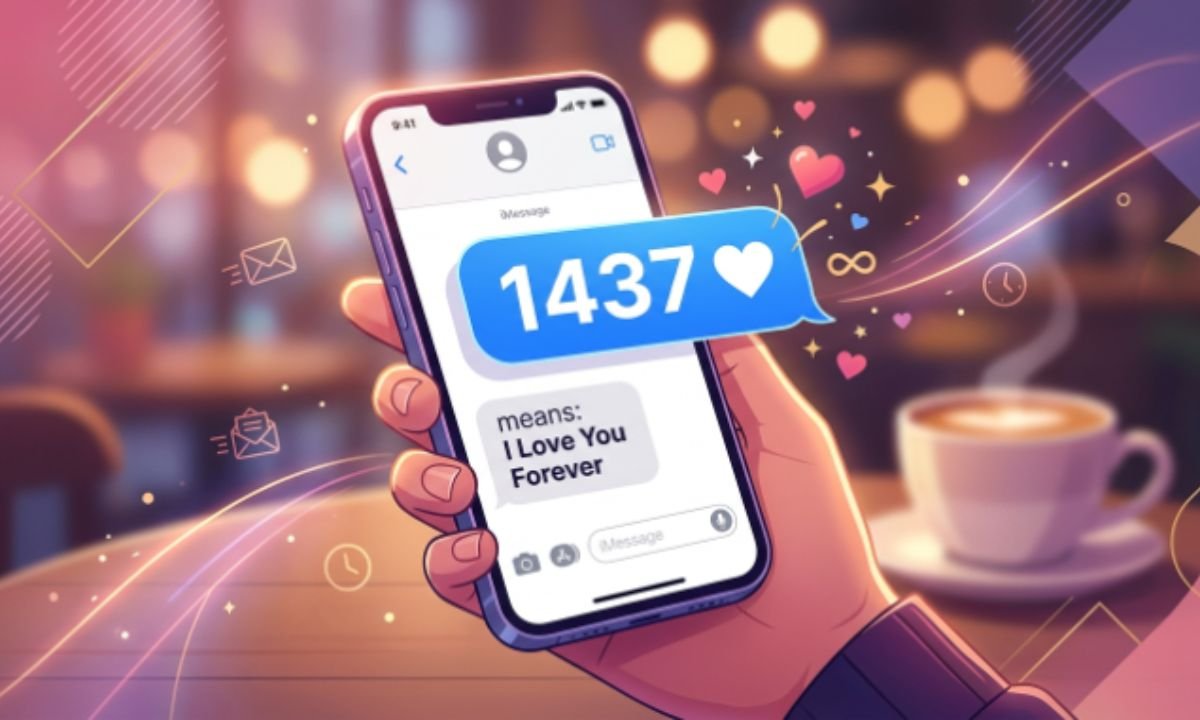
Seeing “1437” pop up in a text can be confusing the first time — it looks like a random number, but it’s actually a coded way of saying something sweet. If you’ve been asking what 1437 means in text, here’s the short answer: it means “I love you forever.” Below, you’ll find exactly how the code works, where it came from, how to use it appropriately, and how to respond when someone sends it to you.
Texting shorthand has always found clever ways to say a lot with very little, and 1437 meaning is one of the best examples still going strong in 2026. Instead of leaving you guessing, this guide breaks the code down line by line — what it means, where it came from, and how to use or answer it the right way. By the end, you’ll know exactly what someone’s saying when “1437” shows up on your screen.
Why 1437 Is More Than a Random Number
1437 is a numeronym where each digit represents the number of letters in a word: I (1), love (4), you (3), and forever (7). It’s part of a much older tradition of turning short phrases into number codes for fast, low-character messaging — and it’s stuck around because a mysterious-looking number still gets people to ask “wait, what does that mean?”, which is exactly the point.
1437 Meaning in Text – Quick Meaning
1437 means “I love you forever.” It’s sent between romantic partners, close friends, and family members as a quick, slightly coded way to express lasting affection without spelling the whole phrase out.
What does each number represent?
| Number | Represents | Letter Count |
| 1 | I | 1 letter |
| 4 | Love | 4 letters |
| 3 | You | 3 letters |
| 7 | Forever | 7 letters |
Grammatically, the phrase is closer to “I will love you forever,” but the shorter numeric form stuck because it’s faster to type and reads as heartfelt rather than clunky.
Origin & Background of 1437
From 143 to 1437
There’s no single documented inventor of 1437 — it’s best understood as an extension of 143, the older number code for “I love you.” 143 itself traces back to the pager era, when devices had limited character space and users needed short, memorable codes to say things like “I love you” quickly and cheaply. Once 143 caught on, people began stretching it into longer variants — 1434 for “I love you too,” 14344 for “I love you very much,” and eventually 1437 for “I love you forever” — each one adding a word onto the same counting logic.
Social media gave the code a new life
1437 has found renewed popularity on TikTok, a reminder of how durable a simple numeric love note can be, decades after the pager-code era ended. It now shows up just as often in Instagram captions, TikTok comments, and Snapchat streaks as it does in private texts.
1437 Meaning in Love
In a romantic context, 1437 is a compact declaration of permanence — it’s often sent after a meaningful moment, before saying goodnight, or as a caption under a couple’s photo. It carries more emotional weight than a simple “❤️” because it takes a second to decode, which makes the recipient pause and actually register the sentiment rather than scroll past it.
1437 Which Country
1437 isn’t tied to one country of origin — it’s English-language internet and texting slang that grew out of the U.S. pager culture of the late 1980s and early 1990s and later spread globally through American-based platforms like TikTok, Snapchat, and Instagram. Because it depends on English letter counts (I, love, you, forever), it’s used almost exclusively by English speakers, though similar number-based love codes exist independently in other languages — for example, 520 is popular in Chinese internet slang because it sounds like “wǒ ài nǐ” (I love you) when spoken aloud.
Real-Life Conversations Using 1437
WhatsApp between long-distance partners
“Only six more weeks until I’m home. 1437.”
“1437 too. Call me when you land.”
Here, the code softens a heavy, distance-related conversation with reassurance.
Instagram DMs between close friends
“Thanks for staying up with me last night.”
“Always. 1437, no homo lol.”
Between friends, 1437 signals platonic love and loyalty rather than romance.
TikTok comments on a relationship video
“This is exactly my situationship 😭 1437 to whoever’s watching this alone tonight.”
On public posts, it’s often used generically, aimed at anyone reading rather than one specific person.
Text messages after an argument
“I’m still upset, but I don’t want to go to bed angry. 1437.”
Here it works as an olive branch — a way to reaffirm love without fully resolving the disagreement yet.
Emotional & Psychological Meaning
Numeric codes like 1437 give people a low-pressure way to say something emotionally significant. Typing out “I love you forever” can feel intense or exposed, especially early in a relationship or in a non-romantic friendship — sending “1437” delivers the same message with a built-in layer of casualness. That said, the underlying feeling is genuine in most contexts; the code shortens the typing, not the sincerity.
Usage in Different Contexts
Social media
Used in captions, story replies, and comment sections, often as a quick tag under sentimental photos or milestone posts.
Friends and relationships
Sent between best friends or family members to express loyalty and appreciation, not just romance.
Work and professional settings
Generally not appropriate — 1437 reads as personal and affectionate, so it doesn’t belong in work chats even as a joke, since tone can be easily misread by colleagues.
Casual versus serious tone
The same code can be playful (“get me a coffee, 1437”) or completely sincere, depending entirely on the conversation leading up to it.
When Not to Use 1437 and Common Misunderstandings
Situations where it may be inappropriate
- Early-stage dating, before feelings have been clearly established
- Workplace or professional messages
- Group chats where the recipient hasn’t agreed to romantic framing
What people often get wrong
A common mistake is assuming 1437 always means romantic love — in reality, tone depends entirely on the relationship and the message thread it’s sent in. Another misconception is treating it as a “secret” or risky term; in most cases it’s simply a positive, wholesome message, not hidden slang for anything else.
1437 Compared With Similar Texting Codes
| Code | Meaning |
| 143 | I love you |
| 1437 | I love you forever |
| 831 | I love you (8 letters, 3 words, 1 meaning) |
| 143 637 | I love you always and forever |
| 143 224 | I love you today, tomorrow, forever |
| 14344 | I love you very much |
143637 combines two codes into one — 143 for “I love you” and 637 for “always and forever.”
Key Insight
Nearly every variation builds on the same base logic as 143 — count the letters, chain the numbers, add more words for a bigger declaration.
Variations and Related Types of 1437
- 14344 — I love you very much
- 1432 — I love you too
- 143637 — I love you always and forever
- 1437224 — a longer, layered variant combining “forever” with “today, tomorrow” phrasing seen in some love-code lists
How to Respond When Someone Sends 1437
Casual replies
“1437 too 😊” or a simple heart emoji keeps things light and easy.
Funny replies
“Only 1437? I was hoping for 14344” plays along without being too serious.
Mature replies
“That means a lot — I feel the same way” works well once a conversation has moved past texting-only.
Respectful replies when you do not feel the same
“That’s really sweet of you to say” acknowledges the message honestly without implying feelings you don’t have.
Regional, Cultural, and Generational Usage
Western culture
Most common in the U.S. and other English-speaking countries, where it originated from pager-era texting shorthand.
Asian culture
Less common than homophone-based codes like 520 in Chinese-speaking communities, though 1437 does appear among younger, English-fluent social media users.
Middle Eastern culture
Used mainly by younger, bilingual social media users who mix English texting slang with their native language.
Global internet usage
Thanks to TikTok and Instagram, 1437 now shows up in captions and comments well outside its original English-speaking base, even when the rest of the post isn’t in English.
Gen Z versus Millennials
Millennials are more likely to recognize the older 143, while Gen Z popularized 1437 specifically through TikTok trends and relationship-focused content.
Is 1437 Safe for Kids?
Yes — 1437 is a wholesome, affectionate phrase rather than risky slang, so there’s nothing inherently unsafe about a child using or receiving it. As with any texting code, context matters more than the code itself; parents should focus on who a child is messaging rather than worrying about this specific term.
Where You’ll See 1437 Besides Texts
Beyond messaging apps, 1437 has crossed into usernames, jewelry engravings, tattoo designs, and song or playlist titles — much like 143 did before it. Because it’s short and numeric, it works well anywhere a full phrase wouldn’t fit, from a necklace charm to an Instagram bio.
Frequently Asked Questions
What does 143 and 831 mean?
Both 143 and 831 mean “I love you” — 143 counts the letters in each word, while 831 stands for “8 letters, 3 words, 1 meaning.”
What is 143 637 meaning?
143 637 means “I love you always and forever,” combining 143 (“I love you”) with 637 (“always and forever”).
What does 5998 mean in texting?
5998 isn’t a widely documented or standardized love code like 143 or 1437 — its meaning varies by group or region, so it’s best to ask the sender directly what they meant.
What does 143 224 mean?
143 224 means “I love you today, tomorrow, forever,” pairing the classic 143 with 224, which on its own means “today, tomorrow, forever.”
What does 1437 mean from a girl?
The meaning doesn’t change based on who sends it — from a girl or anyone else, 1437 still means “I love you forever,” with the emotional weight depending on the relationship.
Is 1437 only used romantically?
No, 1437 is used romantically between partners but just as often platonically between close friends and family members to express lasting care.
What’s the difference between 143 and 1437?
143 means “I love you,” while 1437 extends that same phrase to “I love you forever” by adding a number for the word “forever.”
How should I reply if I don’t want to lead someone on?
A warm, honest reply like “That means a lot to me” acknowledges the message without implying romantic feelings you don’t have.
Final Thoughts
1437 is a simple, affectionate numeronym for “I love you forever,” rooted in the same letter-counting logic as the classic 143 code. Whether it shows up in a couple’s late-night text, a friend’s TikTok comment, or a caption under a family photo, the meaning stays the same even as the tone shifts with context. If someone sends it to you, the safest move is to read the conversation around it before deciding exactly how to respond.

The author is a professional content writer specializing in word meanings, definitions, and English vocabulary. With over 6 years of experience in language research and educational content creation, they produce accurate, well-researched, and reader-friendly articles.