
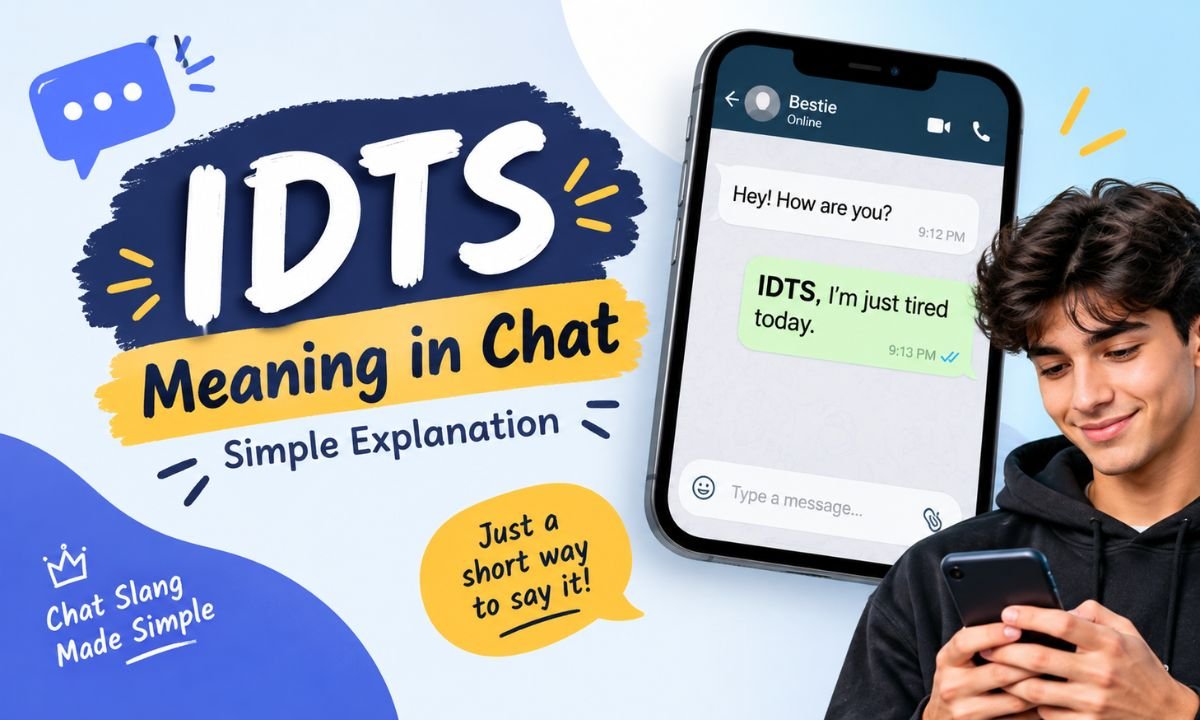
You’re scrolling through a group chat and someone drops “idts” as their entire response. No explanation, no follow-up, just four letters doing all the talking. If you’ve been left guessing what it means or how to reply, you’re definitely not alone.
This guide covers everything: the real definition, where it came from, how people use it across different apps, and the mistakes that make people misread the tone entirely. By the end, you’ll never second-guess this acronym again.
IDTS Meaning in Chat – Quick Meaning
IDTS stands for “I don’t think so.” It’s a quick, casual way to disagree or express doubt without writing out a full sentence.
Simple Definition
It signals mild skepticism or disagreement, softer than a flat “no,” but clear enough to get the point across.
Examples
“Going out tonight?” “Idts, I’m exhausted.” Or: “Think he’ll show up?” “Idts honestly.”
Origin & Background
IDTS emerged in the early 2000s alongside the rise of texting and instant messaging, when character limits and typing speed pushed people toward shorthand. Like LOL and BRB before it, it stuck around because it’s fast, casual, and instantly understood by anyone active in texting culture. As smartphones replaced flip phones, autocorrect and predictive text made typing full words easier, but shorthand like IDTS had already become a habit baked into everyday digital conversation, so it survived the shift instead of disappearing.
Real-Life Conversations
WhatsApp Conversation
Friend: “Is the plan still happening tomorrow?”
You: “Idts, weather’s looking bad.”
Instagram DM
Friend: “Do you think they’ll get back together?”
You: “Idts lol too much happened”
TikTok Comments
“Idts this trend is coming back, it had its moment already 💀”
Text Message
Mom: “Will you make it home for dinner?”
You: “Idts, running late at work”
Snapchat
Same casual usage applies here too, quick doubt or disagreement dropped into a chat reply without needing extra explanation.
Group Chat
Friend 1: “Should we invite him?”
Friend 2: “Idts, remember last time 😬”
Emotional & Psychological Meaning
IDTS carries a tone of hesitation rather than firm rejection. It softens disagreement, letting the sender express doubt without sounding harsh or overly confrontational. That’s part of why it works so well in casual conversation, it disagrees without shutting the door completely. Psychologically, it also gives the sender a bit of protection. If they turn out wrong, “idts” was never a firm prediction to begin with, just a hunch. That built-in flexibility is a big reason people reach for it instead of a flat “no.”
Usage in Different Contexts
Social Media
Common in comment sections and captions to express skepticism about trends, opinions, or claims.
Friends & Relationships
Used casually when unsure about plans, feelings, or decisions someone’s asking about.
Text Messages
Quick response to yes/no questions when the answer leans toward doubt rather than certainty.
Work or Professional Settings
Generally avoided. It reads as too casual for emails or workplace messaging, and it can come across as vague when clarity matters most.
Casual vs. Serious Tone
Among friends it’s lighthearted. In a more serious conversation, it can come across as dismissive if not softened with more context, so pairing it with a short explanation usually helps avoid confusion.
Common Misunderstandings
Mistake 1: Assuming It Means “No”
It’s softer than a definite no, more like “probably not” or “I doubt it.”
Mistake 2: Thinking It’s Rude
It’s not inherently rude, tone and context usually determine how it lands.
Mistake 3: Using It Professionally
It’s too casual for formal settings and can seem unprofessional in work communication.
Mistake 4: Assuming Everyone Knows It
Older generations or people unfamiliar with texting slang may not recognize it at all, which can lead to confused replies or a follow-up question asking what it means.
Comparison Table
| Term | Meaning | Tone | Common Use |
| IDTS | I don’t think so | Mild doubt, casual | Uncertain disagreement |
| IDK | I don’t know | Neutral, unsure | Genuine uncertainty |
| IDEK | I don’t even know | Confused, overwhelmed | Complex or frustrating situations |
| NAH | No | Blunt, direct | Firm disagreement |
Key Insight
IDTS sits between “IDK” and “no,” it’s more decisive than uncertainty but softer than outright rejection.
Variations and Related Types
- IDTS TBH: adds honesty, “I don’t think so, to be honest”
- IDTS LOL: lighthearted disagreement paired with humor
- IDTS FR: emphasizes sincerity, “I don’t think so, for real”
- IDTS Yet: leaves room for change, doubt for now
- Probably IDTS: softens the doubt even further
- Strong IDTS: emphasized, firmer disagreement
- IDTS Either: agreeing with someone else’s doubt
- IDTS Anymore: opinion has shifted over time
- IDTS Honestly: blunt, sincere version
- IDTS But Maybe: leaves a small window of possibility
- IDTS Ngl: paired with “not gonna lie” for extra honesty
- Big IDTS: exaggerated for emphasis, often joking
- IDTS Lowkey: understated doubt, casual tone
How to Respond When Someone Uses It
Casual Replies
“Fair enough” or “Yeah maybe not.”
Funny Replies
“Damn okay tell me how you really feel.”
Mature & Confident Replies
“Why do you think that?”
Private or Respectful Replies
If it seems like a sensitive topic, ask for clarification gently instead of pushing back immediately, since a one-word doubt can sometimes hide a bigger concern the other person hasn’t fully explained yet.
Regional & Cultural Usage
Western Culture
Extremely common across the US, UK, and Canada in texting and social apps.
Asian Culture
Used mostly among English-speaking youth active in Western-influenced online spaces.
Middle Eastern Culture
Growing usage among younger, internet-savvy users mixing English slang into everyday chats.
Global Internet Usage
Widely understood across English-speaking internet communities regardless of region, largely thanks to how universal texting apps and social platforms have become.
IDTS in Gaming and Online Communities
Gamers frequently use IDTS during matches or strategy discussions, quickly signaling doubt about a plan without breaking the flow of conversation. It fits naturally into fast-paced chats where typing full sentences slows things down, especially during live voice-to-text exchanges or quick typed callouts mid-match.
Why Acronyms Like IDTS Keep Growing
Texting culture rewards speed and brevity. As conversations move faster across more platforms, shorthand like IDTS keeps expanding because it delivers tone and meaning in a fraction of the time a full sentence would take. New acronyms constantly rise and fall in popularity, but the ones that stick around, like IDTS, usually do so because they fill a specific emotional gap that a plain “no” or “yes” can’t quite cover.
How to Use IDTS Naturally in Conversation
The key to using IDTS well is pairing it with just enough context so the other person understands your reasoning. A standalone “idts” can feel abrupt, but “idts, traffic’s been brutal lately” gives the same quick doubt with a reason attached. This small addition keeps the tone casual while avoiding the kind of confusion that leads to a follow-up “why not” text.
Frequently Asked Questions
What does idts mean in text?
It means “I don’t think so,” used to express doubt or mild disagreement.
What is IDEK in chat?
IDEK means “I don’t even know,” typically used for confusion or feeling overwhelmed.
What is IDTs in Gen Z language?
Same meaning, casual doubt or disagreement, frequently used in fast, informal texting.
What does LDTS mean in texting?
It’s a rare, inconsistent variant with no widely agreed meaning, likely a typo or regional variation of IDTS.
Is IDTS the same as IDK?
Not exactly. IDK shows genuine uncertainty, while IDTS leans toward doubt or disagreement.
What does IDTS mean on Snapchat?
Same meaning as everywhere else, a quick way to express doubt within a chat.
Is idts rude to say?
Not usually, tone and relationship context determine whether it comes across as dismissive.
What’s the opposite of idts?
“Idts” opposite would be something like “fr” or “ikr,” both expressing agreement rather than doubt.
Final Thoughts
IDTS is one of those small acronyms that carries more nuance than it looks like at first glance. It softens disagreement, keeps conversations moving fast, and fits naturally into casual texting culture. Once you know the tone behind it, you’ll never misread it as harsh or confusing again.

The author is a professional content writer specializing in word meanings, definitions, and English vocabulary. With over 6 years of experience in language research and educational content creation, they produce accurate, well-researched, and reader-friendly articles.