
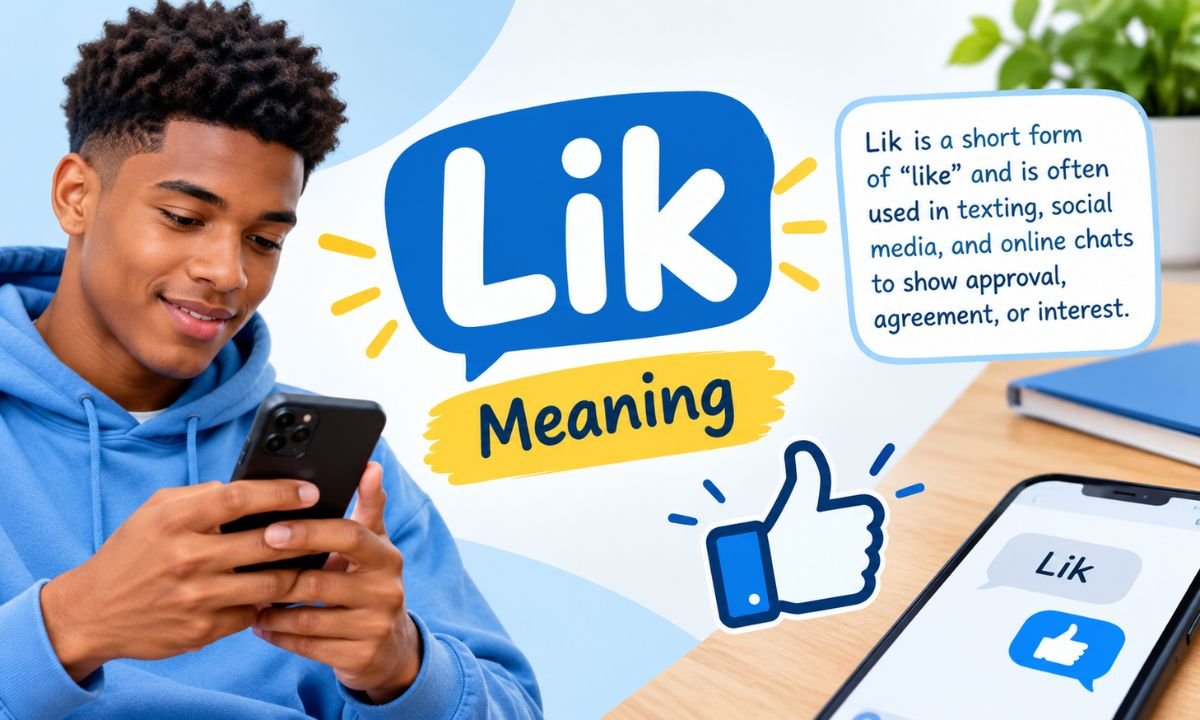
You are scrolling through your chats when a message pops up: “lik that pic.” You stop for a second. Is it a typo? Is it new slang? Is it something rude? Questions like this are common, because chat language changes faster than any dictionary can follow.
The good news is that lik meaning in text is usually simple. In most conversations, “lik” is just a casual, shortened or misspelled version of the word “like.” People type it quickly on WhatsApp, Instagram and TikTok, and sometimes they use it on purpose to sound relaxed. In rarer cases, it can be a typo for “lick” or a word from another language.
In this guide, you will learn what “lik” means, where it came from, and how people use it in real chats. You will also see how to reply, when to avoid it, and how it differs across cultures. By the end, you will know exactly how to read “lik” the next time it lands in your inbox.
Lik Meaning in Text – Quick Meaning
Lik is most often a shortened or misspelled version of “like” in text messages and social media chats. Sometimes it is a typo for “lick” or “lit.” There is no single official definition, so context decides.
LIK Full Form
“Lik” has no official full form. It is not a standard acronym like LOL or BRB. People use it in these ways:
- Like (the most common reading)
- Lick (a dropped “c,” usually a typo)
- Lik as a name, brand or word in another language
Simple meanings:
- A casual spelling of “like”
- A quick way to say “I like this”
- A typo for “lick,” “lit” or “link”
- A word in other languages (for example, Swedish “lik” means similar)
Quick examples:
- “I lik your new haircut.” (I like your new haircut.)
- “lik this post if you agree” (like this post)
- “Don’t lik it” (I don’t like it)
- “Lik what?” (confusion, usually a typo)
Origin & Background
Texting abbreviations have always been about saving time, effort and characters. “Lik” belongs to the same family of phonetic shortcuts as “lyk,” “luv” and “thx.” Nobody invented it on a specific day. It grew out of everyday typing habits.
How it developed:
- Early texting era: Character limits and pay-per-message plans pushed people to drop letters.
- Social media era: Fast typing on phones led to “lik,” “lyk” and “lk” showing up in comments and DMs.
- Style choice: Many users now write it on purpose for a relaxed, playful or “low-effort” tone.
- Autocorrect gaps: Because “lik” is not a standard English word, it sometimes slips through as a typo. In short, “lik” is not a famous slang term with a big backstory. It is a small, organic spelling shift that grew out of everyday chatting.
Real-Life Conversations
Seeing the word in action makes the meaning clearer. Here are four common situations.
WhatsApp Chat
Aisha: Did you see Zain’s story?
Hamza: Yeah, I lik the new look 😂
Meaning: “I like it.”
Instagram DMs
Sara: Lik my last post pls
Dani: Already did 😄
Meaning: “Like my post.”
TikTok Comments
“lik if you watched this at 2am” Meaning: a request for likes, used as an engagement hook.
Text Message
Mom: Dinner at 8?
You: lik that works
Meaning: casual agreement, “like, that works.”
Emotional & Psychological Meaning
Short slang words can carry a mood, even when they look tiny. Here is what “lik” tends to say about the sender.
What it reveals:
On its own, “lik” says very little. The surrounding message tells you more. Typically it signals:
- Relaxed mood. The sender is not polishing their grammar.
- Familiarity. People use it with friends, not strangers.
- Speed. Many senders are just typing quickly.
- Playfulness. Some use misspellings for a youthful, casual vibe. It rarely signals anger or hidden emotion. Do not read too much into it.
More Meanings Of Lik
Because “lik” is so flexible, people search for several other meanings. Here are the most common ones.
Lik meaning army
There is no widely recognized military abbreviation spelled “LIK.” If you see it in a military context, check the document or unit’s own glossary. It could be an internal code, a name or a typo. Do not assume a standard meaning.
Lick you meaning
If someone types “lik you” and means “lick you,” it may be flirty, joking or inappropriate depending on the relationship and tone. It is often a typo for “like you” (“I lik you” = “I like you”). Read the full message before reacting. If it feels uncomfortable, it is fine to ask what they meant.
Lik meaning in english
English has no standard word “lik.” In English chat it is treated as an informal spelling of “like” (to enjoy, to be similar to, or to press the like button).
Lik meaning in urdu
Urdu does not have a common native word spelled “lik” in chat. In Roman Urdu, people sometimes type “lik” for “like” (لائک), as in liking a post. Do not confuse it with لیک (“leek”), which means “leak.” The spelling looks similar in Roman letters, but the meaning is different.
Usage in Different Contexts
The right way to use “lik” depends on where you are and who you are talking to.
1. Social Media
Here “lik” usually means like, as in the button or an opinion. You will see it in captions, comments and engagement prompts such as “lik and share.”
2. Friends & Relationships
Between friends, it reads as relaxed and friendly. In romantic chats, “I lik you” can be sweet and shy. If you are unsure, ask. A quick “lik or lick? 😅” clears it up.
3. Work or Professional Settings
Avoid it. Typos and slang can look careless in emails, Slack messages or client chats. Write “like” in full.
4. Casual vs Serious Tone
| Tone | Is “lik” okay? |
| Casual chat with friends | Yes |
| Group chat | Usually |
| Serious or emotional talk | Better to avoid |
| Professional message | No |
Common Misunderstandings
A few mistakes come up again and again. Avoid them and you will read “lik” correctly almost every time.
1. Thinking It’s Always Slang
Sometimes it is just a typo. If the rest of the message is full of mistakes, the sender probably typed fast.
2. Assuming It Has a Hidden Meaning
Most of the time there is no secret code. Do not spend an hour decoding it.
3. Confusing It With Intentional Style
Some people write “lik” on purpose as a style. Others never meant to. Compare it with how the person normally writes.
4. Using It Everywhere
Overusing slang can confuse people, especially readers who speak English as a second language or do not know the term.
Comparison Table
| Term | Usual meaning | Tone | Best used in |
| Lik | Like (casual spelling) | Relaxed | Chats, comments |
| Lyk | Like (phonetic) | Playful | Texts, social media |
| Lk | Look / like / lucky (varies) | Very short | Quick texts |
| Like | Standard spelling | Neutral | Anywhere |
| Lick | To lick with the tongue | Depends on context | Rarely appropriate in chat |
Key Insight:
“Lik,” “lyk” and “lk” are close cousins, but none has a fixed official meaning. Always read the context before deciding.
Variations / Types of “Lik”
- Lik – casual “like”
- Lyk – another phonetic spelling of “like”
- Likk / Lick – usually a typo or a different word
- Lik (language word) – a real word in languages such as Swedish (“similar”) or a Slavic word meaning “figure” or “character”
- Lik (name/brand) – used as a username, name or short brand tag
- “Lik this” – a call to press the like button
How to Respond When Someone Uses It
Your reply depends on your mood and your relationship with the sender. Here are ready-to-use options.
Casual Replies
- “Haha yeah, same!”
- “Got it 👍”
- “Lik it too!”
Funny Replies
- “Lik? Is that a new language? 😂”
- “Lik or lick? Big difference!”
- “Spelling bee champion right here.”
Mature / Confident Replies
- “Do you mean ‘like’? Just checking.”
- “Not sure I caught that. Can you clarify?”
Private or Respectful Replies
- “I want to make sure I understood you. What did you mean?”
- “Could you say that another way? I don’t want to guess.”
Regional & Cultural Usage
Slang travels, but it does not always mean the same thing everywhere.
Western Culture
In the US, UK and Canada, “lik” appears mostly as a casual typo or phonetic spelling of “like” among younger users.
Asian Culture
In South and Southeast Asia, English chat is often mixed with local languages, so “lik” may appear in Roman script as “like.” The same letters can mean something else in a local language, so context matters.
Middle Eastern Culture
Arabic and Urdu speakers often type in Roman letters (Arabizi or Roman Urdu). “Lik” may stand for “like,” but nearby words like “leak” (لیک) can cause mix-ups.
Global Internet Usage
Online, “lik” is understood mostly as “like.” Its meaning stays flexible, and tone and platform shape how it reads.
Frequently Asked Questions
What does lik mean in online shopping reviews?
It usually means “like,” as in “I lik this product.” It can also be a typo, so judge it alongside the rest of the review.
Is “lik” the same as “lyk”?
Yes, mostly. Both are casual spellings of “like.”
Is “lik” rude?
No. It is casual, not rude. Only the rare “lick” reading could sound inappropriate.
Should I use “lik” in professional emails?
No. Write “like” in full to stay clear and professional.
What does “lik” mean on TikTok?
Usually “like,” as in “lik if you agree.” It is a quick request for engagement.
Does “lik” mean “lick”?
Sometimes, as a typo. Check the tone and the rest of the message.
Is “lik” a real English word?
No. It is an informal spelling of “like,” not a dictionary word.
How do I know which meaning is intended?
Look at the platform, the sender and the sentence. If it is still unclear, ask them.
Final Thoughts
Lik meaning in text is simpler than it looks. In most chats, it is just “like” typed casually. Other readings, such as “lick,” a typo, a word in another language or a username, depend on context.
Before you decide what it means, check:
- Who sent it
- Which platform you are on
- The tone of the whole message Keep “lik” to casual chats and use “like” in full for work or serious conversations. If you are ever unsure, just ask.

The author is a professional content writer specializing in word meanings, definitions, and English vocabulary. With over 6 years of experience in language research and educational content creation, they produce accurate, well-researched, and reader-friendly articles.