
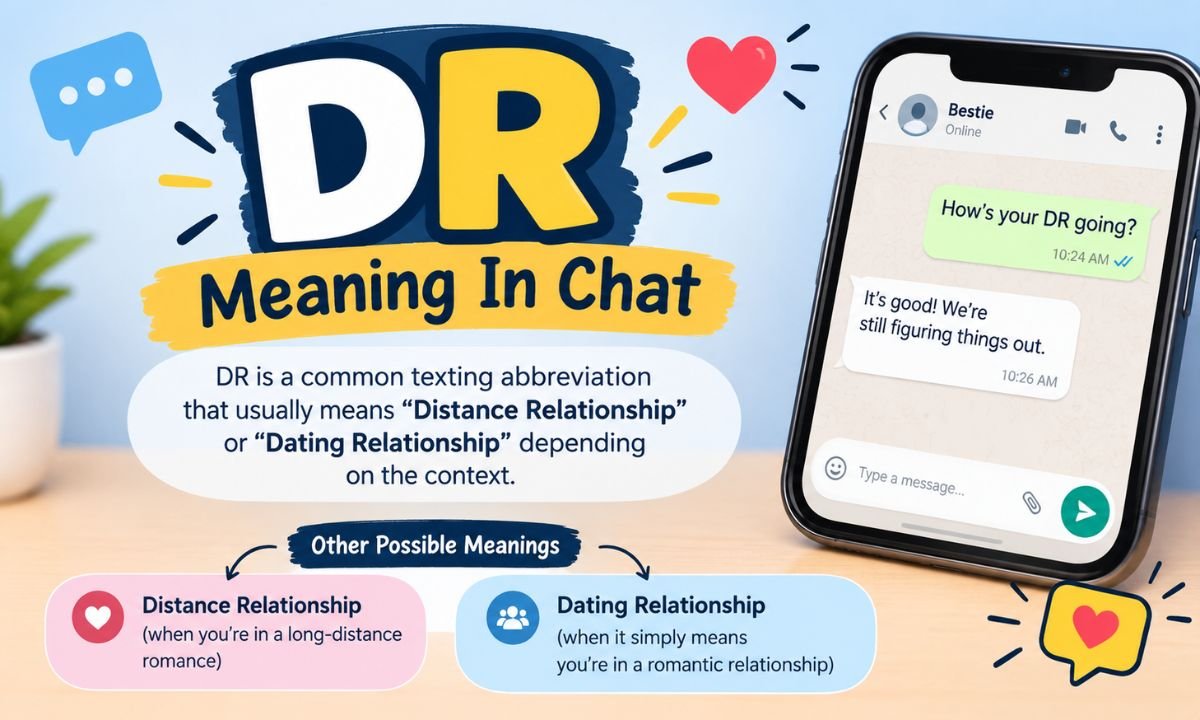
You are scrolling through a group chat and someone replies with just “dr.” No capital letters, no explanation. Is it short for “doctor”? Did they mean “didn’t read”? Or is it a typo that got sent before anyone could stop it?
The honest answer is that DR has no single, settled slang meaning. The two most common readings in chat are “doctor” and “didn’t read,” and a few others show up in specific communities and countries.
This guide sorts them out, with real examples and simple tips. You will learn how to spot the right meaning from context, how to reply, and when to skip the abbreviation entirely.
DR Meaning in Text – Quick Meaning
Quick answer: In text, DR most often means “doctor” (Dr.) or “didn’t read,” a nod to the internet shorthand “TL;DR.” The right one depends on the sentence around it.
If the message mentions health, titles or names, think “doctor.” If it follows a long post or message, think “didn’t read.”
DR Full Form
DR is an abbreviation with several full forms. These are the ones you are most likely to meet:
- Doctor: the most common use, written “Dr.” or “dr.”
- Didn’t read: a casual way to say you skipped a long message.
- Dari: an Indonesian texting abbreviation meaning “from.”
- Debit/debtor: used in accounting.
DR Meaning in Text Slang
As slang, DR is mostly informal and playful. Some online lists show other meanings, but many of those are thinly sourced. If an unusual meaning does not fit the conversation, ask the sender rather than guessing.
Quick Examples
- “Booked with Dr. Patel tomorrow.” (doctor)
- “Sorry, dr. Can someone summarize?” (didn’t read)
- “Dr kantor jam 9.” (Indonesian: “from the office at 9”)
- “Dr Mike is back on the team.” (could be a nickname)
Origin & Background
The title “Dr” is centuries old and comes from the Latin word for “teacher.” It is standard in writing, so people naturally carried it into texts and social posts.
The “didn’t read” sense grew from “TL;DR,” short for “too long; didn’t read.” The phrase began on internet forums as a summary tag and later split into shorter forms. In some places, such as Indonesia, “dr” also became a texting shortcut for “dari.”
So DR is not one slang term with one inventor. It is a short string that several communities adopted for their own needs.
Real-Life Conversations
WhatsApp Chat
Friend: Did you see my long message about the trip? You: Dr, can you give me the short version?
Instagram DM
Friend: My dr said I need rest for a week. You: Take care, then. Rest up.
Text Message
Sibling: Appointment with Dr. Lee is at 4. You: Got it, I’ll drive you.
TikTok Comments
“dr but the video is great 😂” “dr kim explains this so well”
Emotional & Psychological Meaning
DR does not carry one fixed emotion, but each use sends a signal.
- “Doctor”: respect, trust and sometimes worry, since medical topics are often personal.
- “Didn’t read”: honesty and a bit of humor. It can also come across as dismissive if the message mattered to the sender.
- As a nickname: warmth or playful teasing, like calling a smart friend “Dr. Know-it-all.”
The tone depends on the words around it, so read the whole message before reacting.
Usage in Different Contexts
1. Social Media
On social media, DR often appears in comments as “didn’t read,” or in captions as a title. Keep it short and clear so people do not misread it.
2. Friends & Relationships
Between friends, DR is a quick, casual shortcut. In close relationships, “didn’t read” can sting if your partner shared something personal, so give those messages real attention.
3. Work or Professional Settings
At work, DR usually means “Dr.” as a title or sometimes “direct report” or “disaster recovery,” depending on the field. Avoid the “didn’t read” meaning in professional chats.
4. Casual vs Serious Tone
Use DR casually with people who share your style of texting. In serious or sensitive moments, write full words so nothing gets lost.
Common Misunderstandings
Common Mistakes
- Assuming one meaning: DR changes with context.
- Reading it as rude: “didn’t read” is usually honest, not hostile.
- Ignoring capitalization: “Dr.” often signals a title, while lowercase “dr” is more casual.
- Using it with people who will not know it: older relatives may not decode “didn’t read.”
When NOT to Use “DR”
- In formal emails, essays or job applications
- When someone shares bad news or something emotional
- In legal, medical or official messages where clarity matters
- With people who might confuse it with another meaning
Comparison Table
| Meaning | Where it appears | Tone | Example |
| Doctor | Everywhere | Neutral, respectful | “Dr. Smith called.” |
| Didn’t read | Social media, group chats | Casual, humorous | “dr, summary pls” |
| Dari (from) | Indonesian texting | Casual | “dr rumah” |
| Direct report | Workplaces | Professional | “My DRs meet Monday.” |
| Debit | Accounting | Formal | “Dr. 500” |
Key Insight
DR is a context word. The same two letters can be a medical title, a joke about long messages, or a bookkeeping term, so always check where and who it comes from.
Variations / Types of “DR”
- Dr. – the standard title for doctors and PhDs.
- dr – lowercase casual version, often “didn’t read.”
- DR – capitals, used in work or gaming contexts.
- TL;DR – the original “too long; didn’t read.”
- DR: – a label before a short summary in some forums.
- Dr. [Name] – a title with a name, like “Dr. Lopez.”
- Dr. Nickname – playful, like “Dr. Chill.”
- dr (dari) – Indonesian texting shortcut meaning “from.”
- DR (direct report) – a person who reports to you at work.
- DR (disaster recovery) – an IT term for backup and restore plans.
- DR (damage reduction) – a stat in some video games.
- Dr (drive) – a street abbreviation, like “Maple Dr.”
How to Respond When Someone Uses “DR”
Casual Replies
- “Haha, fair. Here’s the short version.”
- “No worries, I’ll sum it up.”
Funny Replies
- “Dr? Don’t worry, there’s no quiz.”
- “Bold move, skipping my masterpiece 😂”
Mature / Confident Replies
- “It’s fairly important, so please read it when you have time.”
- “Happy to explain it more briefly if that helps.”
Private / Respectful Replies
- “No problem. Want to talk about it directly instead?”
- “Understood. I’ll send a shorter note.”
Regional & Cultural Usage
Western Culture
In the US, UK and Australia, DR usually means “Dr.” as a title. “Didn’t read” appears mainly among younger, very online users.
Asian Culture
In Indonesia, “dr.” is the standard written title for medical doctors, and “dr” also works as a texting shortcut for “dari.” Elsewhere in Asia, English chats follow global internet habits.
Middle Eastern Culture
Titles carry weight in many Middle Eastern communities, and “Dr.” is often used respectfully for doctors and PhD holders. In mixed Arabic and English chats, it is usually just a title.
Global Internet Usage
Online, “didn’t read” spreads through the same meme culture that made “TL;DR” famous. Local language habits still shape what DR means in each chat.
Frequently Asked Questions
What does DR mean in text?
Most often it means “doctor,” though some people use it for “didn’t read.”
Is DR slang for “didn’t read”?
Sometimes. It is a shortened form of “TL;DR,” but it is not universal.
Does DR mean “doctor” in chat?
Yes. “Dr.” as a doctor’s title is the most common and safest reading.
Is DR rude?
No, but “didn’t read” can feel dismissive if the other person shared something important.
Can I use DR at work?
Yes, as a title. Avoid the “didn’t read” sense in professional messages.
What does DR mean on TikTok?
It is usually “didn’t read” in comments or a title in captions, so check the context.
What does “dr” mean in Indonesian texting?
It is short for “dari,” meaning “from.”
Final Thoughts
DR is a small abbreviation with several meanings. In chat, “doctor” and “didn’t read” are the most likely, while “dari,” “direct report” and others show up in specific settings.
Read the sentence around it, think about who sent it, and ask if you are unsure. Use it with friends, spell things out in serious moments, and you will never be confused by those two letters again.

The author is a professional content writer specializing in word meanings, definitions, and English vocabulary. With over 6 years of experience in language research and educational content creation, they produce accurate, well-researched, and reader-friendly articles.