
BDSM is an umbrella term for consensual play and relationships built around trust, power, and sensation. Many people search for the BDSM meaning after seeing it in a show, a book, or a social post. This guide explains it in plain words, with safe, non-graphic examples. It is for adults only.
You will learn what the letters stand for, how the main types differ, and which rules keep everyone safe. You will also see real-life examples, common myths, and tips for talking with a partner. Whether you are just curious or planning to try something new, this guide gives you a clear and honest starting point.
bdsm meaning ? with examples
BDSM describes consensual activities between adults that involve restraint, role-play, power exchange, or intense sensation. Everything is agreed on in advance.
Quick examples:
- A couple agrees that one partner will plan the evening and the other will follow.
- Two partners use a soft scarf for light bondage, with a stop word ready.
What Does BDSM Mean?
In everyday use, BDSM means a set of kinky practices and roles where people play with control and trust. It is not one single act. It is a wide spectrum.
Some people only try it once in a while. Others build a whole relationship around it. Both are valid, as long as everyone agrees.
BDSM Meaning and Definition Explained
Wikipedia describes BDSM as a range of erotic practices or role-play involving bondage, discipline, dominance and submission, and sadomasochism. The same source notes that belonging to the community often depends on self-identification, so people define their own place in it.
A simple working definition: BDSM is consensual, negotiated play between adults that uses power, restraint, or sensation.
What Does BDSM Stand For?
BDSM combines three pairs of words:
| Letters | Stands for | Plain meaning |
| B/D | Bondage and Discipline | Restraint, rules, and structure |
| D/s | Dominance and Submission | One person leads, one follows |
| S/M | Sadism and Masochism | Giving and receiving intense sensation |
Sources disagree on when the term first appeared. Some point to the 1980s and others to the early 1990s. It grew out of earlier “S&M” and “B&D” labels.
The Hidden Truth About BDSM Meaning
Here is what most people miss: BDSM is mostly about trust and talking, not pain.
The person who looks like they are “in control” is often following a script the partner approved. The submissive partner usually holds the real power, because they can stop everything with one word. Many scenes involve more conversation than action.
Real Life Examples About BDSM
These are everyday, non-explicit scenarios.
Example 1
A couple agrees on a “yes, no, maybe” list. They only try what both marked yes.
Example 2
One partner takes the lead for a night and picks the movie, the dinner, and the plan. The other happily follows. This is a light power exchange.
Example 3
Two adults use a blindfold and a feather for sensation play. They agree on a safe word first.
Example 4
A long-term pair keeps a “dominant and submissive” dynamic that is written down, reviewed monthly, and changed when needed.
What Are the Main Types of BDSM?
| Type | What it involves | Beginner-friendly example |
| Bondage | Restraint with soft items | Silk scarf, with a quick release |
| Discipline | Rules and consequences, agreed in advance | A “no phones at dinner” rule |
| Dominance and submission | Power exchange | One partner leads the evening |
| Sensation play | Touch, temperature, blindfolds | Feather or ice cube |
| Role-play | Characters and scenarios | Teacher and student, boss and assistant |
| Sadism and masochism | Giving and receiving intense sensation | Only after long discussion and learning |
How Does BDSM Work in Relationships?
It works through negotiation. Partners talk about wants, limits, and roles before they play. Then they check in during and after.
Some couples keep BDSM to the bedroom. Others live a 24/7 dynamic. Neither is “more real.”
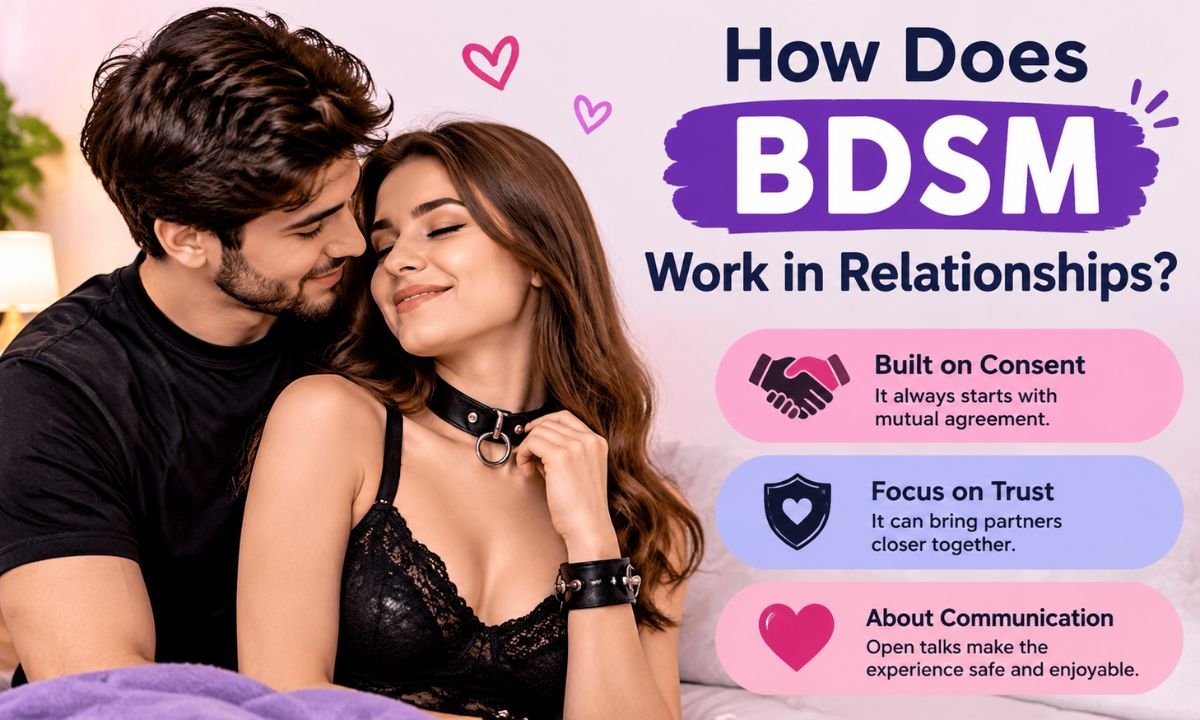
Examples
- Scene-based: A weekend scene with a start time, an end time, and aftercare.
- Lifestyle: A daily dynamic with agreed rules, such as asking permission for big purchases. This is still negotiated and can be changed anytime.
Essential BDSM Terms Every Beginner Should Know
| Term | Meaning |
| Dom / Top | The person leading or giving the action |
| Sub / Bottom | The person following or receiving |
| Switch | Someone who enjoys both roles |
| Scene | One planned play session |
| Safe word | A word that stops everything |
| Hard limit | Something you will never do |
| Soft limit | Something you may try with care |
| Aftercare | Comfort and check-ins after play |
| Sub drop | An emotional dip after a scene |
Real Life Examples
- A new couple fills out a checklist, circles three “maybe” items, and tries only one.
- A partner says “yellow” mid-scene. The other slows down and checks in.
- After a scene, they share water, a blanket, and a short chat about what worked.
BDSM Rules: Key Principles for Safe Practices
The community has several guiding ideas. Most come down to this:
- Only adults, always.
- Talk before you play.
- Agree on a safe word.
- Respect every limit.
- Stay sober, since drugs and alcohol cloud consent.
- Start slow.
- Do aftercare.
Two common frameworks are Safe, Sane, and Consensual (SSC) and Risk-Aware Consensual Kink (RACK). SSC focuses on keeping play safe and clear-headed. RACK accepts that some activities carry risk and asks partners to learn and plan for it.
Examples
- SSC in action: Choosing a low-risk activity and stopping when anyone feels unsure.
- RACK in action: Researching a higher-risk activity, learning the dangers, and agreeing on a plan before trying it.
BDSM Consent: The Most Important Safety Rule
Without consent, it is not BDSM. It is abuse.
Good consent is:
- Clear: said out loud, not assumed.
- Specific: a yes to one thing is not a yes to everything.
- Ongoing: checked throughout.
- Reversible: anyone can withdraw consent at any time.
A popular safe-word tool is the stoplight system. Red means stop, yellow means caution, and green means go.
Common BDSM Practices and Real-Life Examples
- Light bondage: Soft restraints that can be removed instantly.
- Blindfolds: Taking away sight so other senses feel stronger.
- Role-play: Playing characters, such as a strict boss or a shy new hire.
- Rules and rituals: A greeting, a bedtime routine, or an “ask first” habit.
- Aftercare: Cuddling, snacks, and kind words once play ends.
BDSM vs. Kink: What Are the Key Differences?
The words overlap, but they are not identical.
| BDSM | Kink | |
| Scope | Specific themes: bondage, power, sensation | Any unconventional sexual interest |
| Includes | Dom/sub, restraint, S/M | Fetishes, costumes, role-play, and more |
| Relationship | BDSM is a part of kink | Kink is the bigger umbrella |
In short, all BDSM is kink, but not all kink is BDSM.
When To Use And When Not To Use BDSM
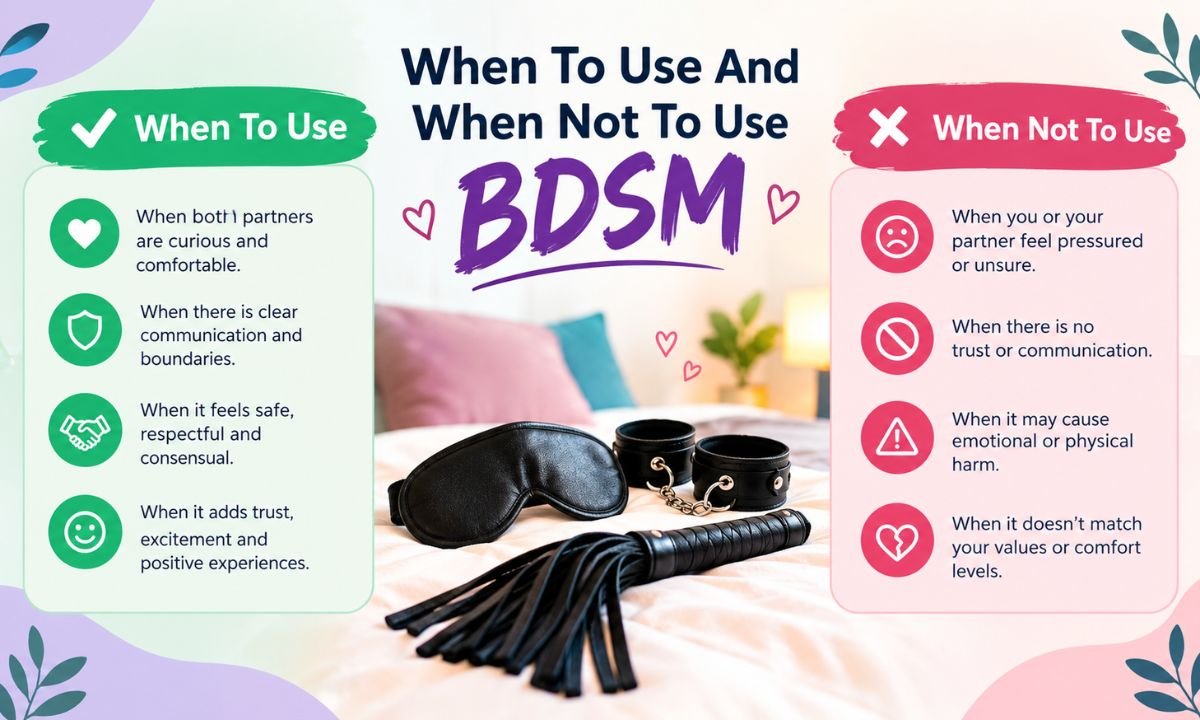
It may suit you when:
- Everyone involved is an adult and truly curious.
- You trust each other and can talk openly.
- You are sober and calm.
Skip it when:
- Someone feels pressured or unsure.
- You are angry, upset, or intoxicated.
- You want to “fix” a broken relationship with it.
- You cannot agree on a stop signal.
Common Myths About BDSM Debunked
- Myth: It is abuse. Fact: Abuse ignores consent. BDSM depends on it.
- Myth: It is all about pain. Fact: Many people never use pain at all.
- Myth: Only dominant people enjoy it. Fact: Many “doms” are shy in daily life, and many “subs” are leaders at work.
- Myth: It means something is wrong with you. Fact: Research does not support that. See the next section.
Is BDSM Normal? Facts You Should Know
Yes. Interest in kink is common, and it is not a mental illness by itself. Recent research finds no clear link between BDSM and psychiatric disorders.
The DSM-5 also separates harmless interests from true disorders. A paraphilic disorder involves distress or non-consenting people, so BDSM alone does not qualify. The WHO’s ICD-11 went further and removed diagnoses for consensual sadomasochism.
Grammar Rules
Quick tips for writing about BDSM correctly:
- Write it in capital letters: BDSM, not “bdsm” or “Bdsm.”
- It is an acronym and works as a noun: “BDSM is popular.”
- As an adjective: “a BDSM scene” or “BDSM play.”
- Use “a” before it, not “an”: “a BDSM class.” The first sound is “bee,” so “a” is correct.
- Use D/s with a capital D and a small s. This shows who leads.
- Do not make it plural. Say “BDSM practices,” not “BDSMs.”
BDSM Safety Tips Every Beginner Must Understand
- Talk first. Share wants, limits, and health concerns.
- Pick a safe word and a hand signal in case speech is hard.
- Start light. Skip risky acts, especially anything near the neck or airway.
- Keep a safety tool close. Safety scissors help if restraints must come off fast.
- Never leave a restrained person alone.
- Protect your health. Use barriers and talk about STI testing.
- Plan aftercare.
- Learn from reliable sources or beginner classes.
BDSM Benefits and Risks: A Powerful Overview
| Possible benefits | Possible risks |
| Stronger trust and communication | Physical injury if done carelessly |
| Stress relief and a feeling of closeness | Emotional drop after intense scenes |
| Better understanding of your own limits | Consent breaches if boundaries are ignored |
| Some studies link it to better mental health for partnered people, though cause and effect are unclear | STI risk with certain activities |
| A sense of community | Privacy and stigma concerns |
Benefits are not guaranteed. They depend on honest communication and care.
How to Talk About BDSM With Your Partner
Starting the talk is often the hardest part. Try this:
- Choose a calm moment, not in the middle of intimacy.
- Begin with curiosity: “I read about something and wondered what you think.”
- Share a small idea, not a full list.
- Listen without judging. “No” and “not yet” are fine answers.
- Use a yes/no/maybe list to find common ground.
- Agree to go slowly, and review after the first try.
Frequently Asked Questions About BDSM Meaning
What does BDSM stand for?
Bondage and Discipline, Dominance and Submission, and Sadism and Masochism.
Is BDSM the same as abuse?
No. BDSM is built on informed, ongoing consent, while abuse ignores it.
Is BDSM a mental illness?
No. Consensual BDSM is not classed as a mental disorder by current diagnostic guides.
What is a safe word?
It is a pre-agreed word or signal that stops play immediately, no questions asked.
What does “vanilla” mean?
It describes sex or relationships without kink or power play.
Can beginners try BDSM?
Yes, with open talks, light activities, and clear limits.
Conclusion
The BDSM meaning is simple once you strip away the myths. It is consensual, adult play built on trust, honest talk, and agreed limits. The letters cover bondage, discipline, dominance, submission, sadism, and masochism, but consent and safety are what hold it all together.
If you are curious, go slowly, talk openly, and only move forward when everyone is comfortable. If you ever feel pressured, stop. That is always your right.
Note:This article is educational and for adults 18+. It is not medical, legal, or therapy advice.

The author is a professional content writer specializing in word meanings, definitions, and English vocabulary. With over 6 years of experience in language research and educational content creation, they produce accurate, well-researched, and reader-friendly articles.