
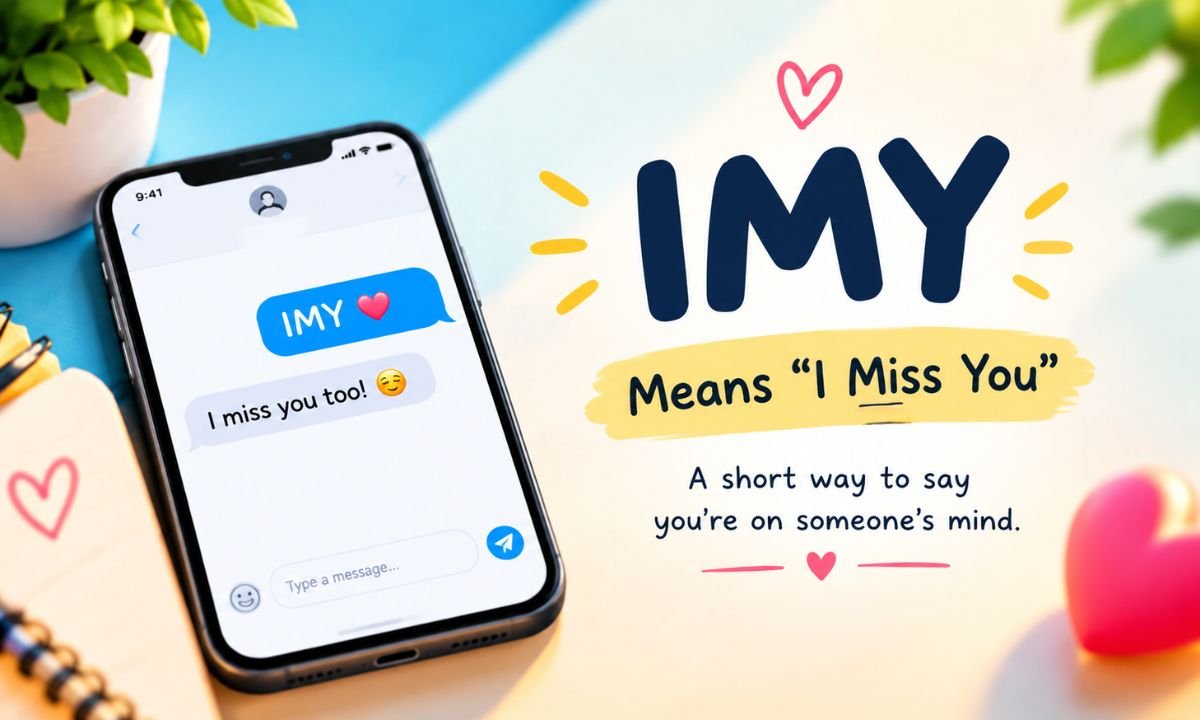
Your phone buzzes, and a message appears with just three letters: “IMY.” If that has ever left you guessing, you are not alone. The IMY meaning is simple: it stands for “I miss you.” People use it in texts, DMs, comments, and captions to show they are thinking about someone. It feels light, but it can carry real warmth.
This guide explains what IMY means, who uses it, and how to reply. You will see examples, variations like IMYT and IMYSM, and the difference between IMY and ILY. We also cover grammar tips, the Urdu meaning, and when to avoid the abbreviation. By the end, you will read and send IMY with confidence.
IMY Meaning
IMY means “I miss you.” It is a texting abbreviation used to tell someone you miss their company. Collins English Dictionary also lists it as a messaging shorthand for that phrase.
Example
- “Haven’t seen you in weeks. IMY!”
- “Good night, IMY ❤️”
IMY Full Form
The full form of IMY is I Miss You.
| Letter | Stands for |
| I | I |
| M | Miss |
| Y | You |
IMY: What Does It Mean?
When someone sends IMY, they are saying they feel your absence. It may mean they want to talk, meet, or just let you know you are on their mind.
The tone depends on the person. Between close friends, it is warm and casual. Between partners, it can feel deeper.
Examples
- A student texts a parent from summer camp: “IMY, can’t wait to see you.”
- A friend replies to your old photo: “Those were the days, IMY.”
- A partner sends it late at night after a long day apart.
What Does IMY Mean in Texting?
In texting, IMY is a quick way to share a feeling without typing a full sentence. It saves time, and it can make an emotional message feel less heavy.
People send it by SMS, WhatsApp, Snapchat, and Instagram DMs. Most readers understand it right away, though older users may need a hint. If you are unsure about the reader, write the full phrase once.
IMY Meaning in Slang and Social Media
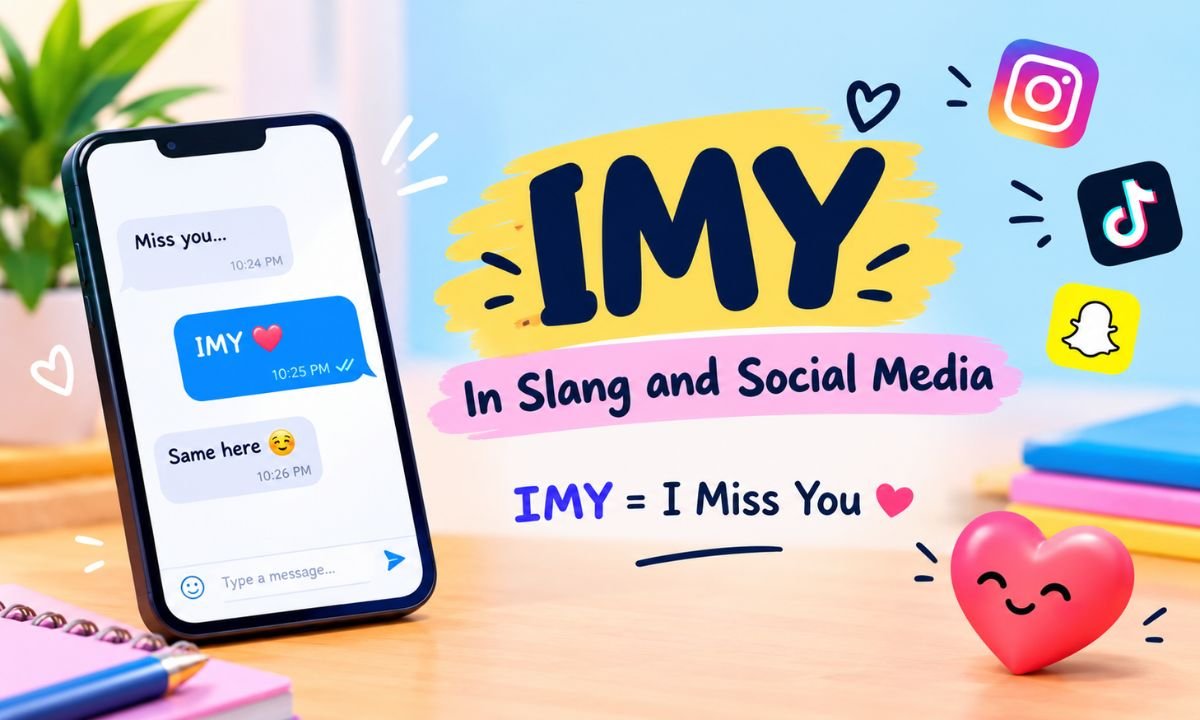
On social media, IMY shows up in comments, stories, and captions. Common uses include:
- A caption on a throwback photo
- A comment on a friend’s post
- A message to a long-distance friend or partner
- A tag on a memory video
Creators also use it with emojis, such as 🥺, 💔, or 🫶, to set the mood. The emoji often tells you if the message is playful or serious.
What Does IMY Stand For?
IMY stands for “I miss you” in nearly every case. Some low-quality pages claim it can also mean “I’m yours,” but that reading is rare and not widely confirmed. Context usually settles any doubt. If the message follows a goodbye or a long gap, it means “I miss you.”
How to Use IMY in a Text Message
Follow these simple steps:
- Pick the right person. Use it with friends, family, or a partner.
- Match the mood. Add an emoji if you want a softer tone.
- Keep it short. IMY works best alone or with one extra line.
- Add a plan. A line like “Let’s meet soon” turns the feeling into action.
Examples:
- “IMY! Call me tonight?”
- “Long day. IMY 🫶”
IMY Meaning From a Girl
The meaning is the same no matter who sends it: “I miss you.” What changes is the relationship, not the gender.
From a close friend, it means she wants to catch up. From a partner, it often shows affection. From someone you rarely talk to, it may be a friendly check-in. Look at the tone, the emojis, and the history of your chats.
IMY Meaning From a Guy
Again, the words mean “I miss you.” Some people send short texts because they like brief messages, not because they care less.
If a guy sends IMY with no emoji, take it at face value. He misses you. If you want clarity, reply warmly and see how the chat goes.
IMY Meaning in Love and Relationships
In love, IMY says “I wish you were here.” Long-distance couples use it often. It keeps the bond alive between calls.
Tips for couples:
- Send it at a calm moment, not only during fights.
- Pair it with a memory: “IMY. Remember our trip?”
- Do not spam it. Too many texts can lose their meaning.
IMY vs. ILY: What Is the Difference?
| Point | IMY | ILY |
| Full form | I miss you | I love you |
| Feeling | Longing, absence | Love, affection |
| Used with | Friends, family, partners | Mostly family and partners |
| Weight | Lighter | Heavier |
IMY is about being apart. ILY is about love. Some people send both: “ILY, IMY.”
Examples of IMY in Conversations
Friends:
- A: “IMY, it’s been forever.”
- B: “IMYT! Weekend plans?”
Couple:
- A: “IMY 🥺”
- B: “IMY more. Counting the days.”
Family:
- Mom: “House feels quiet. IMY.”
- Child: “IMY too, Mom. Home soon.”
More Meanings of IMY
IMY Meaning in Urdu
In Urdu, IMY is expressed as مجھے تمہاری یاد آ رہی ہے (mujhe tumhari yaad aa rahi hai). A polite form is مجھے آپ کی یاد آ رہی ہے.
You can also say میں تمہیں یاد کرتا ہوں (for a man) or میں تمہیں یاد کرتی ہوں (for a woman).
IMY Meaning Other Than “I Miss You”
The dominant meaning is “I miss you.” A few pages suggest “I’m yours,” but this is uncommon. When in doubt, read the full message or ask.
IMY Meaning in Chat
In chat, IMY is a short, warm check-in. It can start a conversation or end one gently.
IMY Meaning Funny
People sometimes use it as a joke. A playful example: “IMY, but I miss my bed more 😂.” The humor comes from the twist, not from a new meaning.
IMYT Meaning
IMYT = I miss you too. It is the standard reply to IMY. Some people write IMY2 for the same idea.
IMYSM Meaning
IMYSM = I miss you so much. It shows stronger feeling than plain IMY. A crying emoji often goes with it.
Grammar Rules
IMY is slang, so strict grammar does not apply. These habits keep it clear:
- It is a full sentence. “I miss you” has a subject, verb, and object, so IMY can stand alone.
- Capitalization is flexible. IMY, imy, and Imy all work. All caps can sound more excited.
- Punctuation sets tone. “imy” feels soft. “IMY!!” feels excited.
- Skip it in formal writing. Use “I miss you” or a more polished line.
- Do not add “so” or “too” inside it. Use IMYSM or IMYT instead.
How to Reply to IMY in Texting
Pick a reply that fits how you feel:
| Your feeling | Sample reply |
| You miss them too | “IMYT ❤️” or “IMY2” |
| You miss them more | “IMY more!” |
| You want to meet | “IMY. Free this weekend?” |
| You feel casual | “Aww, IMY too! How are you?” |
| You feel unsure | “That’s sweet. What’s on your mind?” |
Be honest. A kind, clear answer is better than a quick one you do not mean.
Other Meanings and Variations of IMY
| Abbreviation | Meaning |
| IMYT / IMY2 | I miss you too |
| IMYM | I miss you more |
| IMYSM | I miss you so much |
| IMYSB | I miss you so bad |
| IMYTB | I miss you to bits |
| MU | Miss you |
| ILY | I love you |
A stronger version with explicit language also exists, but it is less common and not suited to most chats.
When to Use and When Not to Use IMY
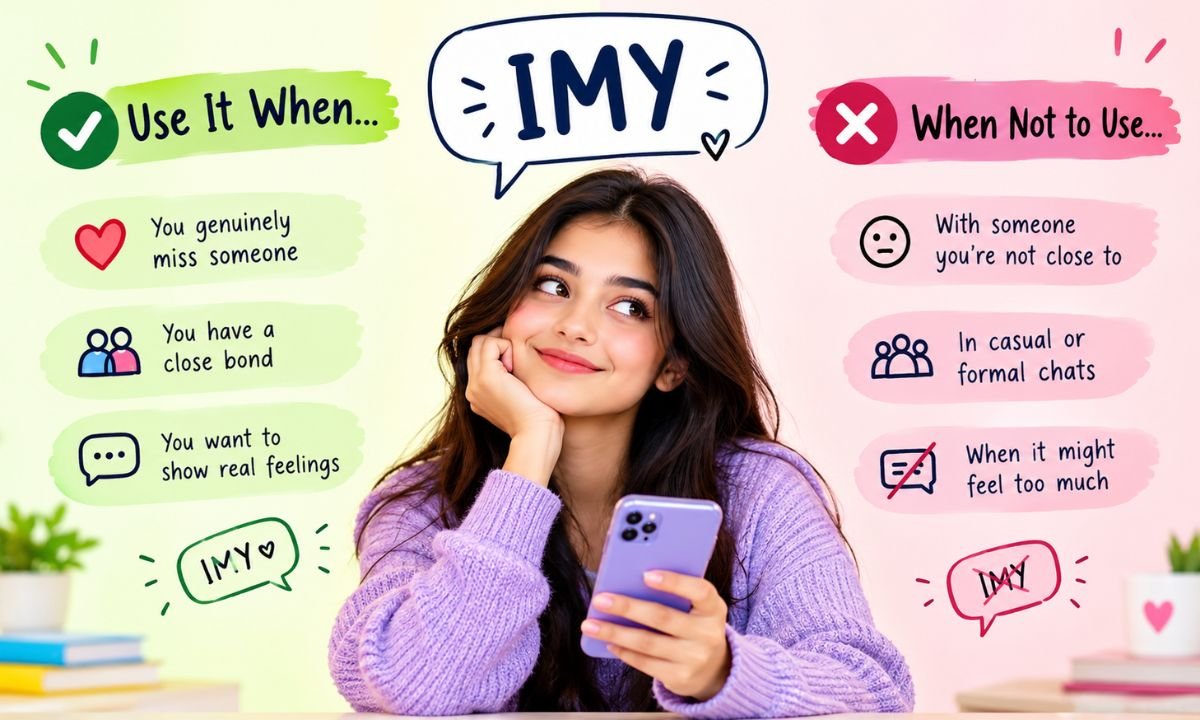
| Use IMY when… | Avoid IMY when… |
| Texting close friends or family | Writing to a boss or client |
| Messaging a partner | Sending school or work emails |
| Replying to a throwback post | The reader may not know slang |
| You truly miss someone | You are in a tense or serious talk |
| You want a light, warm tone | You want to share deep feelings (spell it out) |
Frequently Asked Questions About IMY Meaning
What does IMY mean in text?
It means “I miss you.”
What is the full form of IMY?
The full form is “I miss you.”
What does IMYT mean?
It means “I miss you too,” and it is the usual reply.
What does IMYSM mean?
It means “I miss you so much.”
Is IMY romantic?
Not always. Friends and family use it too, so tone and context matter.
What is the difference between IMY and ILY?
IMY means “I miss you,” and ILY means “I love you.”
How do I reply to IMY?
Say “IMYT,” “IMY2,” or “I miss you too,” and add a plan to meet if you can.
Can I use IMY at work?
It is best to avoid it. IMY is informal and personal.
Conclusion
IMY is a small acronym with a warm message: “I miss you.” It works well with friends, family, and partners, and it fits most chat apps. The meaning stays the same, but tone and emojis shape how it feels.
Remember the basics. Reply with IMYT or IMY2 if you feel the same. Use IMYSM for stronger feelings. Keep it out of formal messages. With that, you can send and read IMY the right way.

The author is a professional content writer specializing in word meanings, definitions, and English vocabulary. With over 6 years of experience in language research and educational content creation, they produce accurate, well-researched, and reader-friendly articles.