
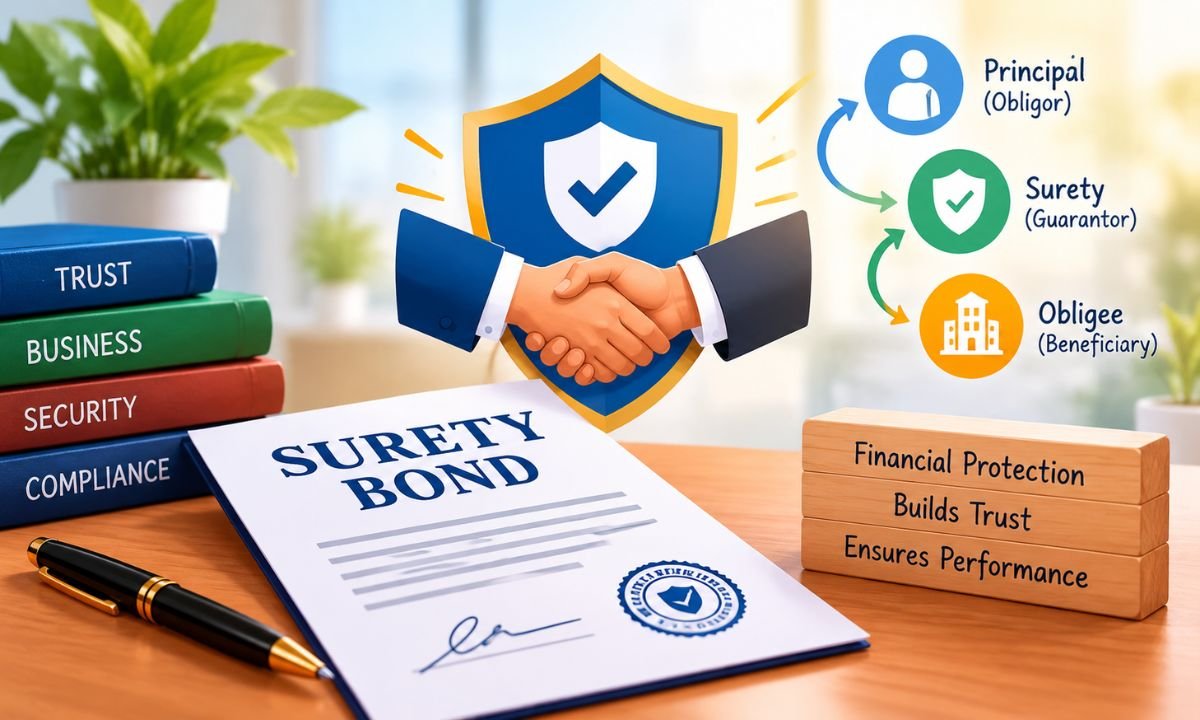
Surety bond meaning is easy to understand once you break it down. It is a written promise, backed by a third company, that a person or business will do what they agreed to do. If they fail, the company behind the bond pays the injured party, up to a set limit.
You may meet a surety bond when you apply for a contractor license, bid on a government job, or deal with a court. This guide explains what it is, how it works, who needs one, and what it costs. You will also see how it differs from insurance and what “cash surety bond” means.
Quick answer: A surety bond is a three-party contract in which a surety guarantees that a principal will meet an obligation to an obligee. If the principal fails, the surety pays, and then the principal must repay the surety.
surety bond meaning
A surety bond is a legal contract that guarantees a promise will be kept. Three sides are involved: the one who must perform, the one who is protected, and the company that backs the promise. The bond protects the party who requires it, not the party who buys it.
Think of it as a safety net for the other side of a deal. It builds trust, since the other side knows money is available if something goes wrong.
Examples
- A plumber buys a license bond so the state can protect customers from unfinished or poor work.
- A contractor buys a performance bond to prove a project will be completed.
- A person named executor of an estate buys a probate bond to protect heirs.
cash surety bond meaning
The term “cash surety bond” is used in two ways, so context matters.
In court and bail settings, it often means the full bail amount is paid in cash, either directly to the court or to a surety that holds it. In the bonding industry, it can also mean a bond backed by cash collateral. Here the principal deposits cash with the surety, instead of relying on credit alone, and the surety holds it as security.
Because rules differ by state and court, check the exact definition in your paperwork.
Examples
- A family pays the full $5,000 bail to the court in cash to release a relative.
- A business with weak credit places cash with a surety to get a license bond approved.
- A defendant pays about 10% to a bail agent instead, which is a standard bail bond and not a cash bond.
What Is a Surety Bond?
A surety bond is a financial guarantee made through a contract. It confirms that the principal will follow a law, license rule, or contract. If they do not, the surety steps in to pay valid claims.
Unlike a bank loan or a simple cash deposit, you pay a small fee, called a premium, for the bond. The bond itself carries a larger limit, called the penal sum.
How Does a Surety Bond Work?
The process is simple:
- The obligee requires a bond.
- The principal applies to a surety company.
- The surety reviews credit and finances.
- The principal pays a premium and receives the bond.
- The bond is given to the obligee.
- If the principal fails, the obligee files a claim.
- The surety investigates and pays valid claims.
- The principal repays the surety.
Step 8 is the key difference from insurance. The surety expects to be paid back.
What Is the Purpose of a Surety Bond?
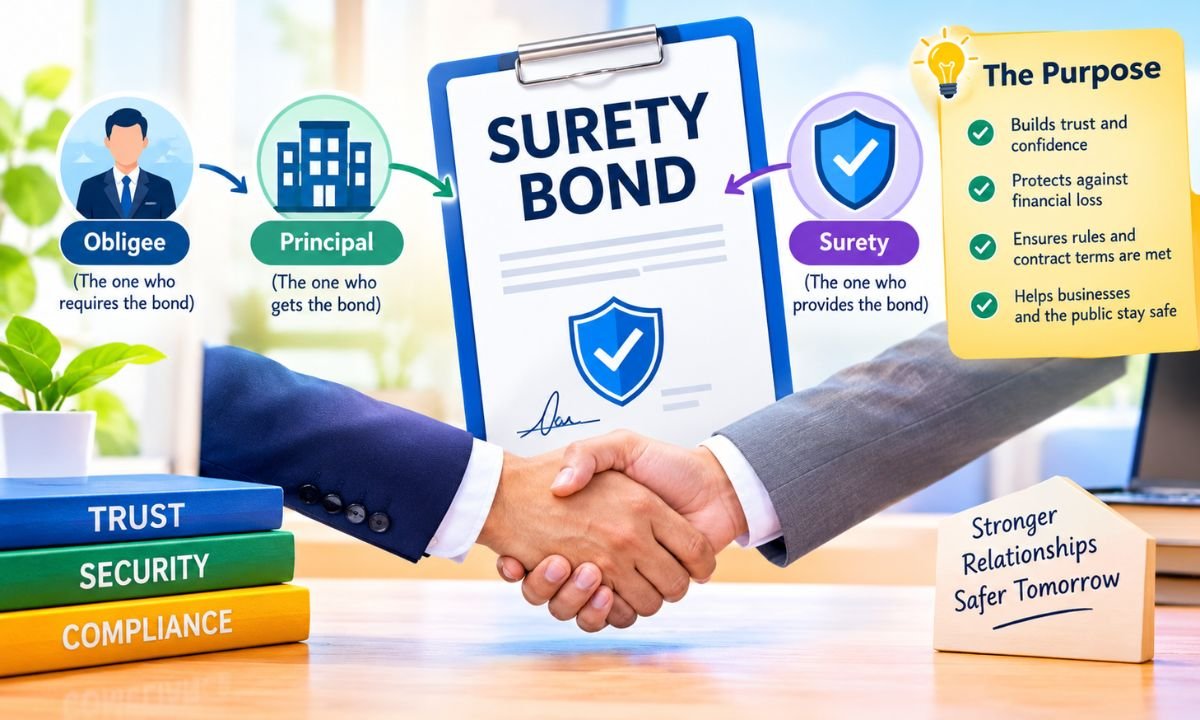
The main purpose is to protect the obligee from financial loss. Governments, project owners, and courts use bonds to lower risk. A bond also helps the principal, because it shows they are trusted and qualified.
In short, a bond:
- Guarantees that work is finished or rules are followed
- Protects the public from fraud or poor service
- Gives honest businesses a way to win trust
Origin And Background
The idea of one person guaranteeing another’s promise is very old. Writers often trace early forms of surety to ancient Mesopotamia and later to Roman law. For centuries, friends and wealthy individuals acted as sureties.
Modern corporate surety grew in the 1800s, when companies began issuing bonds for a fee. In the United States, the Miller Act of 1935 requires performance and payment bonds on federal construction contracts above $150,000. Many states have similar “Little Miller Acts” for public projects.
Who Are the Three Parties Involved in a Surety Bond?
| Party | Role | Simple example |
| Principal | Buys the bond and must meet the obligation | A contractor |
| Obligee | Requires the bond and is protected by it | A city or project owner |
| Surety | Backs the bond and pays valid claims | A surety or insurance company |
The surety protects the obligee, not the principal.
What Are the Different Types of Surety Bonds?
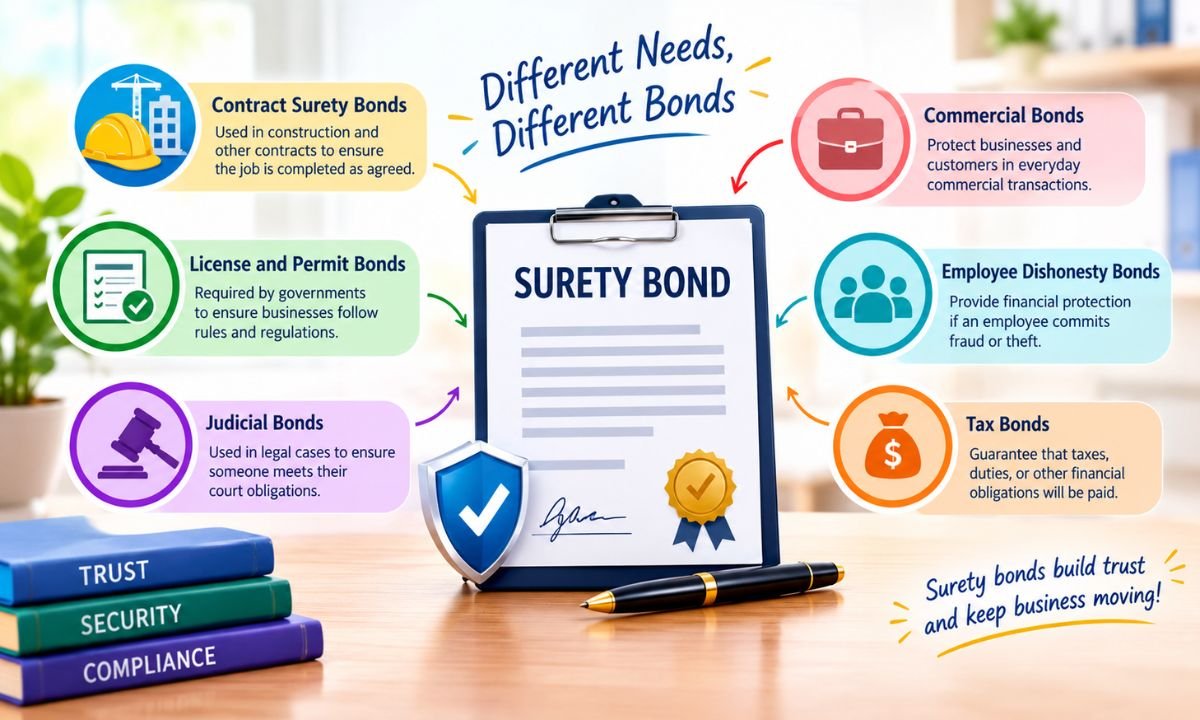
Surety bonds fall into two big groups: contract bonds and commercial bonds.
Contract surety bonds
- Bid bonds
- Performance bonds
- Payment bonds
- Maintenance bonds
Commercial surety bonds
- License and permit bonds
- Notary bonds
- Auto dealer bonds
- Freight broker bonds
Court bonds
- Bail bonds
- Probate and fiduciary bonds
- Appeal bonds
What Is the Difference Between a Surety Bond and Insurance?
| Feature | Surety bond | Insurance |
| Parties | Three | Two |
| Who is protected | The obligee | The policyholder |
| Repayment | Principal repays the surety | Usually no repayment |
| Expected losses | Not expected | Expected and priced in |
| Purpose | Guarantee performance | Cover accidents and risks |
In other words, a bond is closer to a line of credit than to an insurance policy.
Who Needs a Surety Bond?
You may need a bond if you are:
- A contractor or builder
- A licensed professional, such as a plumber or electrician
- An auto or freight business owner
- A notary public
- An executor, guardian, or trustee
- A defendant seeking bail through an agent
Your state, city, or client decides whether a bond is required.
How Much Does a Surety Bond Cost?
You pay a premium, which is a percentage of the bond amount. It is commonly between 1% and 15%, depending on risk.
Example: on a $100,000 bond, a 3% rate costs $3,000.
A rough guide to rates by credit:
| Credit profile | Typical premium |
| Strong (about 700+) | 1% to 3% |
| Fair (about 650 to 699) | 3% to 8% |
| Weak (under 650) | 10% to 15% |
These ranges are estimates and vary by surety and bond type. Many license bonds cost a flat yearly fee.
What Factors Affect Surety Bond Rates?
- Credit score and history: often the biggest factor for smaller bonds
- Bond type and amount: higher limits mean more risk
- Financial strength: cash flow, assets, and debts
- Experience and claims history: past claims raise rates
- Industry risk: some trades face more claims
- Collateral: cash or assets can lower the rate
How Do You Get a Surety Bond?
- Confirm the exact bond type and amount from the obligee.
- Compare quotes from licensed surety agents.
- Submit an application with credit and financial details.
- Wait for underwriting approval.
- Pay the premium.
- Sign the indemnity agreement.
- File the bond with the obligee.
Small bonds are often approved the same day.
What Happens If a Surety Bond Claim Is Filed?
The obligee sends a written claim to the surety. The surety investigates to see if it is valid. If it is, the surety pays up to the bond limit or arranges to fix the problem, such as finishing a project.
Then the surety collects from the principal under the indemnity agreement. A claim can hurt your credit and make future bonds more expensive.
What Are the Benefits of a Surety Bond?
- Wins trust with clients and agencies
- Helps you qualify for licenses and public contracts
- Protects the obligee from loss
- Is affordable compared with posting full cash
- Keeps your cash free for daily business
Are Surety Bonds Required by Law?
Sometimes. Federal construction projects above $150,000 require bonds, and many states require them for licenses, public work, and court actions. Private clients may also ask for one in a contract. Requirements differ by state and trade, so confirm with your licensing office.
How Long Does a Surety Bond Last?
It depends on the bond type:
- License and permit bonds: usually one year, then renewed
- Contract bonds: until the project is done, plus any warranty period
- Court bonds: until the case ends or the court releases the bond
If you do not renew, the bond lapses and your license or contract may be at risk.
When To Use And When Not To Use It
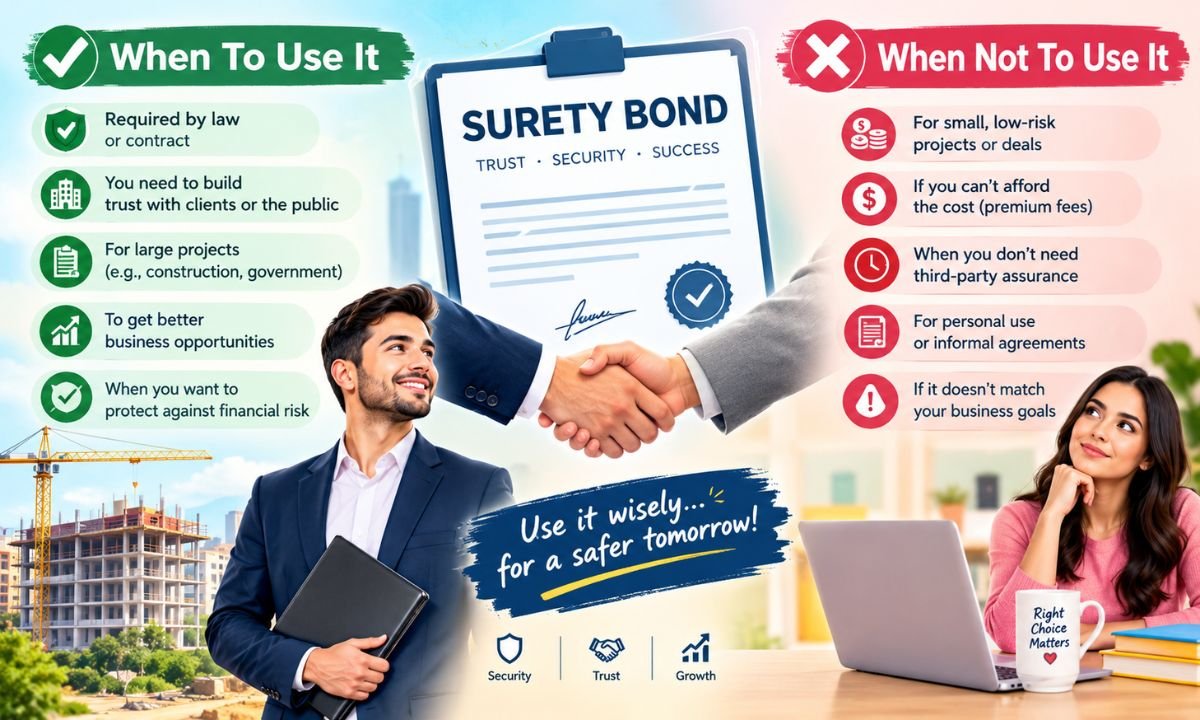
Use a surety bond when:
- A law, license, or contract requires one
- You want to prove you are reliable
- You lack large cash reserves
Skip or rethink it when:
- You expect to cover your own mistakes with it, since it protects the other party
- You cannot repay a claim
- A cash deposit is cheaper and allowed
- You need protection for your own losses, where insurance is the right tool
This article is general information, not legal or financial advice.
Others meaning
The word “surety” appears in several fields.
Surety bond meaning in law
In law, a surety is a person or company that takes responsibility for another’s debt or duty. The surety is liable only if that person fails to perform. The same idea underlies court bonds and guarantees.
Surety bond meaning in insurance
In insurance, a surety bond is a risk product sold by insurers, but it works unlike a policy. The insurer lends its financial strength to the principal and expects repayment after a claim.
Surety or surity
“Surety” is the correct spelling. “Surity” is a rare misspelling and should be avoided. The word is pronounced SHUR-uh-tee, and some people say SHOOR-tee.
Surety bond meaning in construction
In construction, surety bonds guarantee that a contractor will bid honestly, finish the job, and pay subcontractors and suppliers. The main types are bid, performance, and payment bonds.
Surety bond meaning in bail and court cases
In criminal cases, a surety bond usually means a bail bond. A bail agent posts the full bail amount, and the defendant pays a non-refundable premium, often about 10%, though rates vary by state.
Grammar Rules
- Part of speech: “surety” is a noun. It can mean the guarantee itself or the person or company giving it.
- Plural: the plural is “sureties.”
- Common phrase: “stand surety for someone” means to take responsibility for them.
- Compound term: write “surety bond” as two words. No hyphen is needed.
- Capitalization: use lowercase unless it begins a sentence or is part of a title.
- Related words: “suretyship” names the relationship, and “surety company” names the backer.
Frequently Asked Questions
What is a surety bond in simple words?
It is a three-party promise where a surety guarantees a principal will do what they agreed to do for an obligee.
Is a surety bond the same as insurance?
No. A bond protects the obligee and the principal must repay the surety, while insurance protects the policyholder.
Who does a surety bond protect?
It protects the obligee, such as a government agency, project owner, or court.
How much does a surety bond cost?
Usually 1% to 15% of the bond amount per term, based on credit and risk.
What is a cash surety bond?
It usually means bail paid in full in cash, or a bond secured by cash collateral held by the surety.
Can I get a surety bond with bad credit?
Often yes, but expect a higher rate or a request for collateral.
Is a surety bond refundable?
Premiums are generally not refundable. Cash collateral may be returned after the bond is released.
What happens if I cannot repay a claim?
The surety may take legal action and pursue your business or personal assets under the indemnity agreement.
Final Thoughts
The surety bond meaning comes down to trust backed by money. A surety guarantees that a principal will keep a promise to an obligee, and the principal pays the surety back if a claim is paid. It is not insurance for the buyer.
Before you buy, confirm the bond type and amount with the requiring party, compare quotes, and protect your credit. With the right bond, you can meet legal rules, win work, and build lasting trust.

The author is a professional content writer specializing in word meanings, definitions, and English vocabulary. With over 6 years of experience in language research and educational content creation, they produce accurate, well-researched, and reader-friendly articles.