
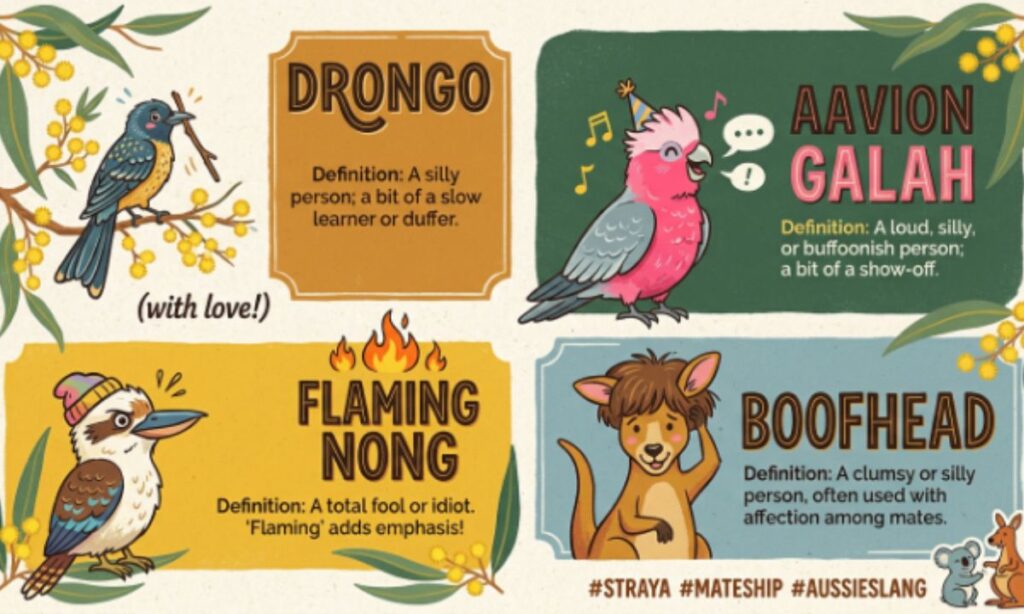
Australians have a habit of turning insults into affection. Call a mate a “drongo” or a “bogan” and, more often than not, you’ll get a laugh rather than a fight. That’s the strange charm of Australian slang insults — they sound sharp, but most of them are dished out with a grin.
This guide breaks down the most common Aussie slang insults, what they actually mean, how offensive (or harmless) each one really is, and how to use them without putting your foot in it. Whether you’re planning a trip, watching Aussie TV, or just curious why someone got called a “flamin’ galah,” you’ll find it here.
Quick Reference Table
| Slang Term | Meaning | Insult Level |
| Bogan | Unsophisticated, low-class stereotype | Mild–Moderate |
| Drongo | Fool, idiot | Mild |
| Wanker | Arrogant, self-important person | Moderate–Strong |
| Nong | Silly, clueless person | Mild |
| Dropkick | Useless or hopeless person | Moderate |
| Galah | Silly fool (named after the bird) | Mild |
| Dill | Someone acting dumb | Mild |
| Mug | Someone easily fooled | Mild |
| Tool | Irritating, obnoxious person | Moderate |
| Goose | Harmlessly silly person | Mild |
| Tosser | Arrogant or annoying person | Moderate |
| Ratbag | Mischief-maker, sometimes affectionate | Mild |
| Dag | Unfashionable but likeable person | Very Mild |
| Deadset Drongo | A total, undeniable idiot | Mild–Moderate |
| Clown | Someone acting foolishly | Mild–Moderate |
30 Australian Slang Insults Explained
Australian slang insults exist on a sliding scale — some are practically compliments in disguise, others can genuinely sting depending on tone. Here’s a closer look at the most widely used ones.
Slang: Bogan
A bogan describes someone seen as unrefined, low-income, or lacking in taste — think mullet haircuts, thongs (flip-flops), and a battered ute. It can be a genuine put-down or a cheeky, self-deprecating label Australians happily apply to themselves. “He’s a bit of a bogan, but he’s harmless” is a completely normal sentence in Australia.
Slang: Drongo
Drongo simply means fool or idiot, usually aimed at someone who’s done something silly rather than someone who’s genuinely stupid. It’s one of the mildest insults on this list and is often said with a laugh: “You left the keys in the door again, you drongo.”
Slang: Wanker
This one carries more bite. A wanker is someone arrogant, self-important, or full of themselves — the person who won’t stop bragging at a barbecue. It’s considered ruder than most entries here, so save it for close friends or genuinely deserved situations.
Slang: Nong
A nong is someone acting clueless or a bit slow on the uptake. It’s light, friendly, and rarely meant to genuinely hurt — closer to “silly billy” than a real insult.
Slang: Dropkick
A dropkick is someone seen as useless, unmotivated, or a bit of a loser. It’s sharper than drongo or nong and usually implies the person isn’t living up to their potential, not just that they made one mistake.
Slang: Galah
Named after the pink-and-grey cockatoo known for its noisy, erratic behaviour, a galah is a fool or a scatterbrain. Often said as “flamin’ galah,” it’s a classic country-Australian insult that’s more amused than angry.
Slang: Dill
A dill is someone behaving foolishly, usually in a minor, forgivable way. It’s an old-fashioned word still common among older Australians and in rural areas.
Slang: Mug
A mug is someone gullible — easily tricked or taken advantage of. “Only a mug would pay full price for that” is a typical use, aimed more at the situation than the person’s character.
Slang: Tool
Calling someone a tool means they’re being obnoxious, self-important, or deliberately annoying. It’s become especially common among younger Australians and sits firmly in the “moderate” insult zone.
Slang: Goose
A goose is silly in a harmless, almost endearing way. It’s one of the gentlest insults here — more likely to make someone laugh than genuinely offend them.
Slang: Tosser
Similar in tone to wanker but slightly less crude, a tosser is someone arrogant or irritating. It’s common in casual arguments and heated banter between mates.
Slang: Ratbag
A ratbag is a mischief-maker or troublemaker, often used affectionately toward kids or cheeky friends. “You little ratbag” is as likely to come with a smile as a scolding.
Slang: Dag
Possibly the gentlest word on this entire list, a dag is someone unfashionable, a bit odd, or socially awkward — but in a likeable, endearing way. Calling someone a dag is often closer to a term of fondness than a genuine insult.
Slang: Deadset Drongo
This is drongo turned up a notch. Adding “deadset” (meaning genuinely, absolutely) intensifies the insult to mean someone has done something undeniably, unmistakably foolish.
Slang: Clown
A clown, in Australian slang, is someone acting foolish or making a scene, usually through their own poor decisions. It’s used both in traffic (“look at this clown”) and everyday conversation.
Generational Slang Differences
Not every generation uses Australian slang insults the same way. Understanding the shift helps you avoid sounding out of place.
Gen Z
Younger Australians lean toward words like tool, clown, and goose, often blending them with internet and gaming culture slang. Delivery tends to be sarcastic and text-based, showing up heavily in group chats and social media comments.
Millennials
Millennials sit in the middle ground, mixing classic terms like drongo, wanker, and bogan with a more self-aware, ironic tone. They’re often the generation most likely to explain the joke to outsiders.
Older Generations
Older Australians favour more traditional slang — galah, ratbag, dag, and dill — usually delivered face-to-face rather than online. These terms carry a nostalgic, folksy tone shaped by decades of everyday use.
Funny Australian Slang Insults (Examples)
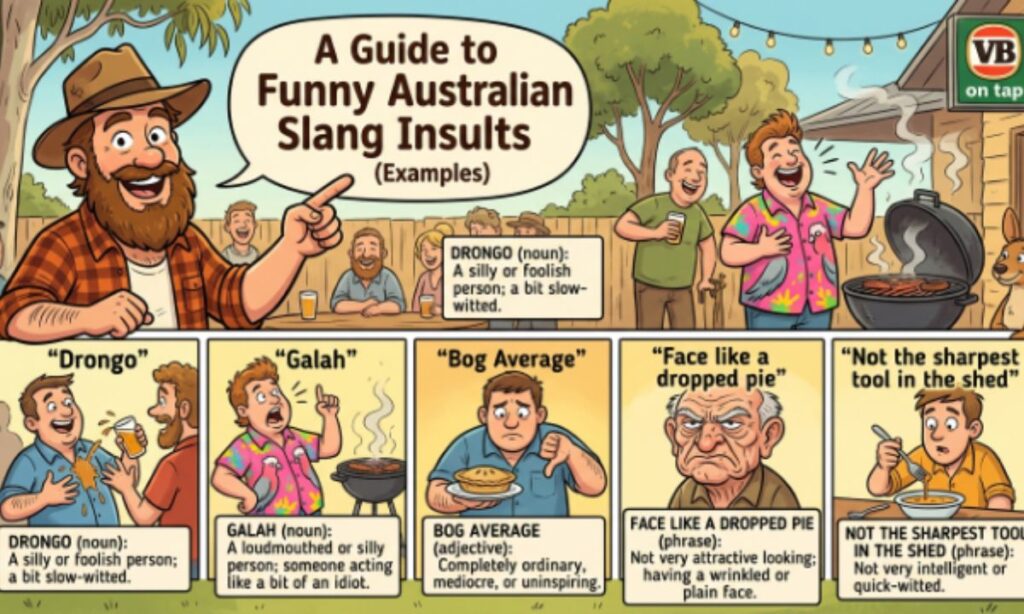
Beyond single words, Australians love colourful insult phrases that paint a picture. These are less about individual words and more about vivid comparisons.
- “He’s not the full quid” – someone who isn’t very bright.
- “A few sandwiches short of a picnic” – lacking common sense.
- “Mad as a cut snake” – erratic or unpredictable behaviour.
- “Couldn’t organise a chook raffle” – hopelessly disorganised.
- “Kangaroos loose in the top paddock” – a bit scatterbrained.
- “Flat out like a lizard drinking, but achieving nothing” – all effort, no results.
- “As useful as an ashtray on a motorbike” – completely pointless.
- “Built like a mallee bull, brains like a gnat” – strong but not smart.
- “One roo short in the top paddock” – slightly dim.
- “As sharp as a bowling ball” – not sharp at all.
Australian Slang Phrases
Some Australian slang insults come as full phrases rather than single words, often used to soften or exaggerate a jab.
- “Up himself” – overly self-important or arrogant.
- “Few kangaroos loose in the paddock” – a bit foolish.
- “Wouldn’t know if his backside was on fire” – clueless.
- “As dry as a dead dingo’s donger” – applied loosely to describe someone or something completely lacking (often humour, not always an insult).
- “Couldn’t lead a cow to water” – incapable of basic tasks.
- “Sook” – someone who complains or sulks easily.
- “Flogging a dead horse” – wasting effort on something pointless (usually about a task, not a person).
- “Full of it” – exaggerating or talking nonsense.
- “Not backward in coming forward” – someone overly pushy or blunt.
- “Chuck a wobbly” – to throw a tantrum.
Australian Insults for Men
Certain Australian slang insults are aimed specifically at male behaviour, especially arrogance, laziness, or try-hard energy.
- Wanker – arrogant, full of himself.
- Dropkick – lazy or underachieving.
- Try-hard – someone overly desperate to impress.
- Big-noter – a man who constantly exaggerates his own achievements.
- Flog – a show-off, often reckless (common in car and sports culture).
- Sook – a man who complains or sulks over small things.
- Bludger – someone who avoids work and relies on others.
- Galah – a man acting foolishly, especially in public.
- Tool – an obnoxious or self-important man.
- Knob – a blunt, moderately rude word for someone acting foolishly or arrogantly.
Australian Insult Generator
Want to build your own Aussie-style insult? Mix a word from Column A with a word from Column B — the sillier the combination, the more authentic it sounds.
| Column A | Column B |
| Deadset | Drongo |
| Flamin’ | Galah |
| Absolute | Dropkick |
| Proper | Muppet |
| Total | Goose |
| Grade-A | Tool |
| World-class | Ratbag |
| Certified | Dag |
Examples: “You’re a deadset galah,” “What a flamin’ dropkick,” “He’s a proper tool.” Keep the tone playful — Australians generally reserve the harsher combinations (wanker, tosser) for genuinely deserved moments, not casual fun.
How to Use Slang Naturally Without Sounding Awkward
- Match the tone of the room. Slang insults work in relaxed, friendly settings — not formal or professional ones.
- Read the relationship. Terms like drongo or dag are safe with friends; wanker or tosser need a closer bond or genuine grievance.
- Let context do the work. A smile, laugh, or teasing tone turns an insult into banter instantly.
- Don’t overuse it. Sprinkling in one well-placed word lands better than stacking several insults in one sentence.
- Avoid it with strangers. Even mild slang can misfire if the other person doesn’t know the local norms.
Common Slang Mistakes
- Using strong words too casually — wanker and tosser aren’t as gentle as drongo or dag.
- Getting the tone wrong — flat, serious delivery can turn a joke into a genuine insult.
- Using outdated slang with younger Australians — terms like dill or galah may sound old-fashioned to Gen Z.
- Assuming every Aussie insult is rude — many, like dag or goose, are closer to affectionate teasing.
- Overusing slang as a non-local — a little goes a long way; forcing too much can sound unnatural.
- Ignoring regional differences — bogan has regional cousins like westie (Sydney) and bevan (Queensland) that don’t always overlap in meaning.
Practice Section
Fill in the Blanks
- “You locked the keys in the car again? You absolute ______!”
- “He never stops bragging about his new car — what a ______.”
- “She’s a bit of a ______, but everyone loves her anyway.”
Suggested answers: 1. drongo/dropkick 2. wanker/tosser 3. dag
Choose the Correct Slang
Which word best fits: someone gullible who just overpaid for a used car? a) Dag b) Mug c) Ratbag
Answer: b) Mug
Which word best fits: a mischievous but likeable kid? a) Wanker b) Tool c) Ratbag
Answer: c) Ratbag
Rewrite the Formal Sentence Into Slang
Formal: “He is behaving in a foolish and reckless manner.” Slang version: “He’s acting like a proper drongo.”
Formal: “That person is extremely arrogant and self-important.” Slang version: “What an absolute wanker.”
Frequently Asked Questions
What does “drongo” mean in Australian slang?
Drongo means a fool or idiot, usually said about someone who’s done something silly rather than someone genuinely unintelligent.
Is calling someone a bogan offensive?
It can be, depending on tone and context — bogan is often used lightheartedly among friends but can be genuinely dismissive when aimed at strangers.
What’s the most offensive Australian slang insult?
Wanker and tosser are generally considered the strongest on this list, carrying more genuine bite than words like dag or goose.
What does “flamin’ galah” mean?
It’s an affectionate way of calling someone a fool, referencing the noisy, erratic native cockatoo of the same name.
Are Australian slang insults meant to be friendly?
Many of them are. Australians frequently use mock insults as a form of bonding and banter, especially between close friends.
What is Australian slang for an idiot?
Common options include drongo, dill, nong, galah, and clown — all relatively mild ways of calling someone foolish.
How do Australians insult someone without swearing?
Words like drongo, dag, galah, and goose let Australians express frustration or tease someone without using profanity.
Do young Australians still use traditional slang insults?
Some, like tool and clown, remain popular, but Gen Z often favours internet-influenced slang over older terms like dill or galah.
Final Thoughts
Australian slang insults say a lot about the national sense of humour — sharp on the surface, friendly underneath. Most of these words are less about causing offence and more about keeping conversations light, especially between mates. Once you understand the tone behind each term, from a harmless “dag” to a pointed “wanker,” you’ll be able to follow — and even join in on — Aussie banter with confidence.

The author is a professional content writer specializing in word meanings, definitions, and English vocabulary. With over 6 years of experience in language research and educational content creation, they produce accurate, well-researched, and reader-friendly articles.