
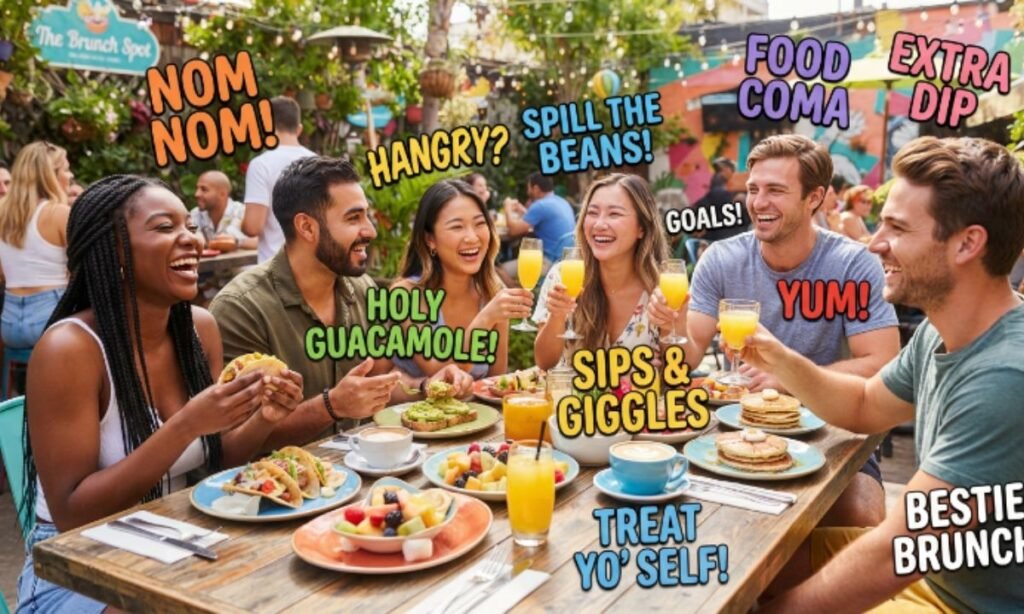
Food has always done more than fill our plates — it fills our vocabulary too. Long before “foodie” became a job title, people were borrowing words like bread, tea, and cheese to talk about everything except actual food: money, gossip, attitude, even attraction.
That’s the fun of food slang. A single word like “snack” can compliment someone’s looks, while “toast” can warn them they’re in trouble. Whether you’re trying to keep up with Gen Z conversations, understand a text from your niece, or just enjoy how playful language can be, this guide breaks down 33 popular food slang terms, where several of them actually came from, and how to use them without sounding like you’re trying too hard.
33 Food Slang Terms
Snack
Calling someone a “snack” means you find them very attractive. Example: “He walked in and everyone agreed — total snack.” It’s a compliment about looks, not food.
Tea
“Tea” means gossip or the real, juicy details of a situation. “Spill the tea” is the classic way to ask someone to share what they know.
Bread
“Bread” is slang for money, in use since at least the 1930s. The logic is simple: bread has long been one of the most basic, essential things people spend money on, so it became shorthand for money itself.
Sauce
Having “sauce” means having style, confidence, or swagger — often used about fashion sense or overall vibe. “That outfit has sauce.”
Cheese
“Cheese” is another slang word for money. One widely cited theory traces it to “government cheese” — a food item once distributed through U.S. welfare programs — after which “cheese” broadened into general slang for money or benefits. It’s also used to describe something overly sentimental, as in “that movie was so cheesy.”
Cookie
Calling someone a “tough cookie” means they’re resilient and don’t give up easily. “Cookie” is also used as a casual, affectionate nickname.
Honey
“Honey” is a classic term of endearment for a partner, friend, or loved one — warm and universally understood.
Peach
Describing someone as a “peach” means they’re kind, pleasant, or easy to get along with.
Lemon
A “lemon” is something defective, most often used for a car that constantly breaks down: “I bought a total lemon.”
Apple
“The Big Apple” refers to New York City, and “the apple of my eye” describes someone deeply cherished and adored.
Sugar
“Sugar” works as a term of endearment, similar to “honey.” It also shows up in “sugarcoating” — softening bad news to make it easier to hear.
Jelly
“Jelly” is a playful, shortened way of saying “jealous.” Example: “Nice trip — don’t be jelly!”
Spice
To “spice things up” means to add excitement, variety, or energy to something that felt routine.
Pickle
Being “in a pickle” means being stuck in a tricky or awkward situation with no easy way out.
Hot Potato
A “hot potato” is a controversial or sensitive topic that people try to avoid handling because it could cause trouble.
Banana
“Going bananas” means becoming extremely excited, upset, or a little wild — usually in a lighthearted way.
Cupcake
“Cupcake” is used as an affectionate nickname, often for someone seen as sweet or endearing.
Toast
If someone says “you’re toast,” it means you’re in serious trouble or about to face consequences.
Jam
A “jam” is a favorite song (“this is my jam”) — the food meaning has nothing to do with it.
Nacho
“Nacho” plays on the sound of “not your,” as in the pun “nacho business” — a playful way to say something isn’t your concern.
Butter
To “butter someone up” means to flatter them, usually right before asking for a favor.
Noodles
“Use your noodle” is an older but still-used phrase meaning “use your brain.”
Milkshake
In pop-culture slang, “milkshake” has been used to describe a standout, attention-grabbing quality someone has.
Donut
“Donut” (or “doughnut”) is sometimes used informally to mean zero — scoring “a donut” means scoring nothing at all.
Egg
Having “egg on your face” means being embarrassed after being proven wrong. A “good egg,” on the other hand, is a decent, trustworthy person.
Candy
“Eye candy” describes something or someone visually appealing.
Taco
Beyond Taco Tuesday, “taco ’bout” is a common pun in captions and jokes, playing on “talk about.”
Pie
“Easy as pie” describes something simple, while “a piece of the pie” means a share of profits, credit, or opportunity.
Corn
Calling something “corny” means it’s cheesy or overly sentimental.
Beans
“Doesn’t know beans about it” means someone has no knowledge of a topic. “Spill the beans” means to reveal a secret. “Beans” has also historically been used as slang for money or coins.
Salt
Being “salty” means being bitter, annoyed, or holding a grudge over something relatively small.
Cake
“Piece of cake” describes a task that’s very easy to complete.
Gravy
Calling something “gravy” means it’s an extra, welcome bonus on top of something already good: “We hit our goal — everything after that is gravy.”
Generational Slang Comparison
| Term | Traditional / Older Usage | Modern / Gen Z Usage |
| Snack | A light between-meal food | An attractive person |
| Bread | A baked staple food | Money in general |
| Cheese | A dairy product | Money, or something corny |
| Tea | A hot beverage | Gossip |
| Sauce | A condiment | Style or confidence |
| Jelly | A fruit spread | Jealous |
| Milkshake | A blended drink | A standout, attention-grabbing quality |
Two patterns stand out. First, older slang (honey, cupcake, sugar, peach) tends to describe personality or affection and has stayed fairly stable for decades. Second, newer slang (snack, sauce, jelly, milkshake) skews toward appearance and social media culture and shifts faster, since it spreads primarily through short-form video and messaging apps rather than everyday speech alone.
How to Use Slang Naturally Without Sounding Awkward
- Match the context. “Snack” or “sauce” fit casual texts and captions, not professional conversations or formal writing.
- Know your audience. Using unfamiliar slang with people outside its usual circle tends to confuse rather than connect.
- Don’t stack it. One or two slang words feel natural in a sentence; five in a row feels performative.
- Listen before you use it. Notice how a term is actually delivered — tone often carries as much meaning as the word itself.
- Retire outdated terms. Slang has a shelf life; a phrase that felt fresh a few years ago can sound dated fast.
Common Slang Mistakes
- Treating dated slang as current — using “cheese” for money in a casual conversation with Gen Z speakers may land as old-fashioned rather than cool.
- Mismatching tone — slang like “jelly” or “toast” is playful; dropping it into a genuinely serious moment can come across as dismissive.
- Overloading a sentence with multiple slang terms, which reads as forced rather than casual.
- Assuming universal meaning — the same word (like “food” itself, see below) can carry a completely different meaning depending on the region or subculture.
Gen Z Slang for Good Food
Beyond calling someone a “snack,” Gen Z has its own vocabulary specifically for praising food itself:
- Bussin’ — extremely good, especially applied to food; it comes from African American Vernacular English (AAVE) and spread widely through food-review content on social media.
- Hits different — describes food that’s unusually satisfying in context, often tied to mood, memory, or timing (comfort food after a hard day, for example).
- Slaps — used for food, music, or anything unexpectedly excellent.
- Ate — means someone (or something) performed excellently; increasingly applied to a dish that exceeded expectations.
Unlike “snack” or “sauce,” these terms describe the food directly rather than borrowing food imagery for something unrelated.
American Slang for Food
American food slang blends regional dialects, pop culture, and internet trends. General words for food or eating — like “grub,” “chow,” and “eats” — are widely understood across the U.S. Meanwhile, newer terms tied to specific dishes or reactions (“bussin’,” “hits different”) spread through social platforms and can become part of everyday conversation within months rather than years.
Food Slang for Money
Food-based money slang has real history behind it, not just modern internet culture:
| Slang Term | Approx. Origin | Notes |
| Bread | Since at least the 1930s | Rooted in the idea of bread as a basic necessity |
| Dough | Since at least the 1830s | Predates “bread” as money slang; dough is the raw material bread is made from |
| Cheese / Cheddar | Popularized mid-to-late 1900s | Widely linked to “government cheese” distributed through U.S. assistance programs |
| Cabbage / Lettuce | Long-standing American slang | Likely tied to the green color of U.S. paper currency |
| Beans | Long-standing slang for coins | Possibly linked to the round shape of coins |
Food and money have been linked in language for so long because, historically, earning money was directly tied to being able to afford food — a connection simple enough that it’s lasted for generations.
Food Slang – “Top Boy”
“Food slang Top Boy” is a common search because of the Netflix/Channel 4 drama Top Boy, set in London’s street and drug-trade culture. In the show’s slang, “food” is used to mean illegal drugs rather than anything edible — a line like “have you got any food?” is asking about drugs, not a meal. This is a good example of how the same food word can carry an entirely different, context-specific meaning depending on the subculture using it, and it’s worth knowing simply so the phrase isn’t misunderstood if you encounter it while watching the show or reading about UK street slang — not as a term to casually reuse elsewhere.
Frequently Asked Questions
What does it mean when someone calls you a snack?
It means they find you very attractive — it’s a compliment about your looks, not literally about food.
What does “spill the tea” mean?
It means to share gossip or reveal interesting, often secret, details about a situation.
Why is money called bread or dough?
Because both were historically essential, widely purchased foods, they became natural stand-ins for money itself; “dough” is actually the older of the two terms, in use since the 1830s.
What does it mean to be “in a pickle”?
It means you’re stuck in a difficult or awkward situation with no simple way out.
What does “bussin'” mean?
It means something — usually food — is extremely good; the term comes from African American Vernacular English and became widespread through social media food content.
What does “food” mean in Top Boy slang?
In the Netflix series Top Boy, “food” is street slang for illegal drugs, not an actual meal.
What is the difference between American and British food slang?
American food slang leans toward compliments, money terms, and pop-culture references, while British food slang can carry entirely different, sometimes region- or subculture-specific meanings, as with “food” meaning drugs in UK street slang.
Final Thoughts
Food slang works because it’s rooted in something everyone understands: eating, sharing, and enjoying good food. Whether it’s calling someone a “snack,” warning them they’re “toast,” or asking them to “spill the tea,” these words turn ordinary food terms into playful shorthand for real feelings and situations. Used naturally and in the right context — and with an awareness that meanings can shift sharply between cultures and subcultures — food slang can make everyday conversations warmer, funnier, and a lot more relatable.

The author is a professional content writer specializing in word meanings, definitions, and English vocabulary. With over 6 years of experience in language research and educational content creation, they produce accurate, well-researched, and reader-friendly articles.