
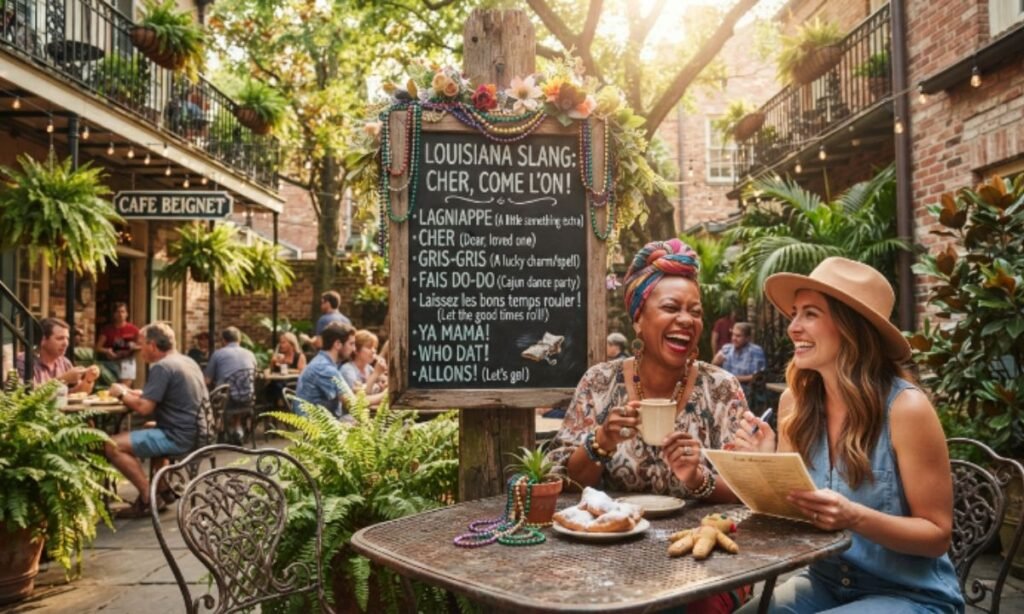
If someone in Louisiana tells you to “pass a good time” while you wait for your po-boy “dressed,” you’re not being tested — you’re being welcomed. Louisiana slang is a living mix of French, Spanish, African, Creole, and Southern English, and it changes depending on whether you’re in New Orleans, the Cajun prairies, or down the bayou. This guide breaks down 50+ real Louisiana slang words and phrases, what they mean, how they’re pronounced, and how to actually use them without sounding like you’re reading off a tourist pamphlet.
Louisiana Slang Terms Explained
Sha
Pronounced “shah,” this comes from the French cher (dear). It’s a term of affection used for babies, sweethearts, friends, or basically anyone you’re fond of. “Look at dat baby, sha, she so precious.” It’s Louisiana Cajun and Creole slang meaning darling, dear, or sweetheart.
Cher
The French root of “sha,” still used on its own, especially among older Cajun and Creole speakers. “Comment ça va, cher?” — how’s it going, dear?
Lagniappe
Pronounced “lan-yap,” this Cajun-French word means “a little extra” — something good given on top of what you paid for. A free side of fries with your po-boy, an extra beignet in the bag, a bonus verse at a second line — that’s lagniappe.
Pass a Good Time
This phrase, rooted in French, is what locals say when it’s time to enjoy themselves — at a festival, a crawfish boil, or a night out. “We passed a good time at the fais do-do last night.”
Fais Do-Do
Literally “to go to sleep,” this refers to a Cajun dance party — the name comes from parents putting babies to sleep in a back room while the adults danced late into the night. Today it just means a lively Cajun dance gathering, often with live zydeco or Cajun band music.
Neutral Ground
The grassy or paved median strip running down the middle of a street, said to originate from Canal Street’s median, which separated the French/Creole and American sides of the city. Locals will tell you to “park on the neutral ground” without blinking.
Dressed
When ordering a po-boy, “dressed” means you want lettuce, tomatoes, pickles, and mayo on it. Say it wrong (“with everything”) and you’ll still get it, but “dressed” is the local shorthand.
Throw Me Something
Short for “Throw me something, mister!” — the classic Mardi Gras parade shout aimed at float riders to earn beads, cups, and doubloons. It works on any float, any parade, any year.
Who Dat
A chant most associated with the New Orleans Saints, tracing back to minstrel and vaudeville acts of the late 1800s and early 1900s. Today it’s shorthand for Saints pride: “Who dat say dey gonna beat dem Saints?”
Making Groceries
A direct translation of the French “faire son marché” (to do one’s grocery shopping) — since “faire” means both “to do” and “to make,” the phrase became “making groceries” in local English. “I’m making groceries” simply means “I’m grocery shopping.”
Boo-dree (Boudin)
Pronounced “boo-DAN,” boudin is a Cajun sausage of rice, pork, and seasoning — and it’s practically its own food group in South Louisiana. “Boo-dree” is a casual, phonetic-friendly way locals sometimes say it in conversation.
Couyon
Pronounced “COO-yawn,” a Cajun French word for someone acting silly, foolish, or a little dense — usually said affectionately, not as a real insult. “Quit being a couyon and eat your gumbo.”
Gris-Gris
Pronounced “GREE-gree,” a Louisiana Voodoo term for a charm, talisman, or spell meant to bring luck or ward off bad energy. You’ll see gris-gris bags sold in New Orleans shops, tied to the city’s Voodoo history.
Laissez les Bons Temps Rouler
Meaning “let the good times roll,” this is one of the most widely known Louisiana phrases, typically heard around Mardi Gras and at any celebration. It’s essentially the state’s unofficial motto.
T-Boy
A Cajun nickname pattern — “T” comes from petit (small/young), so “T-Boy” traditionally marked a son named after his father, or simply a term of affection for a young man. You’ll also hear “T-Paul,” “T-Jean,” and similar variations.
Ya Mama and Dem
Short for “How’s ya mama an’ them?” — a common greeting asking after someone’s whole family, not just their mom. It’s less a literal question and more a friendly hello.
Get Down
In Louisiana, especially New Orleans, “get down” can mean to get out of a car (not just to dance). “Get down out the truck and come on in” is a common instruction, not an invitation to boogie.
Down the Bayou
Refers to the rural, low-lying communities south of major towns, following the bayous toward the Gulf. “He’s from down the bayou” signals someone from a small Cajun fishing or trapping community, not the city.
Boudin Run
A casual road trip made specifically to buy boudin from a favorite gas station, meat market, or grocery store along the way — a genuine South Louisiana pastime, especially on weekends or before a football game.
Fixing To
Widely used across the South but a staple in Louisiana speech, meaning “about to” or “getting ready to.” “I’m fixing to leave” means you’re leaving very soon.
Nawlins
A phonetic, often tourist-driven spelling of “New Orleans.” Locals actually pronounce it “New or-lins” or “new or-lee-yuns,” not “naw-lins” or “new orl-eens,” so use this one carefully — natives sometimes find it a little cringeworthy from outsiders.
Beignet Run
A trip made specifically for beignets — New Orleans’s powdered-sugar square doughnuts — often to Café du Monde or a neighborhood favorite, usually with coffee alongside.
More Louisiana Slang Words and Phrases
| Term | Meaning |
| Where Y’at? | A greeting meaning “how are you,” central to the “Yat” dialect of working-class New Orleans |
| Yeah You Right | An enthusiastic agreement, roughly “you’re absolutely right” |
| Beaucoup | “A lot,” from French, still commonly used in casual speech |
| Parrain / Nannan | Godfather / godmother in Cajun French tradition |
| Chère/Bébé | Terms of endearment similar to “sha,” meaning dear/baby |
| Envie | A craving or hunger for something, Cajun in origin |
| Picayune | From an old Spanish coin worth 1/8 of a dollar, used to mean something small or petty |
| Pirogue | A shallow canoe used for navigating the bayous |
| Second Line | The crowd that follows a brass band, waving handkerchiefs and dancing in a distinctive shuffle step |
| Parish | Louisiana’s equivalent of a county, a holdover from French and Spanish Catholic rule |
| Slap Ya Mama | An exclamation for something extremely delicious (also a popular Cajun seasoning brand) |
| Mais La! | A Cajun French exclamation of surprise or emphasis, roughly “well, there!” |
| Poo-Yie | An exclamation of shock, excitement, or emphasis, similar to “wow!” |
| Trill | Slang for someone real, genuine, or true |
| 504 | The New Orleans area code, used as shorthand for the city itself |
| Shotgun House | A narrow, single-story home style common throughout New Orleans neighborhoods |
| Making Do | Getting by or improvising with what you have |
| Cracklins | Fried, seasoned pork skin snacks, a Cajun staple |
| Roux | The base of gumbo (flour and fat cooked slowly) — also used as slang for a couple that’s “solid” |
| Cush-Cush | A traditional Cajun cornmeal breakfast dish |
| Zydeco | Uptempo Creole dance music blending blues, R&B, and Creole rhythms |
| Envie de | Cajun French for “a longing for” (something specific) |
| Boucherie | A community hog-butchering event where nothing goes to waste — boudin, cracklins, and more are made on the spot |
| Making Cocodrie | Colloquial for a fishing/hunting trip toward the coastal marshes |
| Chunkin’ | Throwing something, as in “chunkin’ beads” during a parade |
| Where Ya Stay At? | Asking where someone lives (not literally where they’re “staying”) |
| T’as pas honte? | Cajun French for “aren’t you ashamed?” — used half-jokingly to scold |
| Cannaille | A Cajun French term for a mischievous or troublesome kid |
| Making a Run | Heading out quickly for a specific errand — a boudin run, a beignet run, a beer run |
Generational Slang Comparison
| Era | Common Slang | Notes |
| Older generation (Cajun/Creole roots) | Sha, cher, couyon, envie, fais do-do, gris-gris | Rooted heavily in French and Creole vocabulary, often used within families |
| Middle generation (post-1970s NOLA) | Making groceries, neutral ground, who dat, dressed, second line | City-specific terms tied to food, parades, and daily New Orleans life |
| Younger generation (2000s–present) | Trill, slugs, 504, bounce-influenced slang, boudin run | Blends older Louisiana terms with hip-hop and bounce-music vocabulary, plus social-media shorthand |
The core French- and Creole-derived words (“sha,” “lagniappe,” “cher”) have stayed remarkably stable across generations, while food and neighborhood-based slang (“boudin run,” “making groceries”) remains constant because the culture around them hasn’t changed. What shifts most is city slang layered on top by bounce music and hip-hop culture starting in the 1990s.
How to Use Slang Naturally Without Sounding Awkward
- Match the context. “Sha” fits a warm, casual moment — not a business meeting.
- Don’t overdo the accent. Using the word is enough; exaggerating a Cajun or Yat accent on top of it usually reads as mocking rather than friendly.
- Let locals lead. If someone greets you with “where y’at,” a simple “aw right, and you?” is the natural response — no need to force multiple slang terms into one sentence.
- Use food and place terms freely. “Dressed,” “neutral ground,” and “making groceries” are functional, everyday words — locals use them without a second thought, and so can you.
- Save affectionate terms for people you know. “Cher” or “sha” toward a stranger can come off oddly familiar; it works best once there’s some rapport.
Common Slang Mistakes
- Saying “Nawlins.” It’s not how the city pronounces its own name, and locals often notice when out-of-towners lean on it.
- Using “y’at” as an insult. It describes a dialect and community identity, not a put-down.
- Mixing up Cajun and Creole slang. They overlap but come from different cultural histories (rural Acadian French settlers vs. New Orleans’s French-Spanish-African urban mix) — treating them as identical can flatten real cultural distinctions.
- Translating literally. “Making groceries” and “get down” (from a car) don’t make sense translated word-for-word — they’re idioms, not literal instructions.
- Overusing exclamations. “Mais la!” and “poo-yie” are punchy precisely because they’re used sparingly, not stacked into every sentence.
Louisiana Slang Words (Funny)
- Blue Dog Stare — an uncomfortable, blank look, referencing the famous “Blue Dog” paintings by artist George Rodrigue
- Kart Ranch — a beloved, universally-liked person
- They Are So Roux — said about a couple with a great relationship, comparing it to a gumbo roux that gets better with time
- Don’t Bring Your Coffee Cup — a warning not to get too comfortable, often said when lending something temporarily
- Houla — a playful nickname for someone who “gets around,” referencing the Catahoula, Louisiana’s state dog
- Whoa’na — an exclamation meaning “uh oh”
Black New Orleans Slang
New Orleans’s Black communities — especially neighborhoods tied to the city’s wards — have shaped a distinct vocabulary that’s spread nationally through bounce music and hip-hop.
- Trill — real, genuine, true
- Slugs — gold teeth; being “slugged up” means having a mouthful of gold
- That/Dat Beat — a nickname for the classic bounce-music beat built on the Triggaman and Brown Beat samples
- Ward — a section of the city, often “called out” or “thrown up” (shown with hand signs) as a point of local pride, a tradition that became especially prominent in New Orleans hip-hop and bounce music starting in the 1980s
- Where Y’at — a defining shout-out heard throughout bounce songs
- 504 — shorthand for New Orleans itself, taken from the area code
Louisiana Hood Slang Words
- On Da Ward — repping or claiming a specific New Orleans ward or neighborhood
- Choppa/Chopper — a rapper or artist name style rooted in local bounce culture (used generally, not as a literal weapons reference in casual conversation)
- Bounce — the genre of New Orleans music defined by chanted refrains, call-and-response, and shout-outs to specific neighborhoods and housing developments
- Second-Lining — the specific dance/shuffle step done while following a brass band parade
- Making a Ward Roll Call — a lyrical tradition in New Orleans hip-hop of naming and honoring specific neighborhoods within a song
New Orleans Slang Insults
Louisiana slang has its share of playful — and occasionally sharp — put-downs. Most lean toward teasing rather than genuinely hostile language:
- Couyon — calling someone a fool or a bit dense, usually gently
- Cannaille — a rascal or troublemaker, often used for kids
- Blue Dog Stare Giver — someone known for cold, unreadable expressions
- Houla — a teasing label for someone who “gets around” romantically
- Picayune — calling someone or something petty and small-minded
Frequently Asked Questions
What does “sha” mean in Louisiana?
“Sha” is a Cajun and Creole term of affection meaning darling, dear, or sweetheart, derived from the French word cher.
What does “who dat” mean?
“Who Dat” is a New Orleans chant of pride, most famously tied to the Saints, asking (rhetorically) who thinks they can beat the home team.
Why do people in New Orleans say “making groceries”?
It comes from a rough translation of the French phrase “faire son marché,” meaning to do one’s grocery shopping — a linguistic holdover from the city’s French roots.
What does “lagniappe” mean and how do you pronounce it?
Lagniappe (pronounced “LAN-yap”) means “a little something extra” given for free, on top of what you already paid for.
What is “neutral ground” in New Orleans?
It’s local slang for the grassy or paved median strip in the middle of a street, a term unique to the city’s layout and history.
What does “fixing to” mean in Louisiana slang?
It means “about to” or “getting ready to” do something — a common phrase across the American South, heavily used in Louisiana.
Is “Nawlins” the correct way to say New Orleans?
No — locals typically say “New or-lins” or “new or-lee-yuns.” “Nawlins” is a phonetic spelling mostly used by outsiders and in tourism marketing, and some residents consider it a bit of a caricature.
Final Thoughts
Louisiana slang isn’t a costume you put on for Mardi Gras — it’s the everyday sound of a state shaped by French, Spanish, Creole, African, and Southern influences layered on top of each other for three centuries. Whether you’re heading down the bayou for a boudin run, catching a second line, or just trying to greet someone the right way (“where y’at?”), the fastest way to sound natural is to use these words the way locals do: casually, warmly, and without overthinking it. Pick a few that fit your own voice, listen more than you talk at first, and the rest will come with time — lagniappe included.

The author is a professional content writer specializing in word meanings, definitions, and English vocabulary. With over 6 years of experience in language research and educational content creation, they produce accurate, well-researched, and reader-friendly articles.