
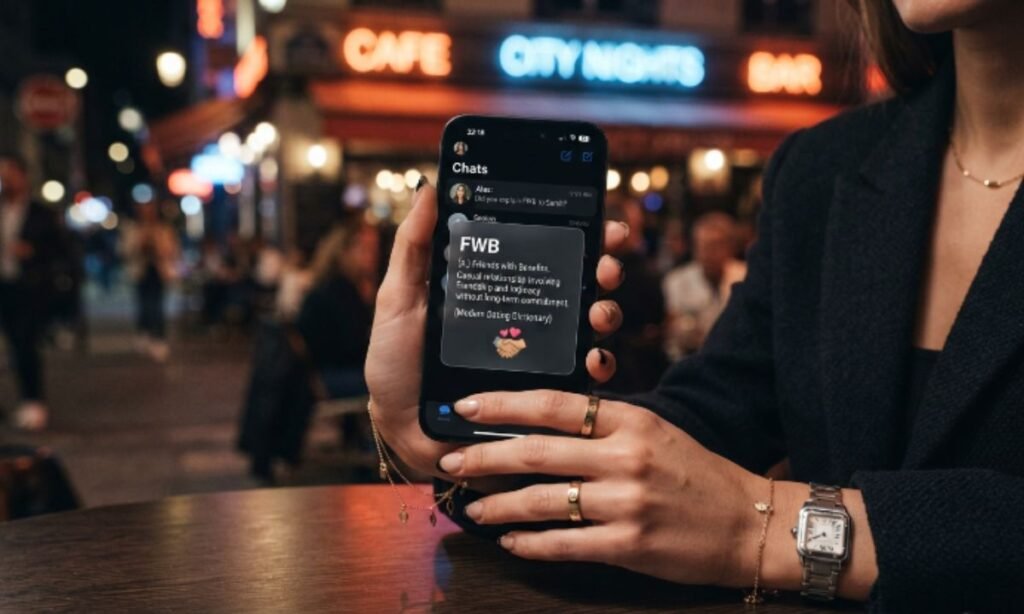
If someone just texted you “FWB” and you’re not totally sure what they meant, you’re not alone — it’s one of the most searched texting abbreviations in modern dating culture. This guide breaks down the FWB meaning in text, where the term came from, how it changes depending on who sends it and where, and what to actually do if it shows up in your own conversations.
What Does FWB Mean in Text?
Primary Meaning of FWB
In texting, dating apps, and social media, FWB almost always stands for “friends with benefits.” It describes two people who are friends and also physically intimate, without the label, commitment, or exclusivity of a romantic relationship.
Simple Definition
FWB = a friendship that includes physical intimacy, but not dating. There’s no boyfriend/girlfriend title, no expectation of exclusivity, and usually no formal “relationship talk” involved — just a mutual understanding between two people.
Example
“We’re not dating, we’re just FWB.” “She asked if I wanted to be FWB instead of official.”
Secondary Meanings of FWB
Outside of dating contexts, FWB can stand for other things depending on the field — including four-wheel brake (automotive), Freight Waybill (logistics and aviation), and FWB as shorthand for the Frankfurt Stock Exchange (Frankfurter Wertpapierbörse) in finance. In everyday texting and social media, though, “friends with benefits” is by far the dominant meaning.
Background and Origin of FWB
Where Did the Term Come From?
The phrase “friends with benefits” started appearing in mainstream pop culture in the 1990s and became firmly established in everyday language through the early 2000s and 2010s, helped along by movies and TV shows that used the phrase directly — most notably the 2011 film Friends with Benefits. Texting culture later shortened the full phrase to the acronym FWB for faster typing.
Why the Term Became Popular
FWB became popular because it filled a real gap in relationship vocabulary. Before the term existed, there wasn’t a quick, casual way to describe a friendship that included physical intimacy without implying dating. As texting and social media made casual, undefined relationships more common and more openly discussed, having a short, recognizable label made conversations easier.
Other Meanings Of FWB
FWB meaning in text from a girl
When a girl sends “FWB,” it typically carries the same core meaning — friends with benefits — but the tone can lean more toward wanting clarity or setting a boundary. It’s often used to define the relationship clearly, such as making sure both people know it’s casual rather than romantic.
FWB meaning in text funny
FWB sometimes shows up in a joking, exaggerated way that isn’t meant literally — for example, teasing a friend about “being FWB” with their favorite snack, pet, or hobby. In this context, it’s just wordplay on the phrase rather than an actual relationship label.
FWB meaning in chat from a boy
From a boy, FWB in chat usually signals interest in something casual rather than a committed relationship. It can also be used more bluntly or directly than when used by a girl, often as a straightforward proposal rather than a hint.
FWB meaning in relationship
When FWB comes up between two people who are already close, it usually means one person wants to add a physical element to the friendship without changing its label. It’s often the starting point of a conversation about expectations, rather than a fully agreed-upon arrangement.
How FWB Is Used in Different Contexts
In Text Messages
In one-on-one texts, FWB is usually used directly and privately, often to clarify what a relationship is or isn’t. “Let’s just keep this FWB, no pressure.”
On Social Media
On public platforms, FWB tends to appear in captions, bios, or comments in a more casual or joking tone, sometimes without referring to an actual real-life arrangement.
In Dating Apps
On dating apps, FWB is commonly listed as a relationship goal or preference, helping users signal upfront that they’re not looking for something serious.
In Professional Conversations
FWB essentially never appears in professional or formal communication with its dating meaning. If it shows up in a work context, it’s almost always referring to an unrelated meaning, such as a company abbreviation or acronym specific to that industry.
FWB Meaning Across Social Media Platforms
On WhatsApp, FWB is used the same way as in regular texting — usually in private, one-on-one conversations to describe or propose a casual arrangement.
On Instagram, FWB shows up in captions, story replies, and DMs, sometimes seriously and sometimes as a joke referencing pop culture or memes.
TikTok
On TikTok, FWB is frequently used in comments and captions tied to relationship storytelling, skits, or “storytime” videos about casual dating experiences.
Snapchat
On Snapchat, FWB carries the same meaning as elsewhere, but the platform’s private, disappearing-message format means it’s often used more directly and less publicly than on Instagram or TikTok.
Discord and Online Gaming
In Discord servers and gaming communities, FWB is less common but still understood, typically used jokingly among friends rather than as a genuine relationship proposal.
Examples of FWB in Real Conversations
Chat Examples
- “Not trying to date anyone rn, but I’d be down to be FWB.”
- “Are we still just FWB or is this becoming something more?”
Meme-Style Examples
- “Me and my ring light: FWB for life.”
- “My bed and I are FWB, we spend way too much time together.”
Quick Bullet Examples
- Friend group chat: “He literally just asked her to be his FWB lol”
- Dating app bio: “Not looking for anything serious, open to FWB”
- Caption: “FWB energy only 😌”
Cultural and Regional Interpretations of FWB
Western Countries
In the US, UK, and much of Europe, FWB is widely recognized and openly discussed in dating culture, media, and everyday conversation, especially among younger adults.
Asian and Middle Eastern Cultures
In many Asian and Middle Eastern cultural contexts, the concept behind FWB is far less openly discussed due to differing social and cultural norms around premarital relationships, even though younger, internet-connected audiences are still familiar with the term itself.
Online Global Culture
Because so much dating and relationship content is now shared globally through social media, the term FWB has spread far beyond its original cultural context and is generally understood internationally, even where the underlying concept isn’t openly practiced or discussed.
Other Meanings of FWB in Different Fields
Automotive
In an automotive context, FWB stands for “four-wheel brake,” referring to a braking system where all four wheels of a vehicle are equipped with brakes.
Business
In finance, FWB is used as shorthand for the Frankfurt Stock Exchange (Frankfurter Wertpapierbörse), one of the largest stock exchanges in the world.
Technical or Aviation Usage
In logistics and aviation/shipping contexts, FWB can stand for “Freight Waybill,” a document used to declare and track freight or parcel shipments.
Common Misconceptions About FWB
Misconception 1: FWB Means Dating
FWB specifically excludes the commitment, exclusivity, and “official” label that dating implies — that distinction is the whole point of the term.
Misconception 2: No Emotions Exist
Just because a relationship is labeled FWB doesn’t mean feelings can’t develop. Emotional attachment can and does happen, even when both people originally agreed to keep things casual.
Misconception 3: FWB Always Fails
While FWB arrangements can get complicated, they don’t automatically end badly. Many people maintain FWB arrangements for extended periods without issue when both people are honest about expectations.
Misconception 4: Everyone Understands the Same Rules
FWB doesn’t come with a universal rulebook. What one person assumes is included (or off-limits) may be completely different from what the other person assumes, which is why clear communication matters.
Psychological and Emotional Meaning Behind FWB
Emotional Reasons People Choose FWB
People often choose FWB arrangements to enjoy physical intimacy and companionship without the time commitment, emotional labor, or pressure that a defined relationship can bring — especially during busy life stages or after a recent breakup.
Possible Emotional Challenges
The most common challenge is uneven feelings: one person may stay emotionally detached while the other develops deeper feelings over time, which can create confusion, jealousy, or hurt if it isn’t addressed directly.
Similar Terms and Alternatives to FWB
Several related terms describe similar or overlapping dynamics:
- Situationship — an undefined relationship with romantic and/or physical elements but no clear label.
- Hookup — typically a one-time or infrequent physical encounter without an ongoing friendship.
- No Strings Attached (NSA) — a casual arrangement explicitly framed around avoiding emotional attachment.
- Booty Call — a purely physical arrangement, often without the ongoing friendship element FWB implies.
- Casual Dating — spending time together and possibly being physical, without exclusivity, but often more relationship-like than FWB.
Is FWB Offensive or Friendly?
Friendly Usage
Between two consenting adults who both understand and agree to the arrangement, FWB is a neutral, commonly used term — not inherently offensive.
Potentially Offensive Usage
FWB can come across as disrespectful or hurtful if it’s suggested to someone who wants something more serious, or if it’s used to avoid an honest conversation about feelings or intentions.
Famous Quotes and Pop Culture Lines About FWB
The concept of “friends with benefits” gained major visibility through 2010s pop culture, most notably the 2011 film Friends with Benefits starring Justin Timberlake and Mila Kunis, alongside a similarly themed 2011 film, No Strings Attached. Both movies explored what happens when a casual physical arrangement between friends starts to blur into real feelings — a tension that’s still central to how people talk about FWB today.
Grammar and Linguistic Insights About FWB
Type of Word
FWB functions as a noun phrase acronym, most often used as a label (“we’re FWB”) or a modifier before another noun (“an FWB situation”).
Similar Internet Acronyms
FWB belongs to a broader family of relationship-status acronyms, including NSA (no strings attached), DTR (define the relationship), and IYKYK (if you know, you know).
How People Use It Grammatically
FWB is typically used as a standalone label (“we’re just FWB”), as an adjective before a noun (“FWB relationship,” “FWB situation”), or as a verb-like shorthand in casual speech (“we’re FWB-ing,” though this is far less common and mostly used jokingly).
How to Respond to FWB in Chat
Casual Reply Examples
- “Honestly, I’d rather keep things how they are.”
- “I’m down, as long as we’re both on the same page.”
More Chat Examples
- “Can we talk about what that actually means for us?”
- “I don’t think I’m looking for that right now, but thanks for being upfront.”
Differences Between FWB and Similar Words
| Term | Emotional Closeness | Physical Intimacy | Commitment |
| FWB | Friendship-level | Yes, ongoing | None |
| Dating | Romantic, growing | Varies | Building toward exclusivity |
| Hookup | Minimal | Yes, often one-time | None |
| Relationship | Deep, romantic | Yes | Exclusive, defined |
FWB vs Dating
Dating typically involves romantic intent, getting to know each other more deeply, and moving toward commitment. FWB deliberately skips that romantic trajectory and stays centered on friendship plus physical intimacy.
FWB vs Hookup
A hookup is usually a single or infrequent physical encounter, often with little ongoing friendship. FWB implies a continuing friendship alongside repeated physical intimacy.
FWB vs Relationship
A relationship comes with exclusivity, defined labels, and typically shared future plans. FWB intentionally avoids all three, focusing on the present rather than commitment.
Common Rules and Boundaries in FWB Relationships
While there’s no universal rulebook, most functional FWB arrangements rely on a few shared understandings:
- Honesty about feelings — agreeing to speak up if emotions start to change.
- Clear boundaries — deciding what is and isn’t included (dates, sleepovers, meeting friends, exclusivity).
- No jealousy expectations — accepting that the other person may see other people, unless explicitly agreed otherwise.
- Regular check-ins — revisiting the arrangement occasionally rather than assuming nothing has changed.
- An exit plan — knowing that either person can end the arrangement without a lengthy explanation.
Signs an FWB Relationship Might Be Changing
It’s common for FWB dynamics to shift over time. A few signals worth paying attention to include:
- Wanting to spend more non-physical time together, like regular hangouts or texting throughout the day.
- Feeling jealous or uncomfortable about the other person seeing someone else.
- I want to introduce them to friends or family.
- One person bringing up “what are we” more frequently.
None of these automatically mean the arrangement is failing — they’re simply cues that it may be time for an honest conversation about where things actually stand.
Why FWB Is Popular in Online Conversations and Dating Apps
FWB remains popular because it communicates a lot of information in three letters: interest, boundaries, and expectations, all at once. On dating apps especially, listing “FWB” upfront saves both people time by filtering out anyone looking for something more serious, which is part of why the term has stayed in constant use even as other slang comes and goes.
Popularity and Trends Over Time
FWB has remained remarkably stable as a term since it entered mainstream slang, unlike many internet abbreviations that faded within a few years. Its consistent use across texting, dating apps, and social media over more than two decades suggests it describes a genuinely common relationship dynamic rather than a passing trend.
Frequently Asked Questions
What does FWB mean in a text?
FWB stands for “friends with benefits,” describing a friendship that includes physical intimacy without romantic commitment.
What does FWB mean from a girl?
When a girl uses FWB, it typically means the same thing as usual — friends with benefits — often used to clearly set expectations for a casual, non-romantic arrangement.
Is FWB the same as dating?
No. Dating usually implies romantic intent and a path toward commitment, while FWB intentionally avoids both.
Can an FWB relationship turn into a real relationship?
Yes, it can, though it doesn’t happen automatically — it usually requires both people to acknowledge changing feelings and have an honest conversation.
What does FWB mean on Snapchat or TikTok?
On both platforms, FWB carries the same meaning as elsewhere: friends with benefits, whether used seriously or jokingly in captions and comments.
Is it OK to ask someone to be your FWB?
It can be appropriate between consenting adults, as long as it’s communicated honestly and the other person is comfortable with a casual, non-exclusive arrangement.
What’s the difference between FWB and a hookup?
A hookup is usually a one-time or infrequent physical encounter, while FWB implies an ongoing friendship combined with repeated physical intimacy.
Does being someone’s FWB mean they like you?
Not necessarily in a romantic sense — FWB is specifically meant to separate physical intimacy from romantic feelings, though feelings can still develop over time.
What does FWB mean besides friends with benefits?
Outside of dating slang, FWB can stand for four-wheel brake (automotive), Freight Waybill (logistics/aviation), or the Frankfurt Stock Exchange (finance), depending on context.
Final Thoughts
At its core, the FWB meaning in text comes down to one clear idea: friendship plus physical intimacy, minus the commitment. How it plays out in real life, though, depends entirely on the two people involved — their honesty, their expectations, and their willingness to communicate if anything changes.
Whether you just saw FWB in a text for the first time or you’re already navigating one, understanding what the term actually implies — and doesn’t imply — is the best way to avoid confusion and make sure both people are genuinely on the same page.

The author is a professional content writer specializing in word meanings, definitions, and English vocabulary. With over 6 years of experience in language research and educational content creation, they produce accurate, well-researched, and reader-friendly articles.