
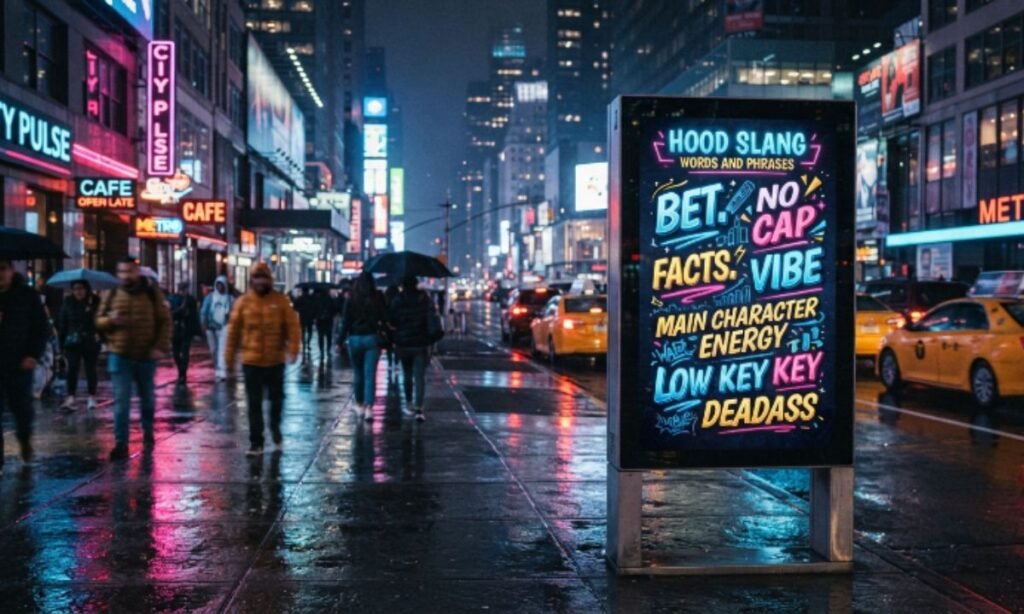
Slang moves fast, and a lot of today’s most common everyday words started in hood and street culture before spreading through music, social media, and eventually into mainstream conversation. This guide breaks down 30 hood slang words and phrases, what they actually mean, and how to use them without sounding like you’re forcing it — plus how the terms have shifted across generations.
30 Hood Slang Terms Explained
Lit
Something exciting, fun, or impressive. “That party was lit” means it was a great time.
Cap
A lie or exaggeration. “That’s cap” means you don’t believe what someone just said.
No Cap
The opposite of “cap” — meaning something is true, no exaggeration. “I got a 4.0 this semester, no cap.”
Drip
Stylish, well-put-together clothing or overall look. “His drip is always on point” means he dresses well.
Flex
Showing off, usually about money, possessions, or achievements. “Stop flexing your new car” means stop showing it off.
OG
Short for “original gangster,” now broadly used to mean someone respected as a pioneer or veteran in a group, scene, or field. “He’s an OG in this neighborhood” means he’s been around and earned respect.
Homie
A close friend, someone from your neighborhood or inner circle. “That’s my homie from way back.”
Lowkey
Doing something quietly, subtly, or without drawing attention — also used to soften an admission. “I’m lowkey nervous about the interview.”
Highkey
The opposite of lowkey — openly, obviously, without holding back. “I’m highkey excited for this trip.”
Bussin
Describes food (or occasionally anything) that’s extremely good. “This food is bussin” means it tastes great.
Bet
An agreement or confirmation, similar to saying “okay” or “deal.” “Meet me at 8?” “Bet.”
Wack
Something bad, disappointing, or low quality. “That movie was wack” means it wasn’t good.
Dope
Something cool, impressive, or well done — an older term that’s stayed consistently popular. “That’s a dope idea.”
Untamed
Used to describe someone bold, unfiltered, or unapologetically themselves — often as a compliment for confidence rather than a literal description. “She’s untamed, she says exactly what she thinks.”
Throwing Shade
Subtly insulting or criticizing someone, often indirectly. “She was totally throwing shade at his outfit.”
Additional Popular Hood Slang
| Term | Meaning |
| Fam | Close friend or family, used affectionately regardless of blood relation |
| Squad | A close group of friends |
| Clout | Influence, attention, or social status, especially online |
| Shook | Startled, nervous, or visibly rattled by something |
| Slaps | Describes music (or food) that’s really good |
| Fire | Something excellent or impressive, often used for music, food, or style |
| GOAT | “Greatest of all time,” used to praise someone as the best in their field |
| Extra | Overly dramatic or doing more than necessary |
| Ghost | To suddenly stop responding or disappear from someone’s life, especially in dating |
| Receipts | Proof or evidence backing up a claim, often screenshots or messages |
| Ride or Die | Someone who’s loyal no matter what, through good times and bad |
| Secure the Bag | To achieve financial success or lock in an opportunity |
| Savage | Someone bold, blunt, or unbothered by others’ opinions |
| Boujee | Acting or living in an upscale, high-class way |
| Thirsty | Desperate for attention, validation, or someone’s interest |
Generational Slang Comparison
| Era | Common Hood Slang | Notes |
| 1980s–1990s | OG, dope, homie, wack | Rooted in early hip-hop culture and East/West Coast rap scenes |
| 2000s–2010s | Fire, ghost, clout, extra | Shaped heavily by reality TV, early social media, and blog culture |
| 2020s–present | No cap, bussin, drip, lowkey/highkey, secure the bag | Spread fast through TikTok and short-form video, often crossing over into mainstream use within months |
Some terms, like “OG” and “dope,” have stayed in steady use for decades because they’re flexible and simple. Others, like “clout” or “extra,” are tied closely to social media culture and only became widespread once platforms built around public attention took off.
Hood Slang for Friend
If you’re looking for casual, friendly alternatives to “friend,” these are among the most common:
- Homie
- Fam
- Bro / Sis
- Squad (for a group)
- Ride or Die
- My Guy / My Girl
- Dawg
Each carries a slightly different tone — “ride or die” implies loyalty specifically, while “squad” refers to a group rather than one person.
American Hood Slang Reference List
Looking for a complete, one-stop hood slang list rather than a scattered set of definitions? This guide is built to work as exactly that: every term above includes a clear meaning and a usage example, organized so you can scan it top to bottom or jump straight to a specific word. Bookmark or save this page in your browser (most browsers let you save any page as a PDF directly from the print menu) to keep it as a quick reference you can return to.
How to Use Slang Naturally Without Sounding Awkward
- Match your audience. Slang that fits casual conversation with friends can feel out of place in professional or formal settings.
- Use it sparingly. Dropping one or two terms naturally lands better than stacking several into one sentence.
- Pay attention to tone, not just definition. “Throwing shade” and “savage” usually come with a light, joking tone rather than genuine hostility.
- Let context guide word choice. “Lowkey” and “highkey” are opposites, so using the wrong one flips your entire meaning.
- Don’t force outdated terms. Slang that peaked years ago can read as trying too hard if used as though it’s still current.
Common Slang Mistakes
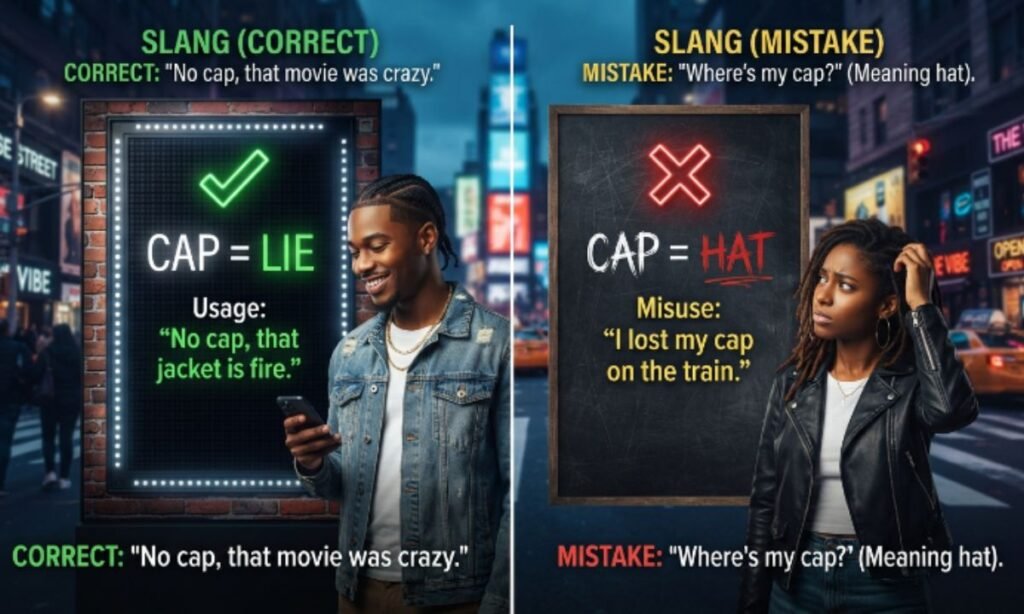
- Confusing “cap” and “no cap.” Remember: “cap” means a lie, “no cap” means it’s true — mixing them up reverses your entire point.
- Overusing “extra” or “shook” for minor things. These words lose their impact when applied to anything and everything.
- Using slang outside its cultural context without understanding it. Many of these terms originated in Black American culture; using them respectfully means knowing where they come from, not just how they sound.
- Treating regional slang as universal. Not every term is used the same way in every U.S. city — some words carry different weight or meaning depending on where you are.
- Forcing slang into writing where it doesn’t fit. A term that works in a text message can feel out of place in an email or formal document.
Frequently Asked Questions
What does “hood” slang mean?
“Hood slang” refers to informal words and phrases that originated in urban neighborhoods, especially within Black American culture, many of which have since spread into mainstream everyday language.
What are some hood slangs?
Common examples include “lit,” “cap,” “no cap,” “drip,” “flex,” “OG,” “bet,” and “bussin,” all defined in detail above.
What are some gangster slang words?
Terms like “OG” (original gangster) and “ride or die” have roots in gang and street culture but are now used broadly to mean respect and loyalty rather than anything related to actual gang activity.
What does hood mean in Gen Z slang?
For Gen Z, “hood” often describes something authentic, street-smart, or tied to urban culture and style, rather than referring literally to a neighborhood.
What does “OG” mean in slang?
“OG” stands for “original gangster” but is now commonly used to describe someone respected as a pioneer, veteran, or the first and best at something.
What does “no cap” mean?
“No cap” means someone is telling the truth with no exaggeration, the opposite of “cap,” which means a lie.
What does “drip” mean in slang?
“Drip” describes a stylish, well-coordinated outfit or overall look, often used as a compliment.
Final Thoughts
Hood slang has shaped mainstream American English more than most people realize — words like “dope,” “flex,” and “no cap” are now used everywhere from group chats to marketing campaigns. Understanding where these terms come from and how to use them naturally, rather than forcing them, is the real difference between sounding authentic and sounding like you’re reading off a list. Pick a few that genuinely fit how you talk, pay attention to context, and the rest becomes second nature.

The author is a professional content writer specializing in word meanings, definitions, and English vocabulary. With over 6 years of experience in language research and educational content creation, they produce accurate, well-researched, and reader-friendly articles.