
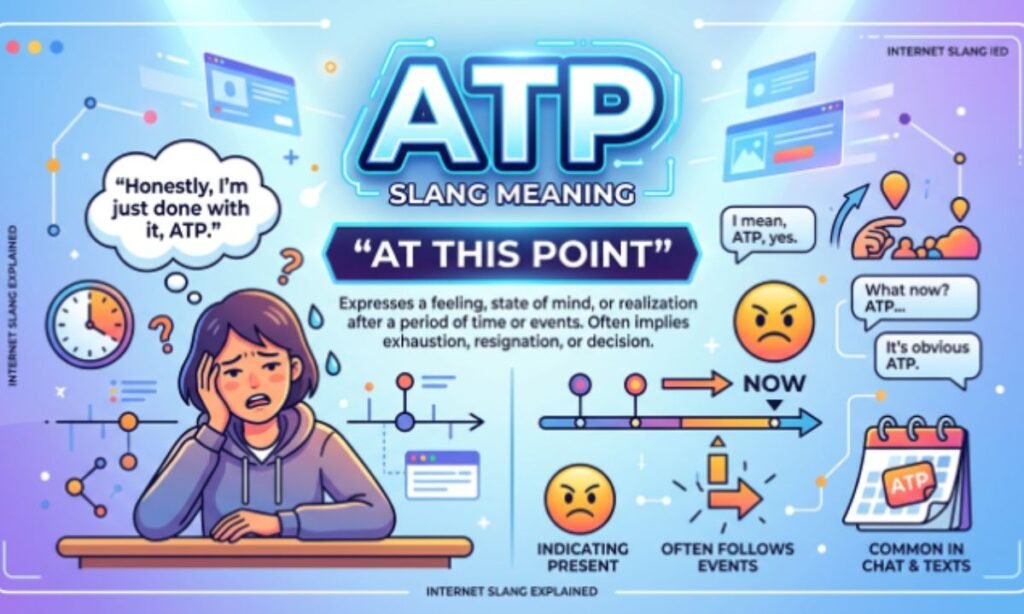
If you’ve seen “ATP” pop up in a text, a TikTok caption, or your kid’s group chat and had no idea what it meant, you’re not alone. The ATP slang meaning that’s exploded across texting and social media has nothing to do with biology class or tennis rankings — it’s a short, expressive way people say they’ve reached their limit, made peace with something, or just don’t have the energy to explain further.
This guide breaks down exactly what ATP means in every context you’re likely to see it, where it came from, how tone changes its meaning, and when you should avoid using it yourself.
ATP Meaning Text Slang – Quick Meaning
What Does ATP Mean in Texting?
In texting and social media, ATP most commonly stands for “At This Point.” It’s used to signal that someone has reached a conclusion, run out of patience, or simply accepted where a situation has landed — often with a mix of tiredness, sarcasm, or dry humor.
A second, less common meaning is “Answer the Phone,” typically used in one-on-one chats after someone has been ignored or missed a call.
| Context clue | Likely meaning |
| Used mid-sentence before a feeling or decision | At This Point |
| Sent alone, right after a missed call | Answer the Phone |
| Used in a biology or science discussion | Adenosine Triphosphate |
| Used in a sports/tennis context | Association of Tennis Professionals |
Examples
- “ATP I’m just going to order food again.”
- “ATP, I don’t even care who’s right anymore.”
- “Call me back, ATP!” (Answer the Phone version)
- “ATP this is basically my whole personality now lol.”
Origin & Background
Where Did ATP Come From?
“At this point” is a normal English phrase that’s existed for decades in formal and casual speech alike. What’s new is the shortening into a three-letter acronym for fast-paced digital conversation — the same process that turned “laughing out loud” into “lol” and “to be honest” into “tbh.”
Cultural Influence
The slang use of ATP grew out of Gen Z and younger Gen Alpha texting culture, where brevity and emotional shorthand are prized. Rather than typing a full sentence about frustration or resignation, three letters do the job — and they do it with a slightly dramatic, meme-friendly flavor.
Social Media Impact
Short-form video platforms accelerated ATP’s spread. Captions and comments favor compact phrases that fit small screens and get read in half a second, and ATP fits that mold perfectly. Once a handful of viral videos used it as a punchline, the acronym spread quickly across comment sections and group chats.
How Its Meaning Evolved
Early on, “at this point” in text was mostly literal — marking a moment in time. Over the past couple of years it’s shifted toward being emotional shorthand: less about when something happened and more about how someone feels about where things stand right now.
Real-Life Conversations
WhatsApp Conversation
Friend 1: He canceled on me again. Friend 2: Again?? What did you say? Friend 1: Nothing. ATP I just expect it now.
Instagram DMs
You: Are you still coming tonight? Them: Idk, ATP I might just stay home lol
TikTok Comments
“ATP this sound has been in my head for three days 😭”
Text Messages
“ATP I’ve rewritten this email five times. Sending it as is.”
ATP Meaning Slang Twitter
On X (formerly Twitter), ATP tends to show up as a quick reaction to a live event, news moment, or ongoing thread — a way to timestamp an opinion without sounding formal. Because the platform rewards short, punchy posts, “ATP” often opens a tweet the way “honestly” or “ngl” would: “ATP I’m convinced this show isn’t coming back.” It signals “here’s where I’ve landed after watching this unfold,” which fits X’s fast, opinion-driven culture well.
Atp Meaning Slang From A Girl
There’s no different or hidden meaning when a girl uses ATP compared to anyone else — the acronym is gender-neutral and used the same way across all genders. The confusion usually comes from tone rather than definition: in a relationship text, “ATP I don’t even want to argue about this” reads as tired resignation, while “ATP just tell me the truth” reads as a direct, no-more-patience request. The letters don’t change; the emotion behind them does.
Emotional & Psychological Meaning
What Emotion Does ATP Express?
Most often: fatigue, acceptance, or mild frustration. It marks the moment someone stops fighting a situation and starts accepting it — sometimes with humor, sometimes with resignation.
Why Do People Use It?
Typing “at this point, I honestly don’t care anymore” takes effort and can feel overly earnest. ATP delivers the same message faster and with a built-in air of casual detachment, which softens an otherwise heavy statement.
What It Reveals About Modern Communication
Acronyms like ATP show how digital conversation increasingly compresses emotional context into shorthand. People aren’t just saving keystrokes — they’re signaling how seriously to take a statement. A full sentence can read as intense; three letters read as low-key.
A Personal-Style Scenario
Picture a group chat planning a trip that’s fallen apart for the third time. Someone types, “ATP let’s just pick a date and stick to it.” No one needs an explanation — the acronym alone carries the shared exhaustion of the last two failed attempts.
Usage in Different Contexts
Social Media
Captions and comments use ATP to add a relatable, slightly self-deprecating tone to everyday frustrations — missed alarms, bad days, chaotic weeks.
Friends and Relationships
Between friends or partners, ATP usually softens a hard truth (“ATP I’m just going to be honest with you”) or signals that someone has stopped overthinking a situation.
Work and Professional Settings
ATP essentially doesn’t belong here. It reads as casual and can come across as dismissive or unclear in an email or Slack message to a colleague.
Casual vs Serious Tone
The words that follow ATP set the tone. “ATP who cares” is light. “ATP I’m done with this relationship” is serious. The acronym itself is tone-neutral — context does the heavy lifting.
When NOT to Use It
Professional Communication
Avoid ATP in emails, reports, client messages, or workplace chats. It can look unpolished and may confuse colleagues who know ATP only as a biology or sports term.
Cultural Sensitivity
Not every audience recognizes internet slang. Using ATP with someone outside your usual social circle — an older relative, a new colleague, someone from a different region — risks a genuine misunderstanding rather than a knowing laugh.
High-Stakes Situations
In serious conversations — health, finances, safety, conflict resolution — shorthand can come across as flippant. Spell it out instead.
Situations That May Cause Misunderstanding
If the reader might interpret ATP as “answer the phone” when you meant “at this point” (or vice versa), it’s worth just typing the full phrase.
Common Misunderstandings
People Think ATP Always Means One Thing
It doesn’t. Depending on the sentence and platform, ATP can mean “at this point,” “answer the phone,” or reference biology (adenosine triphosphate) or tennis (Association of Tennis Professionals).
Tone Confusion
Text lacks facial expression and vocal tone, so “ATP I don’t care” can be read as genuinely annoyed by one person and as a joke by another, even in the same conversation.
Literal vs Figurative Meaning
“At this point” can be literal (marking a moment in time) in formal writing, but in slang it’s almost always figurative — describing a feeling, not a timestamp.
Assuming Everyone Understands It
Slang assumes shared context. Someone unfamiliar with the term may genuinely not know what you mean, especially outside younger, terminally-online circles.
Comparison Table
| Term | Meaning | Typical Tone | Common Platform |
| ATP | At This Point | Tired, resigned, sarcastic | TikTok, texting, IG |
| NGL | Not Gonna Lie | Honest, blunt | Twitter/X, TikTok |
| IDC | I Don’t Care | Dismissive, resigned | Texting, Snapchat |
| TBH | To Be Honest | Sincere, direct | All platforms |
| OTP | One True Pairing | Affectionate, fandom-based | TikTok, fan communities |
Key Insight
ATP overlaps closely with IDC and NGL in tone (tired, blunt honesty) but is unique in that it frames the statement as a conclusion reached “at this point” — implying a process or buildup, not just a flat opinion.
Variations / Types
ATP – At This Point
The base form and default meaning in almost every slang context.
ATP Honestly
Adds sincerity — the speaker wants their statement taken seriously, not as a joke.
ATP Though
A softer, more reflective version, often used mid-conversation rather than as a closing statement.
ATP I’m Done
Signals finality — the speaker has fully checked out of a situation or argument.
ATP Let’s Move On
A practical, forward-looking use — less about emotion, more about resolution.
ATP Who Cares
A dismissive, low-stakes shrug, usually used humorously.
ATP It Doesn’t Matter
Similar to “who cares,” but leans slightly more resigned than joking.
ATP We Tried
Acknowledges effort while accepting an outcome that didn’t go as planned.
ATP Just Laugh
Used when a situation is frustrating enough that humor is the only response left.
ATP What Else Can We Do?
A rhetorical, slightly exasperated way of admitting there’s no clear next step.
How to Respond When Someone Uses It
Casual Replies
“Fair enough.” / “Yeah, same tbh.” / “Makes sense.”
Funny Replies
“ATP is doing a lot of emotional labor in this text 😂” / “Big ATP energy today, huh?”
Mature Replies
“I get it — do you want to talk through it or just vent?” / “That’s understandable given everything that’s happened.”
Respectful Replies
Acknowledge the feeling rather than the acronym: “Sounds like you’ve had enough of this for today, and that’s valid.”
Regional & Cultural Usage
Western Culture
ATP is most common in the US, UK, Canada, and Australia, largely driven by TikTok and Twitter/X trends among teens and young adults.
Asian Culture
Usage exists in English-language social media across Asia, particularly in urban, English-fluent youth communities, though it’s less dominant than locally rooted slang.
Middle Eastern Culture
Similar pattern — ATP appears mainly in English-language texting among younger, internet-connected users rather than in everyday spoken language.
Global Internet Usage
Because it originates from English, ATP travels wherever English-language content spreads, but it isn’t a universal or globally standardized term the way emoji are.
Gen Z vs Millennials
Gen Z uses ATP fluently and frequently, often stacking it with other acronyms. Millennials tend to recognize it but use it less often, sometimes still typing “at this point” in full.
Is It Safe for Kids?
Understanding the Context
ATP itself is harmless slang — it’s not linked to explicit content, harmful challenges, or coded language for anything dangerous. The main thing worth watching for as a parent isn’t the acronym itself, but the tone of what follows it, since it’s often used to express frustration, sadness, or “I’ve given up on this” — which can occasionally be a signal worth a gentle check-in, especially if it appears repeatedly around a specific person or situation.
Other Meanings of ATP Beyond Texting Slang (Full Disambiguation)
Most guides mention ATP’s other meanings only in passing, but it’s worth seeing them side by side since mixing them up is the single biggest source of confusion:
- Adenosine Triphosphate (biology): the molecule cells use to store and transfer energy — a staple term in biology and chemistry classes.
- Association of Tennis Professionals (sports): the governing body of men’s professional tennis, referenced constantly in tournament coverage and rankings.
- Automatic Train Protection (transportation/engineering): a rail-safety system that automatically enforces speed limits and braking.
- “Answer the Phone” (texting): the secondary slang meaning, used when someone wants an urgent callback.
Context — the platform, the sentence, and the people involved — almost always makes the correct meaning obvious within a second or two.
Frequently Asked Questions
What does ATP mean in a text message?
In texting, ATP almost always means “At This Point,” used to express frustration, resignation, or a conclusion someone has reached.
What does ATP mean from a guy or a girl?
The meaning doesn’t change based on who sends it — ATP is gender-neutral slang, and the emotion behind it depends on the sentence, not the sender.
Is ATP a rude or negative word?
No, ATP itself isn’t rude. It can carry a frustrated or resigned tone, but it’s considered normal, harmless casual slang.
What does ATP mean on Snapchat or Instagram?
On both platforms, ATP is used the same way as in general texting: “At This Point,” usually to express a current feeling or decision.
Does ATP always mean “at this point”?
No. Context matters — it can also mean “answer the phone,” or refer to adenosine triphosphate (biology) or the Association of Tennis Professionals (tennis).
How do you use ATP in a sentence?
Place it where you’d naturally say “at this point”: “ATP I’m just going to finish this myself” works the same way as the full phrase.
Is ATP the same as IDC or NGL?
They’re related in tone but not identical — IDC means “I don’t care,” NGL means “not gonna lie,” while ATP implies a conclusion reached after a build-up of events.
Should I use ATP in professional messages?
No. ATP is casual internet slang and isn’t appropriate for emails, work chats, or formal communication.
What is the full form of ATP in chat?
In chat and social media, the full form is most commonly “At This Point,” with “Answer the Phone” as a secondary, less frequent expansion.
Final Thoughts
ATP is a small acronym doing a lot of emotional work. Whether it shows up as a tired sign-off, a sarcastic punchline, or a genuine moment of acceptance, its meaning almost always comes down to “at this point” — with the exact feeling shaped entirely by what comes next in the sentence. Once you know that, decoding it in any text, comment, or DM becomes second nature.

The author is a professional content writer specializing in word meanings, definitions, and English vocabulary. With over 6 years of experience in language research and educational content creation, they produce accurate, well-researched, and reader-friendly articles.