
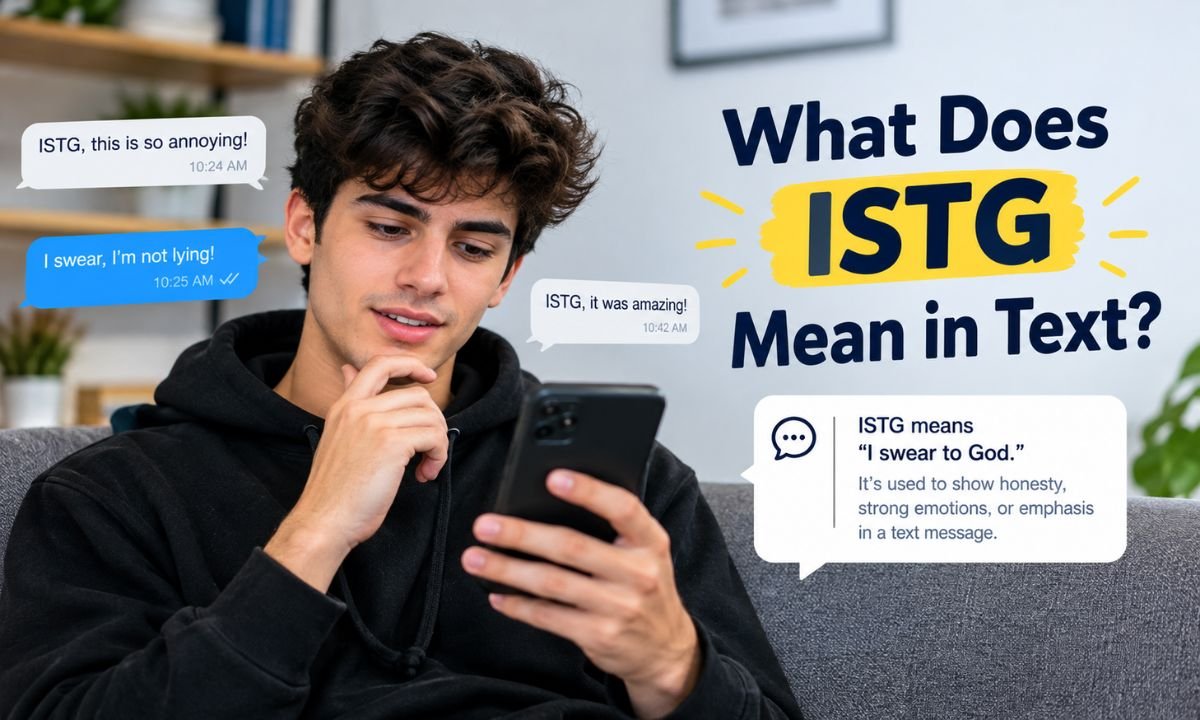
If someone just texted you “istg” and you’re not sure whether they’re joking or genuinely upset, you’re in the right place. ISTG stands for “I Swear To God,” and it’s one of the most common intensifiers used in texting and social media to emphasize honesty, frustration, or strong emotion.
Chances are you’ve seen it pop up more than once this week alone, maybe in a group chat, a comment section, or a text from a friend swearing they’re telling the truth. It’s become such a natural part of everyday digital conversation that most people use it without even thinking twice, yet the tone behind it can shift dramatically depending on who’s typing it and why.This guide breaks down exactly what ISTG means, how tone changes its meaning, and when you should think twice before using it.
ISTG Meaning – Quick Meaning
What Does ISTG Mean?
ISTG is a texting abbreviation for “I Swear To God.” It’s used to add emphasis or conviction to a statement, whether that’s a promise, a complaint, or a strong reaction to something.
Simple Definition
Think of ISTG as digital underlining. It doesn’t change what someone is saying, it just adds weight and emotion behind it.
Quick Examples
- “istg if he’s late again I’m leaving”
- “istg that was the funniest thing I’ve seen all week”
- “istg I did send the file, check again”
Origin & Background
Where Did ISTG Come From?
ISTG grew out of the same texting culture that produced abbreviations like “OMG” and “WTF,” compressing a common spoken phrase into a fast, typable form for digital conversations.
Influence of Internet Culture
Early internet forums and chatrooms favored short, punchy phrases, and “I swear to God” was already a common verbal exclamation long before texting existed. Shortening it to ISTG fit naturally into that fast-paced online communication style.
Social Media’s Role
Platforms like TikTok, Instagram, and Snapchat helped ISTG spread quickly, especially in captions, comments, and quick reaction posts where emotional emphasis matters but character space or attention spans are limited.
How the Meaning Evolved
The core meaning of ISTG hasn’t really shifted, it still signals strong conviction. What has changed is the range of emotions it now covers, expanding from purely serious declarations to include humor, exaggeration, and lighthearted disbelief.
Real-Life Conversations
WhatsApp Conversation
Friend: “Did you really finish the whole project in one night?”
You: “istg I didn’t sleep”
Instagram DM Conversation
Follower: “Is this filter free?”
You: “istg yes, it’s in my saved effects”
TikTok Comments
Comment: “No way this actually worked”
Reply: “istg it did, tried it myself”
Text Message Conversation
Sibling: “You used my charger again didn’t you”
You: “istg I put it back where I found it”
Emotional & Psychological Meaning
What Emotion Does ISTG Express?
ISTG typically signals heightened emotion, conviction, frustration, disbelief, or emphasis, rather than a neutral statement. It tells the reader “this matters to me” more than a plain sentence would.
Why People Use It
People reach for ISTG when they want their message to carry more weight than the words alone provide. It’s a quick way to signal sincerity or intensity without writing a longer explanation.
What It Reveals About Modern Communication
The popularity of ISTG shows how digital conversations rely on small linguistic cues to replace tone of voice and facial expressions, since text alone often strips away emotional context.
Personal-Style Scenario
Picture texting a friend after a rough day: “istg today was the worst.” That single line carries far more emotional weight than simply saying “today was bad,” even though the words describe the same thing.
Usage in Different Contexts
Social Media
On TikTok and Instagram, ISTG often appears in captions or comments to emphasize disbelief, excitement, or strong opinions about a video or post.
Friends and Relationships
Among friends, ISTG is extremely common and generally read as casual, even when it’s expressing real frustration or emotion.
Work and Professional Settings
ISTG has no real place in professional communication. Emails, official messages, and workplace chats should stick to plain language instead.
Casual vs Serious Tone
The same “istg” can mean very different things depending on context, a lighthearted “istg that’s hilarious” reads completely differently than an “istg” attached to a serious argument or complaint.
When NOT to Use It
Professional Communication
Avoid ISTG entirely in emails, official documents, or workplace messaging, where casual intensifiers can come across as unprofessional.
Religious Sensitivity
Because ISTG directly references swearing to God, some people find it inappropriate or offensive, particularly in religious or formal contexts. It’s worth being mindful of your audience before using it.
Situations That Can Cause Misunderstanding
In text-only conversations without emojis or context, ISTG can sometimes come across as more serious or angry than intended, so it’s worth adding tone clarifiers when the stakes are high.
High-Stakes Situations
In genuinely important conversations, such as apologies, serious promises, or emotionally sensitive topics, a fuller, clearer sentence usually communicates more effectively than a shorthand intensifier.
Common Misunderstandings
People Assume It Always Means Anger
ISTG doesn’t always signal frustration. It’s just as commonly used for excitement, humor, or simple emphasis.
People Think It Is Always Religious
While the phrase technically references God, in casual texting it’s almost always used as a generic intensifier rather than an actual religious statement.
Tone Can Be Misread
Without vocal tone or facial expression, ISTG can be misinterpreted as more serious or heated than the sender intended.
Literal vs Figurative Usage
ISTG is used figuratively in nearly all texting contexts, functioning as emphasis rather than a literal oath.
Comparison Table
| Term | Meaning | Typical Intensity |
| ISTG | I Swear To God | High emphasis, wide emotional range |
| Fr | For real | Moderate emphasis, casual confirmation |
| Deadass | Seriously / genuinely | High emphasis, blunt tone |
| No cap | No lie | Moderate emphasis, honesty-focused |
| Ong | On God | High emphasis, similar to ISTG |
Key Insight
ISTG and “ong” (on God) are close cousins, both invoking a similar oath-style phrase for emphasis. The main difference tends to be regional and generational preference rather than meaning.
Variations / Types
ISTG Bro
Adds a casual, friendly tone, often used between close friends.
ISTG I’m Done
Expresses exasperation or giving up on a situation.
ISTG That’s Funny
Emphasizes genuine amusement or disbelief at something funny.
ISTG You’re Right
Used to concede a point with emphasis, showing genuine agreement.
ISTG Stop
A playful or exasperated request for someone to stop doing something.
ISTG I Tried
Expresses genuine effort, often used defensively.
ISTG This Is Real
Used to confirm something surprising or hard to believe is actually true.
ISTG Why Me
Expresses frustration or disbelief about a personal situation.
ISTG I Can’t
Signals being overwhelmed, amused, or unable to handle something.
ISTG Seriously
Reinforces sincerity, usually in response to disbelief from the other person.
ISTG meaning from a girl
When a girl uses ISTG in a text, it carries the exact same core meaning as anyone else using it, “I Swear To God” used for emphasis. There’s no separate or hidden gender-specific meaning behind it. Context still matters most: paired with playful language or emojis, it likely signals humor or lighthearted emphasis, while paired with a serious complaint or short, blunt phrasing, it more likely signals genuine frustration.
Istg mean in text from a boy
Similarly, when a boy sends ISTG, the meaning doesn’t change based on gender. It’s still an intensifier meant to add conviction to whatever statement follows it. As with any texter, the surrounding words, punctuation, and relationship context determine whether it’s serious, joking, or simply habitual phrasing.
How to Respond When Someone Uses It
Casual Replies
“lol okay” or continuing the conversation naturally works fine when ISTG is clearly lighthearted.
Funny Replies
“istg istg, we get it” can playfully acknowledge the emphasis without taking it too seriously.
Mature Replies
In more serious situations, responding with genuine acknowledgment, like “I believe you,” shows you’re taking their emphasis seriously.
Respectful Replies
If someone uses ISTG while expressing real frustration or emotion, following up with empathy rather than humor shows you’re actually listening.
Regional & Cultural Usage
Western Culture
ISTG is extremely common in the US and UK, especially among younger texters and social media users expressing strong opinions or reactions.
Asian Culture
In English-language chats across Asian countries, ISTG appears with similar frequency, often blended with local slang or code-switching between languages.
Middle Eastern Culture
Because of the phrase’s religious reference, usage in the Middle East can vary more by individual comfort level, with some preferring alternatives like “wallahi” that carry similar emphasis without the same phrasing.
Global Internet Usage
Thanks to global social media platforms, ISTG has spread widely beyond any single country, becoming broadly recognizable across English-speaking internet culture.
Generational Differences
Younger users tend to use ISTG instinctively and frequently, while older generations may recognize it less immediately or prefer spelling out the full phrase.
Is It Safe for Kids?
Understanding the Context
ISTG itself isn’t harmful, but because it references swearing to God, some parents may prefer their kids avoid it out of religious or cultural sensitivity. It’s a reasonable conversation to have, more about personal values than online safety.
Frequently Asked Questions
What does “ISTG” mean?
ISTG stands for “I Swear To God,” used to add emphasis or conviction to a statement in texting and social media.
How do I reply to ISTG?
Match the tone: respond casually if it’s lighthearted, or with genuine acknowledgment if the person seems serious or upset.
What does “ISTG” mean in Gen Z slang?
Among Gen Z, ISTG functions as a flexible intensifier, used for everything from genuine frustration to humor and exaggerated reactions.
What does lstg mean in texting?
“Lstg” is typically just a typo or misread version of “istg,” carrying the same meaning of “I Swear To God.”
Is ISTG offensive?
It can be, depending on the person’s religious views, since it directly references swearing to God. It’s worth being mindful of your audience.
What’s the difference between ISTG and “ong”?
Both function similarly as emphasis phrases, “ISTG” means “I Swear To God” while “ong” means “On God,” and the choice between them is mostly personal or regional preference.
Can ISTG be used sarcastically?
Yes, it’s commonly used sarcastically or humorously, especially paired with exaggerated statements or reactions.
Why do people use ISTG instead of just saying something normally?
It adds emotional emphasis and conviction that a plain statement doesn’t carry on its own in text form.
Final Thoughts
ISTG is a simple abbreviation with a clear meaning, “I Swear To God,” but its emotional weight shifts entirely based on context. Sometimes it’s genuine frustration, sometimes it’s pure humor, and reading it correctly comes down to paying attention to the conversation around it.
The safest approach is matching your response to the tone you’re picking up, and steering clear of ISTG altogether in professional or religiously sensitive settings. Once you get a feel for that balance, you’ll never misread an “istg” text again.

The author is a professional content writer specializing in word meanings, definitions, and English vocabulary. With over 6 years of experience in language research and educational content creation, they produce accurate, well-researched, and reader-friendly articles.