

Have you ever seen the word “levies” on a bill, in a budget story, or in a legal notice and wondered what it really means? You are not alone. The levies meaning is simple once you break it down. Levies are compulsory charges, fees, or taxes that a government or other authority forces people and businesses to pay. The word can also mean soldiers who are called up for service.
This guide explains what levies means in plain English, Urdu, law, and medieval history. You will also learn how a levy differs from a tax, which types exist, and why governments use them. Each section gives short, clear answers with real examples, so you can understand the word and use it with confidence in your own writing or reading.
levies meaning
Levies is the plural of “levy.” As a noun, it means an amount of money that must be paid to a government or authority. As a verb, “he levies a fine” means he imposes and collects it. In older usage, levies also means troops who are enlisted for an army.
Example
- The government announced new levies on imported cars.
- The council levies a small fee on every shop in the market.
- Medieval kings relied on local levies to fill their armies.
What Does Levies Mean?
Think of a levy as a payment you cannot say no to. A shop is not forced to sell you a drink, but an authority can force you to pay a levy. The money usually goes toward a specific purpose, such as roads, schools, or clean water.
The word comes from the Old French levée, meaning “a raising.” People originally “raised” money or “raised” an army. Merriam-Webster dates its first known use to the 13th century.
Levies Meaning in English
In everyday English, levies has three main senses:
- Money charged by authority: taxes, duties, fines, and special fees.
- Soldiers recruited for service: local fighters or conscripts called up in times of need.
- The act of imposing a charge: as in “the levying of a fee.”
Dictionaries such as Britannica focus on the first sense. Historical dictionaries put the military sense forward.
Levies Meaning in Urdu
In Urdu, levy is commonly given as لگان (lagaan) or محصول (mahsool). As a verb, it is written as محصول لگانا, meaning “to impose a charge.” Some dictionaries also list چندہ (chanda), which fits a collected contribution.
| English | Urdu | Roman Urdu |
| Levies | محصولات / لگان | mahsulaat / lagaan |
| To levy a tax | محصول لگانا | mahsool lagana |
| Levy a fine | جرمانہ عائد کرنا | jurmana aaid karna |
| Raise an army | فوج جمع کرنا | fauj jama karna |
In Pakistan, you may hear “petroleum levy” in budget news. Urdu media often writes it as پیٹرولیم لیوی, using the English word as it is.
What Is the Definition of a Levy?
A levy is a compulsory charge imposed by a government, council, or other legal authority. It can be a flat amount or a percentage. It can apply to people, goods, property, or activities.
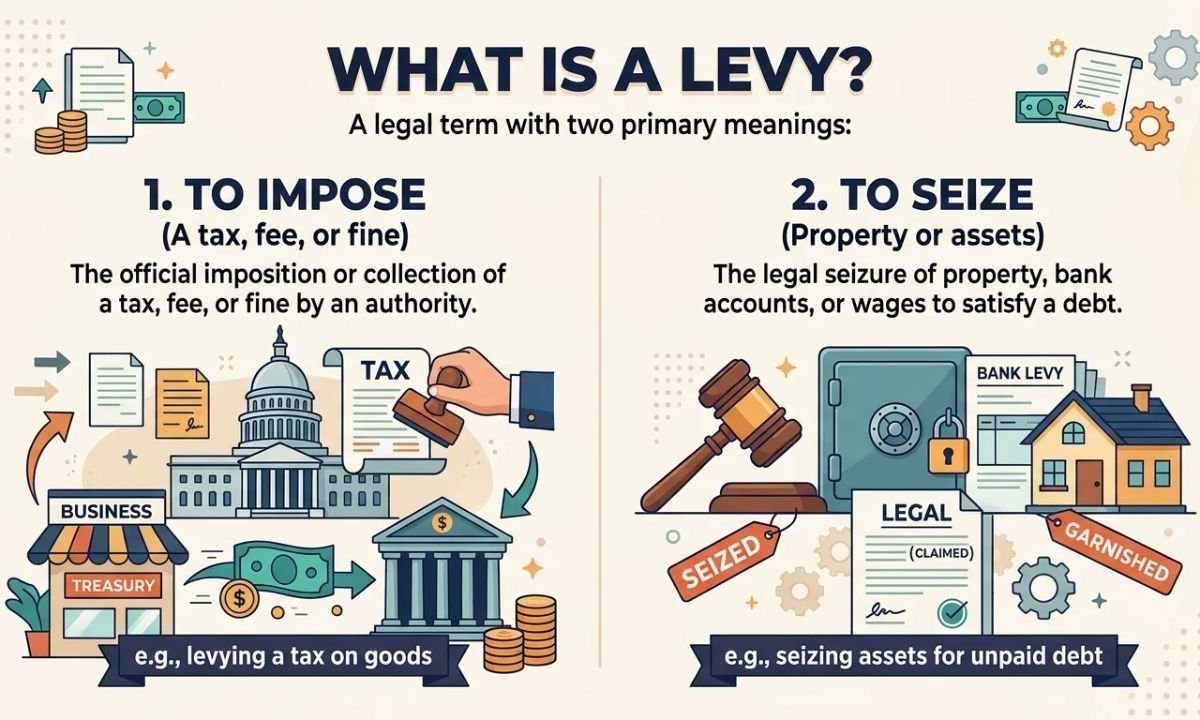
The word works in two ways:
- Noun: “The levy was added to the price of fuel.”
- Verb: “The state levied a duty on cigarettes.”
Verb forms are simple: levy, levies, levied, levying.
Difference Between Levy and Levies
The difference is mostly about number. “Levy” is one charge. “Levies” is more than one, or the verb form for a single subject.
| Word | Form | Example |
| Levy | Singular noun | The new levy is five percent. |
| Levies | Plural noun | Several levies apply to imports. |
| Levies | Verb (he/she/it) | The council levies a fee each year. |
| Levied | Past tense | The court levied a fine. |
| Levying | Present participle | They are levying extra charges. |
Do not confuse levies with levees. A levee is an embankment built to stop a river from flooding. The two words sound almost the same, but their meanings are unrelated.
Types of Levies and Their Uses
Levies come in many forms. Each one targets a certain group or purpose.
| Type of Levy | What It Is | Common Use |
| Fuel or petroleum levy | Charge added to petrol and diesel | Road building, government revenue |
| Property levy | Charge on land or buildings | Local services and rates |
| Industry levy | Fee paid by firms in one sector | Training, safety, research |
| Environmental levy | Charge on pollution or resource use | Cutting waste and carbon output |
| Special levy | Extra one-time charge | Building repairs, shared costs |
| Legal levy | Seizure of assets to pay a debt | Debt collection |
| Military levy | Troops raised for service | Defence, historically |
Some are well known. The UK has an Apprenticeship Levy for large employers. Australia has a Medicare levy on income. Many countries also charge a levy on sugary drinks.
Why Are Levies Imposed by the Government?
Governments use levies for several reasons:
- To raise money for public services like hospitals, roads, and schools.
- To change behaviour, such as cutting sugar use or plastic waste.
- To cover costs of a service paid for by the group that uses it.
- To protect local industry through duties on foreign goods.
- To respond to emergencies such as floods or other disasters.
A levy can be useful because it is targeted. A fuel levy is paid by people who drive. A water levy is paid by heavy water users. Many people feel that is fairer than a general tax.
Common Examples of Levies in Daily Life

You probably pay levies already, even if the bill does not use the word.
- Petroleum levy: added to each litre of fuel you buy.
- Customs duty: charged when goods cross a border.
- Body corporate or association levies: monthly fees paid by apartment owners to maintain shared areas.
- Council or municipal charges: for waste collection and local upkeep.
- Copyright levies: small charges on blank media or devices in some countries, paid to compensate creators.
- Court fines: a penalty imposed by a judge.
Next time you read a receipt, look for lines labelled “levy,” “duty,” or “surcharge.”
Levies meaning in Law
In law, a levy has two main uses.
First, imposing a tax or fine. A court or authority orders that a payment be made.
Second, seizing property to settle a debt. This is the stricter legal sense. If someone owes money and ignores a judgment, an authority can levy on their bank account, wages, or property. The assets are taken to cover the debt.
Bank and wage levies are more common. Property levies happen less often because they involve more steps. In most places, the person is given notice first and can respond or arrange payment.
Contracts also use the word. A lease or sale agreement may say the buyer must pay “all levies” on the property. That means any fees charged by the owners’ association or local authority.
Levies meaning medieval
In medieval times, levies meant soldiers raised on demand. A king or lord could call up men from villages when war came. These men were not full-time professionals. They were farmers, craftsmen, and townsmen who served for a short period.
Two well-known examples are:
- Feudal levies: troops supplied under the feudal system, in return for land.
- Shire levy: a system in medieval England where each county raised fighters for the crown.
Levies were usually lightly armed and less trained than knights. Even so, they made up a big share of many armies.
The idea lived on in later history. Names like the Iraq Levies, the Kachin Levies, and the Pakistan Levies show how local forces were raised in British-era regions. In Pakistan, the Levies are a local law-enforcement force in parts of Balochistan.
How Are Levies Different from Taxes?
Levies and taxes are close cousins, and people often mix them up. A tax is a broad term for compulsory payments to the state. A levy is often narrower and tied to a certain purpose or group.
| Feature | Levy | Tax |
| Purpose | Usually specific | Usually general |
| Who pays | Often a particular group | Wider population |
| Where money goes | Often a set fund or service | General government budget |
| Example | Fuel levy, industry levy | Income tax, sales tax |
| Other meaning | Can mean raising troops | Does not |
Here is the simple view: a levy is often a type of tax. But “levy” can also describe the act of charging it, and it has a military meaning that “tax” does not.
Importance of Levies in the Economy
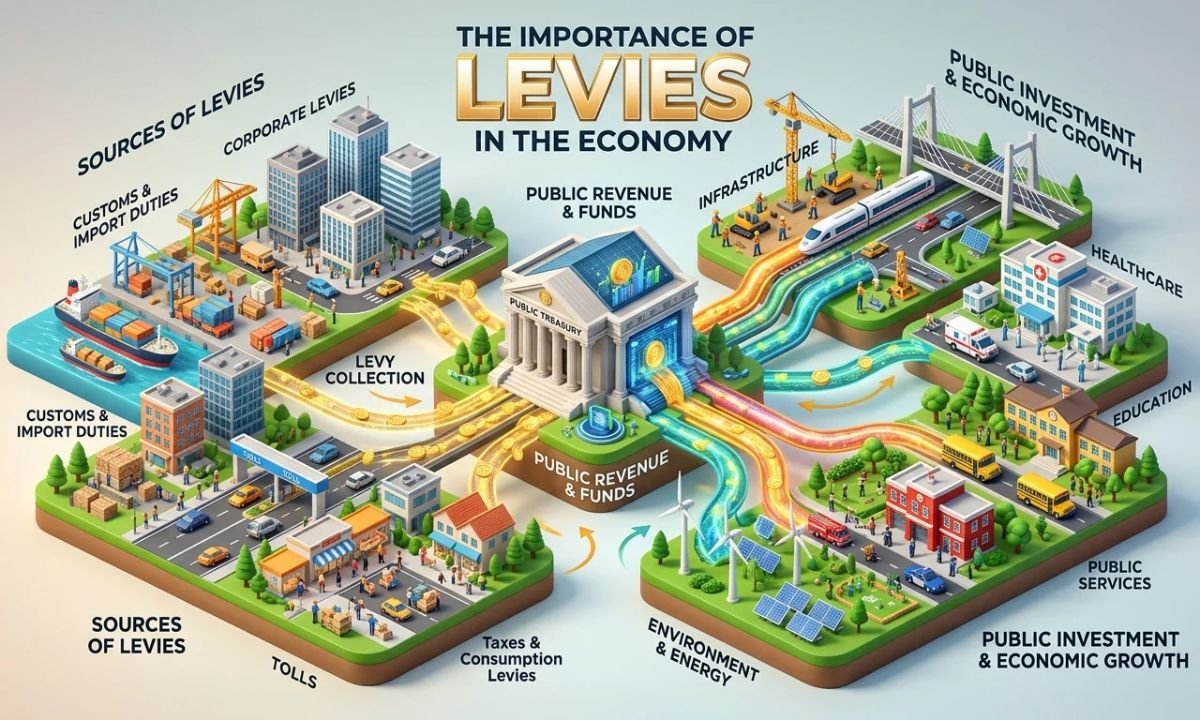
Levies play a real role in how an economy runs.
- Revenue: they give governments steady income, especially from fuel and trade.
- Targeted funding: money can be tied to a clear use, which helps accountability.
- Policy tool: raising or lowering a levy can cool demand or encourage better habits.
- Fairness: those who benefit from a service help pay for it.
There are downsides too. Higher levies can push up prices. A fuel levy, for example, can raise transport costs and food prices. That is why budget news about levies often leads to public debate.
How to Use Levies in a Sentence
Here are examples across different meanings:
- The government introduced new levies on plastic bags.
- Property owners must pay monthly levies for building maintenance.
- The city levies a small fee on every hotel booking.
- Medieval kings relied on local levies to fill their armies.
- Rising fuel levies have made travel more expensive.
- The bank account was frozen after the court levied it.
A quick tip: use “levies” when you mean several charges. Use “levy” for one.
Synonyms and Related Words of Levies
Synonyms for levies (charges):
- Taxes
- Duties
- Tariffs
- Fees
- Charges
- Tolls
- Imposts
- Assessments
- Surcharges
Synonyms for levies (troops):
- Conscripts
- Draftees
- Recruits
- Militia
- Enlistees
Related words: taxation, revenue, customs, excise, penalty, fine, conscription, muster.
Frequently Asked Questions About Levies
What does levies mean in simple words?
Levies are compulsory payments charged by a government or authority. They can also mean soldiers called up for service.
Is a levy the same as a tax?
Not exactly. A levy is usually a specific charge for a certain purpose, while a tax is a broader payment to the state.
What is the meaning of levies in Urdu?
In Urdu, levies means لگان (lagaan) or محصولات (mahsulaat). The verb “to levy” is محصول لگانا.
What is the plural of levy?
The plural of levy is levies.
What is a bank levy?
A bank levy is a legal order that lets an authority take money from your account to pay a debt.
What is the difference between levy and levee?
A levy is a charge or tax. A levee is a wall built to hold back river water.
What does levies mean in medieval history?
It means troops raised from local people to serve in an army for a limited time.
Are levies always paid by individuals?
No. Many levies are paid by businesses, property owners, or whole industries.
Conclusion
Levies are charges, fees, or taxes imposed by an authority, and the word also describes troops raised for war. In law, it can mean seizing assets to settle a debt. In Urdu, it is usually لگان or محصول. Knowing which meaning fits the context is the key.
The next time you see “levy” in a news story, on a bill, or in a history book, you will know what it refers to. Compare it with a tax, check who pays it, and see where the money goes. That small habit makes the word, and the system behind it, much easier to understand.

The author is a professional content writer specializing in word meanings, definitions, and English vocabulary. With over 6 years of experience in language research and educational content creation, they produce accurate, well-researched, and reader-friendly articles.