
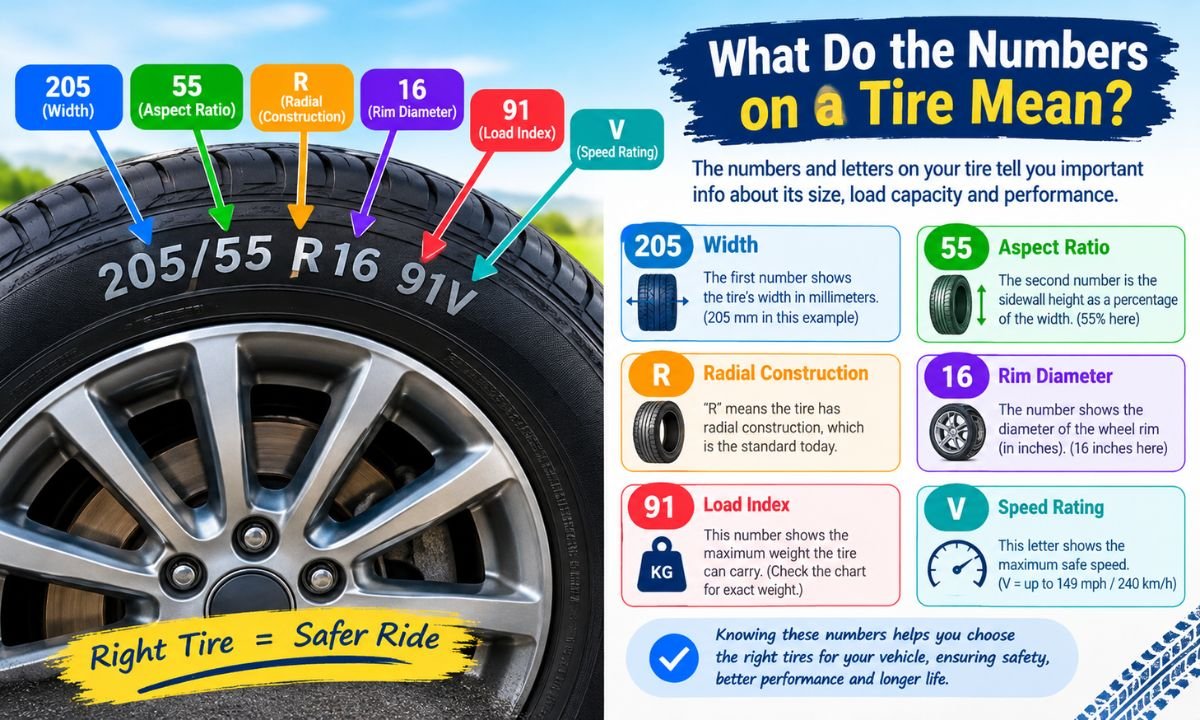
What do the numbers on a tire mean? They are a size and safety code stamped on the sidewall. The code tells you the tire’s width, sidewall height, wheel size, load capacity and top speed rating. It also hides the date the tire was made.
Most drivers never read it until a tire shop asks, “What’s your size?” This guide explains every number in plain words, with examples and charts. By the end, you will know how to read any tire in under a minute.
What Do the Numbers on a Tire Mean?
The numbers on a tire sidewall describe the tire’s size, strength and age. A common example looks like this: P205/55R16 91V.
Think of it as the tire’s ID card, a standard format that lets drivers, tire shops and carmakers identify a tire’s basic dimensions and abilities.
| Part of the Code | What It Tells You |
| P | Tire type (passenger) |
| 205 | Width in millimeters |
| 55 | Aspect ratio (sidewall height) |
| R | Radial construction |
| 16 | Wheel diameter in inches |
| 91 | Load index |
| V | Speed rating |
What Do the 3 Numbers on a Tire Mean?
The three main numbers are the ones in the size code, like 205/55R16:
- First number (205): tire width in millimeters
- Second number (55): aspect ratio, as a percentage
- Third number (16): wheel diameter in inches
The width and aspect ratio come first, and the last figure is the diameter of the wheel the tire fits. When you shop for new tires, these three numbers must match your car’s needs.
How to Read Tire Size Numbers
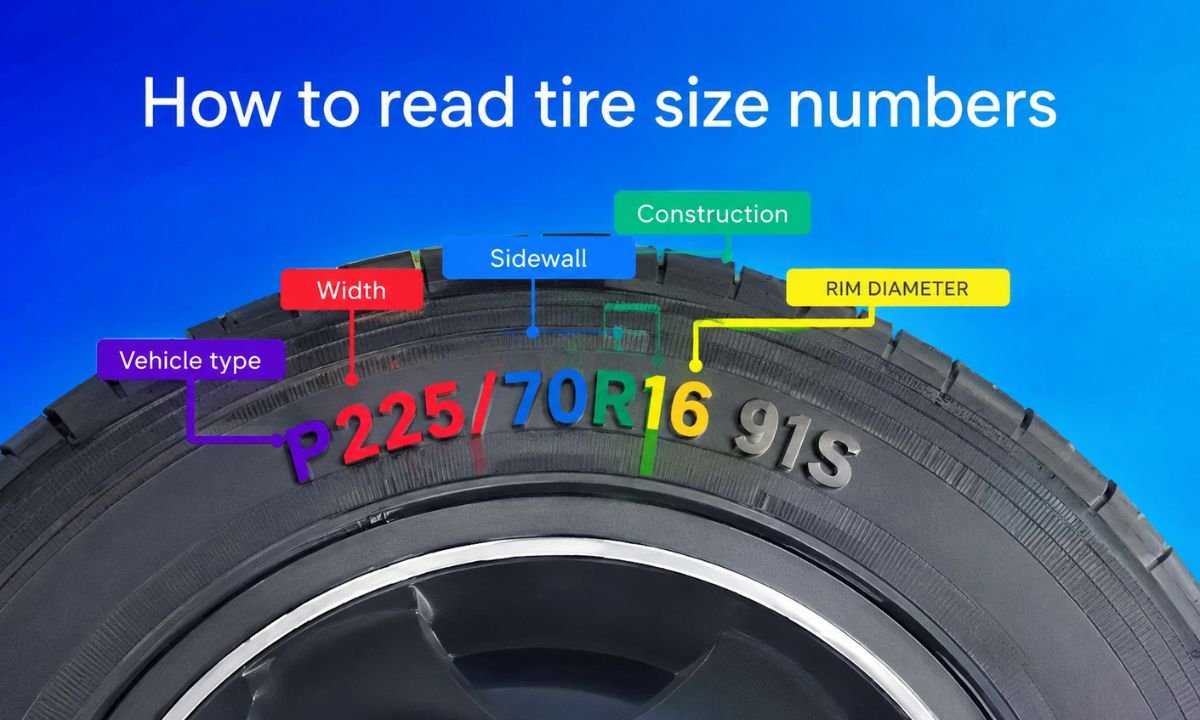
Follow this simple order, left to right:
- Find the letters at the start. P means passenger car. LT means light truck. No letter often means a European metric tire.
- Read the three-digit width.
- Read the two-digit aspect ratio after the slash.
- Spot the letter (usually R) for construction.
- Read the wheel diameter.
- Finish with the load index and speed rating.
Tip: stand in good light and wipe the sidewall first. The letters are raised and can be hard to see on a dirty tire.
What Does 205/55 R16 Mean on a Tire?
This is one of the most common tire sizes in the world. Here is the breakdown:
- 205: the tire is 205 mm wide
- 55: the sidewall is 55% as tall as the width
- R: radial tire
- 16: it fits a 16-inch wheel
To find the sidewall height, multiply: 205 × 0.55 = about 113 mm (roughly 4.4 inches).
What Does Tire Width Mean?
Tire width is the distance from one sidewall to the other, measured in millimeters. Width affects how much of the tire touches the road, which changes grip, stability and handling.
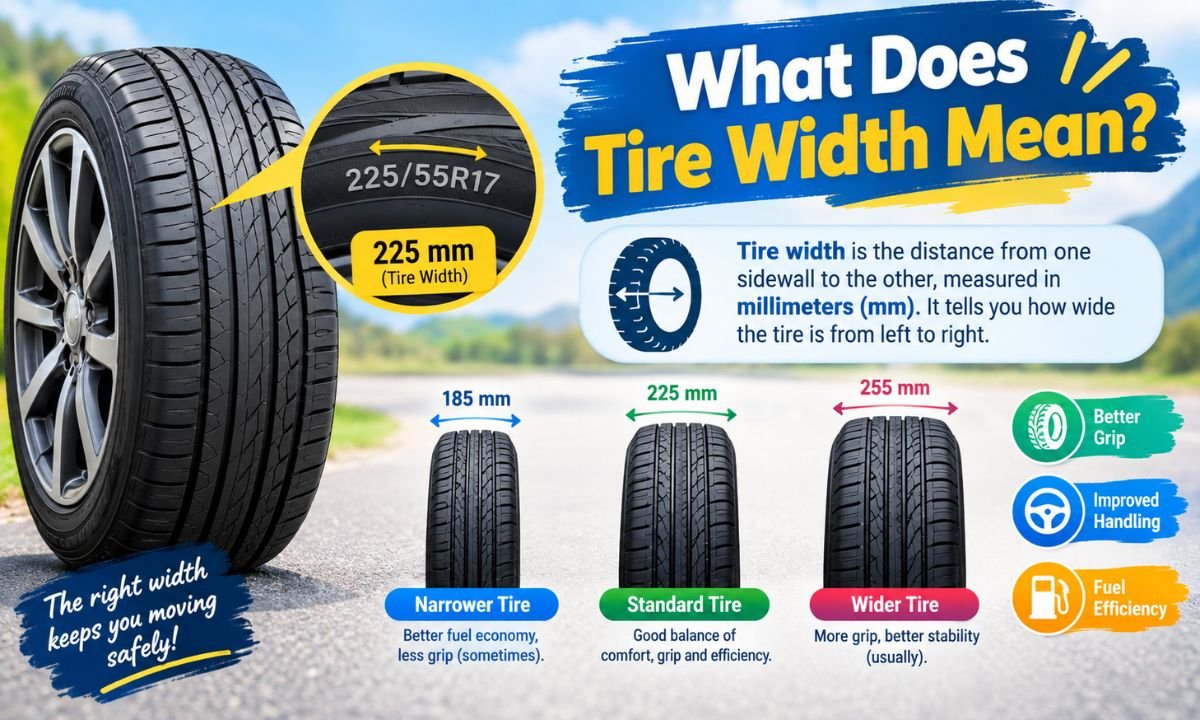
- Wider tires: more grip and sharper handling, but more road noise and often lower fuel economy
- Narrower tires: better in snow and rain, and usually more efficient
What Is the Tire Aspect Ratio?
The aspect ratio is the sidewall height shown as a percentage of the tire’s width. A lower number means a shorter, sportier sidewall, while a higher number means a taller one that absorbs bumps better.
| Aspect Ratio | Feel |
| 35–45 | Sporty, sharp steering, firm ride |
| 50–60 | Balanced comfort and handling |
| 65–75 | Soft, comfortable ride (SUVs and trucks) |
What Does the Letter R Mean on a Tire?
The letter R means radial construction. In a radial tire, the internal cord layers run straight across from bead to bead. Almost all modern car tires are radial.
Other letters you may see:
- D: diagonal (bias-ply)
- B: belted bias
- ZR: a radial tire built for higher speeds
What Does the Wheel Diameter Number Mean?
This number shows the size of the wheel (rim) the tire fits, in inches. A “16” means the tire fits a 16-inch wheel, so you cannot fit it on a 15-inch or 17-inch wheel.
This is the only number in the main size code that is measured in inches. The width is in millimeters.
What Do the Load Index Numbers on a Tire Mean?
The load index is a two- or three-digit number after the size. It shows the maximum weight one tire can carry when properly inflated. For example, a load index of 95 means the tire can carry up to 690 kg.
| Load Index | Max Load Per Tire |
| 85 | 515 kg (1,135 lb) |
| 91 | 615 kg (1,356 lb) |
| 95 | 690 kg (1,521 lb) |
| 100 | 800 kg (1,764 lb) |
| 105 | 925 kg (2,039 lb) |
Never go below the load index your car maker recommends. Going higher is usually safe.
What Does the Tire Speed Rating Mean?
The speed rating is the letter after the load index. It shows the top speed the tire is built to handle under test conditions. It is not a signal to drive that fast.
| Letter | Max Speed |
| Q | 160 km/h (99 mph) |
| S | 180 km/h (112 mph) |
| T | 190 km/h (118 mph) |
| H | 210 km/h (130 mph) |
| V | 240 km/h (149 mph) |
| W | 270 km/h (168 mph) |
| Y | 300 km/h (186 mph) |
A higher letter does not make the tire better for every vehicle. It only shows the speed it is designed to handle.
What Do the DOT Numbers on a Tire Mean?
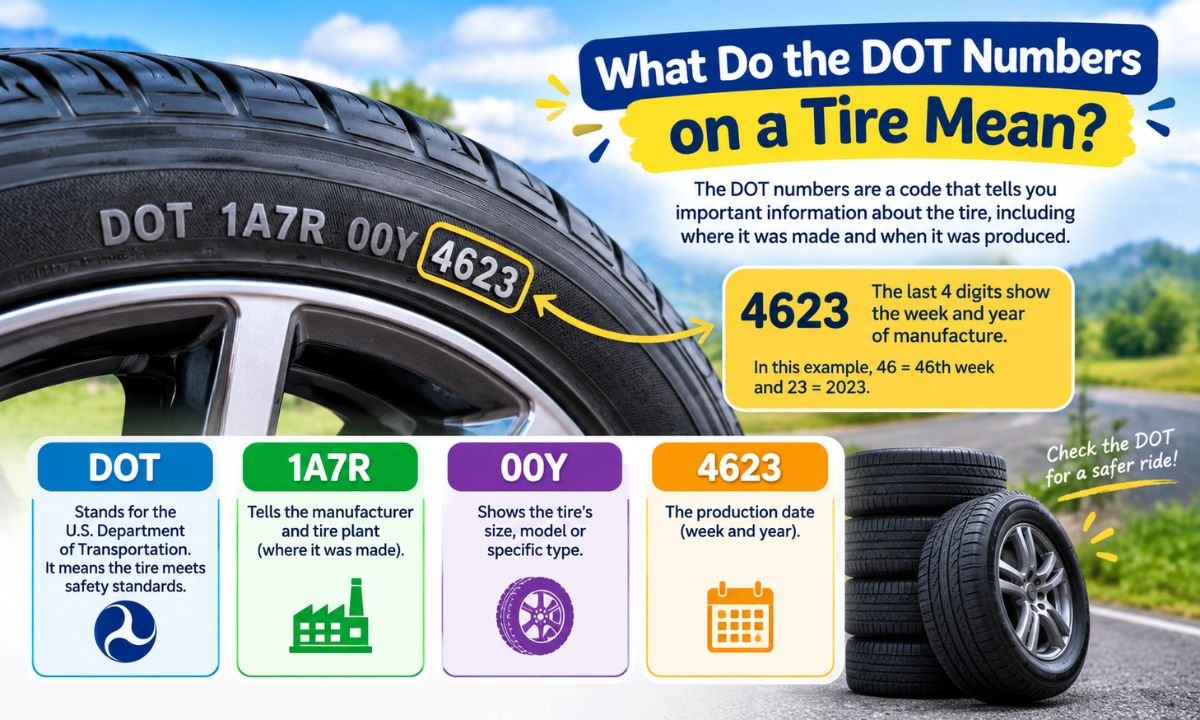
DOT stands for the US Department of Transportation. The code that starts with “DOT” is the Tire Identification Number (TIN). It identifies the tire and helps support recall efforts.
The code usually has these parts:
- Plant code: where the tire was made
- Size code: a manufacturer’s internal tire size code
- Optional code: brand or type details
- Date code: four digits showing when it was made
How to Find the Tire Manufacturing Date
Look at the last four digits of the DOT code. They give the week and year of production.
Example: DOT XXXX XXXX 3722
- 37 = the 37th week of the year
- 22 = 2022
So this tire was made in mid-September 2022.
Many owners mistake other four-digit numbers on the sidewall for the date code, so always check the last four digits of the DOT string. Many tire makers advise replacing tires that are about six to ten years old, even if the tread looks fine. Check your owner’s manual for the exact advice.
What Do Tire Pressure Numbers Mean?
Tire pressure numbers show how much air a tire should hold. They are given in PSI (pounds per square inch), kPa or bar.
Here is the catch. The pressure printed on the sidewall is the maximum the tire can take, not the one you should use. Your recommended pressure is on the sticker inside the driver’s door or in the owner’s manual. A typical car uses about 32–35 PSI, but always check your own.
What Do the Numbers on a Tire Mean on a Car?
On a car tire, you will see:
- Size code: 205/55R16
- Load index and speed rating: 91V
- DOT code: the plant and date
- UTQG ratings: treadwear, traction and temperature
- Max pressure and max load
The treadwear rating is a three-digit number that compares expected tread life with a standard reference tire, and a higher number means longer life. Traction is graded AA, A, B or C. Temperature resistance is graded A, B or C.
What Do the Numbers on a Tire Mean in Inches
Most of the size code uses metric units, but you can convert it to inches:
- Width: divide millimeters by 25.4. A 205 mm tire is about 8.1 inches wide.
- Sidewall height: width × aspect ratio. For 205/55, that is about 4.4 inches.
- Wheel diameter: already in inches.
- Overall diameter: wheel diameter + (2 × sidewall height). For 205/55R16, that is about 24.9 inches.
Some trucks use a full inch format, such as 31×10.50R15. That means 31 inches tall, 10.5 inches wide and a 15-inch wheel.
Letters on Tires Meaning Speed
Letters on tires usually tell you speed, load type or construction. This quick list helps:
- Q to Y: speed ratings (see the table above)
- P: passenger tire
- LT: light truck tire
- R: radial
- M+S: mud and snow
- ZR: high-speed radial
Meaning of Tire Size Numbers on a Motorcycle
Motorcycle tires look similar. A common example is 120/70 ZR17 58W.
- 120: width in mm
- 70: aspect ratio
- ZR: high-speed radial
- 17: rim diameter in inches
- 58: load index
- W: speed rating
Older bikes may use a format like 3.00-18. Here, 3.00 is the width in inches and 18 is the rim size. Motorcycle tires are often marked F (front) or R (rear), so make sure you fit each one in the right place.
What Is the Difference Between Tire Size and Tire Pressure?
| Feature | Tire Size | Tire Pressure |
| What it shows | Dimensions and fit | Air inside the tire |
| Unit | mm, %, inches | PSI, kPa or bar |
| Where to find it | Sidewall | Door sticker or manual |
| Changes over time? | No | Yes, check monthly |
Size tells you which tire fits. Pressure tells you how much air to put in it.
Why Is It Important to Understand Tire Numbers?
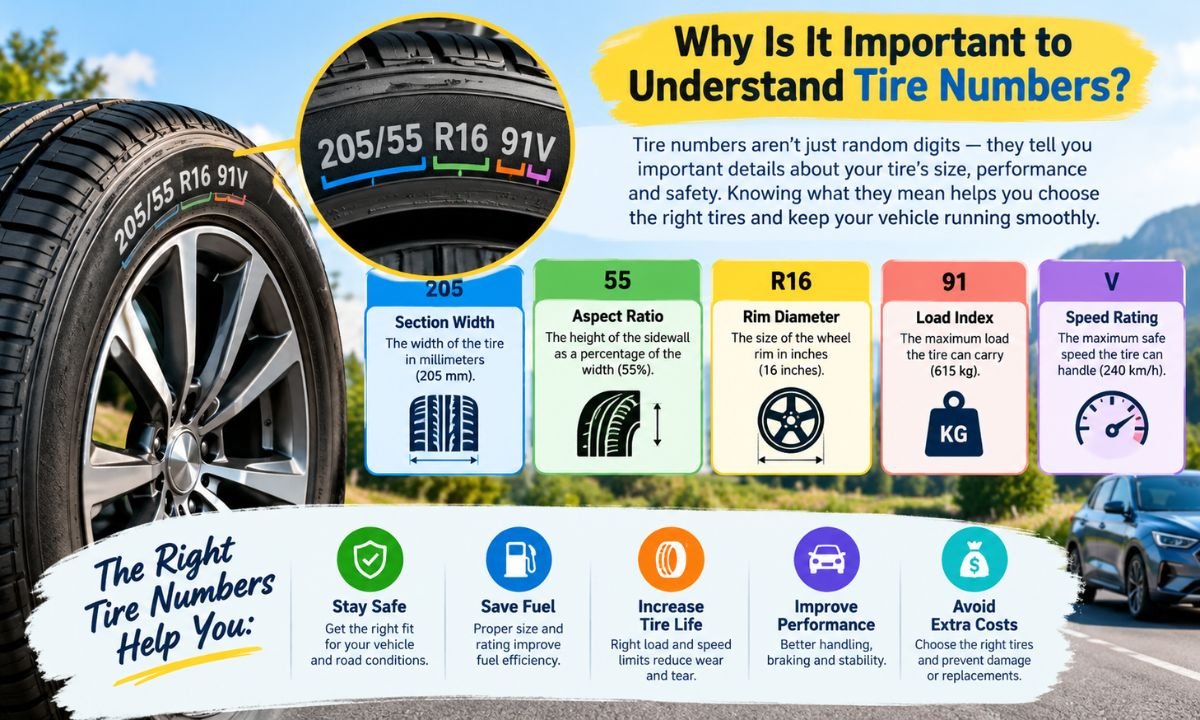
Tires are the only part of your car that touches the road. Reading their numbers helps you:
- Buy the correct size and avoid costly mistakes
- Keep your car safe under load and at speed
- Spot old, unsafe tires by checking the date code
- Compare brands fairly
- Improve fuel economy and tire life with correct pressure
How to Choose the Right Tire Size for Your Vehicle
- Check the door sticker or owner’s manual. This lists the size your car maker approves.
- Match the full code. Do not look only at width, aspect ratio and diameter. Load index and speed rating count too.
- Replace in pairs or sets. Mixing sizes on the same axle harms handling.
- Think about your climate. Choose all-season, summer or winter tires to suit it.
- Ask a tire professional if you want a different size, as it can affect the speedometer and clearance.
Frequently Asked Questions About Tire Numbers
What do the three numbers on a tire mean?
They show tire width in millimeters, aspect ratio as a percentage, and wheel diameter in inches.
What does 225/45 R17 mean?
The tire is 225 mm wide, with a sidewall 45% of that width, radial build, and fits a 17-inch wheel.
Where is the tire size located?
It is printed on the tire sidewall, and your car’s recommended size is on the door jamb sticker.
What does the P before the size mean?
P means a P-metric passenger tire, used on cars, minivans and small SUVs.
How do I read the tire date code?
Check the last four digits of the DOT code. The first two are the week and the last two are the year.
What does the load index mean?
It is a number that shows the maximum weight one tire can carry.
What does the speed rating letter mean?
It shows the highest speed the tire is designed to handle, such as H for 210 km/h.
Is the pressure on the sidewall the right pressure?
No. It is the maximum. Use the number on your driver’s door sticker.
How old is too old for a tire?
Many makers suggest replacing tires at six to ten years, even with good tread.
Can I use a different tire size than the original?
Sometimes, but changes can affect safety and speedometer accuracy, so ask a tire professional first.
Conclusion
The numbers on a tire are not random. They tell you the width, sidewall height, wheel size, load limit, top speed and age of the tire. Once you learn the order, a code like 205/55R16 91V reads like a sentence.
Check your sidewall today, find the date code, and confirm that your pressure matches the door sticker. These small checks help keep you safe and save you money on the next tire purchase.

The author is a professional content writer specializing in word meanings, definitions, and English vocabulary. With over 6 years of experience in language research and educational content creation, they produce accurate, well-researched, and reader-friendly articles.