
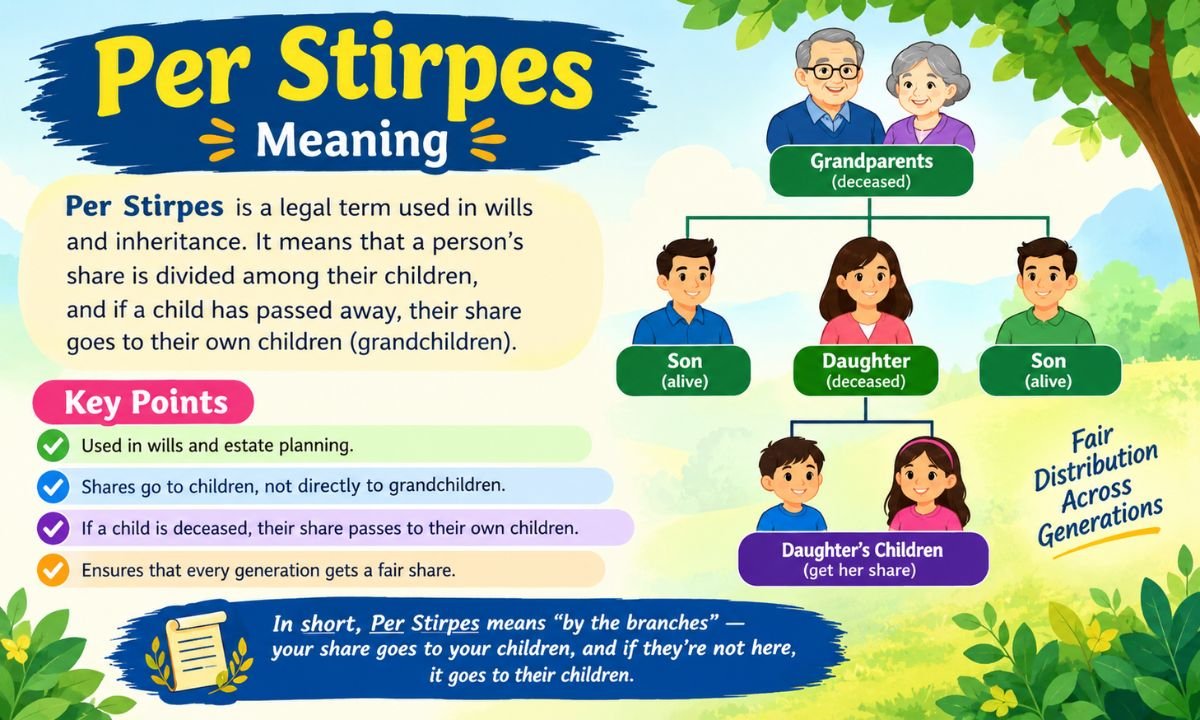
Per stirpes meaning is simple once you see it as a family tree. It is Latin for “by branch.” It decides who gets a share of an estate when one of the named heirs dies before the person who made the will.
Under a per stirpes clause, a deceased heir’s share does not vanish or move to the siblings. It passes down to that heir’s own children. This guide explains how it works, with examples, a comparison table and tips for wording your will. It is general information, not legal advice.
Per Stirpes Meaning
Per stirpes (say it “per STUR-peez”) is a legal phrase used in wills, trusts and beneficiary forms. It means “by branch” or “by root,” and a deceased beneficiary’s share goes to their next of kin. You may also see it written as “by right of representation.”
In plain words: each branch of your family tree keeps its fair share, even if the person at the top of that branch has died.
Examples
- You leave everything to your three children “per stirpes.” One child dies before you. That child’s kids step into their parent’s place.
- A beneficiary on a life insurance form is marked “per stirpes.” If they die first, their descendants receive the payout.
Stirpes Meaning
“Stirpes” is the plural of the Latin word “stirps,” which means stock, root or branch. Think of the trunk of a tree. Each child of yours is a main branch. Their children are smaller branches growing from it.
So “per stirpes” simply means “by the branches.” The law counts shares by family line, not by the number of people alive.
Examples
- Three branches (your three children) means three equal shares.
- A grandchild’s share comes from the branch they belong to, not from the whole pool.
What Does Per Stirpes Mean?
Per stirpes is a method of dividing an inheritance. Under it, the children of a person who died early take, among them, the share their parent would have received. Lawyers say the children “stand in the shoes” of their parent.
It matters only when a beneficiary dies before you do. If everyone you named is alive, per stirpes changes nothing.
How Does Per Stirpes Inheritance Work?
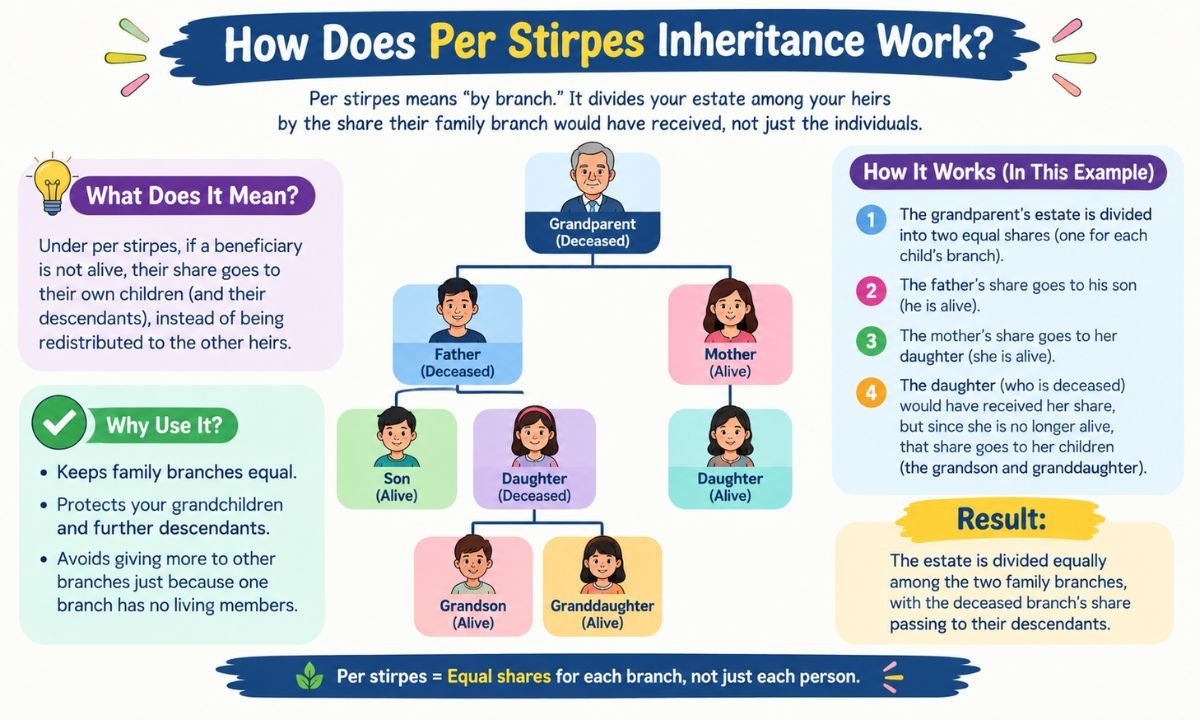
The process has four steps:
- Count the branches. Each named child (or each child with descendants) is one branch.
- Divide the estate into equal shares, one per branch.
- If a branch has a living heir, that heir gets the share.
- If the heir has died, their share is split equally among their own children. If those children have died too, it moves down to the next generation.
The rule keeps going down the line, so a share always stays inside the same family branch.
Per Stirpes Meaning in a Will
In a will, per stirpes is a short instruction placed after a beneficiary’s name or class. A typical line reads: “I leave my estate to my children, A, B and C, per stirpes.” The words tell the court that a child’s descendants inherit if that child has already died.
Without those words, a different default rule may apply. The gift to a dead child could fail and fall into the rest of the estate, or the surviving heirs may split it.
How Is an Inheritance Divided Under Per Stirpes?
Here is a quick view of the split:
| Situation | Result |
| All children alive | Each child gets an equal share |
| One child died, with kids | That child’s kids split that child’s share |
| One child died, no kids | The share is split among the other branches |
| Child and grandchild died | The share moves to the great-grandchildren |
The key point is that shares are set at the child level first. Only then are they divided among grandchildren.
Real-Life Examples of Per Stirpes Distribution
Example 1: Simple split You leave $300,000 to your children A, B and C, per stirpes. B dies before you and leaves two kids.
- A gets $100,000
- C gets $100,000
- B’s two children get $50,000 each
Example 2: Uneven families If A has two children, B and C, and B left two kids while C left three, then B’s two children take half of the estate and C’s three children take the other half. Notice that each grandchild of B gets more than each grandchild of C, because their branch is smaller.
Example 3: No grandchildren If B had no children, the estate is split between A and C. In that case per stirpes works the same as the other method.
Per Stirpes vs. Per Capita: What Is the Difference?
Per capita means “by head.” Under it, a dead beneficiary’s share is split among the beneficiaries still living, and not passed down to descendants.
| Feature | Per Stirpes | Per Capita |
| Latin meaning | By branch | By head |
| Focus | Family lines | Number of living heirs |
| Dead beneficiary’s share | Goes to their children | Goes to the surviving heirs |
| Grandchildren | Protected | May get nothing |
| Best for | Keeping each line equal | Equal shares among those alive |
Using the $300,000 example, under per capita A and C would each get $150,000, and B’s children get nothing.
There is also a middle option called “per capita with representation,” sometimes called modern per stirpes. It divides the estate at the first level where someone is alive, which can give everyone at that level the same share. The wording matters, so ask a lawyer which version your state uses.
What Happens if a Beneficiary Dies Before the Will Maker?

It depends on what the will says.
- With per stirpes: The beneficiary’s descendants receive the share.
- With per capita: The share is split among surviving beneficiaries.
- With no clause at all: State law decides. Many states have “anti-lapse” rules that pass the gift to descendants, but they differ and often cover only close relatives.
Leaving this unclear is a common cause of family disputes.
Who Inherits Under a Per Stirpes Distribution?
Per stirpes only covers your descendants. That means:
- Children
- Grandchildren
- Great-grandchildren, and so on
Spouses, in-laws, friends and siblings are not covered. Adopted children are usually treated as descendants, but check your state’s law for the details.
Advantages and Disadvantages of Per Stirpes Inheritance
Advantages
- Protects grandchildren if their parent dies early
- Keeps each family line equal
- Reflects most parents’ wishes
- Avoids disputes between siblings
- Works in wills, trusts and beneficiary forms
Disadvantages
- Cousins can end up with very different amounts if branches differ in size
- It can send money to descendants you may not know well
- It can slow down distribution if many heirs must be found
- It may not fit blended families without extra wording
Per Stirpes Meaning in Estate Planning
In estate planning, per stirpes is a tool for controlling what happens if plans go wrong. It lets you pick the family branch that gets each share, instead of trusting default rules.
It is used in:
- Wills
- Living and family trusts
- Retirement accounts and life insurance forms
- Transfer-on-death accounts
Many people review it after a birth, a death, a divorce or a remarriage.
Is Per Stirpes Automatically Applied to a Will?
No. Per stirpes is not automatic in a will. You need to write it in, or the court will use state default rules.
There is one exception. If you die without a will, state intestacy law may use per stirpes to decide who inherits. Rules vary by state, so never assume.
Per Stirpes Pronunciation
The usual pronunciation is “per STUR-peez.”
- Per: like the word “purr”
- Stir: like “stir” in a cup of tea
- Pes: sounds like “peez”
You will sometimes hear “per STIR-peez.” Both are fine in everyday talk.
Per Stirpes Meaning in Beneficiary
On a beneficiary form, per stirpes means that if a named person dies first, their share goes to their children. Banks and insurers often show it as a checkbox next to the contingent beneficiary section.
Always read the form. Some ask you to choose between “per stirpes” and “per capita.” If you skip the choice, the company may use its own default.
Does Per Stirpes Include Spouse?
No. Surviving spouses do not inherit via per stirpes. The rule works only down the line of descendants.
To provide for a spouse, name them directly in the will or on the form, or rely on state spousal rights. Many states give a surviving spouse a protected share no matter what the will says.
Opposite of Per Stirpes
The opposite is per capita, meaning “by head.” Instead of keeping each family line equal, it splits the estate among the living heirs in one class.
A close cousin is per capita at each generation, which mixes both ideas. Your lawyer can draft whichever version fits your family.
Common Mistakes to Avoid When Using Per Stirpes

- Mixing up the terms. Writing per capita when you mean per stirpes can cut grandchildren out.
- Assuming it is automatic. Without the words, defaults apply.
- Forgetting beneficiary forms. Your will does not control accounts with named beneficiaries.
- Never updating. Births, deaths and divorces change who is in each branch.
- Expecting it to cover spouses. It only covers descendants.
- Using vague wording. Be clear about whether shares are set at the child level or by generation.
How to Include Per Stirpes Language in a Will
Keep the wording short and clear. A simple example:
“I give my entire estate to my children, [Name], [Name] and [Name], in equal shares, per stirpes.”
Follow these tips:
- Name each beneficiary clearly
- State the word “per stirpes” next to the gift
- Match your will with your account beneficiary forms
- Consider adding a backup if a branch has no heirs
- Have a licensed estate attorney review the draft
Frequently Asked Questions
What does per stirpes mean in simple words?
It means “by branch.” If an heir dies first, their children get their share.
Is per stirpes good?
It is good for keeping each family branch equal, but it may not suit every family. Compare it with per capita before you decide.
Does per stirpes mean equal shares for grandchildren?
No. Shares are equal by branch, so grandchildren in a larger branch get less each.
Can a will use both per stirpes and per capita?
Yes. A will can use different methods for different gifts, as long as each is clearly worded.
Do stepchildren inherit per stirpes?
Usually not, unless the will names them or they were legally adopted.
What is the difference between per stirpes and per capita?
Per stirpes passes a dead heir’s share to their children. Per capita splits it among the living heirs.
How do I write per stirpes in a will?
Add “per stirpes” after the beneficiary names, such as “to my children, per stirpes.” An estate lawyer can confirm it fits your state.
Is per stirpes the same as right of representation?
Yes, the two phrases describe the same idea in most contexts.
Conclusion
Per stirpes means “by branch.” It makes sure that if one of your heirs dies before you, their share goes to their own children. It is simple, fair and popular, but it does not apply to spouses and is not automatic.
Check how your will, trusts and beneficiary forms are worded, and make sure they all say what you mean. Then review them after major life changes. A short chat with an estate attorney can prevent years of family stress.
This article is for general information only and is not legal advice.

The author is a professional content writer specializing in word meanings, definitions, and English vocabulary. With over 6 years of experience in language research and educational content creation, they produce accurate, well-researched, and reader-friendly articles.