
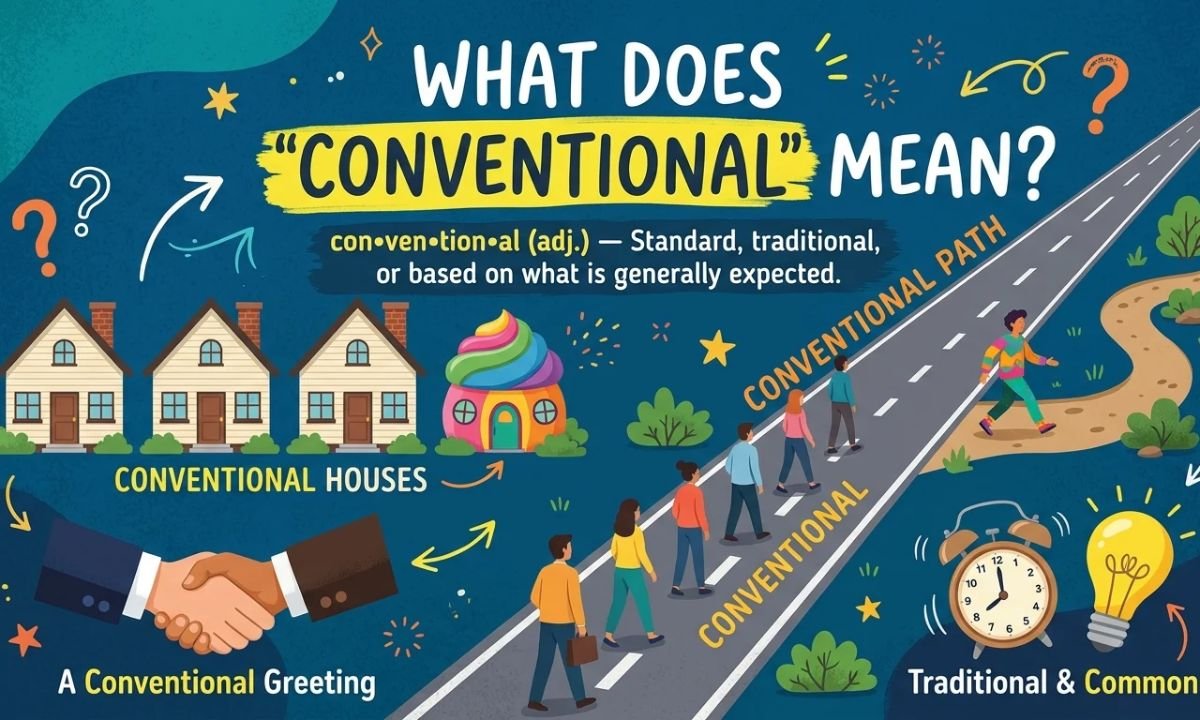
What does conventional mean? In simple terms, it describes something that follows accepted customs, standards, or common practice. A conventional wedding, a conventional doctor, and a conventional loan all share one idea: they stick to the usual, expected way of doing things instead of trying something new.
The word looks easy, but it changes shape depending on where you meet it. In daily talk it can describe people and habits. In finance it points to a certain kind of mortgage. In war it means non-nuclear weapons, and in health it refers to mainstream medicine. This 2026 guide covers every major meaning, with examples, synonyms, and common mistakes, so you can use the word correctly anywhere.
What Does Conventional Mean?
Conventional is an adjective. It describes things that are based on, or agree with, a general custom or accepted standard. The word comes from the Latin conventio, which meant an agreement or gathering. A “convention” is an agreement about how things are done, and “conventional” means following that agreement.
The word can carry a mild tone, too. Sometimes it sounds neutral and respectful (“a conventional approach”). Other times it hints at being ordinary or unoriginal (“a conventional plot”).
Conventional Meaning in English
Dictionaries list several senses. Here are the main ones in plain English:
- Following accepted customs: behaving in a way most people expect.
- Ordinary or unoriginal: lacking new ideas or imagination.
- Traditional or established: a practice handed down from the past.
- Non-nuclear: used for weapons and warfare that do not use nuclear energy.
- Symbolic or agreed: signs, symbols, or forms that people accept by common consent, such as road signs.
- Standard method: the usual, mainstream way, as in conventional medicine or conventional farming.
Pronunciation: /kənˈvenʃənl/ (kuhn-VEN-shuh-nul). Comparative: more conventional. Superlative: most conventional.
Conventional Definition in Simple Words
If you want the easiest version, here it is: conventional means usual, normal, and in line with what most people accept.
Think of it as the “default setting.” A conventional oven heats food with ordinary heating elements. A conventional school follows the standard curriculum. A conventional person lives in a way most others would expect.
What Are the Synonyms of Conventional?
The right synonym depends on the sense you mean.
| Meaning | Synonyms |
| Following custom | customary, orthodox, accepted, established, standard |
| Ordinary | common, usual, routine, regular, typical |
| Traditional | traditional, time-honoured, long-standing, classic |
| Unoriginal | predictable, unimaginative, run-of-the-mill, trite |
| Formal or proper | formal, proper, ceremonial, correct |
Other related words include mainstream, normal, stereotypical, and by-the-book.
What Are the Antonyms of Conventional?
The opposite of conventional is unconventional. Other antonyms depend on the context.
- Unconventional: breaking the usual rules.
- Innovative: introducing new ideas.
- Unorthodox: not following the accepted view.
- Alternative: used for medicine and lifestyles outside the mainstream.
- Original: new and different.
- Radical: far from the usual way.
- Nuclear: the opposite of “conventional” in the weapons sense.
- Eccentric: odd or unusual in behaviour.
Conventional vs. Traditional: What’s the Difference?
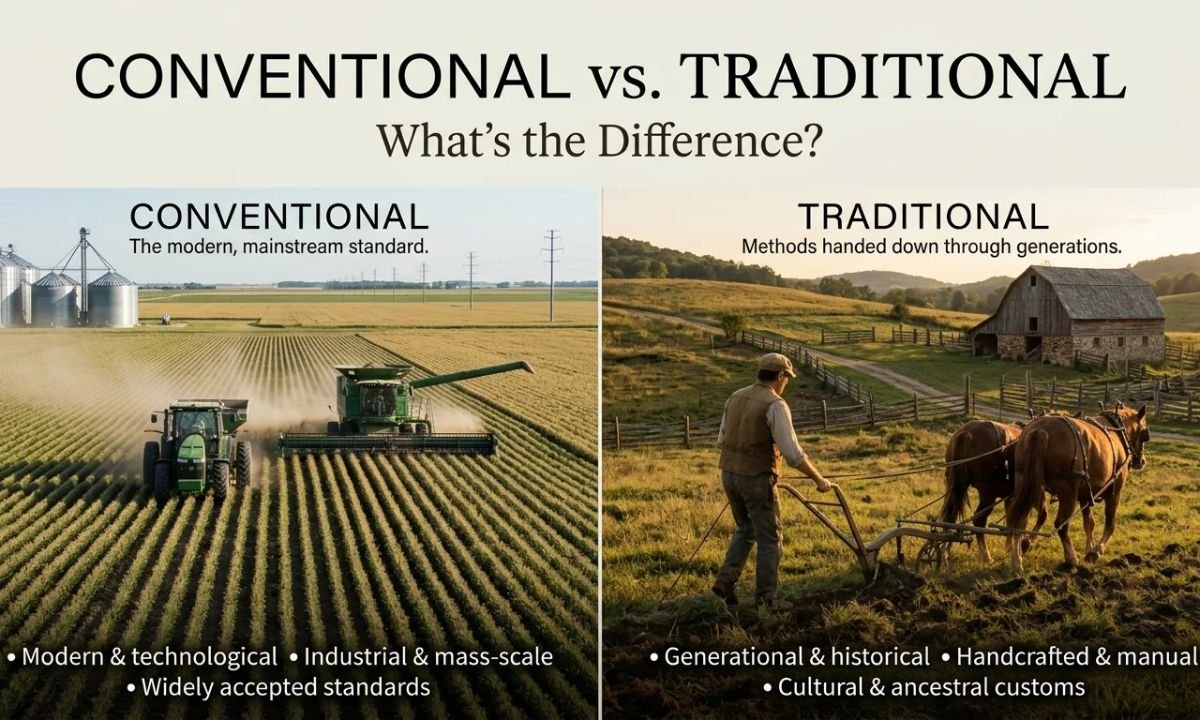
People often treat these words as twins. They overlap, but they are not identical.
| Feature | Conventional | Traditional |
| Core idea | Follows current accepted standards | Passed down through generations |
| Time focus | Present-day norms | The past |
| Can change over time? | Yes, as norms change | Usually stays fixed |
| Example | Conventional loan | Traditional dress |
| Tone | Neutral or slightly dull | Warm, cultural, respectful |
A quick test: if the thing is “what most people do today,” use conventional. If it has been handed down for generations, use traditional.
How to Use Conventional in a Sentence?
Place “conventional” before a noun, or after a linking verb like “is” or “seems.” It almost always describes a person, method, idea, or thing.
- Before a noun: She chose a conventional career in banking.
- After a verb: His views are quite conventional.
- With a comparison: This design is more conventional than the last one.
Use it when you want to say something follows the normal way. Use “unconventional” when it does not.
10 Examples of Conventional in Everyday English
- They had a conventional wedding with a church ceremony and a family dinner.
- The doctor suggested a conventional treatment before trying anything new.
- He wore a conventional grey suit to the interview.
- The film follows a conventional storyline, so the ending is easy to guess.
- Many farmers still use conventional methods instead of organic ones.
- The country has strong conventional forces but no nuclear arms.
- We bought the house with a conventional mortgage.
- She was never a conventional student, but she got great results.
- A conventional oven takes longer than a microwave.
- It is conventional to shake hands when meeting someone new.
Different Uses of the Word Conventional
The word shows up in many fields. Here is where you are most likely to see it.
| Field | Meaning | Example |
| Everyday life | Normal, expected behaviour | A conventional lifestyle |
| Finance | Loan not backed by a government agency | Conventional mortgage |
| Banking | Interest-based banking | Conventional bank vs. Islamic bank |
| Military | Non-nuclear weapons and warfare | Conventional warfare |
| Medicine | Mainstream, evidence-based care | Conventional medicine |
| Agriculture | Non-organic farming with synthetic inputs | Conventional crops |
| Energy | Established sources like coal, oil, and gas | Conventional energy |
| Cooking | Standard heat, no fan or microwave | Conventional oven |
| Art and design | Accepted symbols or styles | Conventional symbols |
| Linguistics | Meaning set by agreement | Conventional implicature |
In Pakistan and other Muslim-majority countries, you will often hear “conventional banking” used to separate it from Islamic banking. In the US, “conventional loan” is a common home-finance term.
Why Is the Word Conventional Important?
This word matters because it helps us compare the usual with the new. Without it, we could not describe what counts as normal.
- Clear communication: it separates standard options from alternatives.
- Decision-making: it helps you compare, for example, conventional and organic food or conventional and electric cars.
- Professional use: terms like “conventional loan” or “conventional warfare” have exact meanings in law, finance, and defence.
- Social understanding: it explains what society expects, and what it considers unusual.
Using it correctly makes your writing sharper, especially in exams, reports, and business documents.
Common Phrases and Expressions Using Conventional
Several fixed expressions are worth knowing.
- Conventional wisdom: an idea most people accept as true. “Conventional wisdom says you should save first.”
- Conventional warfare: fighting with regular, non-nuclear weapons and armies.
- Conventional weapons: guns, tanks, and missiles that are not nuclear, chemical, or biological.
- Conventional medicine: standard medical care taught in medical schools.
- Conventional loan: a mortgage not insured by a government agency.
- Conventional oven: an oven heated by elements without a fan.
- Conventional method: the standard, usual way of doing a task.
- Conventional thinking: ideas that stay within accepted limits.
Conventional system meaning
A conventional system is the standard, long-established way a process or structure works, as opposed to a newer or alternative version. It is the system most people know and use.
Some examples:
- Conventional banking system: banks that earn money through interest, compared with Islamic or digital-only banks.
- Conventional power system: electricity from coal, gas, and oil rather than solar or wind.
- Conventional farming system: crop growing with chemical fertilisers and pesticides.
- Conventional education system: classroom teaching, compared with online learning.
- Conventional heating system: a standard boiler and radiators instead of a heat pump.
The word does not mean the system is old-fashioned or bad. It only means it is the standard option.
Conventional things meaning
“Conventional things” means ordinary items, habits, or ideas that most people accept as normal. These are things that fit expectations and do not stand out.
Examples include:
- A white dress at a Western wedding
- A nine-to-five job
- A plain black pen
- A standard rectangular dining table
- Studying at university after school
When someone says “I like conventional things,” they usually mean they prefer familiar, safe, and proven choices over experimental ones.
Common Mistakes About Conventional Meanings

Learners and writers often slip on this word. Watch out for these errors.
- Mixing it up with “convenient.” Conventional means standard. Convenient means easy or handy.
- Using it only as an insult. It often has a neutral meaning. A conventional loan is not a boring loan.
- Treating it as a perfect synonym of “traditional.” Conventional relates to current norms, while traditional relates to the past.
- Forgetting the weapons meaning. In news, “conventional” often means non-nuclear, not “ordinary.”
- Confusing “convention” and “conventional.” A convention is a custom or a large meeting. Conventional is the adjective.
- Misspelling it. The correct spelling has two “n” letters in the middle: conventional.
Frequently Asked Questions About Conventional
What does conventional mean in simple words?
Conventional means usual, normal, and in line with accepted customs or standards.
What is the opposite of conventional?
The opposite is unconventional. Innovative, unorthodox, and original also work, depending on context.
What does conventional mean in medicine?
It means standard, mainstream medical treatment that is widely accepted and taught in medical schools.
What does conventional mean in war?
It refers to warfare and weapons that do not involve nuclear, chemical, or biological force.
Is conventional a positive or negative word?
It depends on the context. It can be neutral or respectful, but it can also suggest something dull or unoriginal.
What is a conventional loan?
It is a mortgage or loan that is not insured or backed by a government agency.
What is conventional wisdom?
It is a belief or idea that most people accept as true, even without checking it.
Is conventional the same as traditional?
Not exactly. Conventional follows present-day standards, while traditional follows customs passed down over time.
What is the difference between conventional and convenient?
Conventional means standard or customary. Convenient means easy, handy, or suitable.
Conclusion
Conventional means following accepted customs, standards, or the usual way of doing things. It can describe people, ideas, and methods, and it also has special uses in finance, medicine, farming, energy, and war. The tone can be neutral or slightly critical, so context matters.
Next time you read or write this word, ask yourself two questions: what is the “normal” option here, and what is it being compared with? That simple habit will help you use conventional correctly in exams, work, and daily conversation.

The author is a professional content writer specializing in word meanings, definitions, and English vocabulary. With over 6 years of experience in language research and educational content creation, they produce accurate, well-researched, and reader-friendly articles.