

Flie or fly: which one is right? The answer is simple. “Fly” is the correct spelling. “Flie” is not a standard English word. You will not find it in major dictionaries, and spell-checkers will flag it right away.
So why does the question keep coming up? Because English spelling can be tricky. The word “fly” changes to “flies” in some forms, and that “ie” ending makes many writers think “flie” must exist too. This guide clears up the confusion with clear rules, tables, examples, and a short quiz. By the end, you will know exactly when to write fly, flies, flew, or flown.
Quick Overview
- Correct spelling: fly
- Incorrect spelling: flie
- Third-person singular verb: flies
- Plural noun: flies
- Past tense: flew
- Past participle: flown
- Present participle: flying
If you remember only one thing, remember this: the base word always ends in “y,” and “ie” only appears in “flies.”
Key Difference Between Flie or Fly
“Fly” is a real word with many meanings. It can be a verb, a noun, and even an adjective in slang. “Flie” has no meaning in modern English. It is simply a typing or spelling error.
The mix-up happens because “fly” becomes “flies” when you add an “-s” ending. Some people carry the “ie” back to the base word. That creates “flie,” which is wrong.
Comparison Table
| Feature | Fly | Flie |
| Real English word? | Yes | No |
| Found in dictionaries? | Yes | No |
| Part of speech | Verb, noun, adjective | None |
| Meaning | To move through the air; an insect | No meaning |
| Related forms | flies, flew, flown, flying | None |
| Verdict | Correct | Misspelling |
What Does Fly Mean
“Fly” is one of the most useful short words in English. It has several meanings, depending on how you use it.
Fly as a Verb
As a verb, fly means to move through the air or to travel fast. It also appears in many other senses.
- To move through the air: Birds fly south in winter.
- To travel by plane: We fly to Dubai tomorrow.
- To operate an aircraft: She flies helicopters.
- To move quickly: The week flew by.
- To wave in the wind: The flag flies over the building.
Fly as a Noun
As a noun, fly has a few common meanings:
- An insect: A fly landed on the table.
- A trouser opening: He checked his fly before leaving.
- A tent flap: Close the fly to keep out the rain.
- A fishing lure: He tied a fly to his line.
Fly in Sports
In sports, “fly” most often appears in baseball. A fly ball is a ball hit high into the air. A fly out happens when a fielder catches it. A sacrifice fly lets a runner score after the catch.
In boxing, flyweight is one of the lightest weight classes. In fly fishing, anglers use light lures called flies.
What Is Flie
“Flie” is not a recognised English word. It has no definition, no grammar rules, and no standard use today. When you see it in writing, it is almost always one of these:
- A misspelling of fly
- A misspelling of flies
- A typing error for another word, such as lie or file
Spell-check tools often suggest “lie” or “file” when they see it. That tells you how far it is from standard English.
Why People Confuse Flie or Fly
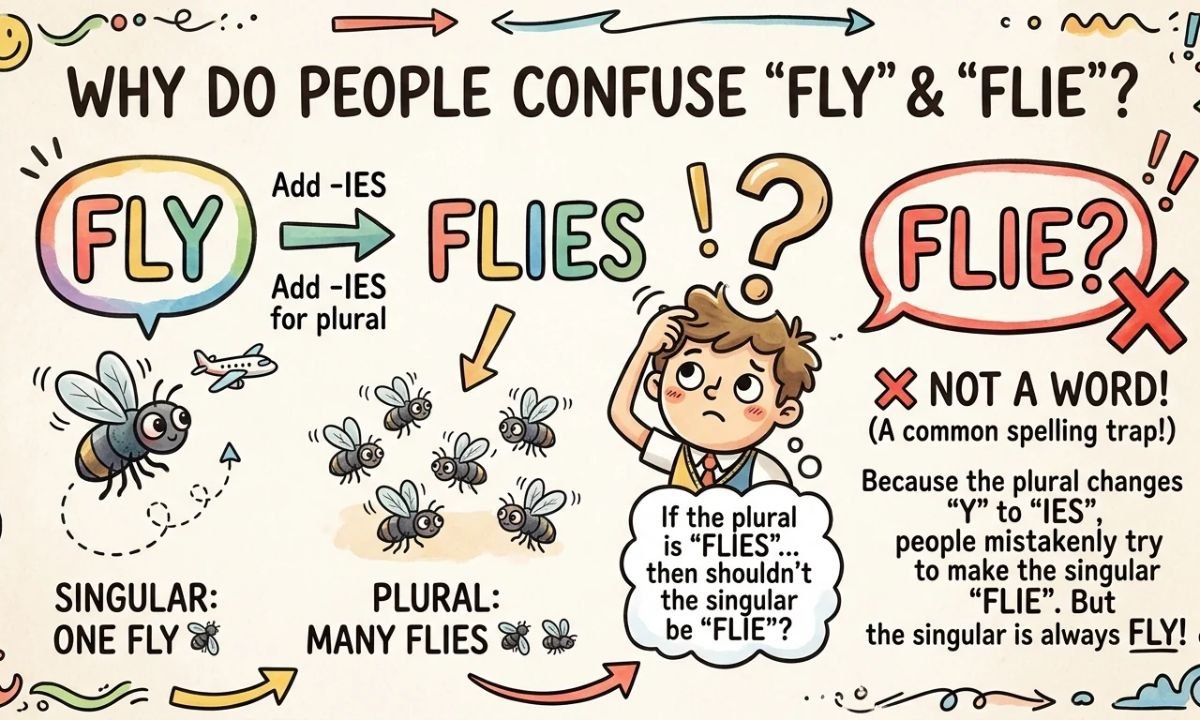
Several small things lead to this mistake.
Similar Sound
“Fly” and “flies” sound alike at the start. Writers hear “fl-eye” and guess the ending. Since “flies” has an “ie,” the brain drops it into the base form too.
Plural Confusion
Most English plurals just add “-s.” Words that end in a consonant plus “y” follow a different rule: change “y” to “i” and add “-es.” That is why puppy becomes puppies and fly becomes flies. Learners often half-apply the rule and end up with “flie” or “flys.”
Typing Mistakes
Fast typing creates odd spellings. The letters “i” and “y” sit on different parts of the keyboard, but a quick slip or autocorrect can still produce “flie.”
English Grammar Rules
English has many irregular verbs. “Fly” is one of them. Its past tense is “flew,” not “flyed.” With so many changes, it is easy to invent forms that do not exist.
Fly in Everyday Life
You use this word more often than you think.
- “Don’t let the fly in the house.”
- “Time flies when you are busy.”
- “I will fly home for Eid.”
- “Her kite flew high above the park.”
- “Fly” can also be slang. In casual speech, “that outfit is fly” means it looks stylish.
Common sayings use it too: time flies, fly off the handle (lose your temper), a fly on the wall (a quiet observer), and pigs might fly (something unlikely).
Fly in Technology and Business

The word has a place in work and tech too.
- On the fly: doing something quickly, without planning. Software can process data “on the fly.”
- Fly-by-wire: an aircraft control system run by electronic signals.
- Flight mode: a phone setting that turns off wireless signals.
- Fly-in fly-out (FIFO): a work pattern where employees fly to a remote site for a work period.
- Fly-by-night: an unreliable business that may disappear quickly.
- Frequent flyer: a travel loyalty program that rewards regular flights.
Grammar Rules for Fly
“Fly” is an irregular verb. Here is how each form works.
Present Tense
Use fly with I, you, we, and they. Use flies with he, she, and it.
- I fly to Lahore every month.
- She flies a small plane.
Past Tense
The past tense is flew. Do not write “flyed.”
- They flew to London last year.
Note: “flied” exists in baseball only. A batter “flied out” when a fielder caught the ball.
Past Participle
The past participle is flown. Use it with have, has, or had.
- He has flown many times.
Present Participle
The present participle is flying. The “y” stays because the ending “-ing” begins with “i.”
- The birds are flying overhead.
Plural Noun
The plural noun is flies.
- Two flies were buzzing near the window.
Common Forms of Fly
| Form | Word | Example |
| Base form | fly | I fly often. |
| Third-person singular | flies | He flies daily. |
| Past tense | flew | We flew yesterday. |
| Past participle | flown | They have flown abroad. |
| Present participle | flying | She is flying today. |
| Plural noun | flies | Flies love warm weather. |
| Possessive | fly’s | The fly’s wing is tiny. |
| Person who flies | flier / flyer | A frequent flier. |
Real World Examples
- The airline flies to over fifty cities.
- A fly was stuck in the spider’s web.
- She flew to Karachi for her cousin’s wedding.
- The pilot has flown more than a thousand hours.
- Kites were flying above the rooftops.
- The batter hit a fly ball to center field.
- The designer changed the plan on the fly.
Common Mistakes

Mistake One
Writing “flie” instead of “fly.” Wrong: A flie landed on my plate. Right: A fly landed on my plate.
Mistake Two
Writing “flys” for the plural or verb. Wrong: Two flys came in. Right: Two flies came in.
Mistake Three
Using “flyed” as the past tense. Wrong: He flyed to Paris. Right: He flew to Paris.
Mistake Four
Confusing “flew” with “flown.” Wrong: She has flew many times. Right: She has flown many times.
Mistake Five
Mixing up “flier” and “flyer.” Both are accepted in many dictionaries. “Flier” is often used for a person who flies, and “flyer” for a leaflet. Pick one style and stay consistent.
Related Comparisons
| Pair | Difference |
| Fly vs. flies | Fly is the base form; flies is the plural or third-person form. |
| Flew vs. flown | Flew is past tense; flown needs a helper verb. |
| Flies vs. flys | Flies is correct; flys is not a modern word. |
| Flier vs. flyer | Both are accepted; usage varies by style guide. |
| Fly vs. flee | Fly means move through the air; flee means run away. |
| Fly vs. fley | “Fley” is not standard; avoid it. |
Visual Grammar Examples
Here is a quick memory chart.
| Subject | Present | Past | Perfect |
| I | fly | flew | have flown |
| You | fly | flew | have flown |
| He / She / It | flies | flew | has flown |
| We | fly | flew | have flown |
| They | fly | flew | have flown |
Simple trick: “fly” is the stem. Add “-ing” for flying. Change “y” to “ies” for flies. Remember “flew” and “flown” as a pair of irregular forms.
Advantages of Using the Correct Spelling
- Clear meaning: readers understand you at once.
- Professional look: emails, resumes, and reports look polished.
- Better search results: correct spelling helps your content show up in search.
- Stronger exam scores: spelling errors cost marks in school and English tests.
- Trust: readers trust writers who get small details right.
Disadvantages of Using Flie
- It looks like a typo and distracts readers.
- It may confuse people about your meaning.
- It lowers the quality of essays, emails, and web content.
- Spell-checkers flag it, and autocorrect may change it into the wrong word.
- It can hurt your SEO if you use it in titles or headings.
Beginner to Advanced Understanding
Beginner Level
Learn one rule: write fly. Use it for the insect and for the action. Add “-ing” to make flying.
Intermediate Level
Learn the forms: fly, flies, flew, flown, flying. Practice using them in short sentences. Remember that “flies” works for both a plural noun and a third-person verb.
Advanced Level
Learn the special uses. These include “flied out” in baseball, “fly” as slang for stylish, “on the fly” in tech, and the flier or flyer choice. Also notice that “flys” was once used for a type of carriage in 19th-century England, though it is not used today.
Regional and Global Usage
American and British English both use fly, flies, flew, and flown in the same way. Neither variety accepts “flie.”
The small differences are elsewhere. American English often prefers “flier” for a person and “flyer” for a leaflet, but style guides differ. British English often uses “flyer” for both. In South Asia, Australia, and Canada, standard spelling follows the same rules.
When To Use Fly And When To Use Flie
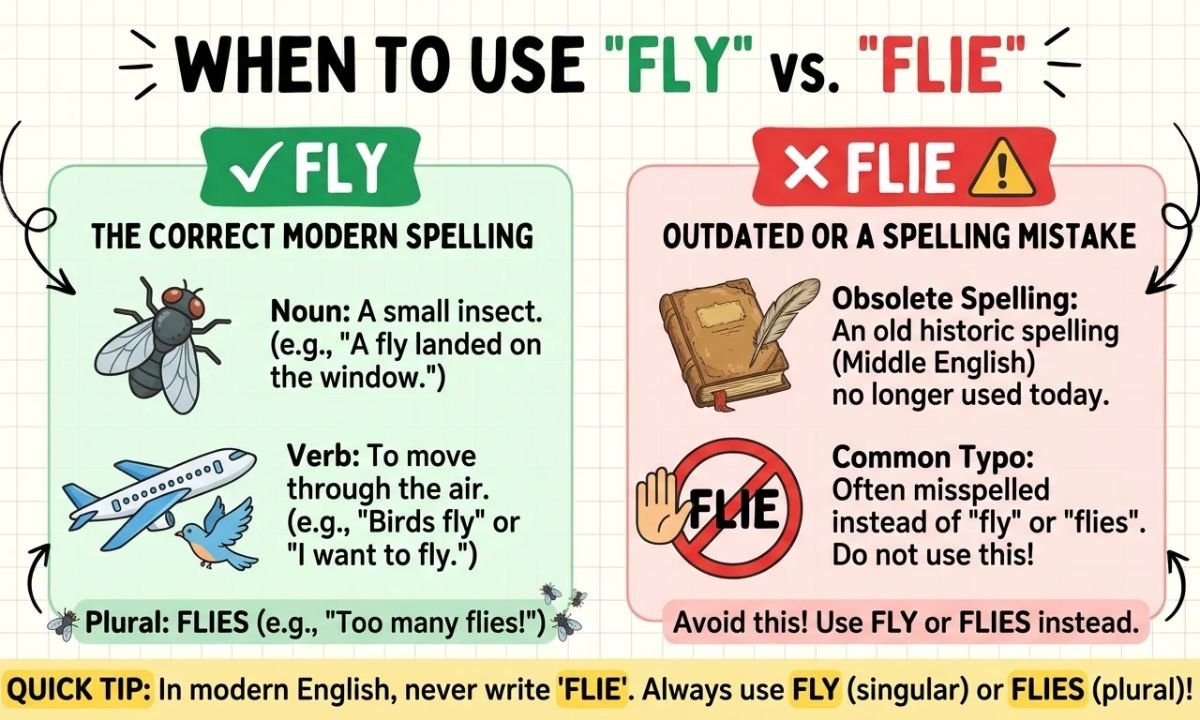
This one is easy.
- Use fly whenever you mean the insect, the action, or the base form of the verb.
- Use flies for more than one insect, or for he, she, and it.
- Never use flie. There is no correct situation for it in modern English.
If you are unsure, say the sentence out loud and check the form: base, plural, past, or participle. Then pick from the five correct words above.
Exercises With Answers
Choose the correct word to complete each sentence.
Question One
A small ______ was buzzing around the kitchen. (fly / flie)
Answer: fly
Question Two
Two ______ landed on the fruit. (flys / flies)
Answer: flies
Question Three
Yesterday, we ______ to Islamabad. (flew / flown)
Answer: flew
Question Four
She has ______ planes for ten years. (flew / flown)
Answer: flown
Question Five
He ______ to Lahore every Friday. (fly / flies)
Answer: flies
Frequently Asked Questions
Is flie a real word?
No. “Flie” is not a standard English word. It is a misspelling of fly or flies.
What is the correct spelling, flie or fly?
The correct spelling is fly.
What is the plural of fly?
The plural of fly is flies.
Is flys correct?
No. The correct form is flies for both the plural noun and the third-person verb.
What is the past tense of fly?
The past tense is flew. The past participle is flown.
Is flied ever correct?
Yes, but only in baseball. A player “flied out” when the ball is caught in the air.
What is the difference between flier and flyer?
Both are accepted. Flier is often used for a person who flies, and flyer for a printed leaflet.
Can fly be an adjective?
Yes. In slang, “fly” means stylish or cool. In older British use, it can mean clever or sharp.
Conclusion
The answer is clear: fly is correct, and flie is not. Remember the five main forms: fly, flies, flew, flown, and flying. The only time you will see “ie” is in “flies,” the plural noun and third-person verb.
Keep this guide handy, practice with the quiz, and check your writing before you publish. Small spelling choices like this make your work look sharper and more trustworthy.

The author is a professional content writer specializing in word meanings, definitions, and English vocabulary. With over 6 years of experience in language research and educational content creation, they produce accurate, well-researched, and reader-friendly articles.