
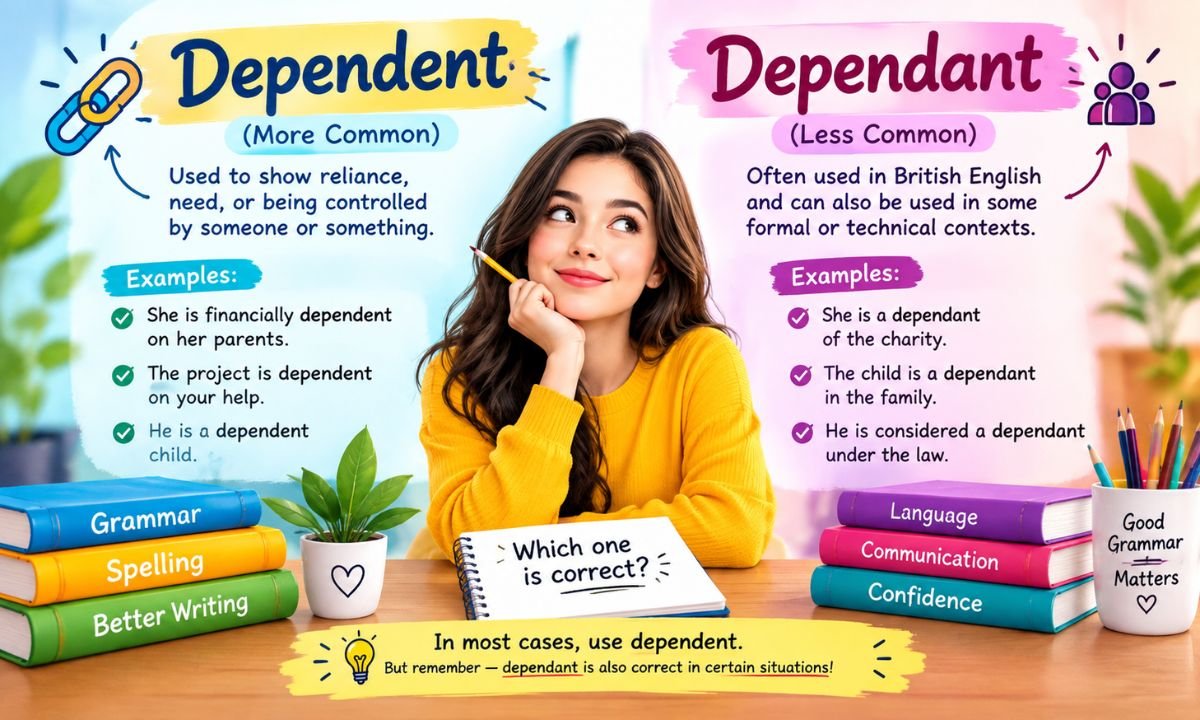
Dependent or dependant? Both spellings are real words, and the right one depends on where you write and how you use the word. In American English, “dependent” is the only spelling you need. In British English, “dependent” is the adjective and “dependant” is the traditional noun for a person who relies on someone else.
This guide acts like a grammar coach. You will get clear rules, side-by-side tables, real sentences and a short test. By the end, you will know which spelling to pick for emails, essays, tax forms and everyday chats.
What Does Dependent Mean?
“Dependent” describes something that relies on, or is controlled by, something else. It is also a noun in American English. As an adjective it means “reliant upon” or “determined by.”
- The plant is dependent on sunlight.
- Her mood was dependent on the weather.
What Does Dependant Mean?
“Dependant” is a noun. It means a person who relies on another person for support, usually money. Writers in British, Australian, Canadian and New Zealand English use it this way.
- He listed his wife and two children as dependants.
- The scheme covers employees and their dependants.
Dependent or Independent Variable With Examples
In science and maths, we always write “dependent variable.” The dependent variable is what you measure. The independent variable is what you change.
| Study | Independent Variable | Dependent Variable |
| Sleep and test scores | Hours of sleep | Test score |
| Fertilizer and plant growth | Amount of fertilizer | Plant height |
| Price and sales | Price of a product | Number sold |
Memory trick: the dependent variable depends on the independent one. Here the spelling is never “dependant,” because a variable is a thing, not a person.
Dependent or Dependant: What Is the Difference?
| Feature | Dependent | Dependant |
| Part of speech | Adjective (and US noun) | Noun |
| Meaning | Relying on something | A person who relies on someone |
| US English | Always used | Not used |
| UK English | Adjective | Noun (traditional) |
| Example | She is dependent on her parents. | She is her parents’ dependant. |
In short, “dependant” names a person, while “dependent” describes a relationship in which one thing relies on another.
When Should You Use Dependent?
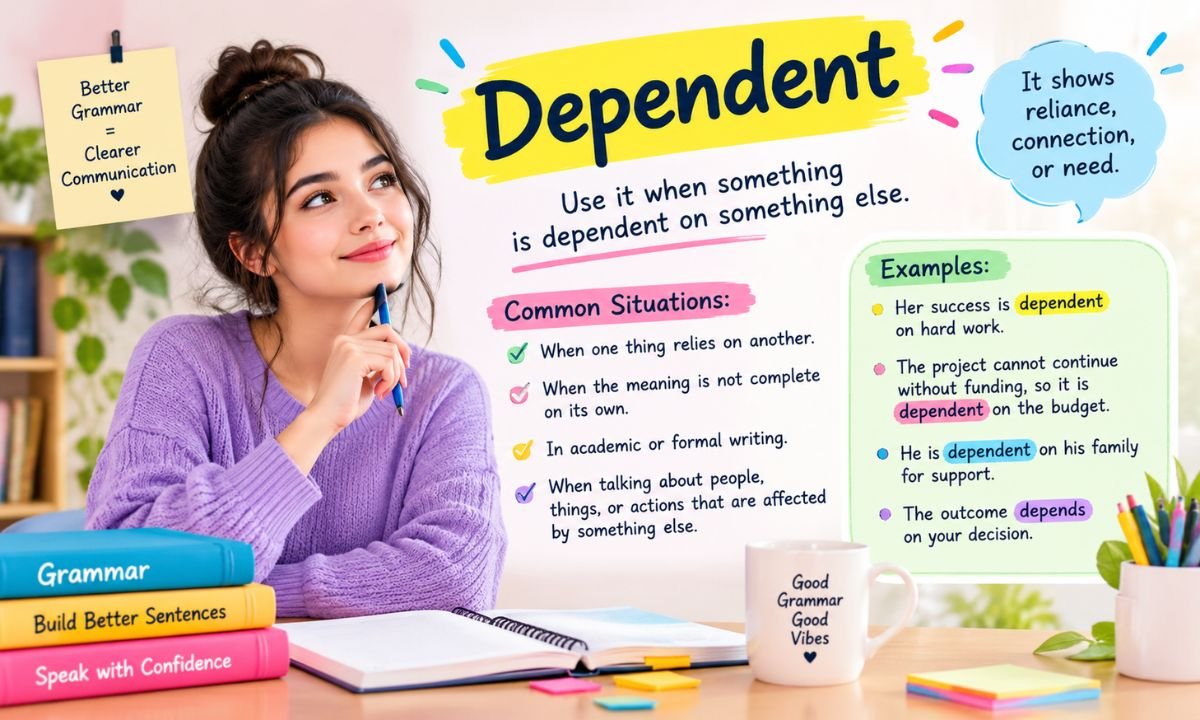
Use “dependent”:
- As an adjective in any variety of English
- As a noun in American English
- In science and maths (“dependent variable”)
- In grammar (“dependent clause”)
When Should You Use Dependant?
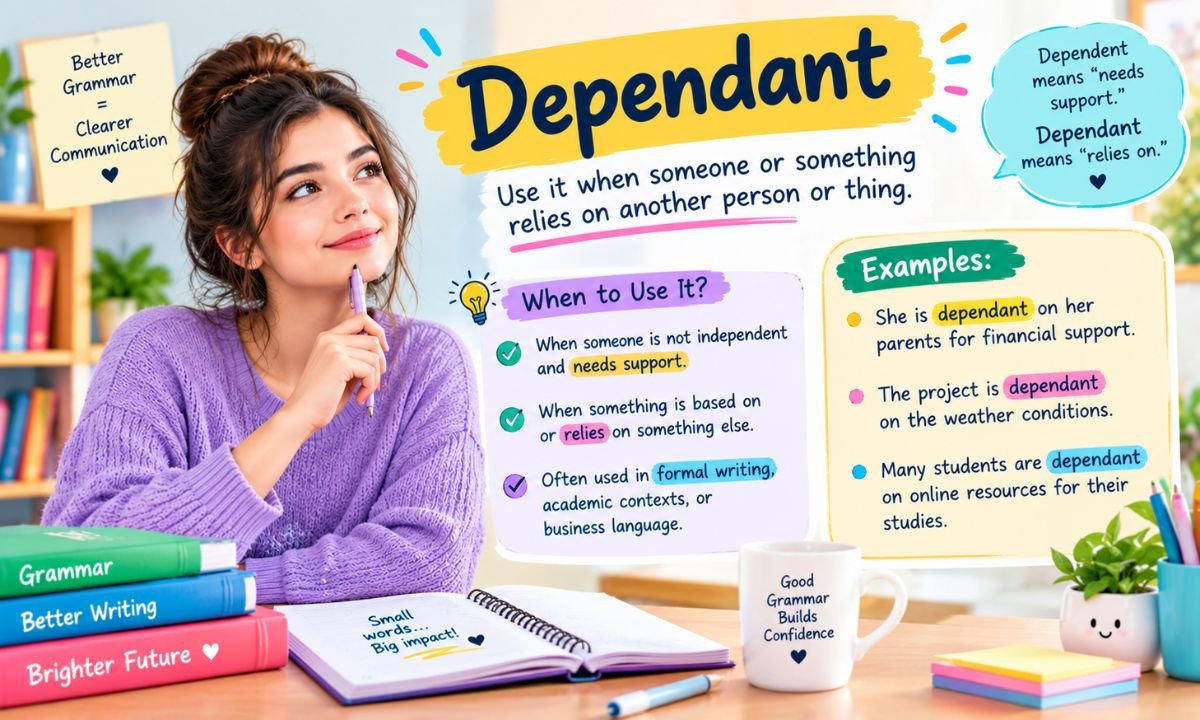
Use “dependant” only when:
- You write in British, Australian, Canadian or New Zealand English, and
- You mean a person who is supported by someone else.
If you are not sure, “dependent” is the safer choice. Many modern guides say “dependent” has become accepted even as a British noun, though “dependant” was historically preferred there.
Dependent as an Adjective
As an adjective, “dependent” is followed by “on” (or “upon”). It tells us what something relies on.
- Our plan is dependent on the budget.
- Young birds are dependent on their parents.
- Is the result dependent on luck?
Dependent as a Noun
In US English, a dependent is a person supported by someone else.
- She claimed her son as a dependent.
- Dependents may be covered by the health plan.
British writers would write “dependant” in these two sentences.
Common Phrases With Dependent
Dependent on
The standard pattern. “The outcome is dependent on the weather.” Avoid “dependent of,” which is wrong.
Financially dependent
Relying on someone for money. “Many students are financially dependent on their families.”
Emotionally dependent
Relying on someone for emotional comfort. “He became emotionally dependent on his partner.”
Completely dependent
Having no independence. “The village is completely dependent on tourism.”
Dependent variable
The outcome measured in an experiment. “Plant height is the dependent variable.”
Dependent in Work and Business
In business, “dependent” shows links between tasks, teams or money.
- The launch date is dependent on legal approval.
- Our revenue is heavily dependent on two clients.
- Project managers track “dependent tasks,” which cannot start until another task ends.
Dependent in Taxes and Benefits
Forms often ask for “dependents” (US) or “dependants” (UK). These are people you support financially, such as children or elderly parents.
- US: “Do you have any dependents?”
- UK: “Please list all dependants living with you.”
Rules on who counts differ by country, so check official guidance for your situation.
Dependent in Family Relationships
Here, the word shows who relies on whom.
- Newborns are fully dependent on their carers.
- She cared for her dependent mother.
- He is the sole breadwinner for three dependants. (UK)
Dependent in Science and Research
Science uses “dependent” for cause and effect. Besides the dependent variable, you may see “dependent on temperature” or “dose-dependent,” meaning the effect changes with the dose.
Dependent and Independent
These two words are opposites in most uses.
| Dependent | Independent |
| Relies on others | Stands alone |
| Controlled by another factor | Controls other factors |
| Dependent variable | Independent variable |
| Dependent clause | Independent clause |
Dependent vs Dependant in British English
British English keeps two spellings:
- Dependent = adjective (“She is dependent on her income.”)
- Dependant = noun (“She has two dependants.”)
Many dictionaries now list “dependent” as an alternative spelling, but keeping the two apart is still helpful for clarity.
Dependent vs Dependant in American English
American English uses “dependent” for everything. It has done so in all contexts since at least the mid-20th century. If your reader is in the US, never use “dependant.”
Why Do Dependent and Dependant Look Different?
English has many words ending in either “-ant” or “-ent,” from the French and Latin roots behind them. Pairs like “defendant” and “descendant” kept their “-ant” form, while many others took “-ent.” Over time, British English let “dependant” mark the noun and “dependent” mark the adjective. American English dropped that split for simplicity. The words sound the same, so only spelling shows the difference.
Common Mistakes With Dependent and Dependant
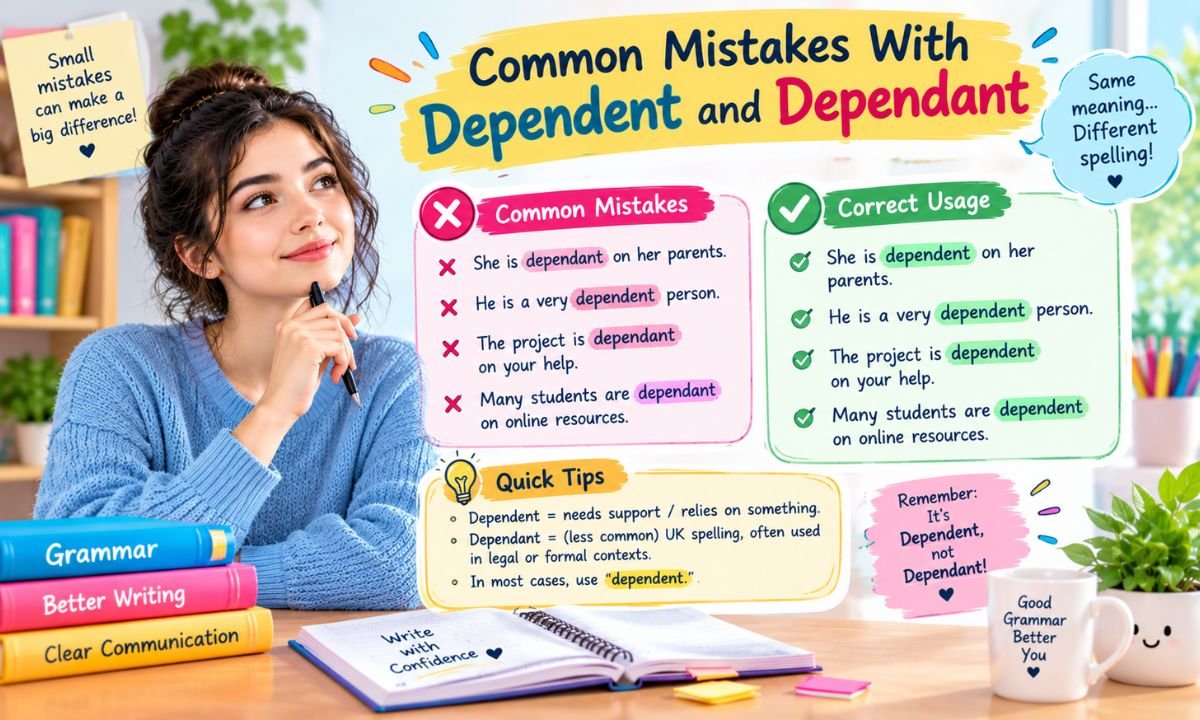
- ❌ “She is dependant on her parents.” ✅ She is dependent on her parents.
- ❌ “Dependent of the weather.” ✅ Dependent on the weather.
- ❌ Using “dependant” in US writing.
- ❌ Writing “dependant variable.” ✅ Dependent variable.
- ❌ Mixing both spellings in one document.
Dependent or Dependant in Formal Writing
In formal documents, stay consistent with one English variety. For UK contracts, policies and visa forms, use “dependant” for people and “dependent” for the adjective. For US forms and reports, use “dependent” throughout. Check your style guide or your client’s preference.
Dependent or Dependant in Everyday Conversation
When you speak, the two words sound identical: dih-PEN-dent. In texts and emails, most people simply use “dependent.” If you spell it that way, few readers will complain.
Dependent in Academic Writing
Academic writing needs precision. Use:
- “dependent variable” in methods and results
- “dependent clause” in linguistics
- “dependent on” with a clear cause
For an essay with a UK audience, “dependants” is correct for people. When in doubt, follow your university’s style guide.
How to Remember the Difference
Try these tricks:
- Ant = a person. “Dependant” ends in “-ant,” like “assistant” and “applicant,” which are people.
- Ent = a description. “Dependent” ends in “-ent,” like “different” and “excellent,” which are describing words.
- Safe default. “Dependent” will always work, so avoid “dependant” unless you are sure.
Examples of Dependent in Sentences
- The festival is dependent on good weather.
- Her success was dependent on hard work.
- Babies are dependent on adults for everything.
- The dependent variable changed after treatment.
- A dependent clause cannot stand alone.
- He claimed one dependent on his tax return. (US)
Examples of Dependant in Sentences
- The visa covers the applicant and any dependants.
- She has three dependants to support.
- Employers must consider staff with dependants.
- He is her only dependant.
- The insurance pays a benefit to the worker’s dependants.
Quick Grammar Test
Ask yourself two questions:
- Is it a person? If yes, British writers use “dependant.”
- Is it describing something? If yes, use “dependent.”
If you write for the US, skip the test and use “dependent.”
Practice: Dependent or Dependant?
Fill in the blank with the right word (UK English).
- The company’s profits are ______ on exports.
- He has two ______ at home.
- The ______ variable is test score.
- Please list all ______ on the form.
- She is financially ______ on her sister.
Answers
- dependent (adjective)
- dependants (person)
- dependent (variable is a thing)
- dependants (people)
- dependent (adjective)
Dependent or Dependant: Which One Should You Choose?
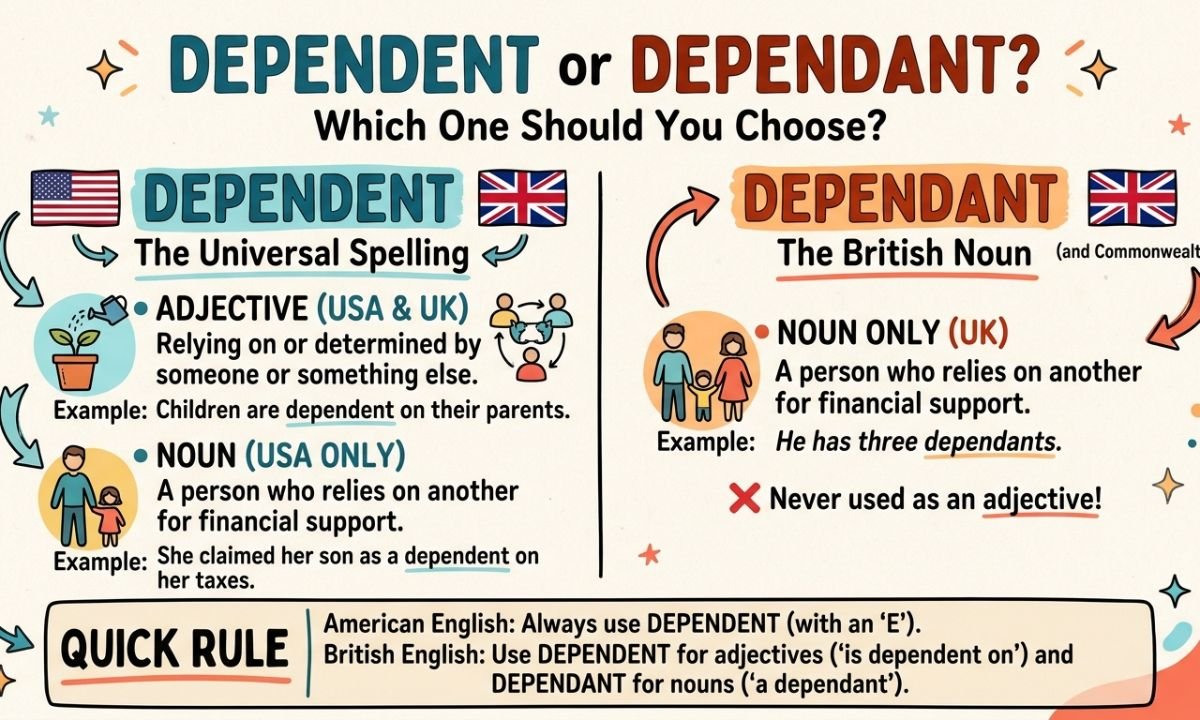
Use this quick guide:
| Your Situation | Best Choice |
| Writing for a US audience | Dependent |
| UK adjective | Dependent |
| UK noun for a person | Dependant |
| Science, maths, grammar | Dependent |
| You’re unsure | Dependent |
Dependent or Dependant UK English
In UK English, follow the split: “dependent” for adjectives and “dependant” for people. Example: “Those who are dependent on benefits may have dependants to support.” Both words appear in one sentence, and each has its own job.
Dependent or Dependant Synonym
| Word | Used For | Example |
| Reliant | Adjective | He is reliant on his phone. |
| Contingent | Adjective | The deal is contingent on approval. |
| Subject to | Phrase | The offer is subject to contract. |
| Conditional | Adjective | A conditional offer. |
| Ward / charge | Noun | The guardian and her ward. |
| Supported person | Noun | A supported family member. |
Opposites: independent, self-sufficient, self-reliant.
Final Tips for Using Dependent and Dependant
- Pick one English variety and stay with it.
- Use “dependent on,” not “dependent of.”
- Check your style guide for forms and contracts.
- Read your text aloud, then check spelling.
- Run spellcheck set to the right language (US or UK).
Grammar Rules
- “Dependent” is an adjective. It describes a noun and takes “on.”
- “Dependant” is a noun (UK). It names a person.
- “Depend” is the verb. “Success depends on effort.”
- “Dependence” is the noun for the state. “Her dependence on coffee.”
- “Dependency” can mean a territory or an addiction.
- A dependent clause has a subject and a verb but cannot stand alone. “Because it rained” is dependent. “We stayed home” is independent.
FAQs
Is it dependent or dependant?
Use “dependent” for adjectives everywhere. Use “dependant” only for a person in British English.
Is dependant spelled correctly?
Yes, but mostly in British, Australian, Canadian and New Zealand English as a noun.
What is the difference between dependent and dependant?
“Dependent” describes reliance. “Dependant” names the person who relies on someone.
Do Americans use dependant?
No. American English uses “dependent” for both the adjective and the noun.
Is it “dependent on” or “dependent of”?
“Dependent on” is correct. “Dependent of” is a mistake.
Is it dependent variable or dependant variable?
It is always “dependent variable.”
Can dependent be a noun?
Yes, in American English it means a person supported by someone else.
Is dependants plural?
Yes. “Dependants” is the plural of the UK noun.
Which spelling is safest?
“Dependent” is safest when you are unsure.
Conclusion
“Dependent” is your main tool. It works as an adjective in all English, as a noun in US English, and in science and grammar. “Dependant” is a UK-style noun for a person who relies on someone else. Keep the two apart for British readers, and use “dependent” everywhere else.
Match the spelling to your audience, stay consistent, and use “dependent on” with the preposition. With these rules and the quick test above, you can choose the right spelling in seconds.

The author is a professional content writer specializing in word meanings, definitions, and English vocabulary. With over 6 years of experience in language research and educational content creation, they produce accurate, well-researched, and reader-friendly articles.