
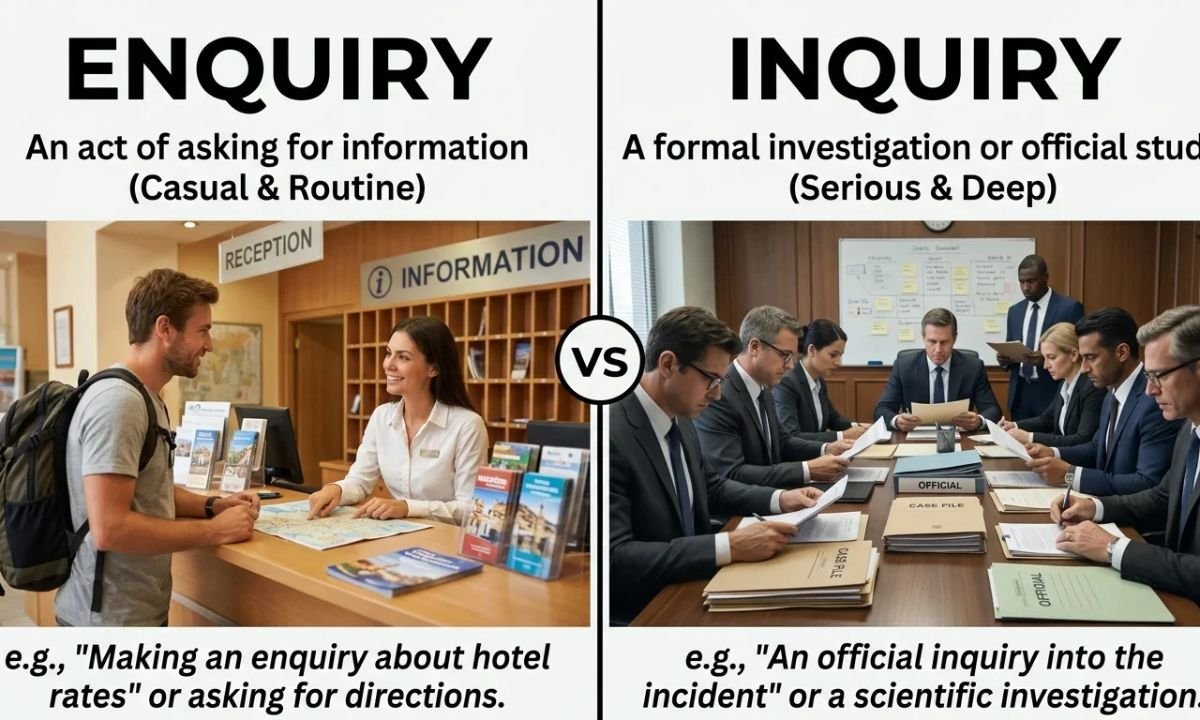
Enquiry vs. inquiry is one of those word pairs that trips up even confident writers. Both words mean an act of asking or investigating, and both come from the same Latin root. The real difference is mostly about region and tone: Americans use inquiry for everything, while British writers often split the two. This guide shows you which one to pick and when.
You will find clear definitions, examples, and a simple comparison table. We also cover business emails, customer service, and SEO, because that is where most people get stuck. Read on and you will never second-guess your spelling again.
Enquiry or Inquiry: Which One Is Correct?
Both are correct. They are two spellings of the same noun, and the choice depends on your audience.
- American English: use inquiry.
- British English: use inquiry for a formal investigation and enquiry for a general question.
- Canadian English: it leans toward the American style but allows both.
If you are unsure, inquiry is the safer pick worldwide.
Inquiry or Enquiry With Examples
Examples make the pattern easy to see.
- The police opened an inquiry into the missing funds.
- The hotel received an enquiry about weekend rooms. (British)
- I sent an inquiry about the job opening. (American)
- The government will hold a public inquiry next month.
Enquiry or Inquiry Synonym
Several words can stand in for these two, depending on the sentence.
- Question
- Query
- Request for information
- Investigation
- Probe
- Examination
- Research
Pick the synonym that matches the tone. “Probe” feels strong, while “question” feels casual.
What Does Inquiry Mean?
Inquiry is a noun. It means a request for information, or a formal investigation into something. In the US, it covers both meanings.
It can describe a polite question (“a customer inquiry”) or an official process (“a congressional inquiry”). Its verb form is inquire.
What Does Enquiry Mean?
Enquiry is the other spelling of the same noun. In British English, it usually means a simple question or request for details. Its verb form is enquire.
You will see it on UK shop pages, hotel sites, and “contact us” forms.
Enquiry or Inquiry or Query
A query is a close cousin. It is a question, often short and direct. In tech, a query can also be a search request sent to a database.
| Word | Typical Use | Tone |
| Inquiry | Questions or investigations | Neutral to formal |
| Enquiry | General questions (UK) | Neutral |
| Query | Short question, data request | Neutral to technical |
Inquiry in American English
In the US, inquiry is the standard spelling. Dictionaries and style guides prefer it, and many Americans see “enquiry” as a typo.
American writers use the word for both a polite question and an official probe. There is no split in meaning.
Enquiry in British English
British English keeps both forms. Enquiry usually points to an everyday question, while inquiry points to a formal process. This split is common but not a strict rule.
So a shop may have an “enquiries desk,” but the government launches a “public inquiry.”
Inquiry vs Enquiry in Business Writing
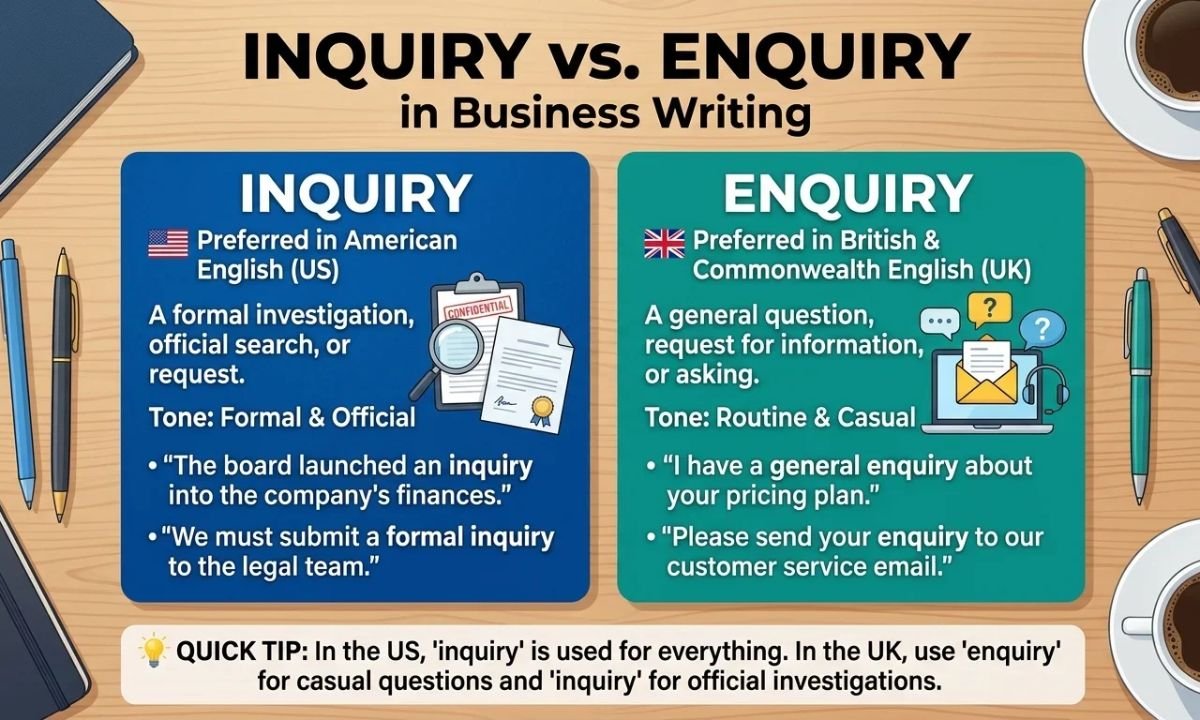
In business writing, match your reader. For global or US-based audiences, inquiry is smoother. For UK, Indian, or Australian audiences, enquiry looks natural.
Keep one spelling throughout a document. Switching halfway looks careless.
Inquiry or Enquiry for Customer Service?
For customer service, both work. Use the spelling your customers expect.
- US company: “customer inquiry”
- UK company: “customer enquiry”
What matters most is a fast, helpful reply, not the spelling.
Inquiry or Enquiry in Email Writing
In emails, a short subject line helps. Examples include “Product inquiry” or “Enquiry about pricing.” Open politely and state what you want to know.
A simple template: “I am writing to inquire about the availability of the item. Could you please confirm the price and delivery time?”
Inquiry as a Formal Investigation
This is the serious meaning. A formal inquiry is an official process that looks into events, decisions, or wrongdoing.
- A public inquiry
- A judicial inquiry
- A parliamentary inquiry
British English uses inquiry (not enquiry) for these cases.
Inquiry as a Simple Question
In everyday use, inquiry is just a question asked politely. “She made an inquiry about the bus schedule” is perfectly normal, especially in the US.
Inquiry and Question: Are They the Same?
They are close, but not identical. A question is any request for an answer. An inquiry sounds more formal and often implies a request for specific details or a deeper look.
Inquiry and Investigation: What Is the Difference?
An inquiry can be light or serious. An investigation is almost always a careful, detailed search for facts, often by an official body.
| Term | Depth | Example |
| Inquiry | Light to formal | An inquiry about a refund |
| Investigation | Detailed, structured | A fraud investigation |
Common Mistakes With Enquiry and Inquiry
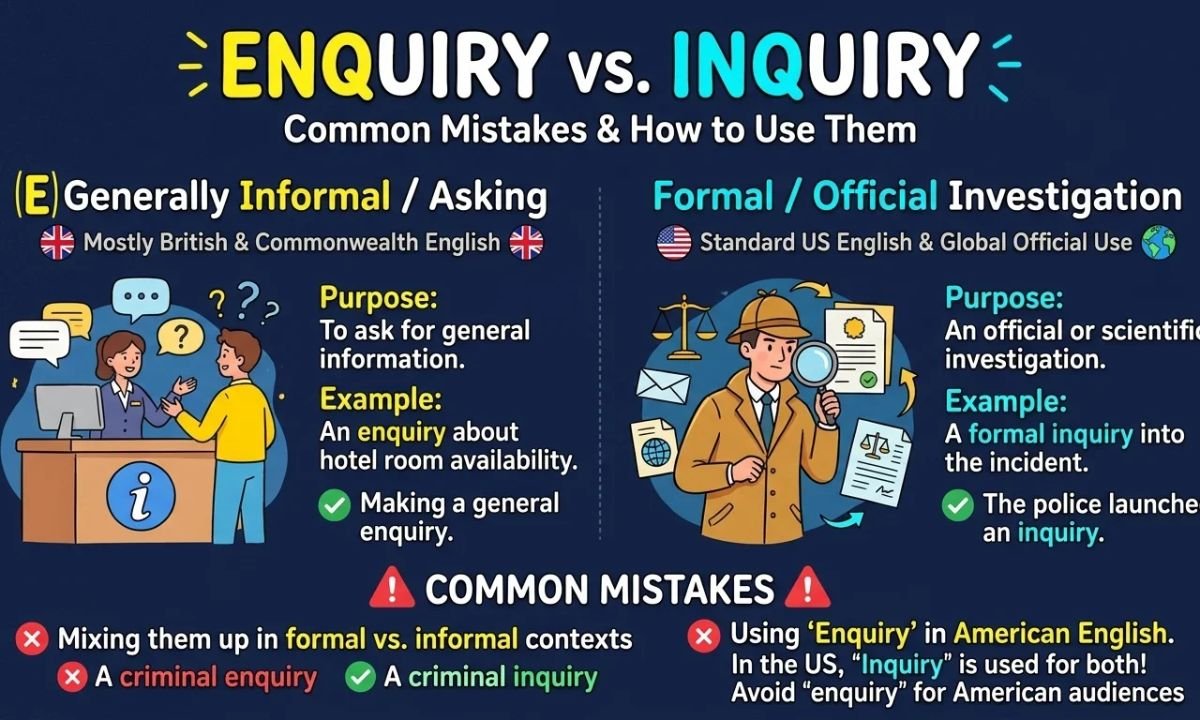
- Mixing both spellings in one document
- Using enquiry for a formal investigation in British writing
- Writing “inquire” and “enquiry” together by accident
- Using “inquiry” when you simply need “question”
- Forgetting the plural: inquiries or enquiries
Inquiry, Inquiries, Inquire, and Inquiring
This word family is simple once you see it in one place.
| Form | Part of Speech | Meaning |
| Inquiry | Noun | A question or investigation |
| Inquiries | Noun (plural) | More than one inquiry |
| Inquire | Verb | To ask for information |
| Inquired | Verb (past) | Asked |
| Inquiring | Adjective or verb | Curious, or in the act of asking |
Examples
- She sent an inquiry about the course.
- The office handled ten inquiries today.
- I will inquire about the delivery date.
- He inquired politely about the price.
- She has an inquiring mind.
How to Remember the Difference
Here is a quick trick. Think I for Investigation: inquiry with an I fits formal investigations. Think E for Everyday: enquiry with an E fits ordinary questions.
If you write for Americans, skip the trick and use inquiry every time.
Real-World Examples of Inquiry

Customer Service
“We received your inquiry and will reply within 24 hours.”
Business
“Thank you for your inquiry about our bulk pricing.”
Education
“Inquiry-based learning helps students ask better questions.”
Employment
“I am writing to inquire about the open marketing role.”
Media
“For press inquiries, please contact our media team.”
Shopping
“I made an inquiry about the size and color options.”
Travel
“Please send your inquiry for tour packages and flight deals.”
Government
“The committee opened an inquiry into public spending.”
Common Phrases With Inquiry
These phrases appear often on websites and in emails.
Customer Inquiry
A question or request from a customer about a product, order, or service.
General Inquiry
A broad question that does not fit a specific category. Many contact forms use this option.
Sales Inquiry
A question from a potential buyer who wants pricing, demos, or details.
Media Inquiry
A request from a journalist or publisher for comments, interviews, or information.
Product Inquiry
A question about features, price, stock, or specifications of a product.
Further Inquiry
An extra question or a deeper look. For example: “The case requires further inquiry.”
Is Inquiry More Professional Than Question?
Often, yes. Inquiry sounds a bit more formal and polished, which suits business emails and official notices. In casual chat, “question” feels more natural.
Use the tone that fits your reader.
Enquiry or Inquiry for SEO?
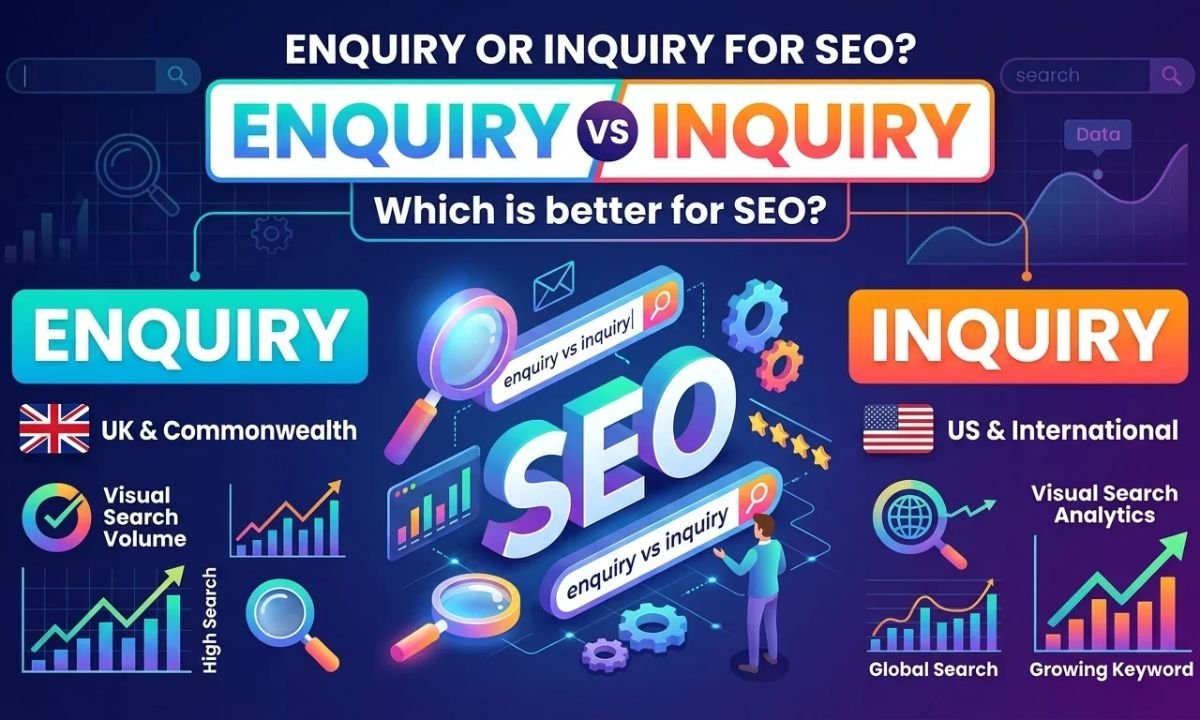
Search engines treat both spellings as close variants, but people still search for them differently. Many US searchers type “inquiry,” while many UK, Indian, and Commonwealth searchers type “enquiry.”
- Use the spelling your main audience uses.
- You can include the second spelling once in a natural place, such as a form label or FAQ.
- Do not repeat both words just to catch traffic.
Clear, helpful content beats keyword tricks every time.
Practice: Choose the Correct Word
Pick the best word for each sentence (American English unless noted).
- The senator called for a formal ______ into the issue. (inquiry / enquiry)
- She wrote an ______ about the room rates. (inquiry / enquiry)
- I would like to ______ about your return policy. (inquire / enquire)
- The UK shop had a lot of ______ about opening times. (enquiries / inquiries)
- A judge launched an ______ into the incident. (inquiry / enquiry)
Answers
- inquiry
- inquiry (enquiry is also fine in British English)
- inquire (enquire is also fine in British English)
- enquiries (inquiries is also acceptable)
- inquiry
Enquiry or Inquiry: A Simple Comparison
| Feature | Inquiry | Enquiry |
| Main region | US, global business | UK, Commonwealth |
| Common meaning | Question or investigation | General question |
| Formal investigation | Yes | Less common |
| Verb form | Inquire | Enquire |
| Plural | Inquiries | Enquiries |
Which Spelling Should You Use?
Follow your audience.
- Writing for Americans? Use inquiry.
- Writing for British readers? Use enquiry for questions and inquiry for investigations.
- Writing for a global audience? Choose inquiry.
- Following a style guide? Do what it says.
Final Tips for Using Inquiry and Enquiry
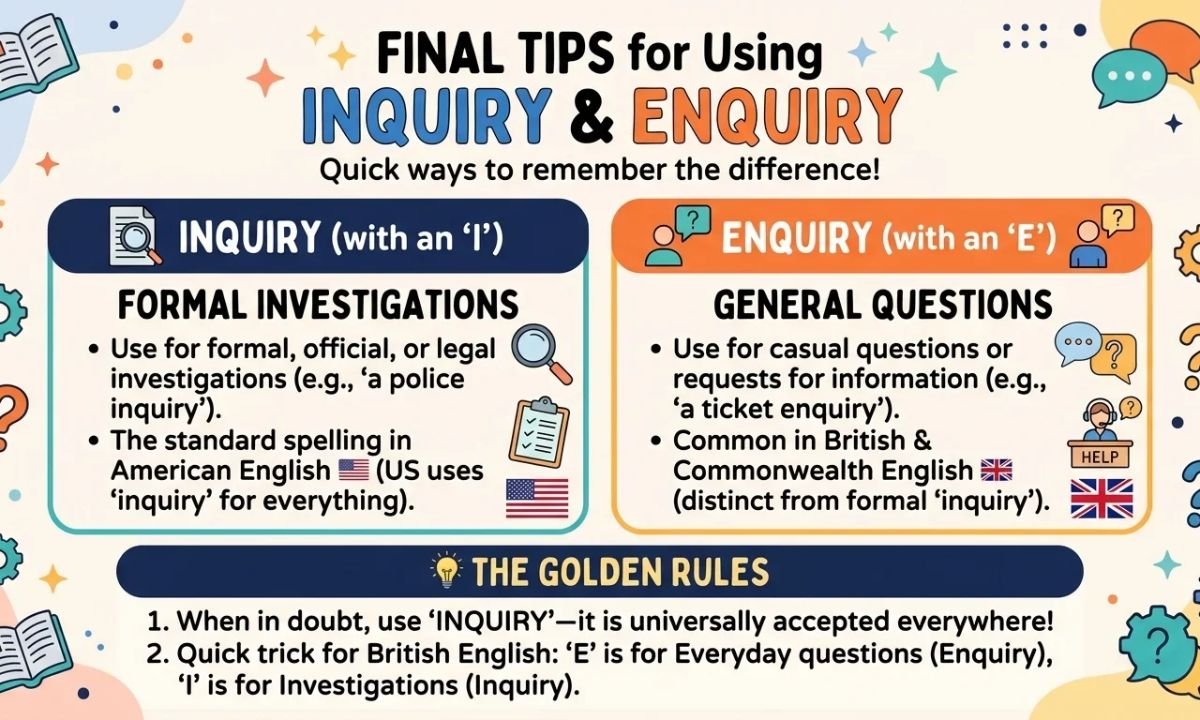
- Stay consistent in each piece of writing.
- Match the verb and noun forms (inquire with inquiry, enquire with enquiry).
- Use “inquiry” for formal probes.
- Choose simpler words, like “question,” for casual writing.
- Use a spell checker set to the right English variant.
Grammar Rules
- Both words are nouns. Inquire and enquire are verbs.
- They can be countable: one inquiry, two inquiries.
- Common prepositions are into (investigation) and about or regarding (question).
- Pair them with polite verbs: make, send, receive, handle, open.
- Do not mix the spelling forms in the same text.
Frequently Asked Questions
Is it enquiry or inquiry?
Both are correct. Use inquiry in American English and enquiry for general questions in British English.
What is the difference between enquiry and inquiry?
There is little difference in meaning. British writers often use inquiry for formal investigations and enquiry for simple questions.
Which is more common?
Inquiry is more common worldwide, especially in the US.
Is enquiry wrong in American English?
It is not wrong, but it is rare. Many Americans see it as a spelling mistake.
Is inquire the same as enquire?
Yes. They are two spellings of the same verb that means to ask for information.
Can I use inquiry in British English?
Yes. It is especially common for official investigations and public inquiries.
What is a good synonym for inquiry?
Good options include question, query, request, probe, and investigation.
Conclusion
Enquiry vs. inquiry comes down to audience and tone. Inquiry is the safe choice in the US and in global writing, while enquiry still has a place for everyday questions in British English.
Pick one spelling, keep it consistent, and match your reader. That is all you need to write with confidence.

The author is a professional content writer specializing in word meanings, definitions, and English vocabulary. With over 6 years of experience in language research and educational content creation, they produce accurate, well-researched, and reader-friendly articles.