
The difference between worse and worst is simple. “Worse” compares two things. “Worst” picks the lowest one out of three or more. Both words come from “bad,” but they work at different levels.
Many people mix them up because they look and sound alike. When we speak fast, the “t” in “worst” often disappears, so the two words blur together. This guide explains both words in plain English, with examples, a table, and a quick quiz to test yourself.
What Does Worse Mean?
“Worse” is the comparative form of “bad.” It means more bad, lower in quality, or in a poorer condition than something else. You use it when you compare two things, or when something gets bad over time.
- My cold is worse today.
- This road is worse than the highway.
- The pain got worse after lunch.
“Worse” can also work as an adverb (“He sings worse than I do”) and as a noun (“a change for the worse”).
What Does Worst Mean?
“Worst” is the superlative form of “bad.” It means the most bad, the lowest in quality, or the most severe. You use it when you compare three or more things, or when you name an extreme.
- That was the worst movie I have seen this year.
- She had the worst score in the class.
- The worst is over.
“Worst” can be an adjective, an adverb (“the worst-hit area”), or a noun (“fear the worst”). It is also a rare verb meaning to defeat someone.
Worse vs Worst: The Main Difference
| Feature | Worse | Worst |
| Form | Comparative | Superlative |
| Compares | Two things | Three or more things |
| Meaning | More bad than another | The most bad of all |
| Often paired with | “than” | “the” |
| Example | This one is worse than that one. | This is the worst one of all. |
Bad, Worse, and Worst
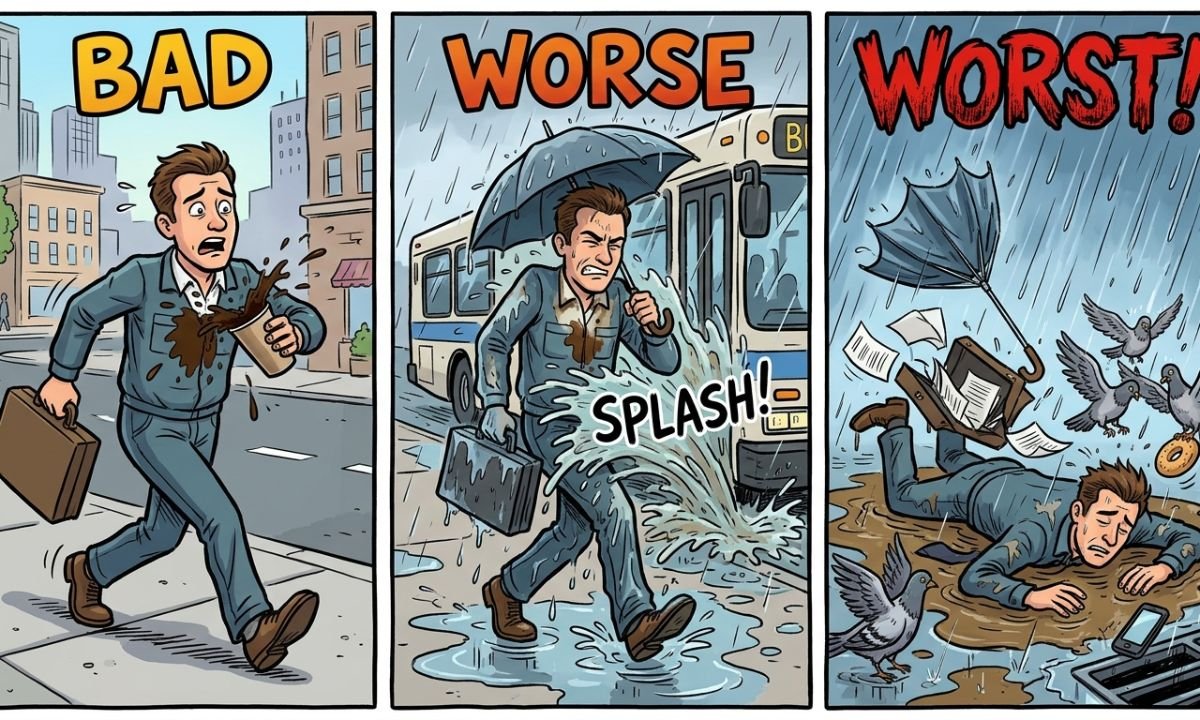
These three words are one family. They show three levels of badness.
Bad
“Bad” is the base form. It describes quality on its own, with no comparison. Example: “The coffee is bad.”
Worse
“Worse” is the middle step. It sets one thing against another. Example: “The tea is worse than the coffee.”
Worst
“Worst” is the top step. It marks the lowest point in a group. Example: “The juice is the worst drink on the menu.”
Think of it as a ladder: bad → worse → worst. The good side works the same way: good → better → best. These are irregular adjectives, so you never write “badder” or “baddest.”
When Should You Use Worse?
Use “worse” in these cases:
- You compare two people, places, or things.
- Something gets lower in quality over time.
- You follow it with “than.”
- You describe a person’s health or mood getting poorer.
Example: “The traffic is worse than it was yesterday.”
When Should You Use Worst?
Use “worst” in these cases:
- You pick the lowest one from a group of three or more.
- You describe an extreme or the most severe case.
- You put “the” or “my/his/her” before it.
Example: “This is the worst storm in ten years.”
Worse Than
“Worse than” is the standard pattern for comparing two things.
- Today’s exam was worse than the last one.
- Waiting is worse than knowing the result.
The word “than” is your clue. If a sentence has “than,” you almost always need “worse.”
The Worst
“The worst” works like a title for the lowest item in a group.
- He is the worst driver I know.
- That was the worst day of my week.
The word “the” is your second clue. It points to one standout item, which signals “worst.”
Worst Than Is Incorrect
“Worst than” is always wrong. Because “than” sets up a comparison between two things, you need the comparative form.
- ❌ This plan is worst than the old one.
- ✅ This plan is worse than the old one.
Worse or Worst With “Ever”
When you say “ever,” you are looking at everything in the past. That calls for “worst.”
- This is the worst meal I have ever had.
But if you compare only two things, “worse” still wins.
- This meal is worse than any I have ever had.
Worse Than Before
This phrase shows decline over time. It compares a past state with a present one.
- My internet is worse than before the update.
- Things got worse than before.
Worse Than Expected
Here, reality is compared with what you hoped for. Again, two things are compared.
- The test results were worse than expected.
- Sales came in worse than expected this quarter.
Worst Case Scenario
The correct phrase is “worst-case scenario.” It means the most negative outcome that could happen.
- In the worst-case scenario, the flight gets cancelled.
“Worse case scenario” is a common error. There is only one worst case, so use the superlative.
Prepare for the Worst
Here “worst” is a noun. It means the most terrible outcome.
- Hope for the best, but prepare for the worst.
- Don’t fear the worst before you know the facts.
If Worse Comes to Worst
This idiom means “if the situation gets as bad as it can.” Dictionaries list “if worse comes to worst” and “if worst comes to worst” as acceptable. The first version is more common.
- If worse comes to worst, we can take a taxi.
For Better or Worse
This phrase means “no matter if the result is good or bad.” Here, “worse” is a noun.
- For better or worse, the plan is now final.
- He stood by her for better or for worse.
Worse or Worst Synonyms
Looking for other words? Here are some options.
Synonyms for worse: poorer, inferior, lower, weaker, more severe, more serious, deteriorated
Synonyms for worst: lowest, poorest, most terrible, most severe, least acceptable, most awful
Worse in Everyday Conversation
In daily talk, “worse” often describes feelings, health, and situations.
- “I feel worse than yesterday.”
- “Traffic got worse after the rain.”
- “It could be worse.”
“It could be worse” is a friendly way to find a bright side.
Worst in Everyday Conversation
People use “worst” to complain, joke, or exaggerate.
- “That’s the worst!”
- “Monday mornings are the worst.”
- “He’s the worst at keeping secrets.”
Worse or Worst With Problems
Use “worse” when a problem grows. Use “worst” when you name the biggest one.
- The leak got worse overnight.
- The worst problem is the lack of staff.
Worse or Worst With Experiences
For personal experiences, “worst” is common because we rank memories.
- That was the worst trip of my life.
- The second hotel was worse than the first.
Common Mistakes With Worse and Worst
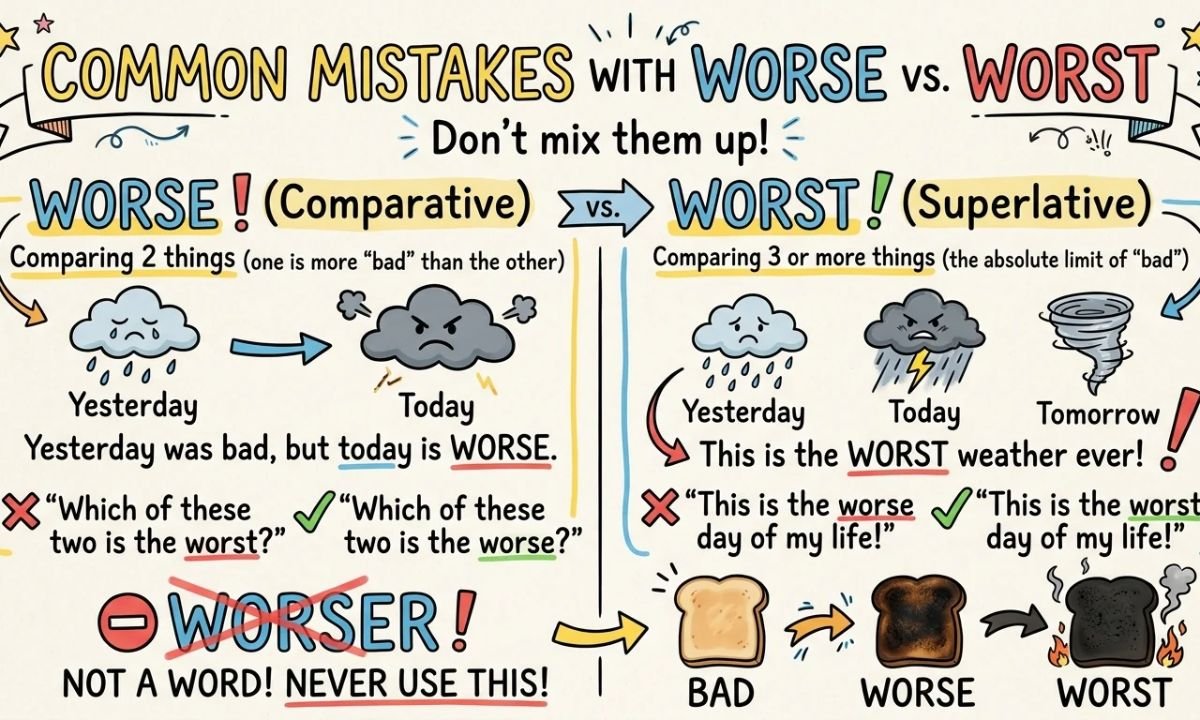
Mistake One: Worst Than
- ❌ He plays worst than me.
- ✅ He plays worse than me.
Mistake Two: Worse of All
“Of all” signals a group, so you need the superlative.
- ❌ This is the worse of all.
- ✅ This is the worst of all.
Mistake Three: Using Worst for Two Things
If only two things are in play, don’t use “worst.”
- ❌ Of the two options, this is the worst.
- ✅ Of the two options, this is the worse.
Mistake Four: Using Worse for the Lowest Ranking
- ❌ She ranked worse in the whole school.
- ✅ She ranked worst in the whole school.
Worse or Worst When Comparing Two Things
Stick with “worse.” Two items mean one comparison.
- The first draft is worse than the second.
- Rain is worse than snow for this road.
Note: Formal grammar says “the worse of the two.” You may see this in careful writing.
Worse or Worst When Comparing Three or More Things
Switch to “worst.” One item must stand at the bottom of the list.
- Of the three phones, this one has the worst battery.
- She picked the worst seat in the hall.
Worse Can Describe Change Over Time
“Worse” fits anything that is moving in the wrong direction. It works like a before-and-after photo.
- His cough is getting worse.
- The situation went from bad to worse.
- Prices are getting worse each year.
Worst Can Describe an Extreme Situation
“Worst” fits peaks and records. It often appears in news headlines.
- The worst flood in fifty years hit the city.
- This is the worst-hit region.
- The worst of the heat is expected at noon.
Worse vs Worst in a Sentence
Example # 1
“The weather was bad on Monday, worse on Tuesday, and the worst on Wednesday.”
This one sentence shows the full ladder in order.
Example # 2
“My old laptop is slow, but my brother’s is worse. Our dad’s laptop is the worst of the three.”
A Simple Memory Trick
Here are two quick tricks you can keep in mind.
- Match the ending. “Worst” ends in st, just like “best” and “most.” All three are superlatives, so they point to the top (or bottom) of a group.
- Look for “than” and “the.” “Than” goes with “worse.” “The” goes with “worst.”
Practice Questions
Choose the correct word. Answers are below.
- This soup is ______ than the last one.
- That was the ______ day of my life.
- His cough got ______ at night.
- Of all my classes, math is the ______.
- If ______ comes to worst, we will walk home.
Answers: 1. worse, 2. worst, 3. worse, 4. worst, 5. worse (or worst)
Quick Comparison Examples
| Worse | Worst |
| My headache is worse now. | This is the worst headache I’ve had. |
| He is worse at chess than me. | He is the worst chess player here. |
| The roads are worse in winter. | Winter has the worst roads of all seasons. |
| It got worse than before. | It was the worst thing that could happen. |
Worse or Worst in Questions
In questions, check how many things you compare.
- Which is worse, rain or snow? (two things)
- Which is the worst season for travel? (many things)
- Is this worse than last time? (two moments)
- What’s the worst that could happen? (an extreme)
Worse or Worst in Formal Writing
Academic and business writing needs accuracy. Avoid casual exaggeration like “the worst!” Use precise terms instead.
- The results were worse than the control group’s.
- This is the worst-performing region in the report.
Hyphenate “worst-performing” and “worst-case” when they come before a noun.
Worse or Worst in Professional Communication
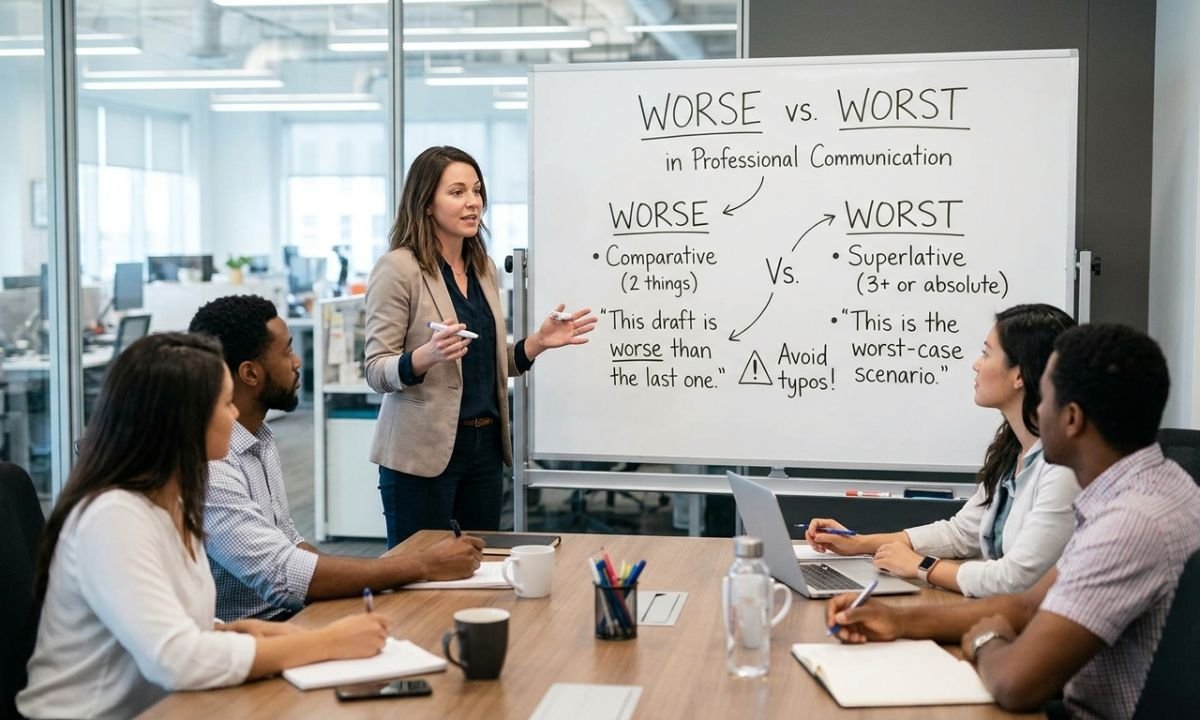
In emails, reports, and presentations, a wrong word can hurt your credibility. A manager who writes “worst than expected” may lose trust over a single typo.
- Sales were worse than forecast.
- We must prepare for the worst-case outcome.
- This is our worst quarter on record.
Read your message once for “than” and “the” before you hit send.
Final Tips
- Count what you compare: two means “worse,” three or more means “worst.”
- “Than” almost always pairs with “worse.”
- “The” almost always pairs with “worst.”
- Never write “worst than.”
- Remember the ladder: bad → worse → worst.
Frequently Asked Questions
Is it worse or worst?
Use “worse” to compare two things and “worst” for the lowest of three or more.
What is the difference between worse and worst?
“Worse” is the comparative form of “bad,” while “worst” is the superlative form.
Is “worst than” correct?
No. Write “worse than,” because “than” needs the comparative form.
Is it worse case or worst case?
It is “worst case.” The phrase “worst-case scenario” refers to the most negative possible outcome.
Is it “if worse comes to worst” or “if worst comes to worst”?
Both are accepted, but “if worse comes to worst” is more common.
Can worse be a noun?
Yes. In phrases like “for better or worse” and “a change for the worse,” it works as a noun.
What is the opposite of worse and worst?
The opposite of “worse” is “better,” and the opposite of “worst” is “best.”
Is “more worse” correct?
No. “Worse” is already comparative, so adding “more” is a double comparison.
Conclusion
The difference between worse and worst comes down to how many things you compare. Use “worse” for two things or for a decline over time. Use “worst” for the lowest of three or more, or for an extreme. Keep “than” with “worse” and “the” with “worst,” and you will rarely go wrong. A little practice makes the choice automatic.

The author is a professional content writer specializing in word meanings, definitions, and English vocabulary. With over 6 years of experience in language research and educational content creation, they produce accurate, well-researched, and reader-friendly articles.