
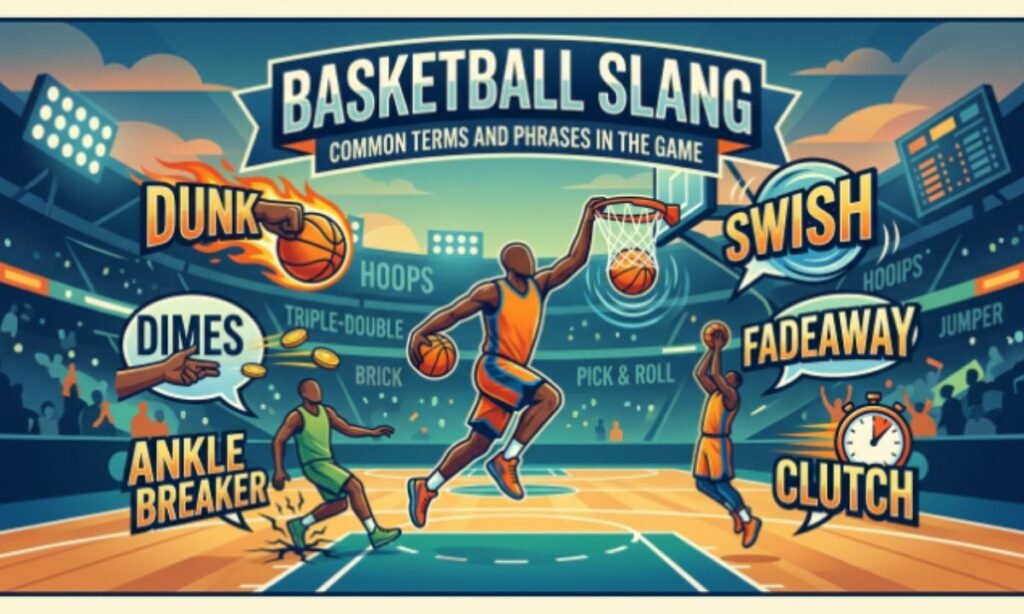
Watch any basketball game, pickup run, or NBA 2K stream for five minutes and you’ll hear words that have nothing to do with the official rulebook. Someone gets “cooked,” a pass is called a “dime,” and a highlight reel dunk leaves a defender “posterized.” None of it is complicated once you know what it means — it’s just the sport’s own shorthand, built over decades of playground courts, broadcast booths, and locker rooms.
This guide breaks down the slang you’ll actually hear — on TV, at the park, or in your group chat after a big game — with plain definitions and real examples, so you’re never left guessing what someone just said.
33 Basketball Slang Terms Explained
Buckets
“Buckets” means points, and calling someone “a bucket” means they score easily and often. “He’s been getting buckets all night.”
Dime
A dime is a perfect assist — a pass that sets a teammate up for an easy score. The term borrows from old slang for “dropping a dime” to pass along information. “That was a dime right through traffic.”
Ankle Breaker
A dribbling move so quick and deceptive that the defender loses their balance trying to keep up — as if their ankles gave out. “That crossover was a straight ankle breaker.”
Posterized
When a player gets dunked on so emphatically that the moment looks like it belongs on a poster — usually not a compliment for the defender. “He got posterized on a fast break.”
Clamps
Tight, suffocating defense that shuts a player down. “Putting the clamps on” someone means guarding them so well they can’t get anything going. “He put the clamps on their best scorer all game.”
Brick
A badly missed shot, one that clangs off the rim or backboard instead of falling smoothly. “That free throw was an absolute brick.”
Splash
The sound-inspired term for a shot, often a three-pointer, that drops cleanly through the net. “Splash — nothing but net.”
Heat Check
When a player who’s already on a hot scoring streak takes a difficult, often low-percentage shot just to see if they’re still “heating up.” “He pulled up from thirty — total heat check.”
Cooked
Used when a defender gets beaten so badly on a play that it looks almost effortless for the offensive player. “That crossover had him cooked.”
Snatch
To grab a rebound aggressively, especially over or away from an opponent. “He snatched that board right out of the air.”
And-One
Shouted when a player scores while being fouled, earning a free throw for the extra point. “He finishes through contact — and one!”
Iso
Short for isolation — a play where one offensive player is given space to go one-on-one against a defender. “They cleared out and ran an iso for their star guard.”
Lockdown
Describes elite, hard-to-beat defense, usually applied to a specific defender. “He’s their lockdown guy on the perimeter.”
Swish
The clean sound of a shot going through the net without touching the rim — the purest kind of make. “Swish, all net.”
Jelly
A flashy, contorted finish at the rim, usually involving extra hang time and body control to avoid a shot-blocker. “That jelly finish had the whole bench up.”
Board
Short for rebound — grabbing the ball after a missed shot. “He grabbed 15 boards tonight.”
Downtown
Describes a shot taken from well beyond the three-point line. “He’s shooting from downtown.”
Fade
Short for fadeaway — a jump shot where the shooter leans backward, away from the defender, as they release the ball. “He hit a fade over two defenders.”
Lock Him Up
A defensive callout telling a teammate to guard their assigned player tightly and not let them get open looks. “Lock him up, don’t leave him open.”
Green
Hitting the perfect timing window on a jump shot, a term that started in NBA 2K’s shot meter and has since spread to real-court talk. “He’s been in the green zone all game.”
No Look
A pass delivered without the passer looking at the intended receiver, meant to fake out the defense. “That no-look pass caught everyone off guard.”
Step Back
A move where a player dribbles, then quickly hops backward to create separation from the defender before shooting. “He stepped back and drained it.”
Putback
An immediate score off an offensive rebound, tipping or dunking the ball back in right after a missed shot. “He grabbed the miss and put it back in for two.”
Fast Break
A quick offensive push down the court before the defense has time to set up, usually following a rebound or steal. “They pushed the fast break for an easy layup.”
Alley-Oop
A pass thrown near the rim that a teammate catches in midair and finishes with a dunk or layup. “They connected on the alley-oop right before halftime.”
Big Man
A term for a taller player who typically plays center or power forward, usually near the basket. “Their big man dominated the paint.”
Handles
A player’s dribbling skill and ball control. “He’s got some of the best handles in the league.”
Deep Three
A three-point shot taken from well behind the three-point line, farther than a standard attempt. “He pulled up for a deep three at the buzzer.”
Game Winner
The shot that decides the outcome of a close game, typically made in the final seconds. “He hit the game winner as time expired.”
Hoops
A casual nickname for the sport of basketball itself. “You still play hoops on weekends?”
Baller
Someone widely recognized as a skilled, standout player. “She’s a straight-up baller.”
Chucker
A player who shoots constantly regardless of shot selection, often to teammates’ frustration. “Stop being a chucker and move the ball.”
The Rock
Another nickname for the basketball itself. “Give me the rock, I’ve got this.”
Basketball Expressions Slang
Beyond single-word slang, basketball has plenty of full expressions that carry their own meaning:
- “Give me the rock” — a request to get the ball
- “He’s in the bag” — a player is locked in and playing at their best
- “Run it back” — play another game right after finishing one
- “Ball don’t lie” — said when a missed free throw seems to “punish” a player for a bad foul call
- “Protect the rock” — a reminder to avoid turnovers
Basketball Terms and Slang
Some terms sit right between official terminology and slang, used constantly by broadcasters and players alike:
| Term | Meaning |
| Post up | Positioning with your back to the basket to receive a pass near the rim |
| Pick / screen | Blocking a defender to free up a teammate |
| Zone | A defense where players guard areas of the court instead of specific players |
| Transition | The shift from defense to offense (or vice versa) after a change of possession |
| Triple-double | Reaching double digits in three statistical categories in one game |
Funny Basketball Slang Terms
Some slang exists purely for flavor — often affectionate, sometimes a light jab:
- Cherry picking — hanging near your own basket waiting for an easy score instead of playing defense
- Scrub — a player fans view as weak or replaceable, usually said jokingly among friends
- Sweat — someone who plays a casual pickup game with way too much intensity
- Buster — someone who talks a big game but folds under real pressure
- Hack-a-Shaq — intentionally fouling a poor free-throw shooter to force them to the line, named after Shaquille O’Neal
Basketball Violation Terms
Not all basketball language is casual — some terms describe actual rule violations:
- Traveling — moving with the ball without dribbling
- Double dribble — dribbling with both hands at once, or stopping and then dribbling again
- Goaltending — illegally blocking a shot on its way down toward the basket
- Carrying (palming) — dribbling with your hand under the ball instead of on top of it
- Over-and-back — moving the ball from the frontcourt back into the backcourt after crossing half-court
Generational Slang Comparison
Basketball slang shifts with each generation of players and fans. Older generations leaned on more technical, broadcast-driven terms like “fast break” and “fadeaway,” shaped by early NBA coverage. Millennials grew up on streetball culture and AND1 mixtapes, which is when terms like “posterized,” “ankle breaker,” and “dime” became mainstream. Gen Z fans mix basketball slang with gaming and internet culture — words like “cooked,” “green,” and “clamps” spread quickly through NBA 2K, TikTok highlight clips, and Twitch streams, and now move just as fast from screens onto real courts.
How to Use Slang Naturally Without Sounding Awkward
- Learn it in context first. Watch how a term gets used in a real game or clip before trying it yourself.
- Don’t force it into every sentence. Calling every decent pass “a dime” wears the term out fast and sounds try-hard.
- Match the setting. Pickup games and group chats are fine for slang; coaching reports and formal write-ups usually aren’t.
- Ask someone you trust. If you’re unsure what a term means, ask quietly rather than guessing out loud.
- Let it develop naturally. Slang that gets adopted gradually, once you actually understand when it fits, always sounds more genuine than slang used just to seem in-the-know.
Common Slang Mistakes
- Using “dime” for any decent pass. A dime specifically describes an especially good, well-timed assist — not just any completed pass.
- Confusing “brick” with any miss. A brick describes a particularly clumsy, off-target miss, not a close shot that simply rims out.
- Mixing up violation terms with casual slang. “Traveling” and “double dribble” are official rule calls, not interchangeable playground terms.
- Overusing trash talk in casual games. Terms like “scrub” or “buster” are meant to stay light — using them too seriously can turn a friendly game sour.
- Assuming all slang is universal. Some terms, especially gaming-influenced ones like “green,” are newer and won’t be recognized by every generation of players.
Streetball and Pickup Court Culture
A lot of basketball’s slang didn’t start in the NBA at all — it grew out of streetball and pickup courts, where players developed their own vocabulary long before it reached mainstream broadcasts. Terms like “ankle breaker” and “posterized” trace back to this playground culture, popularized further by events like the AND1 Mixtape Tour. Pickup games also come with their own informal etiquette — like not cherry picking or calling your own fouls fairly — that matters just as much as knowing the vocabulary.
Basketball Slang in Gaming Culture
Basketball slang doesn’t stay confined to real courts anymore. Games like NBA 2K have introduced their own terms — “green” for a perfectly timed shot, “cheese” for an overpowered move or build — that have since crossed over into real pickup game conversations. This gaming-to-court pipeline is one of the fastest ways new slang spreads among younger players today.
Regional and League Differences
Slang can vary depending on where you’re playing and at what level. NBA broadcasters tend to favor more polished, TV-friendly terms, while streetball and pickup slang stays rougher and more improvised. College and high school programs often sit somewhere in between, blending official terminology with whatever slang players bring from their local courts. It’s worth listening for these differences rather than assuming one set of terms applies everywhere.
Frequently Asked Questions
What does “dime” mean in basketball?
A dime is basketball slang for a perfectly placed assist — a pass that sets a teammate up for an easy score.
What does “brick” mean in basketball?
A brick is a badly missed shot that clangs off the rim or backboard instead of falling smoothly.
What does “posterized” mean in basketball?
Getting “posterized” means a defender was dunked on so emphatically that the moment looks worthy of a highlight poster.
What does “and-one” mean in basketball?
“And-one” is called when a player scores a basket while being fouled, earning them a free throw for an extra point.
What is an ankle breaker in basketball?
An ankle breaker is a dribbling move so quick and deceptive that it makes the defender lose their balance.
What does “cooked” mean in basketball slang?
Getting “cooked” means a defender was beaten so easily on a play that it looked almost effortless for the scorer.
What is the difference between a “baller” and a “hooper”?
Both describe skilled players, but “hooper” usually refers more casually to anyone who plays regularly, while “baller” implies standout skill or style.
Final Thoughts
Basketball slang isn’t something you need to memorize all at once — it’s picked up naturally by watching games, playing pickup, and paying attention to how real players and commentators use it. Once a handful of these terms feel familiar, the rest come easily, and you’ll follow the game — and sound like you belong on the court — without missing a beat.

The author is a professional content writer specializing in word meanings, definitions, and English vocabulary. With over 6 years of experience in language research and educational content creation, they produce accurate, well-researched, and reader-friendly articles.