

Have you ever seen the word “collate” in a print window and wondered what it does? The collate meaning is simple. It means to gather items and put them in the right order. You will see this word in offices, schools, spreadsheets, and even databases. Most people use it daily without knowing the full picture. This guide explains the collate definition in plain English.
You will learn how to pronounce it and how to use it in a sentence. We also cover what it means in Excel, SQL, and business. You will see its Urdu and Spanish meanings, plus synonyms and antonyms. A few common mistakes are included too. By the end, you will know when to use collate and when to pick another word.
What Does Collate Mean?
Collate means to collect pieces of information or paper, compare them, and arrange them in the correct order.
It is a verb. It works on things that belong together but arrive scattered. Think of survey forms, report pages, invoices, or rows of data.
The word has two core ideas:
- Gathering: you bring items from different places into one spot.
- Ordering: you check them and place them in a clear sequence.
Some dictionaries also stress the “compare” part. When you collate two texts, you read them side by side and note the differences.
Collate Meaning With Examples
Here are simple examples that show how the word works in real life:
- She collated the feedback forms before the staff meeting.
- Please collate the pages so each set starts at page 1.
- The team collated sales figures from all five branches.
- The editor collated two old manuscripts to find missing lines.
In each case, someone gathers material and puts it in order. That is the heart of the word.
What Does Collate Mean When Printing?
In printing, collate means each copy comes out as a full set, in page order. If you print three copies of a four-page file, you get 1-2-3-4, then 1-2-3-4, then 1-2-3-4.
Uncollated printing gives you stacks of the same page: 1-1-1, 2-2-2, 3-3-3, and so on.
| Feature | Collated | Uncollated |
| Page order | 1-2-3, 1-2-3, 1-2-3 | 1-1-1, 2-2-2, 3-3-3 |
| Best for | Reports, manuals, handouts | Flyers, forms, single-page sheets |
| Sorting needed after | No | Yes, by hand |
| Single copy | Same result | Same result |
With one copy, there is no difference. Collating matters only when you print two or more copies of a multi-page file.
Collate Meaning in Excel
In Excel, “collate” shows up in two ways. The first is the print setting. The second is the act of combining data from many sheets or files.
For printing, go to File > Print. Then open the collation drop-down and choose Collated or Uncollated. Collated is usually the default.
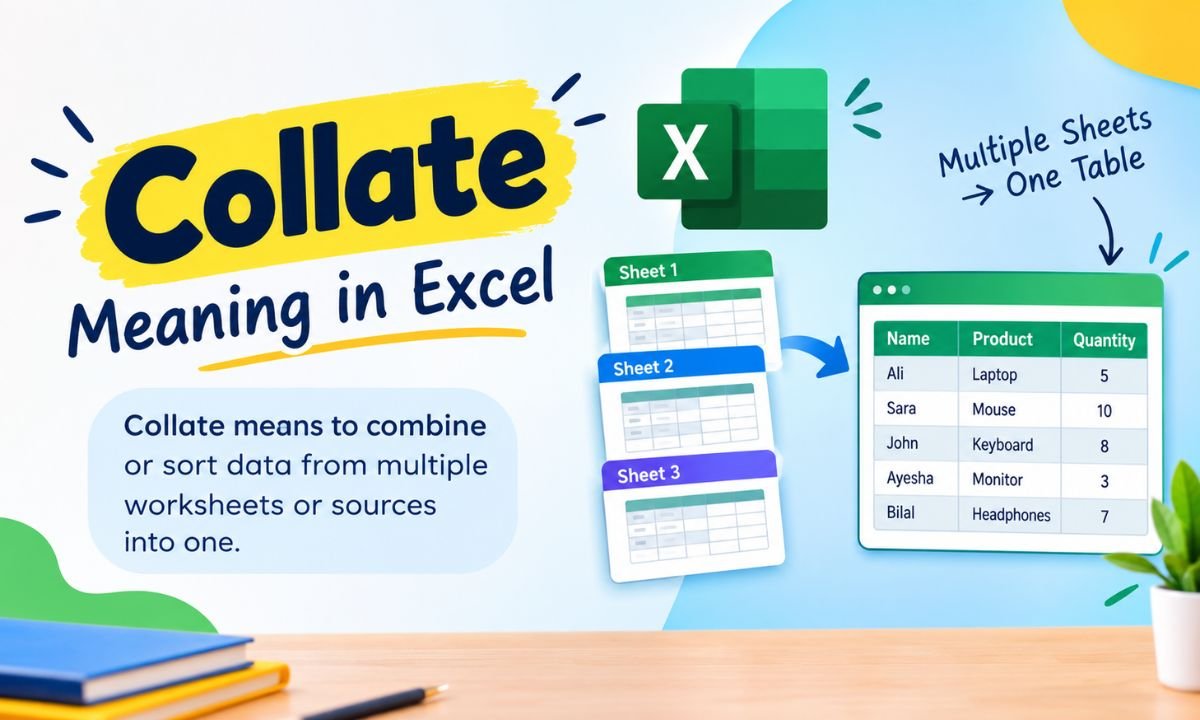
For data, collating means merging and ordering information. Excel gives you a few tools for this:
- Data > Consolidate to combine values from several ranges
- Power Query (Append) to stack tables from different files
- Sort and Filter to put the merged rows in order
Examples
- Three regional managers each send a sales sheet. You append the tables into one master sheet. Then you sort by date. That is collating.
- You print a 10-page workbook for 20 people. You choose Collated so each person gets pages 1 to 10 in order.
Collate Meaning in English
In everyday English, collate is a fairly formal word. It sounds right in offices, schools, research, and law. In casual talk, people say “put together” or “sort out.”
The word often points to information or documents. You collate data, notes, results, reports, records, and files. You rarely collate objects like fruit or toys.
Related forms you may see:
- Collated (past tense)
- Collating (present participle)
- Collation (noun)
- Collator (a person or machine that collates)
Collate Definition and Pronunciation
Definition: to collect and combine information or pages from different sources and arrange them in proper order.
Part of speech: verb
Pronunciation: /kəˈleɪt/, which sounds like kuh-LAYT. The stress falls on the second syllable. In American English, some speakers also say KOH-layt, but kuh-LAYT is the most common.
Origin: The word comes from Latin collatus, meaning “brought together.” It entered English in the early 1600s. This history explains why it carries the idea of bringing things into one place.
Collate Meaning in Urdu
In Urdu, collate is commonly given as مقابلہ کرنا (muqabla karna), which means to compare. That covers the “compare texts” sense of the word.
For the “arrange in order” sense, Urdu speakers often use ترتیب دینا (tarteeb dena). For gathering and combining data, you can say اکٹھا کر کے ملانا.
Example sentences:
- براہ کرم ان کاغذات کو ترتیب سے لگا دیں۔ (Please arrange these papers in order.)
- دونوں رپورٹوں کے اعداد و شمار کا مقابلہ کریں۔ (Compare the figures in both reports.)
No single Urdu word fits every use. Pick the one that matches your context.
Synonyms and Antonyms of Collate
| Synonyms | Antonyms |
| Compile | Scatter |
| Assemble | Disperse |
| Arrange | Jumble |
| Organize | Disorganize |
| Gather | Separate |
| Consolidate | Scramble |
| Compare | Mix up |
| Sort | Disarrange |
Not every synonym is a perfect swap. “Compile” stresses building a final document. “Compare” stresses checking differences. “Collate” does a bit of both.
How to Use Collate in a Sentence
Use this simple pattern: collate + something + (from / with) + something.
- Collate the data from the field reports.
- Collate the new edition with the old one.
- The assistant will collate the receipts by month.
A few quick tips:
- Use it with information, papers, or data.
- Keep it formal or semi-formal.
- Avoid adding “together.” The word already means bringing things together.
Grammar Rules of Collate
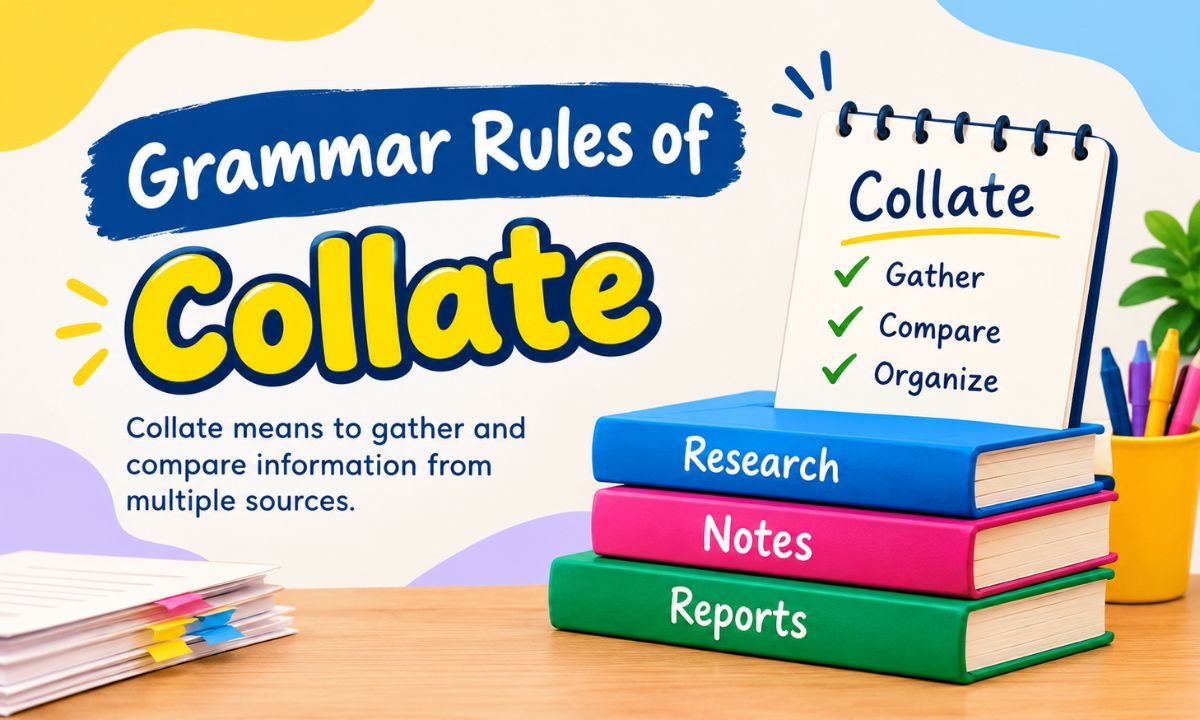
Collate is a regular verb, so the grammar is easy. Here are the rules you need.
1. Collate Is a Transitive Verb
It needs an object. You must say what you collate.
- Correct: She collated the reports.
- Incorrect: She collated. (Collated what?)
2. Verb Forms
| Form | Word | Example |
| Base form | collate | I collate the files every Monday. |
| Third person singular | collates | She collates the forms. |
| Past tense | collated | They collated the data yesterday. |
| Past participle | collated | The data has been collated. |
| Present participle | collating | He is collating the results now. |
3. Common Prepositions
- Collate from: Collate the figures from each branch.
- Collate with: Collate this copy with the original.
- Collate into: Collate the pages into sets.
- Collate by: Collate the invoices by date.
4. Active and Passive Voice
Both voices work well.
- Active: The clerk collated the files.
- Passive: The files were collated by the clerk.
The passive is common in reports and business writing. It puts the focus on the material, not the person.
5. Related Word Forms
- Collation (noun): The collation of the records took two days.
- Collator (noun): The collator checks each page.
- Collated (adjective): She handed out collated packets.
- Collatable (adjective): Rarely used, but it means able to be collated.
6. Words That Often Go With Collate
Collate usually pairs with information-type nouns, such as data, information, results, figures, records, reports, notes, and documents.
Do not use it with a plain object that has nothing to arrange. “Collate the apples” sounds odd. Say “sort” or “collect” instead.
More Meanings of Collate With Examples
Collate Meaning in Spanish
Spanish has no single word for it. The best choice depends on the situation:
- Cotejar means to compare texts or data. Hay que cotejar los datos de ambos informes.
- Compaginar means to put pages in order.
- Intercalar means to insert or interleave pages.
Collate Meaning in Business
In business, collate means to pull together facts from many places so a team can use them. A manager might collate customer feedback, sales numbers, or invoices.
Example: “Finance will collate the quarterly figures from each department by Friday.”
It also appears in job descriptions. Roles in admin, research, and operations often list “collate and analyse data” as a duty.
COLLATE Meaning in SQL
In SQL, COLLATE is a clause that sets the rules for comparing and sorting text. It decides if “A” equals “a,” or if “é” equals “e.”
Common collation suffixes:
| Suffix | Meaning |
| CI | Case-insensitive (“A” = “a”) |
| CS | Case-sensitive (“A” ≠ “a”) |
| AI | Accent-insensitive (“e” = “é”) |
| AS | Accent-sensitive (“e” ≠ “é”) |
Example:
SELECT username
FROM users
WHERE username COLLATE Latin1_General_CS_AS = ‘John’;
This query matches “John” but not “john.” Collation names differ across MySQL, PostgreSQL, and SQL Server, so check your system’s list.
Collate Examples in Everyday English
You may meet this word in daily life more often than you think:
- A teacher collates worksheets into packets for each student.
- A student collates notes from three lectures before an exam.
- A journalist collates quotes from several interviews.
- A librarian collates the pages of a damaged book.
- A researcher collates results from different trials.
Collate vs. Collect: What Is the Difference?
The two words overlap, but they are not the same.
| Point | Collect | Collate |
| Main action | Gather items | Gather, check, and order items |
| Order involved? | Not necessarily | Yes |
| Comparison involved? | No | Often |
| Typical objects | Stamps, money, samples | Pages, data, reports |
| Tone | Everyday | More formal |
Quick rule: You collect first. Then you collate.
If you only pick things up, say “collect.” If you sort and arrange them too, say “collate.”
Different Uses of Collate in English
Collate appears in several fields, each with its own flavor:
- Office work: putting pages or forms into sets
- Research: comparing texts, sources, or results
- Publishing: checking that book pages run in the right order
- Law: arranging case documents by date
- Computing: sorting and comparing text in databases
- Printing: producing copies as complete sets
The core idea never changes. Items come together, and order is applied.
Collate Meaning in Printing and Computing
Printing and computing are where most people meet the word today.
In printing, collate saves time. Printers sort pages for you, so you do not need to stack them by hand. Many copiers also offer a collate button. Professional presses use machines called collators for the same job.
In computing, collation covers sorting text. It affects search results, filters, and joins between tables. A wrong collation can make two matching names look different. That is why developers check it early.
Common Mistakes When Using Collate
Watch out for these slips:
- Mixing it up with “collaborate.” Collaborate means to work with others. Collate means to arrange information.
- Confusing it with “collateral.” Collateral is an asset pledged for a loan.
- Using it for simple gathering. If no ordering happens, “collect” is the better word.
- Saying “collate together.” This is redundant.
- Choosing “uncollated” by accident. You then get stacks of single pages you must sort by hand.
- Ignoring CI and CS in SQL. This can return wrong or missing rows.
When to Use and When Not to Use Collate

| Use collate when… | Avoid collate when… |
| You merge data from many sources | You only pick up or store items |
| You arrange pages in order | You mean “work together” (use collaborate) |
| You compare two versions of a text | You mean a loan guarantee (use collateral) |
| You write formal or business text | You talk casually with friends |
| You set sorting rules in a database | You only need a quick, rough sort |
Frequently Asked Questions About Collate
What does collate mean in simple words?
It means to gather papers or information and put them in the right order.
What does collate mean when printing?
It means each copy prints as a full set in page order, such as 1-2-3, then 1-2-3 again.
Is collate the same as collect?
No. Collect means to gather, while collate means to gather, check, and arrange.
What does collate mean in Excel?
In Excel, it is a print option for page order, and it also describes merging data from several sheets.
What is the Urdu meaning of collate?
It is commonly given as مقابلہ کرنا (muqabla karna), and “ترتیب دینا” fits the arranging sense.
What does COLLATE do in SQL?
It sets the rules for sorting and comparing text, such as case and accent handling.
What is the opposite of collate?
Words like scatter, disperse, and jumble work as antonyms.
How do you pronounce collate?
Say it as kuh-LAYT, with the stress on the second syllable.
Conclusion
To collate is to bring scattered items together and set them in order. That one idea runs through printing, Excel, business reports, and SQL databases. Once you see it, the word is easy to use.
Remember the quick rule: collect first, then collate. Use it for pages, data, and records, and choose a simpler word in casual talk. Keep it apart from lookalikes such as collaborate and collateral. Then you can use it with confidence in any setting.

The author is a professional content writer specializing in word meanings, definitions, and English vocabulary. With over 6 years of experience in language research and educational content creation, they produce accurate, well-researched, and reader-friendly articles.