
You are scrolling through a chat and someone writes, “IMAO that movie was way too long.” You stop for a second. Is that a typo for LMAO? Is the person laughing, or are they just sharing a strong opinion? It is a fair question, because the letters look almost the same.
IMAO most often means “in my arrogant opinion.” It is a playful, slightly cheeky twist on IMO and IMHO. Some people also use it as a laugh, which is where the mix-up starts. This guide covers the meaning, the origin, real chat examples, and how to reply. You will also learn when to use it and when to skip it.
IMAO Meaning – Quick Explanation
Simple meaning:
IMAO stands for “in my arrogant opinion.” The writer shares a strong view and admits, with a wink, that it might sound bold.
IMAO meaning in text
In a text message, IMAO introduces an opinion. It works like IMO, but with more attitude. Example: “IMAO, pineapple does not belong on pizza.”
IMAO meaning in chat
In group chats and live chats, it adds humor to a hot take. It tells readers, “I am confident, but I am joking a little.”
Common intent behind IMAO:
- To share an opinion with a playful, confident tone
- To soften a strong claim with humor
- To sound self-aware instead of preachy
- To show personality in a short message
Short examples:
- “IMAO, that finale made no sense.”
- “IMAO, my playlist is better than yours.”
- “IMAO, you should sleep first and decide later.”
Origin & Background of IMAO
How it evolved:
IMAO grew out of IMO (“in my opinion”) and IMHO (“in my humble opinion”). Someone swapped “humble” for “arrogant” to make fun of the polite version. Merriam-Webster notes that it plays off IMHO, and that some versions also stretch to IMMAO (“in my most arrogant opinion”) or IMNSHO (“in my not so humble opinion”).
Internet influence:
Early forums, chat rooms, and text messaging loved short forms. Typing four letters beats typing a full sentence. Social media then carried IMAO into comments, replies, and gaming chats, where people trade strong opinions all day.
Real-Life Conversations (How People Actually Use IMAO)
WhatsApp Chat
Sam: Which pizza place should we order from? Zara: IMAO, the one near the station. Best crust in town. Sam: Bold. I am in.
Instagram DMs
Her: Did you watch the new season? Him: Yes. IMAO, season two was better. Her: Wow, that is a hot take 😂
TikTok Comments
“IMAO, this song is better than the original.” “IMAO, he should have cooked the rice longer.”
When To USE And When Not To USE IMAO
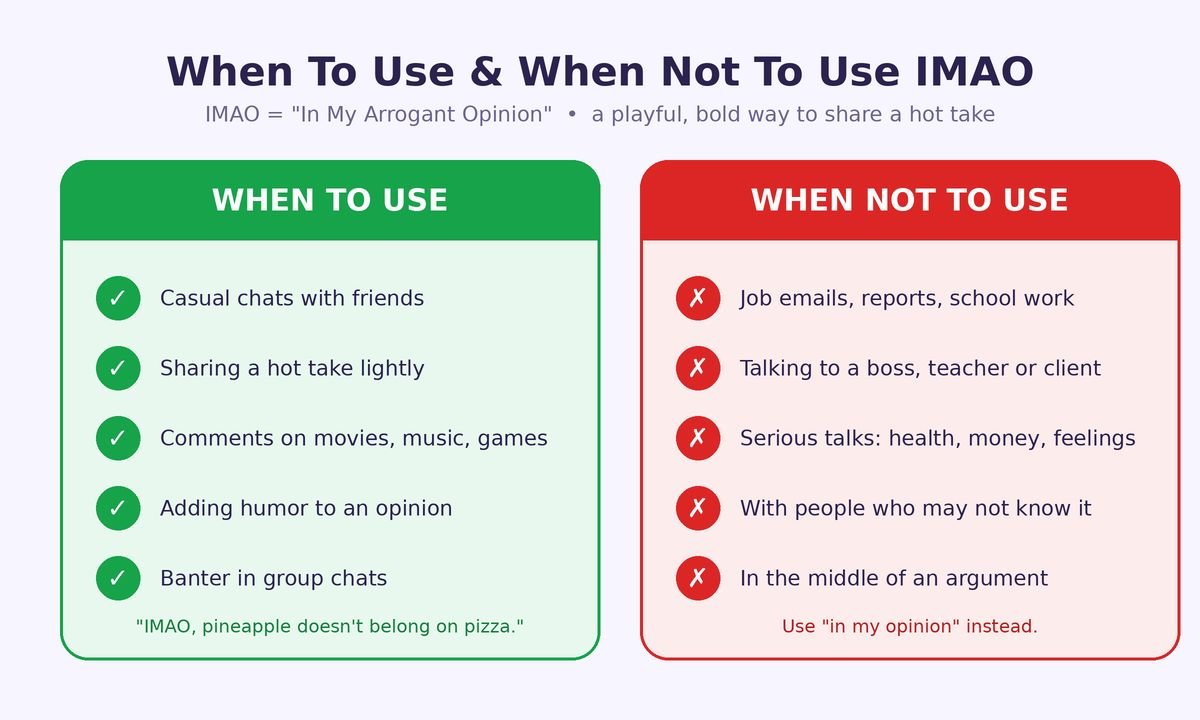
When To USE
- In casual chats with friends
- When you share a hot take and want it to sound light
- In comments on movies, music, food, or games
- When you want to add humor to an opinion
When NOT TO USE
- In job emails, reports, or school work
- With a boss, teacher, or client
- In serious talks about health, money, or feelings
- When the other person may not know the slang
Emotional & Psychological Meaning
IMAO is a small shield. Sharing an opinion online can feel risky, because people may argue. Adding “arrogant” in advance shows you know your view is bold, so it feels less like an attack.
For the reader, it often lands as friendly and funny. Most people hear it as confidence mixed with humor, not real arrogance. Tone still matters, so a harsh message with IMAO can sound rude.
Usage in Different Contexts
Social Media
On X, Instagram, and TikTok, IMAO sits in front of a quick take. It keeps comment threads light and can invite replies.
Friends & Relationships
Friends read it as banter. In a relationship, it can be teasing, as in, “IMAO, I make better pasta than you.”
Work or Professional Settings
Avoid it in formal emails. In a relaxed team chat, it may pass with close coworkers, but “in my opinion” is the safer choice.
Casual vs Serious Tone
Casual: “IMAO, Monday should be banned.” Serious: “In my opinion, we need a new plan.” Use IMAO only when the mood is relaxed.
More Meanings OF IMAO
Most sources agree on “in my arrogant opinion.” Some newer pages say people also use it as a playful form of LMAO. Sources differ here, so read the context.
IMAO meaning in text from a guy
Guys often use it to state a hot take or tease a friend. Example: “IMAO, that team is overrated.” It is usually banter.
IMAO meaning laugh
Some people type IMAO as a laugh or a typo of LMAO. If it comes right after a joke, with no opinion attached, it may be laughter.
Imao meaning in game
In gaming chats, it often tags a bold claim, like “IMAO, that weapon is broken.” It can also show up as a laugh after a funny moment.
IMAO meaning from a girl
The meaning does not change with gender. A girl may use IMAO to share a confident view or to joke around, so look at the sentence and the tone.
Common Misunderstandings About IMAO
1. Thinking it has a separate official meaning
There is no single official ruling beyond the standard “in my arrogant opinion.” Other uses come from habit and context.
2. Assuming it’s always a typo
Sometimes it is a typo for LMAO, but not always. If an opinion follows it, the writer likely means the original phrase.
3. Believing it’s rude
It is mostly playful. It only turns rude when the message around it is insulting.
4. Using it in formal writing
IMAO belongs in casual talk. Formal writing needs plain wording.
When NOT to use IMAO:
Skip it with people you do not know well, in group projects, and during arguments. It can make a tense moment worse.
IMAO vs Similar Terms (Comparison Table)
| Term | Full Form | Tone | Best Used |
| IMAO | In my arrogant opinion | Playful, bold | Casual chats |
| IMO | In my opinion | Neutral | Any informal chat |
| IMHO | In my humble opinion | Polite | Soft disagreement |
| IMNSHO | In my not so humble opinion | Cheeky | Strong takes |
| LMAO | Laughing my a** off | Funny | Reacting to jokes |
Key point: IMAO shares an opinion. LMAO shows laughter.
Variations & Related Forms of IMAO
- IMMAO: In my most arrogant opinion, the extra-bold version
- IMNSHO: In my not so humble opinion
- IMHO: In my humble opinion
- IMO: In my opinion
- Lowercase “imao”: Same meaning, more casual look
- IMAO + emoji: “IMAO 😏” adds a smirk to the hot take
How to Respond When Someone Uses IMAO
Casual Replies
- “Fair point.”
- “Hmm, I see your take.”
Funny Replies
- “Wow, such arrogance. I respect it.”
- “IMAO, your opinion needs a tax.”
Mature / Confident Replies
- “I disagree, but I get why you think that.”
- “Interesting view. Here is mine.”
Private or Respectful Replies
- “Let’s talk about it later in private.”
- “I would rather not debate this here, but thanks for sharing.”
Regional & Cultural Usage
No study tracks IMAO by country, so treat these as general trends.
Western Culture
People enjoy sarcasm and hot takes, so IMAO fits easily into casual talk.
Asian Culture
Many chats lean polite, so bold wording may feel strong. A softer phrase like IMO may feel more natural.
Middle Eastern Culture
Respect matters in many chats. IMAO suits close friends, but a gentler tone is wiser with elders or new people.
Global Internet Usage
Because the term is English, it spreads through social media, games, and memes. Its meaning stays mostly the same, but not everyone knows it.
Frequently Asked Questions
What does IMAO mean in text?
It means “in my arrogant opinion,” a playful way to share a strong view.
Is IMAO the same as LMAO?
No. IMAO shares an opinion, while LMAO shows laughter, though some people mix them up.
Is IMAO rude?
Usually not. It is mostly joking, but harsh wording around it can sound rude.
What is the difference between IMAO and IMHO?
IMHO sounds humble and polite. IMAO sounds bold and playful.
Can I use IMAO at work?
It is best to avoid it in formal messages. Use “in my opinion” instead.
How do I reply to IMAO?
Keep it simple: agree, disagree politely, or tease back with a joke.
Final Thoughts
IMAO is a small word with a clear idea. It stands for “in my arrogant opinion,” and people use it to share bold views with a smile. Some use it as a laugh too, so context decides.
Use it with friends, skip it at work, and keep your tone kind. If you are unsure what someone means, just ask. That is faster than guessing.

The author is a professional content writer specializing in word meanings, definitions, and English vocabulary. With over 6 years of experience in language research and educational content creation, they produce accurate, well-researched, and reader-friendly articles.