
If someone has ever replied to your long, heartfelt message with a single letter “K,” you already know how confusing that tiny reply can feel. The k meaning in text is one of the most searched texting questions online, and for good reason — one letter can sound calm, cold, annoyed, or perfectly normal depending on who sent it and when. This guide breaks down every angle of the k meaning in text, from its origin to how it’s used on WhatsApp, Instagram, TikTok, and beyond.
What Does K Mean in Text & Chat?
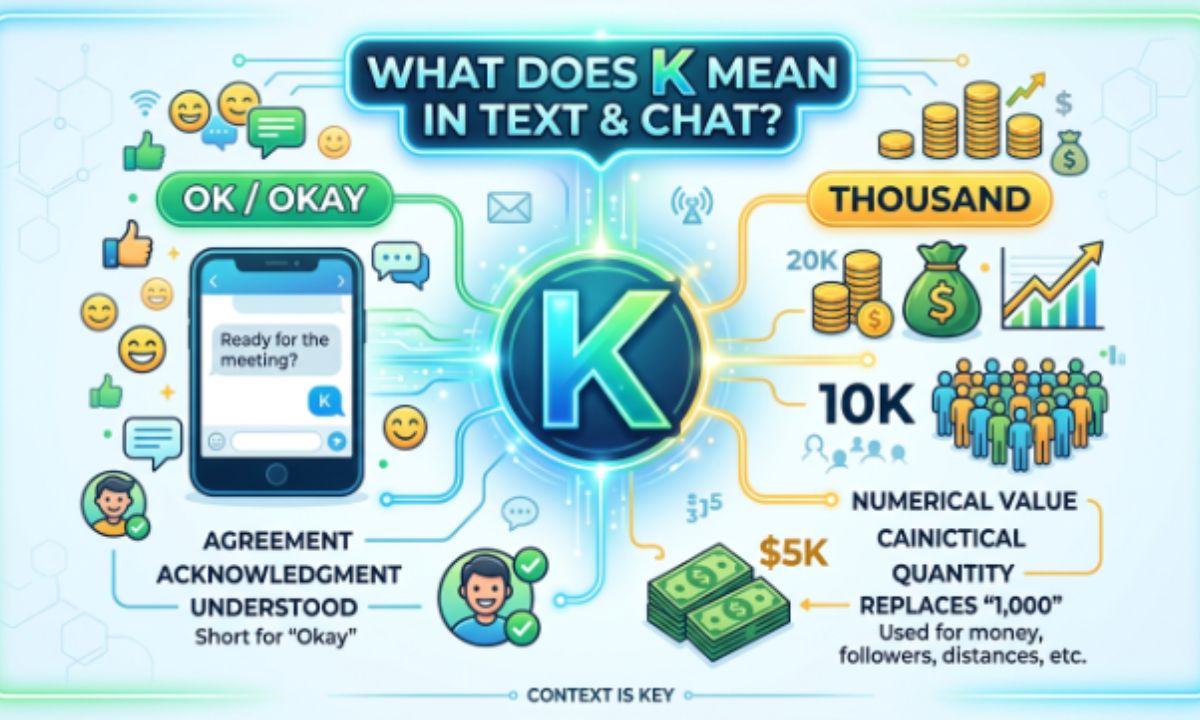
In most conversations, “K” is simply short for “okay.” It’s a quick way to confirm you read and understood a message without typing a full reply. The k meaning in text almost always centers around agreement or acknowledgment — but the tone behind it depends heavily on context, punctuation, and your relationship with the sender.
A single “K” can mean:
- Okay, understood, no issue
- Fine, but said in a rush
- Mild annoyance or disinterest
- A neutral, no-drama response
Quick Example
Friend: “Running 10 minutes late, sorry!” You: “K”
Here, “K” simply confirms you saw the message. No attitude, no drama — just a fast acknowledgment.
Full Form, Stands For & Short Meaning of K
Many people assume “K” is an acronym, but it isn’t. It doesn’t officially stand for anything — it’s simply the first letter of “okay,” used as shorthand to save time and keystrokes.
Short Meaning
In one line: K = a shortened way of saying “okay.” That’s the core k meaning in text, whether you see it in a chat app, comment section, or DM.
Interestingly, “K” also appears in completely different technical contexts, most notably in data science and machine learning, where it refers to a clustering algorithm rather than an abbreviation for “okay.”
K-means Clustering Example
K-means clustering is an unsupervised machine learning technique that groups similar data points into a set number of clusters, represented by “K.” For example, a retailer might use K-means clustering to group customers into three segments — budget shoppers, average spenders, and premium buyers — based on purchase history.
K-means Clustering Formula
The core formula minimizes the distance between data points and their cluster center (centroid):
J = Σ Σ ||x_i − c_j||²
Here, x_i is a data point, c_j is the centroid of cluster j, and the algorithm repeats until the centroids stop changing significantly.
K-means Clustering Python
In Python, K-means clustering is commonly implemented using the scikit-learn library. A basic K means clustering Python scikit learn example looks like this:
from sklearn.cluster import KMeans
import numpy as np
data = np.array([[1, 2], [1.5, 1.8], [5, 8], [8, 8], [1, 0.6], [9, 11]])
model = KMeans(n_clusters=2, random_state=0)
model.fit(data)
print(model.labels_)
print(model.cluster_centers_)
If you want ready-to-use projects, searching for K means clustering Python code GitHub will show open-source repositories with full datasets, visualizations, and step-by-step notebooks you can study or reuse.
The broader K-means clustering algorithm works in four simple steps: choose the number of clusters (K), randomly place initial centroids, assign each data point to the nearest centroid, and recalculate centroids until the groups stabilize.
K Meaning in Slang
Outside of clustering and texting, slang usage of “K” can also mean “cool” in a flat, low-energy way, or represent “thousand” (like 10K followers). Context always decides which meaning applies.
Origin, History & First Known Use of K
The use of “K” as shorthand for “okay” isn’t new. It dates back to the 1990s SMS era, when phones had strict 160-character limits and multi-tap keyboards made typing slow. Shortening “okay” to a single letter saved time and effort. As smartphones and instant messaging apps grew, the k meaning in text stayed the same, but the emotional weight attached to it changed — largely because full keyboards removed the old excuse of “it was just faster to type.”
How People Use K in Daily Conversations

Texting Examples
- “Leaving now, be there in 10.” → “K”
- “Can you send the file?” → “K, sending now”
- “Don’t forget the meeting.” → “K.”
Social Media Usage
On social platforms, “K” often appears in comments, DMs, and quick replies where a full sentence feels unnecessary. It’s common in fast-paced group chats and casual comment threads.
Casual Situations
Friends, siblings, and close coworkers often use “K” without any negative intent — it’s simply efficient shorthand between people who already understand each other’s texting style.
K Meaning Across Platforms
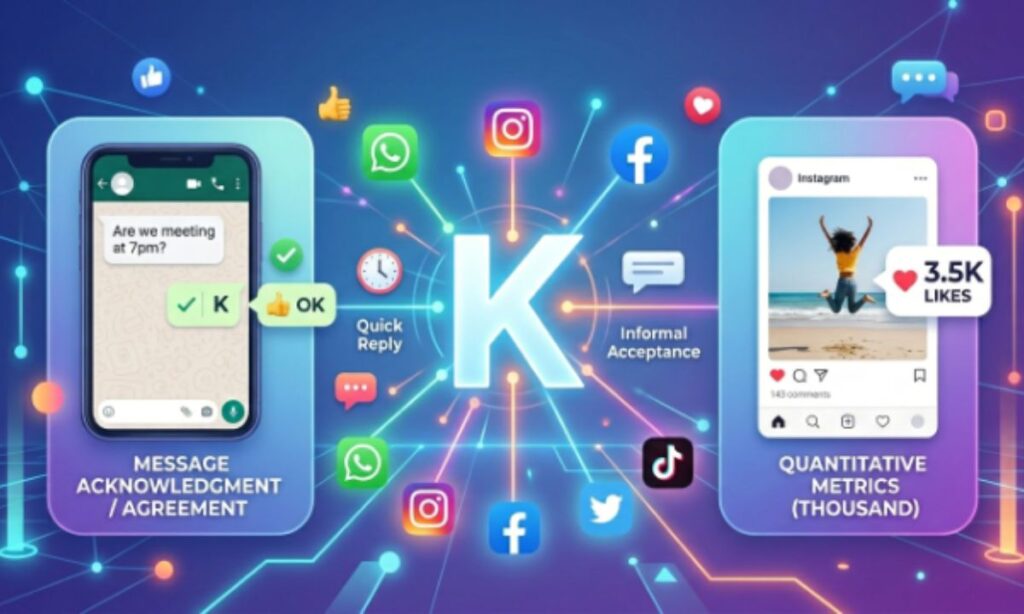
The k meaning in text doesn’t change much across apps, but tone and expectations do.
| Platform | Common Tone of “K” | Typical Use Case |
| Neutral, practical | Quick confirmations in personal or group chats | |
| Casual, sometimes distant | DMs, comment replies | |
| TikTok | Playful or dismissive | Comment sections, duet replies |
| Snapchat | Can feel cold | Fast back-and-forth chats |
| Neutral, older audience | Messenger replies, group posts |
On WhatsApp, “K” is usually a fast, no-fuss confirmation, especially in family or work groups where quick replies are the norm.
In Instagram DMs, a lone “K” can sometimes feel abrupt, especially if the previous message was longer or more emotional.
TikTok
On TikTok, “K” often shows up in comment replies, sometimes used sarcastically or jokingly rather than literally.
Snapchat
Because Snapchat conversations move quickly, a plain “K” can be misread as disinterest, even when the sender didn’t mean it that way.
Facebook Messenger usage tends to skew more neutral, often used by an older audience simply as shorthand for “okay.”
Different Meanings of K in Other Fields
Beyond texting, “K” shows up across science, finance, and technology:
- Chemistry: K is the symbol for potassium
- Physics: K represents Kelvin, a temperature unit
- Finance: K commonly means “thousand” (e.g., $50K salary)
- Sports: K stands for “strikeout” in baseball scorekeeping
- Data Science: K represents the number of clusters in K-means clustering
Examples
- “He earns 80K a year” → 80,000
- “The pitcher recorded 10 Ks” → 10 strikeouts
- “Set K=3 for this dataset” → three clusters in K-means clustering
Common Confusions, Mistakes & Wrong Interpretations
Many arguments start simply because someone misread a plain “K.” The biggest mistake is assuming tone without asking. Text lacks facial expression and voice inflection, so people often fill in the blanks with negative assumptions that were never intended.
Common Misunderstandings
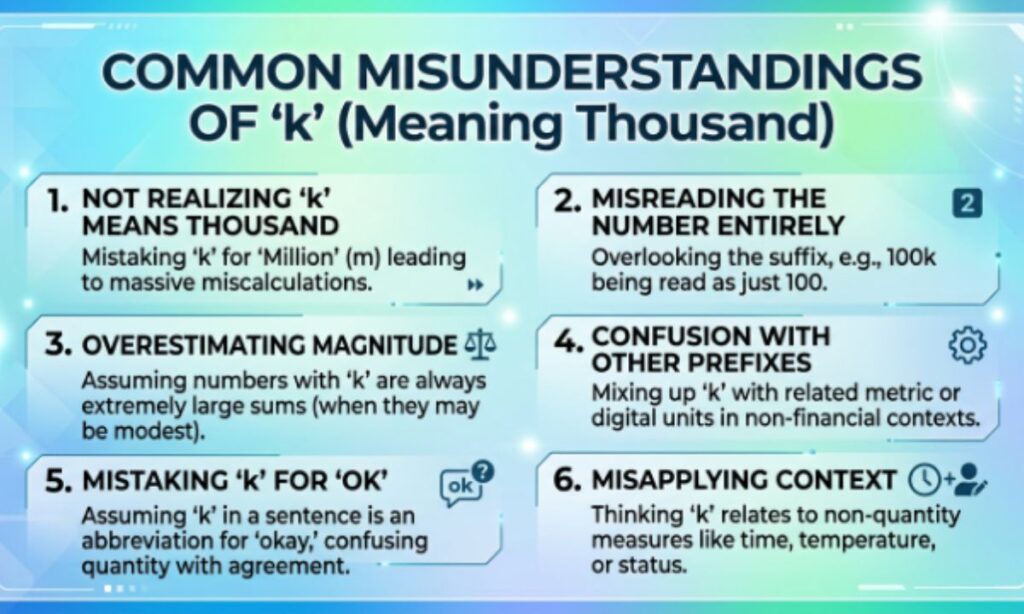
Thinking K Is Always Rude
Not true. Many people type “K” purely out of habit or convenience, with zero attitude attached.
Assuming Someone Is Angry
A short reply doesn’t always mean anger — it might just mean the person is busy, driving, or multitasking.
Confusing K With Thousand
In casual chats, “K” almost always means “okay.” In numbers or finance contexts, it means “thousand.” Context makes the difference clear.
Similar Terms, Alternatives & Related Slang
If you want to avoid sounding cold, try alternatives that soften the same message:
- Kk – friendlier, softer version of okay
- Okay / Ok – neutral and safe
- Sure – warm and agreeable
- Got it – confirms understanding clearly
- Alright – casual but complete
Examples of K in Real Chat Situations
- Coworker: “Meeting moved to 3 PM.” You: “K, thanks for the heads-up!”
- Partner: “I’ll call you tonight.” Partner 2: “K.”
- Friend: “Bringing snacks to the party.” You: “K perfect, see you then”
Notice how added punctuation, emojis, or extra words completely shift the feel of the same letter.
How to Reply When Someone Says K
Casual Replies
- “Cool”
- “Sounds good”
- “Yup”
Friendly Replies
- “Okay! Talk soon 😊”
- “Got it, thanks!”
Funny Replies
- “K as in okay, or K as in you’re mad at me? 😂”
- “Noted, captain.”
Formal Replies
- “Understood, thank you.”
- “Noted. I’ll follow up shortly.”
Is K Still Popular? Trends & Online Usage
Who Uses It Most?
Teenagers, young adults, and casual texters use “K” the most, especially in fast-moving group chats and DMs.
Is Usage Growing or Declining?
Usage remains steady, though many younger users now prefer “kk” or emoji reactions to avoid sounding cold, showing a slight shift away from the plain single-letter reply.
Where Is It Commonly Seen?
It’s most common in texting apps, Instagram and Snapchat DMs, gaming chats, and casual workplace messaging.
Quick Facts Section
- “K” is shorthand for “okay,” not an official acronym
- The k meaning in text dates back to the SMS character-limit era
- “K.” with a period often signals irritation
- “KK” typically feels friendlier than a single “K”
- In numbers, K equals 1,000
- In data science, K refers to K-means clustering
- In chemistry, K is the symbol for potassium
Read the Meaning:HYD Meaning in Text 2026: What Does HYD Actually Mean?
FAQs
What does K mean when a girl texts it?
It usually just means “okay” or agreement, though tone and prior conversation context can hint at mild annoyance.
Is texting K rude?
Not inherently — it can feel abrupt in emotional conversations but is often just a fast, habitual reply.
What is the difference between K and OK?
“OK” feels neutral and complete, while a single “K” can feel shorter, faster, and sometimes colder.
Why do people say K instead of okay?
It’s faster to type and has been used as shorthand since the early days of character-limited text messaging.
What does KK mean in texting?
“KK” means “okay, okay” and generally sounds friendlier and warmer than a plain “K.”
What does K mean in numbers or money?
In numbers, K represents “thousand,” such as 50K meaning 50,000.
What does K mean in K-means clustering?
Here, K represents the number of groups or clusters the algorithm divides the data into.
Conclusion
At its core, the k meaning in text is simple: it’s shorthand for “okay.” What complicates things is tone, punctuation, platform, and relationship context, which can turn a harmless one-letter reply into a source of overthinking. Whether you see it on WhatsApp, Instagram, TikTok, or in a data science project using K-means clustering, understanding the situation behind the letter matters more than the letter itself. The next time you receive a plain “K,” take a breath — it’s probably just someone saying okay, nothing more.

The author is a professional content writer specializing in word meanings, definitions, and English vocabulary. With over 6 years of experience in language research and educational content creation, they produce accurate, well-researched, and reader-friendly articles.