
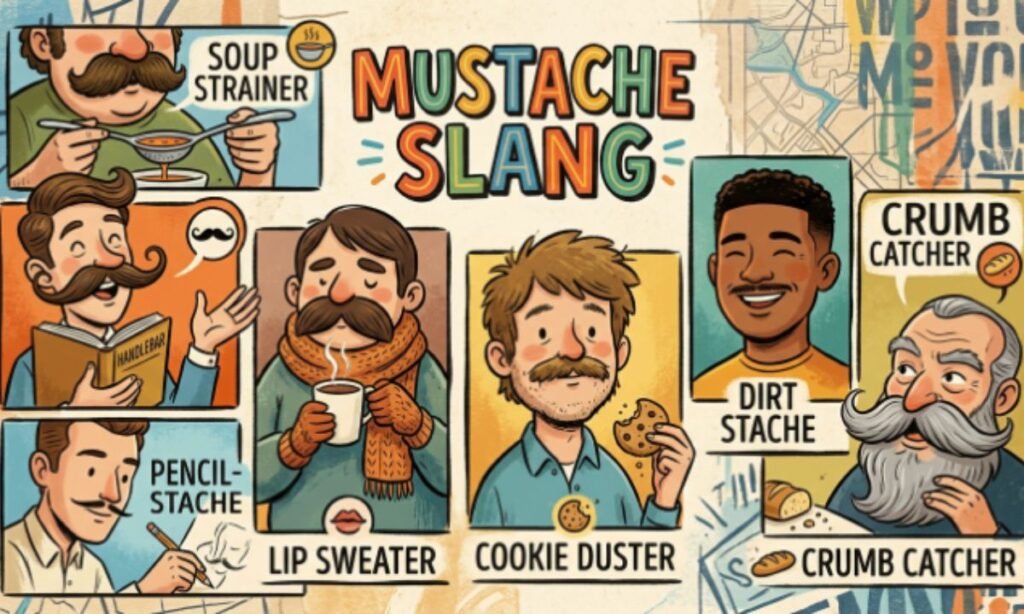
A mustache has one official name, but online and in barbershops, it goes by dozens of unofficial ones. Someone calls it a “cookie duster,” someone else calls it a “lip sweater,” and if you’ve never heard either, you’re left wondering whether you just got complimented or roasted. Mustache slang has been around for generations, and it keeps growing — new terms show up on Reddit and TikTok almost as fast as the older ones fade.
This guide rounds up the most common mustache slang terms people actually use, where they tend to show up, and how the vocabulary shifts depending on who’s saying it.
21 Popular Slang Terms for Mustache
Stache
The most common shorthand for mustache, used casually across age groups and regions. “He’s finally growing out his stache.”
Cookie Duster
A playful nickname suggesting a mustache brushes crumbs off before food reaches the mouth. It’s one of the oldest and most widely recognized mustache slang terms, especially in American English. “Nice cookie duster you’ve got there.”
Lip Sweater
Describes a thick or bushy mustache that looks like it’s keeping the upper lip warm. “That’s not a mustache, that’s a full lip sweater.”
Crumb Catcher
Similar logic to cookie duster — implies the mustache collects food debris during meals. “Watch out, crumb catcher’s picking up your sandwich.”
Flavor Saver
A joking term suggesting the mustache “saves” bits of a meal’s flavor for later. “He calls it his flavor saver, not his mustache.”
Mouth Brow
An internet-era term comparing a mustache to an eyebrow positioned above the mouth instead of the eyes. “That mouth brow is looking sharp today.”
Soup Strainer
An old-school term implying a bushy mustache would literally strain soup before it reaches the mouth. “Grandpa’s had that soup strainer since the ’70s.”
Face Caterpillar
A visual comparison, usually for a mustache that’s still thin, patchy, or just starting to fill in. “That’s less a mustache, more a face caterpillar right now.”
Lip Rug
Describes a mustache thick and dense enough to resemble a small carpet. “That’s a serious lip rug you’re rocking.”
Nose Neighbor
A lighthearted term pointing out the mustache’s proximity to the nose. “Say hi to your nose neighbor.”
Fuzz Bar
A casual term for a mustache in its early, fuzzy growth stage. “Still working on that fuzz bar, give it time.”
Upper Lip Beard
A more literal, slightly humorous way of describing a mustache as a “beard” confined to the upper lip. “He’s committed to the upper lip beard look.”
Gentleman’s Stripe
A polished, retro-leaning nickname for a neatly trimmed, classic mustache style. “Very gentleman’s stripe, very distinguished.”
Retro Stache
Refers to a mustache styled after vintage or old-fashioned looks, often thick or waxed. “That’s a full retro stache, straight out of the ’70s.”
Mini Beard
A term sometimes used for a thicker mustache that starts to resemble a small, contained beard. “With that thickness, it’s basically a mini beard.”
Lip Hedge
Describes a mustache dense and wide enough to resemble a small hedge above the lip. “That’s not trimmed, that’s a whole lip hedge.”
Vintage Whisker
A nostalgic term for mustache styles associated with earlier decades or classic grooming aesthetics. “Very vintage whisker energy with that curl.”
Tache
The short, everyday British equivalent of “stache,” used casually across the UK. “Your tache is barely there, mate.”
Mo
A term tied directly to Movember, the mustache-growing charity tradition, especially common in the UK and Australia. “Growing a mo for Movember this year.”
Face Fuzz
A general term for early or light facial hair, not always specific to a full mustache. “Still just face fuzz at this point, not a full stache yet.”
Pornstache
A pop-culture term for a thick, exaggerated 1970s-style mustache, popularized through film and TV characters. “That’s a full pornstache, straight out of an old cop show.”
Generational Slang Comparison
Gen Z
Gen Z tends to favor shorter, meme-friendly terms that spread through TikTok and group chats — “mouth brow” and “face caterpillar” are good examples of slang built for quick, visual humor rather than tradition.
Millennials
Millennials mostly grew up with the classic 2000s-era internet slang — “cookie duster,” “flavor saver,” and “lip sweater” all saw heavy use in forums and early social media, and they remain the most widely recognized terms across generations today.
Older Generations
Older generations, particularly Baby Boomers and Gen X, tend to stick with older, barbershop-rooted terms like “soup strainer” and “stache” — phrases that were common well before the internet accelerated slang turnover.
Funny Names for Mustaches on Reddit
Reddit threads on mustache slang tend to lean further into the absurd than mainstream lists, mixing genuinely funny terms with ones that are more shock-value than practical. Common Reddit favorites include “womb broom,” “whisker biscuit,” and “dirt squirrel” — playful, sometimes crude terms that thrive in casual forum banter but don’t always translate well outside that context. As with most Reddit-originated slang, it’s worth reading the room before using these terms elsewhere.
Funny Mustache Names for Guys
When it comes to nicknaming a specific guy’s mustache rather than mustaches in general, the humor usually leans on the style or vibe it gives off. Common examples include “the gentleman’s stripe” for a neat, classic mustache, “the pornstache” for a thick 1970s-style one, and “dirt stache” for that awkward early growth phase that just looks unintentional. These work best as friendly ribbing between people who already know each other well.
Mustache Names for Cats
Cat owners often borrow mustache slang for cats with distinctive dark or two-toned markings around the mouth — nicknames like “Whiskers,” “Bigote” (the Spanish word for mustache), “Mustache,” or “Stache” are common choices, sometimes paired with a cat’s actual personality, like “Colonel Mustache” for a more dignified-looking cat.
Mustache in Spanish
The standard Spanish word for mustache is bigote (masculine: el bigote), used across virtually all Spanish-speaking countries. A less common, more theatrical or humorous alternative is mostacho. Interestingly, bigote is also used for a cat’s or other animal’s whiskers, so context usually clarifies which meaning is intended — “el gato tiene bigotes” means “the cat has whiskers,” not a mustache.
How to Use Slang Naturally Without Sounding Awkward
Match the Tone
Mustache slang works best in lighthearted, joking conversations — using it to describe someone’s mustache in a serious or formal moment can land oddly.
Understand the Context
Terms like “cookie duster” read as playful teasing between friends, but the same word from a stranger can come across differently — know your audience before using it.
Consider the Social Setting
Casual settings like group chats, barbershops, or social media comments are ideal for this kind of slang; professional or unfamiliar settings usually aren’t.
Common Slang Mistakes
Using Outdated Slang
Terms that were common decades ago, like some of the older barbershop phrases, can sound dated or confusing to younger audiences who’ve never heard them.
Using Slang in Formal Writing
Mustache slang has no place in professional bios, formal descriptions, or serious writing — it’s built for casual, conversational use only.
Overusing Slang
Stacking multiple mustache nicknames into one conversation or caption quickly loses its charm and starts to feel forced rather than funny.
Frequently Asked Questions
What are common slang terms for mustaches used in pop culture?
Pop culture has popularized terms like “pornstache” for an exaggerated 1970s-style mustache and “cookie duster,” both of which show up frequently in films, sitcoms, and internet memes.
What are some common slang terms for a mustache?
Common slang terms include “stache,” “cookie duster,” “lip sweater,” “soup strainer,” and “flavor saver,” most of which reference the mustache’s shape, texture, or location above the mouth.
What is the origin of the term “cookie duster” for a mustache?
“Cookie duster” is widely believed to come from older American slang joking that a mustache brushes crumbs away from the mouth while eating, though its exact origin isn’t formally documented.
What do the British call a mustache?
In British English, “tache” is the most common everyday term, alongside “mo,” which is closely tied to the Movember mustache-growing tradition.
What is a thick, old-fashioned mustache called in slang?
A thick, exaggerated, retro-style mustache is often called a “pornstache” or a “soup strainer” in casual slang.
What is the funniest slang name for a mustache?
Funniest is subjective, but widely shared favorites include “cookie duster,” “flavor saver,” and Reddit-popular terms like “whisker biscuit” and “womb broom.”
Is “mustache” or “moustache” the correct spelling?
“Mustache” is the standard American spelling, while “moustache” is the standard British spelling — both refer to the same thing.
What is the Spanish word for mustache?
The Spanish word for mustache is “bigote,” which can also refer to an animal’s whiskers depending on context.
Final Thoughts
Mustache slang says a lot about how playful language can get around something as simple as facial hair. Whether it’s an old barbershop classic like “soup strainer” or a newer meme term like “mouth brow,” these nicknames turn an everyday feature into a running joke — and knowing a few of them means you’ll never be caught off guard the next time someone calls your mustache a cookie duster.

The author is a professional content writer specializing in word meanings, definitions, and English vocabulary. With over 6 years of experience in language research and educational content creation, they produce accurate, well-researched, and reader-friendly articles.