
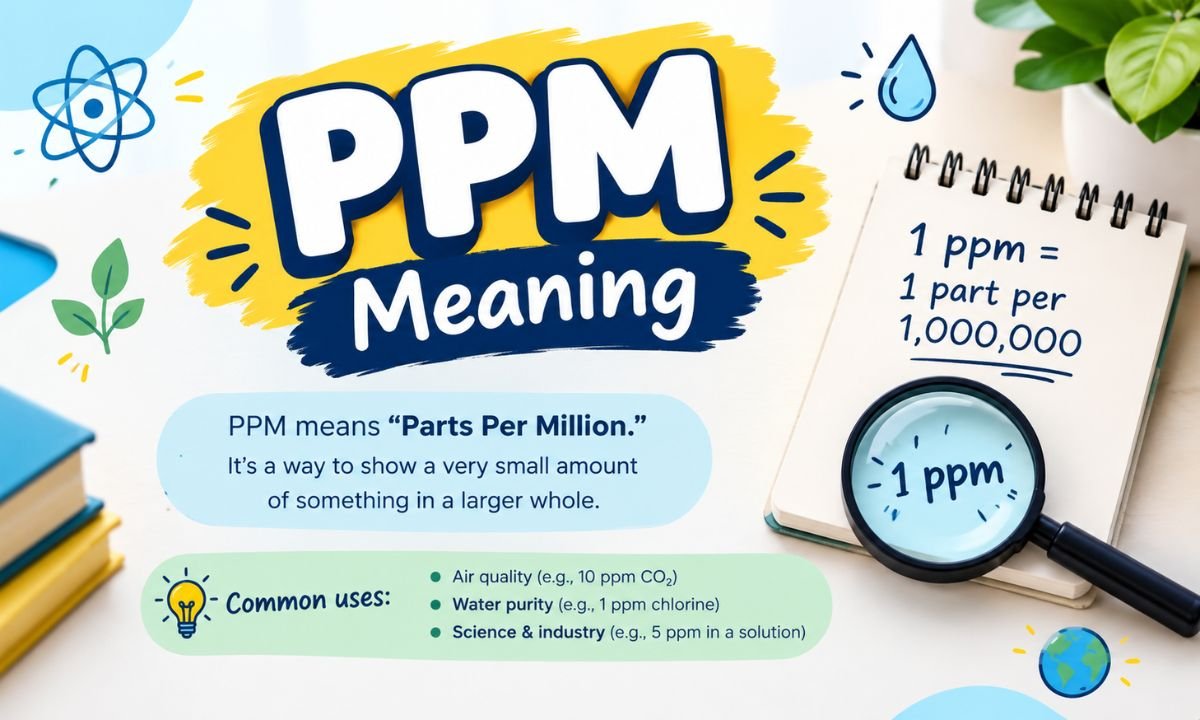
PPM most commonly stands for parts per million. It is a unit that shows how much of a substance is present in one million parts of a mixture. Scientists, engineers, and pool owners all use it to talk about tiny amounts, such as chlorine in a pool or minerals in drinking water. One ppm is just one part in a million, so it is a very small number.
Still, the same three letters appear in many other places. In an office, PPM can mean planned preventive maintenance or project portfolio management. On a printer box, it means pages per minute. This guide covers every major meaning of PPM, with the formula, simple examples, and real chat scenarios, so you can tell which one fits your situation.
PPM Meaning – Quick Explanation
what is ppm?
PPM is short for parts per million. It describes the concentration of a substance inside a larger mixture, like salt in water or carbon dioxide in air. Think of it as a “percent” that is used when the amount is too small for percentages to be practical.
what is p.p.m ? with examples
“P.P.M.” is just another way to write ppm, with dots. The meaning does not change. For example, 3 p.p.m. of chlorine in a pool means 3 parts of chlorine in every 1,000,000 parts of pool water.
ppm meaning with examples
- Water: A drinking water sample with 50 ppm of a mineral has 50 mg of it in every litre.
- Air: Carbon dioxide in Earth’s atmosphere is measured in ppm, and it sits above 420 ppm today.
- Printers: A printer rated at 20 ppm prints 20 pages every minute.
Simple definition
PPM = the number of parts of a substance in every 1,000,000 parts of the whole mixture.
ppm formula
The standard formula is:
PPM = (amount of substance ÷ total amount of mixture) × 1,000,000
Keep both amounts in the same unit, such as grams and grams. For example, 5 g of salt in 1,000 g of solution gives (5 ÷ 1,000) × 1,000,000 = 5,000 ppm.
In plain words
If you could split a mixture into one million equal pieces, ppm tells you how many of those pieces are the thing you are measuring. In dilute water, 1 ppm is roughly the same as 1 mg per litre.
Quick examples
- One drop of ink in about 50 litres of water is close to 1 ppm.
- 2 grams in 1,000,000 grams = 2 ppm.
- 1% = 10,000 ppm, and 1 ppm = 0.0001%.
Origin & Background of PPM
Where it started
The idea comes from ratios. We already use “per cent” for parts per hundred, and “per mille” for parts per thousand. As scientists began measuring very small amounts, they needed a unit that worked at a much smaller scale. “Parts per million” filled that gap.
How it evolved
PPM spread through chemistry labs first, then into water testing, food safety, and air quality work. Related units followed, such as parts per billion (ppb) and parts per trillion (ppt). Over time, other fields borrowed the same three letters for their own terms.
Modern influence
Today, ppm shows up in climate news, home water tests, pool care, and product quality reports. Cheap TDS meters and test strips let ordinary people check ppm at home. As a result, the term is no longer limited to laboratories.
Real-Life Conversations Using PPM (Mandatory Examples)

WhatsApp Chat – Home Water Filter
Sana: My new filter says the water is 180 ppm. Is that okay? Imran: That’s the TDS reading. Under 300 is usually fine for drinking. Sana: Great, I was worried it was a typo for percent!
Here ppm refers to dissolved solids in water. The number is milligrams per litre, not a percentage.
Workplace Slack Conversation
Hassan: Did the HVAC check happen this month? Rida: It’s on the PPM schedule for Thursday. Hassan: Perfect, I’ll tell the facilities team.
In this chat, PPM means planned preventive maintenance. It is routine servicing done before a machine breaks.
Instagram Comment on a Pool Cleaning Reel
@poolpro_amir: Always keep free chlorine around 1–3 ppm. @kiran.k: Mine was 6 ppm, so I just let it sit for a few days. Thanks!
Pool owners use ppm all the time, because chlorine levels need to stay in a safe range. Too little will not disinfect, and too much can irritate skin and eyes.
Emotional & Psychological Meaning of PPM
Why people care about it
For most people, ppm is about safety and trust. A small number on a test report can decide whether water is safe to drink or a room is safe to breathe in. Seeing a low or normal ppm brings relief, while a high ppm brings worry.
What mindset it reflects
Using ppm shows a careful, detail-focused mindset. It tells others that you care about precision and not just guesses. In the workplace, it also signals planning, because maintenance and quality teams use ppm to stay ahead of problems.
More Meanings To Understand the PPM
PPM meaning business
In business, PPM often means project portfolio management, which is how a company chooses and tracks its projects. It can also mean product portfolio management, or pay per 1,000 impressions in online advertising. In manufacturing, supplier quality teams talk about defective parts per million.
PPM meaning in engineering
Engineers use ppm in several ways. Pulse-position modulation is a signal method, and a peak programme meter measures audio levels. ppm/K shows how much a component changes with temperature.
PPM meaning in water
In water testing, ppm tells you how much of a substance is dissolved. It is used for TDS, hardness, chlorine, and fluoride. In plain water, 1 ppm is about 1 mg per litre.
PPM meaning project management
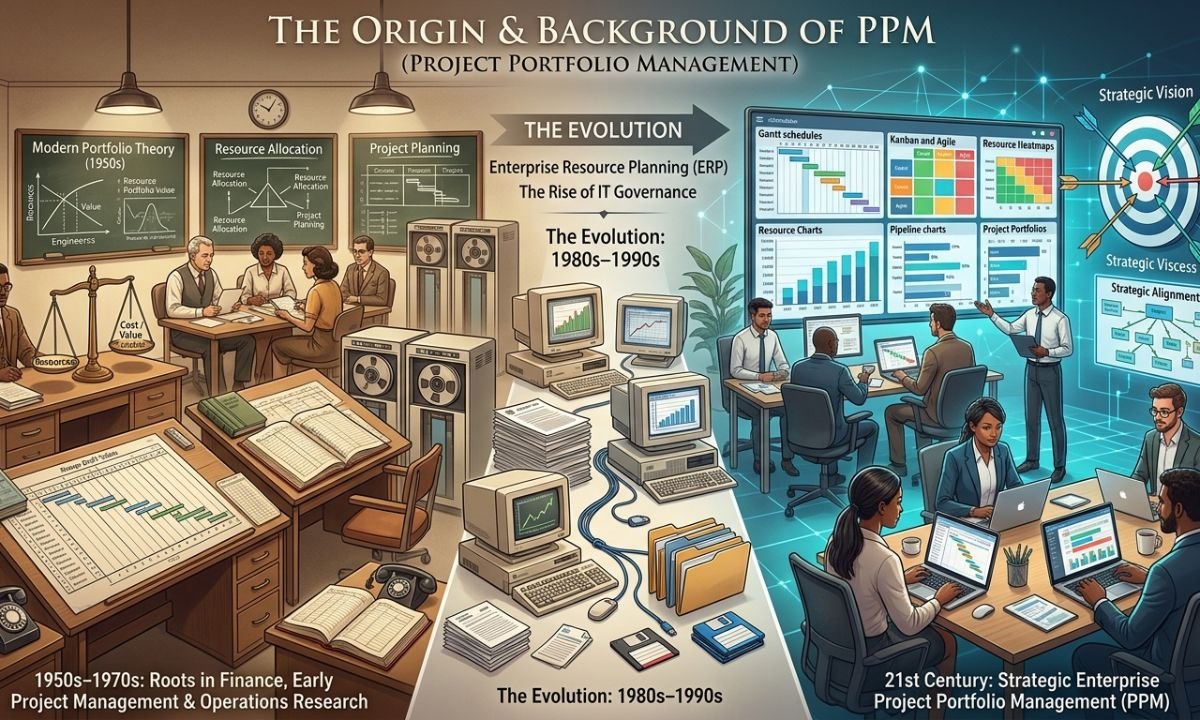
Here PPM means project portfolio management. It helps leaders compare projects, budgets, and risks across the whole company. It is different from managing one single project.
Ppm meaning medical
In medicine, ppm may describe tiny concentrations, such as fluoride in toothpaste or carbon monoxide in the air. Some medical abbreviations also share the letters, such as permanent pacemaker and physician practice management. Always check the context, and ask a doctor if a report is unclear.
Ppm meaning in chemistry
In chemistry, ppm is a concentration unit for very dilute solutions. It is used for mass, volume, or mixed ratios. Students use it with the formula (solute ÷ solution) × 1,000,000.
PPM meaning maintenance
In facilities and building management, PPM means planned preventive maintenance. Tasks such as checking lifts, fire alarms, or air conditioners are scheduled in advance. The aim is to catch faults early and avoid sudden breakdowns.
PM meaning dating
In dating and chat apps, “PM” means private message. “PM me” asks someone to message you privately. PPM is not an established dating slang term, so if you see it there, it is probably a typo or a personal shorthand.
Usage of PPM in Different Contexts
1. Social Media
On social media, ppm comes up in pool care, aquarium, gardening, and climate posts. People share test results and ask if the number is safe. Printers and tech reviews also mention pages per minute.
2. Friends & Daily Life
At home, ppm appears on water filters, TDS meters, and test strips. It also appears on fish tank kits and garden fertiliser labels. Friends often ask each other, “Is this ppm normal?”
3. Work & Professional Settings
At work, the meaning depends on the department. Facilities teams use it for maintenance, managers for portfolio management, and quality teams for defect rates. If you are not sure, ask for the full form once.
4. Casual vs Serious Usage
In casual talk, ppm is a quick number check. In serious use, such as safety, health, or compliance, exact measurements and units matter. A small mistake can change the result.
Common Misunderstandings About PPM
1. Thinking PPM means percentage
PPM is not a percentage. It is 10,000 times smaller than 1%. To convert, divide ppm by 10,000: 500 ppm is 0.05%.
2. Assuming small means harmless
A small ppm can still be important. Carbon monoxide, for example, can be dangerous at low ppm levels. Trace amounts of some metals in water can also matter.
3. Using PPM in the wrong context
Mixing up meanings causes confusion. Writing “20 PPM” in a maintenance email may be read as a schedule, not a printer speed. Add a few words, like “20 ppm (pages per minute),” to be clear.
PPM Comparison Table
| Unit | Full Form | Equal To | Common Use |
| % | Percent | 1 in 100 | Everyday amounts |
| ppm | Parts per million | 1 in 1,000,000 | Water, air, chemistry |
| ppb | Parts per billion | 1 in 1,000,000,000 | Very tiny traces |
| ppt | Parts per trillion | 1 in 10¹² | Ultra-trace analysis |
Quick conversions: 1% = 10,000 ppm, and 1 ppm = 1,000 ppb.
When TO USE And When NOT TO USE PPM
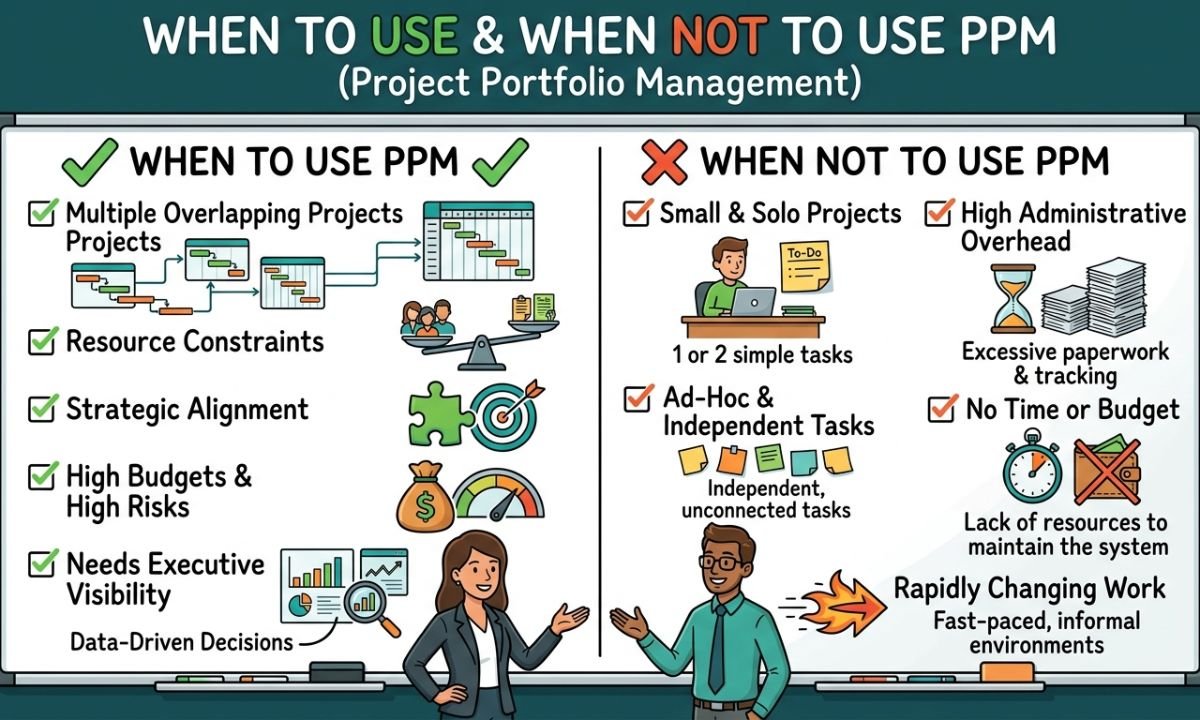
Use PPM when:
- You are describing small concentrations in water, air, or a mixture.
- You are talking about maintenance, printers, or project portfolios and the context is obvious.
- You include the unit or full form for clarity.
Avoid PPM when:
- The amount is large enough that percent is simpler.
- Your audience may not know which meaning you intend.
- You are writing a formal report without defining the term first.
Variations / Types of PPM (Common Uses)
| Short Form | Full Form | Field |
| PPM / ppm | Parts per million | Science, water, air |
| PPM | Planned preventive maintenance | Facilities, engineering |
| PPM | Project portfolio management | Business |
| PPM | Product portfolio management | Marketing, business |
| ppm | Pages per minute | Printers, computing |
| PPM | Pulse-position modulation | Electronics |
| PPM | Peak programme meter | Audio |
| .ppm | Portable pixmap image format | Computing |
| PPM | Pay per 1,000 impressions | Online advertising |
| PPM | Pashtun Protection Movement | Organisations |
How to Respond When Someone Uses “PPM”
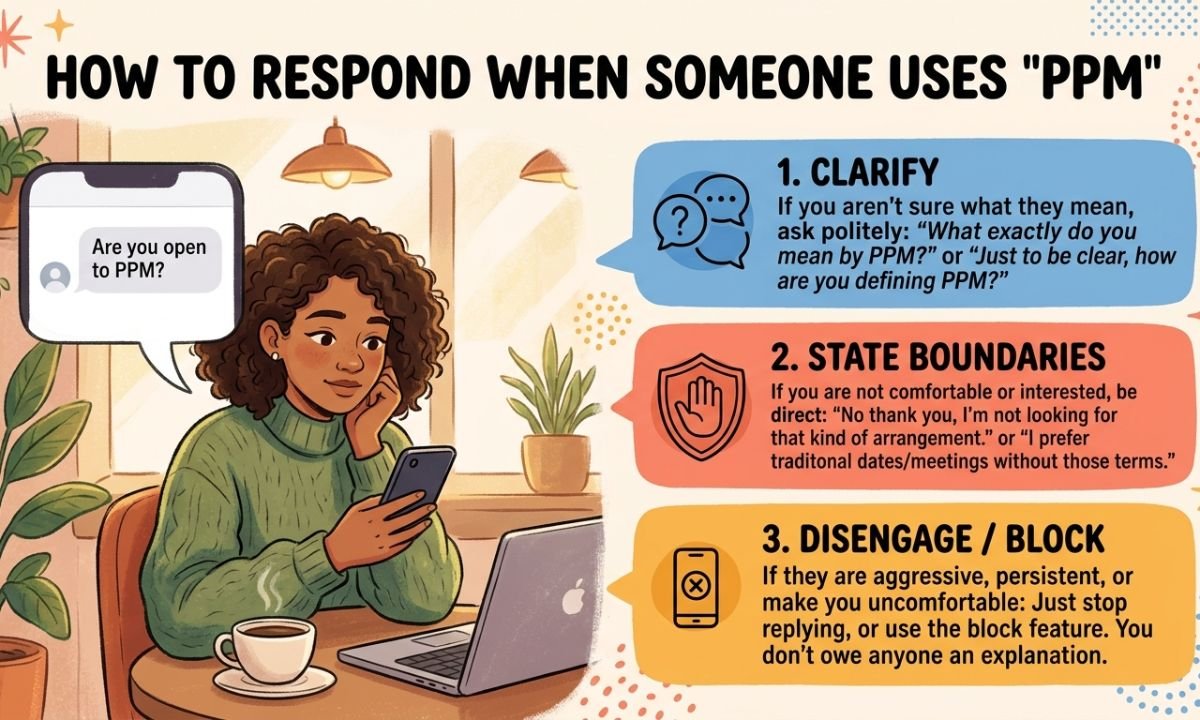
Casual Replies
- “Do you mean parts per million?”
- “Which PPM are we talking about?”
- “Got it, thanks for the number.”
Funny Replies
- “Is that a lot of million? Asking for my pool.”
- “Parts per million, but my questions per minute are higher.”
Mature & Confident Replies
- “Could you confirm the unit and the source of that reading?”
- “That’s within the usual range, but let’s retest to be sure.”
Private or Respectful Replies
- “Thanks for sharing. Would you like help reading the report?”
- “Let’s go over the numbers together, no rush.”
Regional & Cultural Usage of PPM
Western Culture
In the US and Europe, ppm is common in pool care, climate news, and environmental reports. Facilities teams in the UK often use PPM for planned preventive maintenance. Office teams use it for portfolio management.
Asian Culture
In countries like Pakistan and India, many households check TDS in ppm on RO and water filters. Students also learn ppm in chemistry class. English abbreviations are common in workplaces, so maintenance and project meanings appear too.
Middle Eastern Culture
Drinking water quality is a regular topic in the region, so ppm and TDS are widely mentioned. Pools, desalination, and facilities management also use the term. English acronyms are common in business and engineering work.
Global Internet Usage
Online, ppm is used worldwide in science, DIY, and tech discussions. Because it has many meanings, context decides what it stands for. Adding the full form once removes the confusion.
Frequently Asked Questions
What does PPM stand for?
PPM most commonly stands for parts per million. It can also mean planned preventive maintenance, project portfolio management, or pages per minute.
What is the ppm formula?
PPM = (amount of substance ÷ total amount of mixture) × 1,000,000.
How many ppm is 1 percent?
1% equals 10,000 ppm.
Is 1 ppm the same as 1 mg/L?
In dilute water solutions, yes, 1 ppm is about 1 mg per litre.
What does PPM mean in water?
It shows how much of a substance, such as minerals or chlorine, is dissolved in water.
What does PPM mean in maintenance?
It means planned preventive maintenance, which is scheduled servicing done before equipment fails.
What does PPM mean on a printer?
It means pages per minute, which is how fast the printer can print.
What does PM mean in dating?
PM means private message. PPM is not a standard dating term.
Is a higher ppm always bad?
No. It depends on the substance. Some need a minimum ppm, such as pool chlorine, and others must stay very low.
Final Thoughts
PPM is a short term with several valid meanings. Most often it means parts per million, a handy way to describe tiny amounts in water, air, and other mixtures. In business and facilities, it can instead mean portfolio management or planned preventive maintenance.
The easiest way to decode it is to look at the setting. Science and water tests point to parts per million, office schedules point to maintenance or portfolios, and printer specs point to pages per minute. When you write it yourself, add the full form once, and your readers will never be confused.

The author is a professional content writer specializing in word meanings, definitions, and English vocabulary. With over 6 years of experience in language research and educational content creation, they produce accurate, well-researched, and reader-friendly articles.