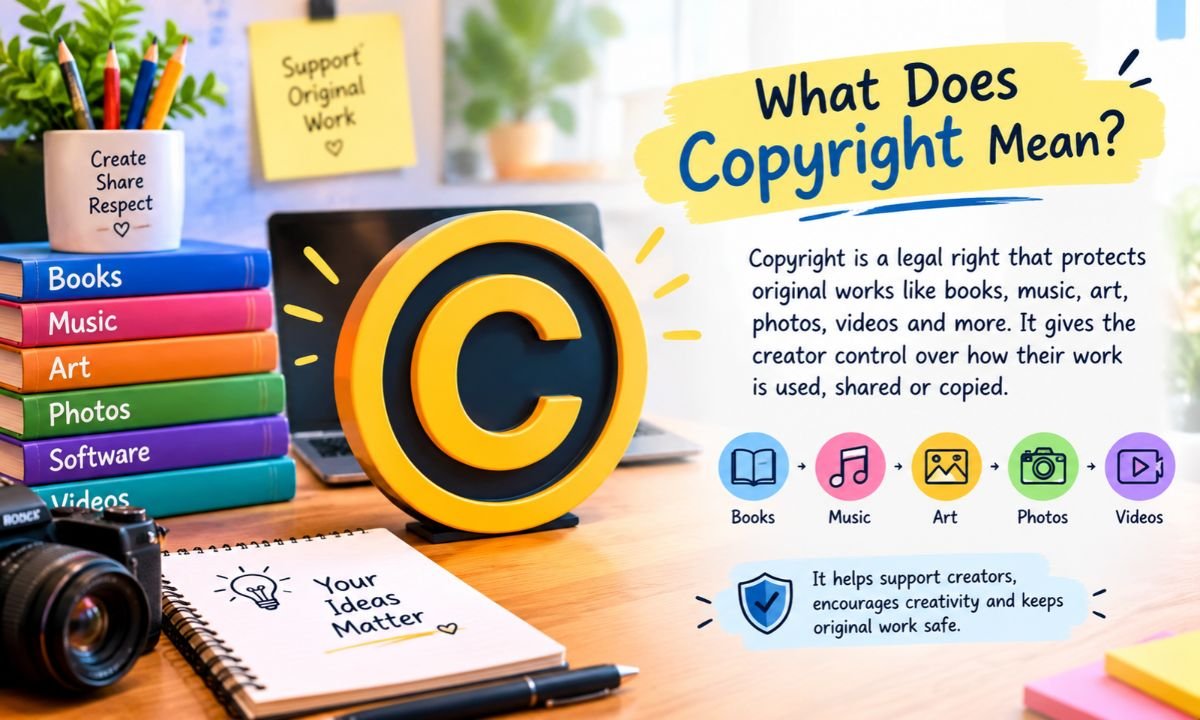
So, what does copyright mean? In short, copyright is the legal right that gives creators control over their original work. It covers things like books, songs, photos, films, software, and drawings. If you made it, copyright lets you decide who can copy it, share it, sell it, or change it.
You deal with copyright every day, often without noticing. Every song you stream, meme you share, and photo you download belongs to someone. This guide explains the meaning of copyright in plain words, with examples, rules, penalties, and tips to stay safe online.
Copyright Definition and Example
Copyright is a legal right that protects original creative work from being copied, shared, or changed without the creator’s permission.
The work must be original and fixed in some form. That means it is written down, recorded, drawn, or saved as a file.
Example: A photographer takes a picture of a sunset. The moment she presses the shutter, she owns the copyright. A website cannot use that photo without her permission.
What Does Copyright Mean in Simple Words?
Think of the word itself: the right to copy. The owner decides who gets to make copies of the work.
Here is an easy way to picture it:
- You write a song. It is yours.
- Others can listen to it.
- Others cannot copy it, sell it, or perform it for profit without asking you first.
What Is Copyright and How Does It Work?
Copyright is a form of intellectual property. It starts automatically the moment you create something original and put it in a lasting form.
The owner holds several exclusive rights:
- Reproduce the work (make copies)
- Distribute it (sell or share copies)
- Perform it in public
- Display it in public
- Create derivative works, such as translations, sequels, or remixes
The owner can also sell or license these rights. For example, an author can license a book to a publisher or a movie studio.
Why Is Copyright Important?
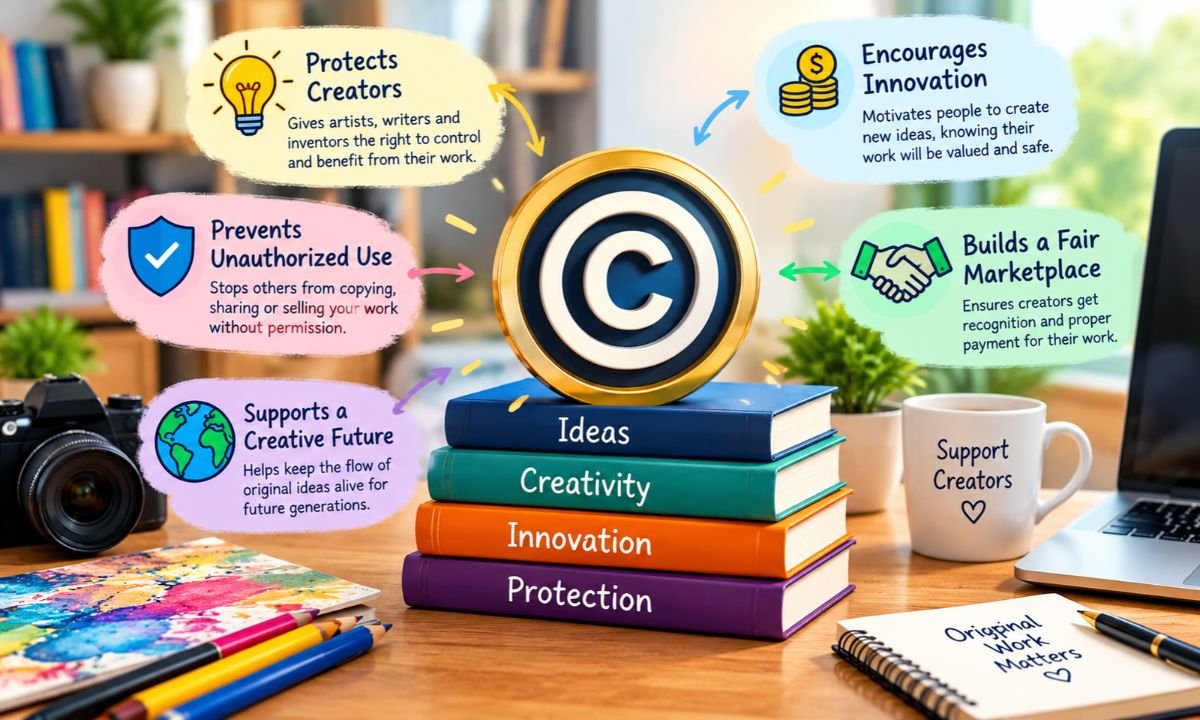
Copyright matters because it protects both creators and the public.
- It rewards creators. Writers, artists, and musicians earn a living from their work.
- It encourages new ideas. People create more when their work is protected.
- It prevents theft. Nobody can pass off your work as their own.
- It supports businesses. Publishers, studios, and software companies rely on it.
- It gives clear rules. Everyone knows what is allowed and what is not.
What Types of Work Are Protected by Copyright?
Copyright covers original works of authorship. Common categories include:
| Category | Examples |
| Literary works | Books, articles, blog posts, poems, scripts |
| Musical works | Songs, lyrics, compositions |
| Visual works | Photos, paintings, illustrations, graphics |
| Audiovisual works | Movies, videos, TV shows, animations |
| Sound recordings | Albums, podcasts, audiobooks |
| Software | Apps, games, source code |
| Architectural works | Building designs and plans |
| Dramatic works | Plays, choreography |
Not protected: ideas, facts, methods, names, titles, and short phrases. Copyright protects the way something is expressed, not the idea behind it.
What Are Some Examples of Copyright?
Real-life examples make the rule clearer:
- A novel: Nobody can republish your book without a license.
- A song: A café needs a license to play music for customers.
- A YouTube video: You cannot re-upload someone else’s video as yours.
- A logo design: The artist owns the artwork unless rights are transferred.
- A blog post: Copying it word for word onto another site is infringement.
- Software code: Developers hold rights over their source code.
- A stock photo: You must follow the license terms before using it.
How Does Copyright Protection Work?
Protection begins automatically. You do not have to file anything.
Still, registration helps. In the United States, you generally must register a work before you can sue for infringement. Timely registration also unlocks statutory damages and attorney’s fees.
Here is the basic path:
- Create an original work.
- Fix it in a lasting form.
- Add a copyright notice (optional but smart).
- Register with your national copyright office (optional but powerful).
- Keep records, such as drafts and dated files, as proof.
What Is the Difference Between Copyright, Trademark, and Patent?
These three are often mixed up. Each protects something different.
| Feature | Copyright | Trademark | Patent |
| Protects | Creative works | Brand names, logos, slogans | Inventions |
| Example | A novel or song | The Nike swoosh | A new engine design |
| Starts | Automatically on creation | Through use or registration | After approval by a patent office |
| Typical length | Life of author plus 70 years in the U.S. | Can last indefinitely if renewed and used | Around 20 years from filing |
How Long Does Copyright Last?
The length depends on the country and the type of work. In the United States, for works created after 1977:
- Individual authors: the author’s life plus 70 years
- Joint works: 70 years after the last surviving author dies
- Anonymous, pseudonymous, or work-for-hire: 95 years from publication or 120 years from creation, whichever ends first
Many countries follow similar rules. Some use life plus 50 years. When the term ends, the work enters the public domain, where anyone can use it freely.
What Happens If You Violate Copyright Laws?
Copyright infringement means using protected work without permission. The results can be serious.
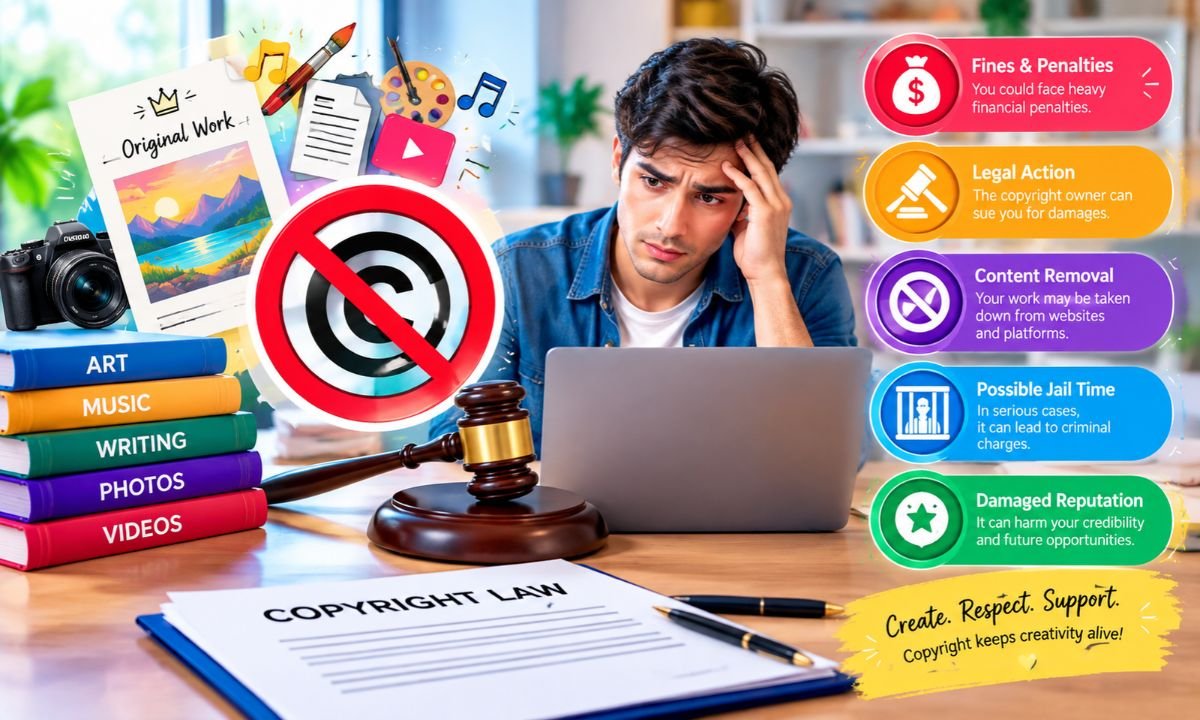
Civil penalties in the U.S.:
- Actual damages and profits lost by the owner, or
- Statutory damages of $750 to $30,000 per work
- Up to $150,000 per work if the court finds the infringement was willful
- Possible payment of court costs and attorney’s fees
Criminal penalties can apply to willful infringement, including up to five years in prison and fines of up to $250,000.
Online, you may also face takedown notices, removed posts, or a suspended account.
How Can You Avoid Copyright Infringement?
Follow these simple habits:
- Ask for permission. A short email often solves the problem.
- Use licensed material. Buy or license images, music, and fonts.
- Choose free-to-use sources. Look for public domain or Creative Commons content, and read the license.
- Give credit, but know it is not enough. Attribution does not replace permission.
- Create your own. Original work carries no risk.
- Keep proof. Save license receipts and permission emails.
- Learn about fair use. It allows limited use for purposes like criticism, news, teaching, and research, but it depends on the facts. It is not an automatic shield.
Is Everything on the Internet Copyrighted?
Most content online is protected, even without a © symbol. Blog posts, photos, videos, music, and social media posts all carry copyright by default.
Some content is free to use. This includes public domain works, material released under open licenses, and content the owner has clearly marked for reuse. When in doubt, assume it is protected.
Can You Use Copyrighted Images for Free?
Not automatically. Finding a picture on Google does not mean you can use it.
Safe options include:
- Images with a Creative Commons license that fits your use
- Public domain images
- Free stock sites with clear license terms
- Photos you took yourself
- Images you bought with a proper license
Always read the license. Some require credit, and some ban commercial use.
What Does Copyright Mean on YouTube and Social Media?
Platforms follow copyright rules too. On YouTube, if you use music, clips, or footage you do not own, the system may flag it.
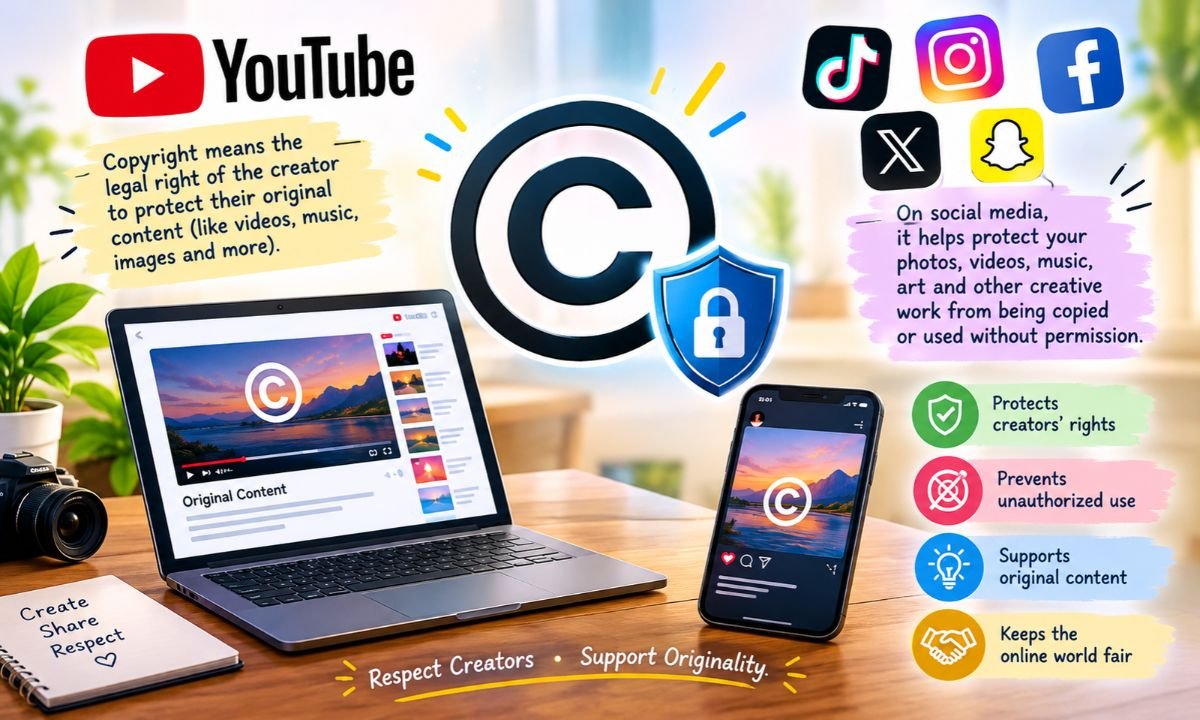
What can happen:
- Content ID claims: The owner may block the video, mute the audio, or take the ad revenue.
- Copyright strikes: Repeated strikes can lead to channel termination.
- Takedowns: Posts on Instagram, TikTok, and Facebook can be removed after a report.
Giving credit or adding “no copyright intended” does not protect you. Use licensed music, original footage, or the platform’s own audio library.
How Can You Check If Something Is Copyrighted?
No tool gives a perfect answer, but these steps help:
- Look for a notice, such as © and the owner’s name.
- Check the source page for license or terms of use details.
- Run a reverse image search with Google Lens or TinEye to find the original creator.
- Search the copyright office database of your country for registered works.
- Check the date. Very old works may be in the public domain, but the rules vary.
- Contact the owner when you are unsure.
Copyright Symbol
The copyright symbol is ©. A full notice usually has three parts:
© 2026 Your Name
- The symbol (©), the word “Copyright,” or the abbreviation “Copr.”
- The year of first publication
- The owner’s name
For sound recordings, the symbol is ℗. The notice is optional in most countries today, but it warns people that the work is protected. It also makes it harder for an infringer to claim they did not know.
How to type it: Press Alt + 0169 on Windows, Option + G on Mac, or type “©” in HTML.
Grammar Rules
Using the word correctly makes your writing sharper.
- Noun: The copyright belongs to the author.
- Verb: She copyrighted her song last year.
- Adjective: This is copyrighted material.
- Plural: Copyrights refers to several separate rights or works.
- Spelling: It is one word, not “copy right.”
- Do not confuse it with “copywriting.” Copywriting means writing ads or marketing text. A copywriter writes it, while the owner holds the copyright.
- Prepositions: We say copyright on a work or copyright in a work, and copyright of the author.
- Capitalization: Use lowercase unless it starts a sentence or appears in a title.
Frequently Asked Questions
What does copyright mean?
Copyright is the legal right of creators to control how their original work is copied, shared, and used.
Do I need to register to have copyright?
No. Protection is automatic once you create the work, though registration helps you enforce it in court.
Is it illegal to copy something with a copyright symbol?
Copying without permission is infringement, whether or not the symbol appears. The symbol only serves as a warning.
Can I use copyrighted material if I give credit?
No. Credit does not replace permission, unless the license specifically asks only for attribution.
What is fair use?
Fair use allows limited use of protected work for purposes like criticism, news, teaching, and research. Courts decide case by case.
How long does copyright last in the U.S.?
Usually the author’s life plus 70 years, or 95 to 120 years for work-for-hire and anonymous works.
What is the difference between copyright and trademark?
Copyright protects creative works. Trademark protects brand names, logos, and slogans.
What does “all rights reserved” mean?
It tells people that the owner keeps every right and that reuse requires permission.
Conclusion
Now you know what copyright means: a legal shield for original creative work that starts the moment you create it. It gives owners control over copying, sharing, and selling, and it rewards the people who make the books, music, images, and videos we enjoy.
The safest rule is simple. If you did not create it or license it, ask before you use it. Use original, licensed, or public domain material, and keep your proof. That keeps you protected and helps creators keep creating.
This article is for general information and is not legal advice. Copyright laws differ by country, so check local rules for your situation.
The author is a professional content writer specializing in word meanings, definitions, and English vocabulary. With over 6 years of experience in language research and educational content creation, they produce accurate, well-researched, and reader-friendly articles.