
You’ve probably seen “POV” attached to a TikTok caption, a meme, or even a text from a friend. The POV meaning seems simple at first — until you notice it’s used in a dozen different ways across different apps and contexts. What started as a filmmaking term has turned into one of the most flexible slang expressions online in 2026.
This guide breaks down the full POV meaning — its origin, how it’s used across platforms, its role in memes and dating apps, and why it refuses to go out of style.
Meaning & Definition of POV
Primary Meaning:
POV stands for “Point of View.” In its original sense, it describes the perspective or angle from which something is seen, told, or experienced.
Secondary Meaning (Internet Use):
Online, the POV meaning has shifted into a storytelling device. Instead of simply describing a perspective, it invites the viewer or reader to imagine themselves inside a specific scenario — often exaggerated, funny, or relatable.
Examples:
- “POV: you just realized it’s Monday again.”
- “POV: your best friend ditched the group chat.”
- A TikTok video captioned “POV: you’re the main character today.”
Background & Origin of POV
Traditional Use:
Long before social media, POV was a standard term in literature and filmmaking. In writing, point of view determines whether a story is told in first person, third person, or another narrative angle. In film and photography, a POV shot shows exactly what a character is seeing.
Digital Evolution:
TikTok reshaped the POV meaning entirely. Creators began using the tag to simulate an experience directly from their own camera angle, turning ordinary clips into immersive mini-scenes. Over time, POV stopped being about literal camera perspective and became a narrative marker — a way of saying “imagine you’re in this situation,” even when the viewer isn’t actually seeing through anyone’s eyes.
Usage in Different Contexts
The POV meaning shows up differently depending on where and how it’s used.
Social Media Content
Creators use “POV:” as a caption starter to set up a relatable or dramatized scenario, often turning it into a short skit or acting bit.
Chat Conversations
In texting, POV is used more loosely to introduce a scenario or joke: “POV: you forgot your charger again.”
Storytelling & Memes
Memes frequently open with “POV” to instantly place the viewer inside a funny or exaggerated situation without extra explanation.
Gaming Community
Gamers use POV to describe their in-game camera perspective, especially in shooter or racing games where first-person view matters.
Meanings Across Platforms

The POV meaning stays consistent at its core, but each platform gives it a slightly different flavor.
| Platform | Common Usage |
| Used casually in chats to set up a joke or relatable scenario | |
| Common in captions and Reels to frame a moment from a specific perspective | |
| TikTok | The birthplace of the modern POV trend; used in skits, roleplay, and immersive video formats |
| Snapchat | Used in captions or snaps to describe a funny or relatable moment |
On WhatsApp, the POV meaning stays close to its casual, joke-setup function — used between friends to frame a relatable situation in text.
Instagram Reels and captions use POV to pull viewers into a specific mood or moment, often paired with trending audio.
TikTok
TikTok remains the biggest driver of the POV meaning, with entire video formats — roleplay, skits, and “day in the life” clips — built around the tag.
Snapchat
Snapchat usage mirrors Instagram, with POV captions used to add context or humor to a quick snap or story.
Other Fields Where POV is Used
Film & Photography
In film and photography, POV refers to a specific camera shot that shows the audience exactly what a character sees, creating an immersive first-person effect.
Psychology
In psychology, “point of view” describes an individual’s perspective, beliefs, or way of interpreting a situation — a foundational concept in discussions about empathy and perception.
Automotive & Aviation
In vehicles and aircraft, POV cameras are sometimes used to record a driver’s or pilot’s viewpoint for training, testing, or documentation purposes.
Science & Technical Fields
In technical writing and research, POV can describe the analytical angle or framework used to approach a problem or dataset.
Common Misconceptions & Mistakes
Common Mistakes:
- Using “POV” when describing someone else’s perspective instead of the viewer’s imagined one.
- Confusing a POV caption with a personal opinion statement.
- Overusing POV in formal writing, where it can appear too casual.
Misconception:
Many assume the POV meaning always involves literal first-person camera footage. In slang usage, it often has nothing to do with an actual camera angle — it’s a narrative setup instead.
Correct Usage:
POV works best when it invites the audience to imagine themselves in a specific, often relatable or funny, scenario — not simply as a label for any video or photo.
Similar Terms & Alternatives
- IMO – In My Opinion
- Imagine this – a plain-language alternative to a POV setup
- Relatable – used to tag content with a similar shared-experience feel
- First-person – the technical term behind the POV camera style
- Main character energy – a related Gen Z phrase often paired with POV content
How to Respond to POV in Chats
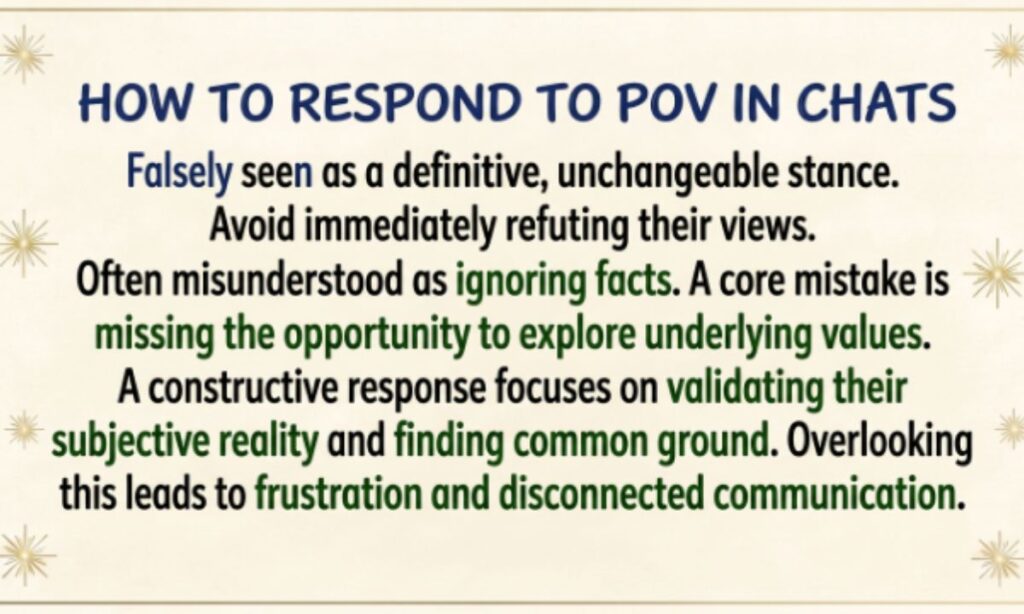
When someone sends a POV-style message, the easiest response is to play along with the scenario or react to the humor behind it.
Examples:
- “Lol accurate, I felt that.”
- “POV: same thing happened to me yesterday 😭”
- “Why is this too real.”
Differences From Similar Words
POV vs Opinion:
An opinion is a direct statement of belief, while a POV setup places the reader inside a scenario rather than stating a view outright.
POV vs Story:
A story typically has a full narrative arc, while a POV caption sets up a single moment or scenario, often without further detail.
POV vs Caption:
A regular caption simply describes content, while a POV caption actively frames the viewer’s imagined role within it.
| Term | Function | Example |
| POV | Places viewer inside a scenario | “POV: you’re running late” |
| Opinion | States a personal belief | “I think mornings are the worst” |
| Story | Full narrative with detail | A multi-scene TikTok explaining an event |
| Caption | Describes the content shown | “Beach day with friends” |
Relevance in Online Conversations & Dating Apps
Why it’s used:
On dating apps, POV setups add humor and personality to a bio or opening message, making a profile feel more interactive and relatable rather than generic.
Examples:
- “POV: you match with someone who actually replies first.”
- A bio that reads: “POV: we’re already arguing about pineapple on pizza.”
POV Meaning Slang
In slang, the POV meaning is less about literal camera angles and more about dropping someone into a relatable or exaggerated moment — a quick, punchy way to set a scene without extra explanation.
POV Meaning in Porn
In adult content categories, “POV” is used as a genre label describing videos filmed from a first-person camera angle, similar to how the term functions in mainstream film — indicating the viewer’s implied perspective rather than a third-person view. This usage is separate from the playful, caption-style meaning seen on TikTok and Instagram.
POV Meaning in Meme
In meme culture, POV is a setup format — the text “POV:” appears above an image or clip to instantly frame a funny or relatable situation, letting the humor land without further explanation.
POV in Gen Z
For Gen Z, POV has become second nature shorthand for framing everyday humor, awkward moments, or “main character” scenarios, often blending real footage with exaggerated acting for comedic effect.
Popularity & Trends Over Time
Trend Timeline:
- Pre-social media: POV existed mainly in film, photography, and literature as a technical term.
- Early TikTok era: Creators began tagging first-person clips as “POV” videos.
- Mainstream slang shift: POV evolved into a narrative device used across captions, memes, and chats.
- 2026: POV remains a staple format across TikTok, Instagram Reels, and everyday texting.
Why it stays popular:
The POV meaning keeps evolving because it’s endlessly adaptable — usable for comedy, relatability, roleplay, or storytelling, which keeps the POV meaning relevant across new trends rather than fading out like older slang terms.
FAQs
What does POV mean in social media apps?
It means “Point of View” — a caption or video format that places the viewer inside a specific, often relatable scenario.
What does POV stand for in internet culture?
POV stands for “Point of View,” used as a storytelling device rather than a literal description of camera angle.
What is a POV in social media?
It’s a content format, usually a caption or short video, that frames a moment from a specific imagined perspective.
What is POV in Gen Z?
For Gen Z, POV is shorthand for setting up a relatable or exaggerated moment, often used in captions, memes, or skits.
What is another word for POV?
Alternatives include “first-person,” “perspective,” or simply “imagine this.”
What is a POV in slang?
In slang, POV is a quick way to place someone inside a scenario, often for comedic or relatable effect.
Is POV formal or casual language?
POV is casual and social-media-friendly; it isn’t suitable for formal or professional writing.
Conclusion
The POV meaning has traveled a long way from film school terminology to one of the internet’s most versatile slang tools. Whether it’s setting up a TikTok skit, framing a meme, adding personality to a dating profile, or simply texting a friend about a relatable moment, POV keeps proving that a perspective — real or imagined — is one of the easiest ways to make content instantly engaging. Once you understand how flexible the term has become, spotting and using POV correctly gets a lot easier.

The author is a professional content writer specializing in word meanings, definitions, and English vocabulary. With over 6 years of experience in language research and educational content creation, they produce accurate, well-researched, and reader-friendly articles.