
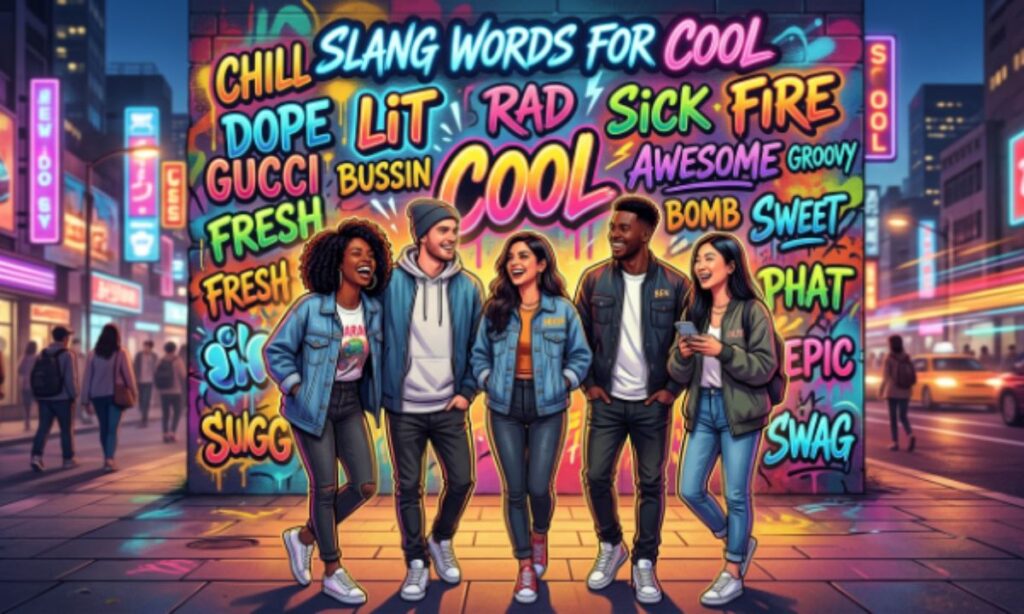
“Cool” is one of the most replaced words in the English language. Every generation reinvents it — fire, drip, dope, groovy, tight, bussin’ — and if you’ve ever nodded along to a text or TikTok comment without knowing what it actually meant, you’re not alone.
This guide rounds up 25 slang words for cool that are actually in use, explains where they came from, breaks down how “cool” slang has shifted by decade, and shows you how to use these words without sounding like you’re trying too hard.
25 Slang Words That Mean “Cool”
Lit
Exciting, fun, or high-energy. “That concert was lit.”
Fire
Excellent or impressive — currently one of the most common ways to say something is great. “Her new track is fire.”
Dope
Cool or impressive, rooted in decades of hip-hop culture. “That’s a dope jacket.”
Sick
Impressive or amazing (the opposite of its literal meaning). “He landed a sick trick on his skateboard.”
Fresh
Stylish, new, or well put-together, especially about appearance. “Those sneakers are fresh.”
Chill
Relaxed, easygoing, or low-key enjoyable. “It was a chill night, nothing crazy.”
Clean
Sharp, well-designed, or visually satisfying. “That logo redesign is clean.”
Drip
Standout style or fashion sense. “He’s got serious drip today.”
Gas
Used to hype someone or something up, often as a compliment on looks or performance. “That outfit is gas.”
Slaps
Describes music that’s especially good. “This song slaps.”
Heat
Something impressive, often used for shoes, music, or performance. “Those are straight heat.”
Untamed
Describes bold, unapologetic energy or style that stands out from the crowd. “Her whole vibe tonight was untamed.”
Legit
Genuine, impressive, or authentic. “That’s a legit good burger.”
Tight
Well done, impressive, or well put-together — an older term still in casual use. “Nice, that’s tight.”
Wicked
Excellent or impressive, especially common in New England and British slang. “That was a wicked good game.”
Solid
Reliable and good — dependable rather than flashy. “He gave a solid performance.”
Fly
Stylish or attractive, popular from the 90s onward. “She’s looking fly today.”
Banger
An excellent song or standout moment. “That new single is a banger.”
Smooth
Effortlessly impressive, confident, or well-executed. “That was a smooth move.”
Epic
Impressively large-scale, dramatic, or memorable. “That was an epic finish.”
Bussin’
Extremely good, most often used for food. “This pizza is bussin’.”
Goated
Short for “Greatest Of All Time” — used for someone or something considered the best. “He’s the goated player on this team.”
Slay
To do something exceptionally well or look great. “She slayed that performance.”
Iconic
Instantly memorable or culturally significant, often used with some exaggeration. “That outfit was iconic.”
Rizz
Short for charisma — smooth, cool social confidence, especially in flirting. “He’s got major rizz.”
Generational Slang Comparison
Slang for “cool” cycles roughly every decade, often echoing the tone of the culture around it — laid-back in the 70s, flashy in the 80s, ironic in the 90s, and internet-driven from the 2010s onward.
| Era | Popular Term | Vibe |
| 1970s | Groovy, Far out | Laid-back, countercultural |
| 1980s | Radical, Rad, Awesome | Energetic, over-the-top |
| 1990s | Fly, Da bomb, Tight | Confident, hip-hop and pop-culture driven |
| 2000s | Sick, Sweet, Off the hook | Casual, internet-forum era |
| 2010s–2020s | Fire, Lit, Drip, Bussin’, Goated | Fast, visual, meme and social-media driven |
How to Use Slang Naturally Without Sounding Awkward
- Match the setting. Slang belongs in texts, captions, and casual conversation — not emails, reports, or formal speech.
- Don’t overuse one word. Repeating the same slang term in every sentence makes it feel forced rather than natural.
- Watch your delivery. Slang often lands better with a flat, casual tone than an exaggerated one.
- Listen before using it. Pay attention to how the people around you actually use a term before adopting it yourself.
- Let it fade when it fades. Slang has a shelf life — using outdated terms as if they’re current is often what makes usage feel awkward.
Common Slang Mistakes
- Using outdated slang as if it’s still current (this is often more noticeable than not knowing slang at all)
- Mixing slang from different eras or cultures inconsistently in the same sentence
- Overexplaining a slang term right after using it, which undercuts the casual tone
- Using slang in professional or formal writing where it reads as unprofessional
- Assuming a term means the same thing in every region or community
Slang Words for Cool
Beyond the core list above, other widely recognized ways to say “cool” include bad (used ironically), money, stellar, boss, and world-class — many of which cross over from general enthusiasm slang into describing people, style, or performance specifically.
80’s Slang Words for Cool
In the 1980s, the go-to terms were radical, rad, awesome, tubular, and bodacious — big, expressive words that matched the decade’s equally bold fashion and pop culture.
Current Slang Words for Cool
Right now, the most commonly used terms are fire, drip, bussin’, slaps, and goated, depending on whether the compliment is about style, food, music, or overall skill.
70s Slang Words for Cool
The 1970s favored groovy, far out, and outta sight — mellow, countercultural phrases tied closely to the era’s music and social movements.
90s Slang Words for Cool
The 1990s brought fly, da bomb, tight, and all that, reflecting the decade’s hip-hop influence and confident, pop-culture-driven tone.
Synonyms for Cool (Adjective)
When describing temperature or a calm demeanor, common synonyms for “cool” include chilly, crisp, composed, unruffled, and level-headed — distinct from the slang meaning of “impressive.”
Synonyms for Cool as in Awesome
When “cool” means impressive rather than temperature, common alternatives include awesome, amazing, fantastic, stellar, outstanding, and, informally, fire or legit.
Practice: Choose the Correct Slang
Try matching the right term to the context before checking your answer.
Choose the Correct Slang
- Someone just finished an amazing basketball highlight — is it “chill” or “sick”?
- Your friend’s new sneakers look great — is it “wicked” or “bussin'”?
- You had a relaxing, low-key evening — is it “epic” or “chill”?
(Answers: 1. Sick, 2. Wicked or fresh work well; “bussin'” is best reserved for food, 3. Chill)
Rewrite in Slang
Try rewriting these plain sentences using a slang word for cool:
- “That movie was really good.” → “That movie was fire.”
- “Your outfit looks really nice today.” → “You’ve got drip today.”
- “He’s very confident and charming.” → “He’s got rizz.”
Frequently Asked Questions
What is the most popular slang word for cool right now?
“Fire” is currently one of the most widely used slang words for describing something impressive, alongside “drip,” “bussin’,” and “slaps” depending on context.
What did people say instead of “cool” in the 90s?
Common 90s alternatives included “fly,” “da bomb,” and “tight.”
Is “lit” still used in 2026?
“Lit” is still recognized and used, though it’s considered slightly more established than the newest slang compared to terms like “goated” or “bussin’.”
What does “bussin'” mean?
“Bussin'” means extremely good, and it’s most commonly used to describe food.
What’s a professional way to say something is cool?
In professional settings, alternatives like “impressive,” “excellent,” or “well done” communicate the same idea without sounding too casual.
Why does slang change so quickly?
Slang spreads and evolves quickly because of social media trends, music, and youth culture, with terms often rising and fading within a few years or even months.
What does “goated” mean in slang?
“Goated” comes from the acronym G.O.A.T. (“Greatest Of All Time”) and describes someone or something considered the best in its category.
Is it okay for adults to use Gen Z slang?
It’s generally fine in casual, low-stakes conversation, but using it too deliberately or in the wrong setting can come across as trying too hard rather than natural.
Final Thoughts
Slang for “cool” will keep changing — that’s the nature of language shaped by culture, music, and the internet. The goal isn’t to memorize every term that shows up online, but to recognize the words in use around you and reach for them naturally, in the right setting, without overdoing it. Whether it’s “groovy” from your parents’ era or “goated” from today’s group chats, the underlying idea has never changed: it’s just a fast way to say something’s genuinely good.

The author is a professional content writer specializing in word meanings, definitions, and English vocabulary. With over 6 years of experience in language research and educational content creation, they produce accurate, well-researched, and reader-friendly articles.