
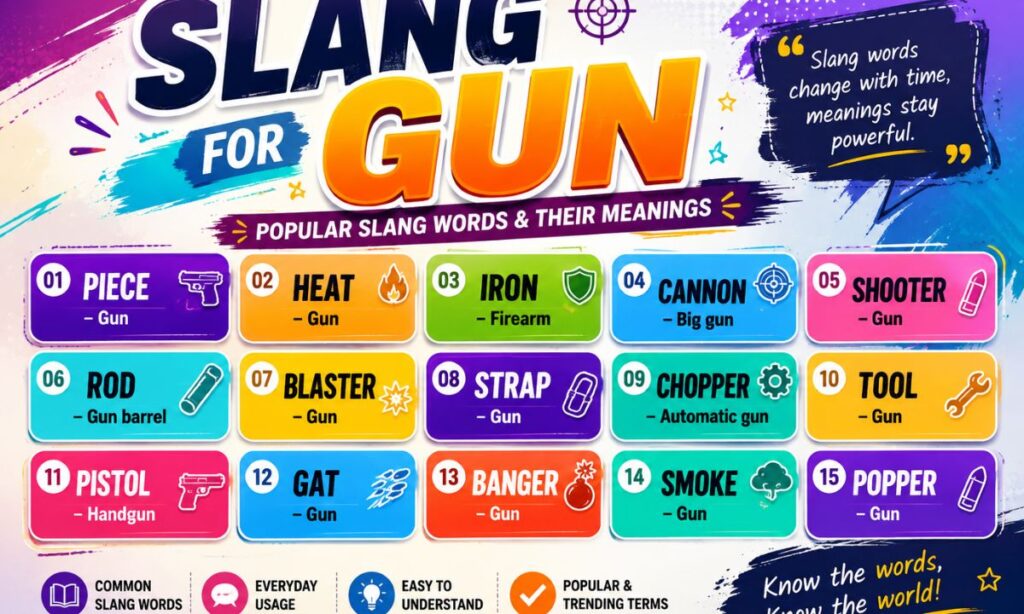
If you’ve ever heard someone say “he’s got a strap” or “that’s a chopper” and weren’t sure what it meant, you’re not alone. Slang for gun has been part of everyday language for decades, shaped by crime fiction, hip-hop, regional dialects, and internet culture.
This guide is a straightforward reference — not an endorsement or how-to guide. It exists purely to help you understand these terms when you come across them in music, film, conversation, or online, along with where many of them originated.
50 Slang Terms Explained
Piece
A general, catch-all term for a gun, most often a handgun, that’s been used across generations of crime slang.
Example
“He kept a piece under the driver’s seat, just in case.”
Strap
Refers to a gun someone carries on their body, often concealed, tracing back to the idea of strapping a holster on.
Example
“Are you strapped tonight, or did you leave it at home?”
Heater
A slang term for a handgun, believed to reference the heat generated when a gun is fired repeatedly.
Example
“He tucked the heater into his jacket before walking out.”
Tool
A vague, almost coded way to refer to a gun without naming it directly, often used to avoid drawing attention.
Example
“Word is he was carrying a tool when things went sideways.”
Burner
A gun meant to be used once or twice and then discarded, usually because it’s untraceable.
Example
“Detectives figured it was a burner — no serial number, no history.”
Glock
Originally a firearm brand, now used loosely in slang to mean any handgun, regardless of actual manufacturer.
Example
“In the song, he raps about keeping a Glock close by.”
Blaster
A dramatic, almost fictional-sounding term for a gun, popularized heavily by science fiction media.
Example
“The character pulled out a blaster straight out of a sci-fi movie.”
Cannon
Used to describe an unusually large or powerful-looking handgun.
Example
“That thing looks like a cannon, not a pistol.”
Iron
An old-school term for a gun, referencing the metal the weapon is made from.
Example
“He’s been carrying iron since he was a teenager, or so the story goes.”
Roscoe
A vintage slang term for a revolver, most common in 1930s–1950s crime fiction and film noir.
Example
“The detective in the film reached for his roscoe before opening the door.”
Nine
Shorthand for a 9mm pistol, one of the most common handgun calibers referenced in slang.
Example
“He mentioned keeping a nine nearby for protection.”
Chopper
Slang for a fully automatic or rapid-firing weapon, frequently referenced in rap lyrics.
Example
“The lyrics describe a chopper that never seems to run out.”
Bangstick
An informal, almost playful term emphasizing the loud “bang” a gun makes.
Example
“He joked about his bangstick being louder than it looked.”
Rod
An older slang term for a handgun, common in mid-20th-century crime slang.
Example
“The old-timer still calls his revolver a rod.”
Stick
A short, coded term sometimes used for a gun, particularly a rifle or long gun.
Example
“He mentioned grabbing the stick before heading out to the range.”
Smoke
Occasionally used to reference a gun, tied to the visual of smoke after firing.
Example
“They said he was carrying smoke, though no one confirmed it.”
Blam
An onomatopoeic term imitating a gunshot sound, sometimes used loosely to reference a gun itself.
Example
“He said one word — ‘blam’ — to describe what happened.”
Popper
Informal slang for a small, low-caliber handgun.
Example
“That’s not much of a threat, just a little popper.”
Shooter
Can refer either to the weapon itself or, more commonly, to the person using it.
Example
“Reports said a shooter was seen leaving the scene.”
Heat
A widely used street term for a gun someone is carrying for protection.
Example
“He said he wasn’t worried, since he had heat on him.”
Boomstick
A humorous, exaggerated term for a shotgun, popularized by movies and games.
Example
“He grabbed the boomstick and grinned before heading out.”
Blower
An older, largely outdated slang term for a gun.
Example
“In old detective novels, characters often reach for a blower.”
Pocket Rocket
A playful term for a very small, easily concealed handgun.
Example
“He called it his pocket rocket, since it barely showed under his jacket.”
Lead Spitter
A dramatic, descriptive term for a gun, referencing the bullets (“lead”) it fires.
Example
“The story described the weapon as a lead spitter with no mercy.”
Blam Blam
A repeated, emphasized version of “blam,” used to describe rapid gunfire.
Example
“Witnesses described hearing blam blam before people scattered.”
Strap Piece
A combined slang phrase emphasizing that a gun is being carried on the body.
Example
“He referred to it as his strap piece, always close at hand.”
Clicker
Slang referencing the mechanical click sound associated with certain firearms.
Example
“He called his old revolver ‘the clicker’ as a joke between friends.”
Gat
A widely used street term for a gun, especially popular in hip-hop culture since the 1990s.
Example
“The lyrics reference keeping a gat close during rough times.”
Mac
Short for MAC-10, a compact automatic weapon, used loosely to reference any similar-looking firearm.
Example
“He mentioned the mac in the same breath as other street hardware.”
Hardware
A broad, almost technical-sounding term used to describe guns collectively.
Example
“Police said they recovered serious hardware from the vehicle.”
Fire Stick
An informal term combining “fire” and the gun’s shape, used to describe a firearm.
Example
“He referred to it jokingly as his fire stick.”
Gauge
Slang specifically referencing a shotgun, based on the gauge measurement used for shotgun shells.
Example
“He kept a gauge by the door for home protection.”
Biscuit
A coded, almost innocent-sounding slang term for a gun, common in some regional dialects.
Example
“He called it his biscuit, careful not to say the actual word.”
Toolie
A variation of “tool,” used similarly as an indirect reference to a firearm.
Example
“Word was he had his toolie with him that night.”
Choppa
An alternate spelling of “chopper,” referencing an automatic or rapid-fire weapon, common in rap lyrics.
Example
“The song repeats the word choppa throughout the chorus.”
Whistle
A less common slang term for a gun, referencing the sound a bullet can make in flight.
Example
“Old-school slang sometimes used ‘whistle’ to mean a gun.”
Ratchet
Originally general slang for something rough or messy, occasionally extended to mean a gun in certain regional slang.
Example
“In some dialects, ‘ratchet’ has been used loosely to reference a weapon.”
Thumper
Slang for a gun, particularly a shotgun, referencing its heavy recoil or “thump.”
Example
“He called the shotgun his thumper because of the kick.”
Extendo
Refers to an extended magazine attached to a firearm, sometimes used loosely to describe the gun itself.
Example
“The lyrics mention an extendo holding way more rounds than usual.”
Fully
Short for “fully automatic,” used as slang shorthand in some contexts.
Example
“He bragged about having a fully, though no proof was ever shown.”
Pump
Slang for a pump-action shotgun, named for its cocking mechanism.
Example
“He grabbed the pump before checking outside.”
Draco
References a specific pistol variant popular in some rap lyrics, sometimes used loosely for similar-looking firearms.
Example
“The song name-drops a Draco as a symbol of street status.”
Nina
A playful variation of “nine,” referencing a 9mm handgun.
Example
“He referred to his nine as ‘Nina’ throughout the story.”
Blicky
A modern slang term for a handgun, especially common in contemporary rap and social media slang.
Example
“He posted about keeping a blicky nearby, according to the caption.”
Toaster
An older, somewhat outdated slang term for a small handgun.
Example
“In vintage slang, ‘toaster’ occasionally referred to a compact pistol.”
Stainless
References a stainless-steel finished handgun, used as shorthand for the weapon itself.
Example
“He described it simply as his stainless, without naming the brand.”
Fowty
Slang referencing a .40 caliber handgun.
Example
“He mentioned carrying a fowty instead of his usual nine.”
Smoker
An informal term sometimes used for a gun, tied to imagery of a smoking barrel after firing.
Example
“Old street slang occasionally used ‘smoker’ to mean a gun.”
Pistola
The Spanish word for pistol, frequently used as slang within English conversation in bilingual communities.
Example
“He switched languages mid-sentence and mentioned his pistola.”
Nickel
References a nickel-plated handgun finish, used as informal shorthand for the weapon.
Example
“He called it his nickel, referring to the finish rather than the caliber.”
Pea Shooter
A dismissive, joking term for a small or weak-looking handgun.
Example
“He laughed it off, calling it a pea shooter compared to his own.”
Other Slang Meaning
Spanish Slang for Gun
In Spanish-speaking communities, common gun slang includes pistola (pistol), fusca, and cuete — the last of which literally translates to “firecracker,” used as a colorful stand-in for a firearm.
Example
“He asked, in Spanish, if his friend had brought the fusca.”
Gat Slang for Gun
“Gat” has roots tracing back to the Gatling gun and became widely popularized through 1990s hip-hop, where it remains one of the most recognizable gun slang terms today.
Example
“The chorus repeats ‘gat’ as a recurring symbol throughout the song.”
Heater Slang for Gun
“Heater” has been used in American slang since at least the mid-20th century, often tied to crime fiction and later reinforced by hip-hop lyrics describing a gun as something that “runs hot.”
Example
“In the film, the character refers to his weapon simply as ‘the heater.'”
Generational Slang Comparison
Gun slang has shifted noticeably across decades, often mirroring the crime fiction, music, and media most popular at the time.
| Era | Popular Terms | Cultural Influence |
| 1930s–1950s | Roscoe, Rod, Blower | Film noir, pulp crime novels |
| 1970s–1980s | Piece, Iron, Heat | Crime films, early hip-hop |
| 1990s–2000s | Gat, Nine, Strap, Burner | Golden-era hip-hop |
| 2010s–2020s | Chopper, Choppa, Draco, Extendo | Modern rap, social media |
| Current | Blicky, Fowty, Toolie | Regional slang, streaming and short-form video |
How to Use Slang Naturally Without Sounding Awkward
- Understand the context first. Many of these terms carry serious real-world weight — know the setting before using any casually.
- Recognize it’s mostly cultural reference, not everyday vocabulary. Most people encounter this slang through music or film rather than actual use.
- Avoid formal or professional settings entirely. These terms have no place in workplace, academic, or official communication.
- Pay attention to regional variation. A term common in one city’s slang may be unfamiliar or mean something different elsewhere.
- When in doubt, don’t use it at all. Recognizing the meaning of a term is different from needing to use it yourself.
Common Slang Mistakes
- Assuming a slang term always refers to the same specific gun type (many are used loosely and interchangeably)
- Using outdated slang (like “roscoe” or “blower”) as if it’s current
- Mixing up regional or cultural slang without understanding its origin
- Treating song lyrics as a literal, technical glossary rather than stylized language
- Using this vocabulary in serious contexts where it could be misread or cause alarm
Why People Use Gun Slang
Slang around guns often serves the same purpose as slang in general — building identity, signaling belonging to a particular culture or community, and adding stylistic flair to storytelling, music, and everyday conversation. In crime fiction and later in hip-hop, coded or indirect language also became a way to reference something without stating it outright.
Gun Slang in Music and Pop Culture
Hip-hop has been one of the biggest drivers of modern gun slang, with terms like “gat,” “chopper,” and “strap” appearing across decades of lyrics, often as part of broader storytelling about street life. Film and television — particularly crime dramas and film noir — introduced earlier terms like “roscoe” and “heater” that later carried into everyday slang.
Slang for Different Types of Guns
| Gun Type | Common Slang Terms |
| Handgun / Pistol | Piece, Heater, Strap, Nine, Pistola |
| Shotgun | Gauge, Boomstick, Pump, Thumper |
| Automatic / Rapid-fire weapon | Chopper, Choppa, Fully, Mac |
| Revolver | Roscoe, Rod, Clicker |
| Small / concealable handgun | Pocket Rocket, Popper, Pea Shooter |
Frequently Asked Questions
What is the most common slang word for a gun?
“Strap” and “heater” are among the most widely recognized and commonly used slang terms for a gun in modern American English.
What does “gat” mean in slang?
“Gat” is slang for a gun, popularized by hip-hop culture and tracing back historically to the Gatling gun.
What does “chopper” mean in slang?
“Chopper” refers to a fully automatic or rapid-firing weapon, a term frequently used in rap lyrics.
What is “blicky” slang for?
“Blicky” is modern slang for a handgun, especially common in contemporary rap and social media language.
What does “strap” mean in street slang?
“Strap” refers to a gun someone is carrying, often concealed on their body.
Why do rappers use gun slang in their lyrics?
Gun slang is often used in rap as part of storytelling about street life, identity, and cultural authenticity, similar to how slang functions in other music genres.
What’s the Spanish slang word for gun?
Common Spanish slang terms for a gun include “pistola,” “fusca,” and “cuete.”
Is it safe or appropriate to use gun slang in casual conversation?
It depends heavily on context — this vocabulary is common in music, film, and informal conversation, but should be avoided entirely in professional, academic, or formal settings where it could be misunderstood.
Final Thoughts
Slang for gun has evolved for nearly a century, shaped by crime fiction, regional dialects, and decades of music that continue to introduce new terms while keeping older ones alive. Understanding this vocabulary isn’t about using it yourself — it’s about recognizing it when it shows up in a song, a movie, or a conversation, and understanding the cultural context behind it.

The author is a professional content writer specializing in word meanings, definitions, and English vocabulary. With over 6 years of experience in language research and educational content creation, they produce accurate, well-researched, and reader-friendly articles.