
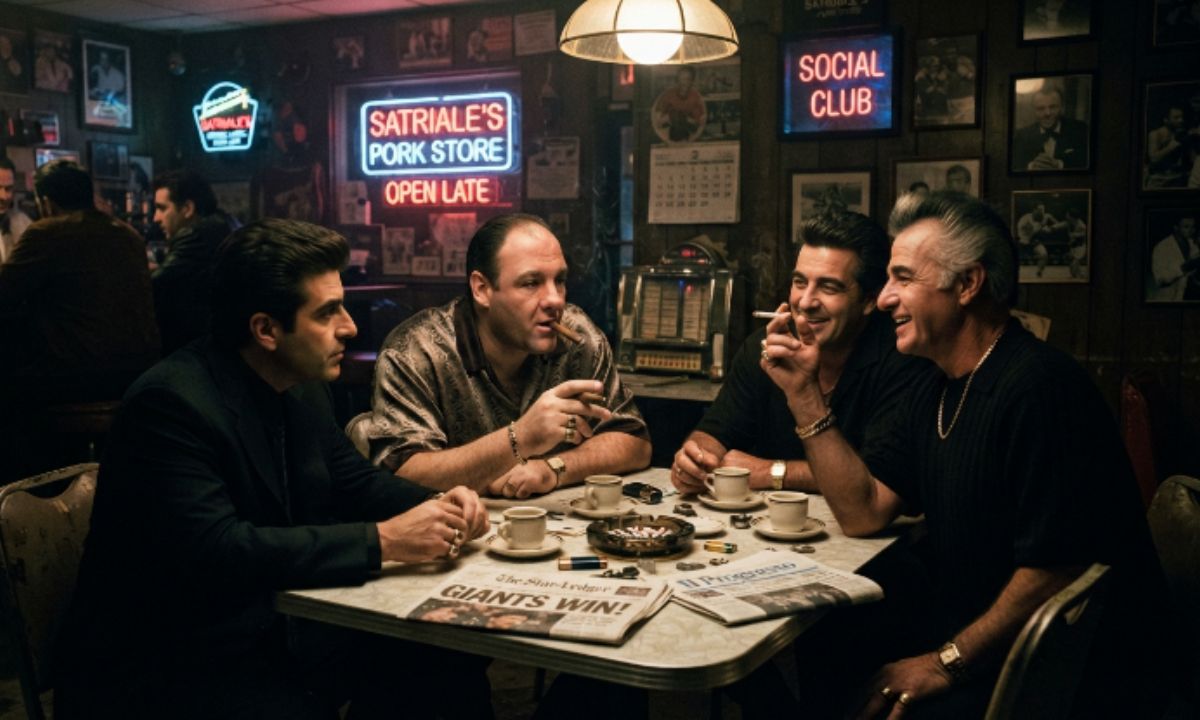
If you’ve ever watched The Sopranos and wondered what “gabagool” actually means, or why everyone keeps saying “madone,” you’re not alone. Sopranos Italian slang isn’t standard Italian — it’s a distinct Italian-American dialect, shaped by Southern Italian immigrants and reshaped again by New Jersey street culture, that the show helped introduce to millions of viewers.
This guide breaks down over 40 of these terms, explains where they really come from, and shows how they’re used — without treating the show’s dialogue as a literal Italian textbook.
40 Sopranos Italian Slang Terms
Gabagool
A New Jersey Italian-American pronunciation of capicola (capocollo), a cured pork cold cut. It’s arguably the most famous word associated with the show.
Example
“He ordered a sandwich piled high with gabagool and provolone.”
Madone
A shortened exclamation derived from “Madonna,” used to express shock, frustration, or disbelief — similar to saying “oh my God.”
Example
“Madone, would you believe the traffic on the parkway today?”
Stugots
A slang term rooted in an Italian vulgarity referring to male anatomy, generally used to describe someone’s nerve, guts, or attitude.
Example
“You’ve got some stugots showing up late to your own wedding.”
Goombah
Refers to a close friend, associate, or fellow Italian-American, sometimes used affectionately and sometimes to describe someone tied to organized crime.
Example
“He introduced his goombah from the old neighborhood.”
Fuggedaboutit
A phonetic spelling of “forget about it,” used broadly to mean anything from “don’t worry about it” to “that’s out of the question.”
Example
“Ask him to split the bill? Fuggedaboutit.”
Paisan
A term for a fellow countryman or close friend, derived from the Italian word paesano, meaning someone from the same village or region.
Example
“He greeted his old paisan with a big hug outside the restaurant.”
Marone
A Southern Italian dialect variation of “Madonna,” used as an exclamation similar to “damn it” or “good grief.”
Example
“Marone, this line has been an hour long already.”
Fanook
A derogatory Italian-American slang slur historically used against gay men; it appears in the show as period-accurate but offensive language rather than a term to use today.
Example
Because this term is a slur, it’s better understood as historical/cultural context than used in modern conversation.
Bada Bing
Derived from the sound of a quick, decisive action (“just like that”), and famously used as the name of the show’s strip club setting.
Example
“Just fix the paperwork and bada bing, you’re done.”
Skifosa
A dialect term meaning disgusting or filthy, often used to describe a person’s behavior or character.
Example
“He called the whole situation skifosa and walked away.”
Capisce
Italian for “understand” or “get it,” commonly used as a rhetorical check-in at the end of a statement.
Example
“Don’t be late again — capisce?”
Comare
Originally meaning “godmother” in standard Italian, but repurposed in Italian-American slang (often as “goomah”) to describe a mistress.
Example
“Rumors spread quickly once people found out about his comare.”
Moozadell
A New Jersey Italian-American pronunciation of mozzarella cheese.
Example
“She picked up fresh moozadell from the deli counter.”
Agita
A term describing stress, anxiety, or an upset stomach caused by worry, borrowed loosely from the Italian word for heartburn.
Example
“Just thinking about the meeting gives me agita.”
Faccia Bruta
A dialect phrase meaning “ugly face,” used as a mild insult about someone’s appearance or attitude.
Example
“He jokingly called his cousin a faccia bruta after losing the card game.”
Paisano Talk
A general term for the informal, dialect-heavy way of speaking common among Italian-American communities, blending English with regional Italian expressions.
Example
“Listening to the older relatives was like a crash course in paisano talk.”
Oof Madone
An emphasized, exaggerated version of “madone,” often used for comedic effect to show frustration or exasperation.
Example
“Oof madone, not this again.”
Wiseguy
Slang for a made member of organized crime, though also used more loosely to describe someone acting tough or streetwise.
Example
“He walked in acting like a real wiseguy.”
Meatball Talk
An informal way of describing casual, unpolished conversation filled with slang and dialect rather than proper Italian or English.
Example
“The uncles at the table were deep in meatball talk about the game.”
Fugazi
Slang for something fake or counterfeit, believed to derive from the Italian word fugace, meaning fleeting or short-lived.
Example
“That deal sounded fugazi from the start.”
Goomah
A slang term for a mistress, closely related to “comare,” widely used throughout the show to describe extramarital relationships.
Example
“Everyone in the neighborhood knew about his goomah, but nobody said a word.”
Mannaggia
An exclamation of frustration or annoyance, roughly translating to “damn it” or “curse it.”
Example
“Mannaggia, I forgot the keys again.”
Stunad
A dialect insult meaning stunned, foolish, or slow-witted.
Example
“Don’t be a stunad — read the instructions first.”
Va Fangool
A vulgar dialect phrase used as a strong dismissal, roughly equivalent to a crude English expletive phrase.
Example
“He told the guy to va fangool and walked off.”
Cugine
Slang describing a younger, lower-ranking associate in organized crime circles, sometimes used to describe someone flashy or inexperienced.
Example
“He was still just a cugine, trying to prove himself.”
Scumbaz
A slang variation of “scumbag,” used to describe someone considered dishonest or low-quality.
Example
“He called his old business partner a total scumbaz.”
Bacala
Literally salted codfish in Italian, used figuratively as slang for someone who is socially awkward or unassertive.
Example
“They teased him for years about being such a bacala around women.”
Chooch
A term for someone acting foolish or clumsy, derived from an Italian word for a donkey.
Example
“Stop being a chooch and pay attention.”
Mortadell
A dialect pronunciation of mortadella, an Italian cured meat, used the same casual way as “gabagool.”
Example
“He piled mortadell and cheese onto the sandwich.”
Skeevy
Slang for someone or something that feels sketchy, dishonest, or unpleasant.
Example
“That whole business deal felt skeevy from the start.”
Guappo
A term historically used to describe a flashy, tough-acting man, sometimes tied to Southern Italian street culture.
Example
“He strutted around like a real guappo in his new suit.”
Sfogliatell
A dialect shorthand for sfogliatelle, a flaky, shell-shaped Italian pastry.
Example
“No holiday was complete without a box of sfogliatell.”
Basta
Italian for “enough,” used as a firm way to end an argument or conversation.
Example
“Basta! I don’t want to hear about it anymore.”
Minchia
A Sicilian dialect exclamation expressing surprise, frustration, or emphasis, similar in function to “wow” or a stronger expletive depending on tone.
Example
“Minchia, I didn’t expect that at all.”
Consigliere
Italian for “counselor” or “advisor,” used in organized crime slang to describe a trusted advisor to a boss.
Example
“He served as consigliere, offering advice before every major decision.”
Omerta
A code of silence historically associated with organized crime, referring to the refusal to cooperate with authorities.
Example
“The old-timers still talked about omerta as an unbreakable rule.”
Made Man
Slang for someone formally inducted into organized crime, holding official status within the group.
Example
“Becoming a made man was treated as the ultimate achievement.”
Sit-Down
Slang for a formal meeting, often to resolve a dispute or make a major decision.
Example
“They scheduled a sit-down to settle the disagreement.”
Capo
Short for caporegime, referring to a captain or leader of a crew within an organized crime hierarchy.
Example
“He answered directly to the capo of his crew.”
Underboss
The second-in-command within an organized crime hierarchy, ranking below the boss.
Example
“The underboss handled daily operations when the boss was unavailable.”
Other Meaning of Slang
Sopranos Slang for Money
Common slang for money in this dialect includes terms like “scratch,” “cake,” and “cheddar” (used broadly in American slang), alongside more specific terms tied to organized crime culture like “tribute” or “envelope,” referring to regular cash payments made up a hierarchy.
Example
“He said he needed to drop off an envelope before the weekend.”
Italian American Slang Insults
Beyond playful terms like “stunad” or “chooch,” this dialect includes sharper insults such as “scumbaz” and “faccia bruta,” most of which rely heavily on tone and context to land as either joking or genuinely offensive.
Example
“He jokingly called his brother a stunad during the card game.”
Sopranos Italian Slang Phrases
Beyond single words, the show popularized full phrases like “fuggedaboutit” and “oof madone,” which function more like verbal punctuation than literal translations of standard Italian.
Example
“When asked if he was worried, he just said, ‘fuggedaboutit.'”
Sopranos Italian Slang Reddit
Online communities, including Reddit threads dedicated to the show, frequently debate the “correct” spelling and pronunciation of these terms, since most were never standardized and instead passed down orally through generations.
Example
“A Reddit discussion broke down whether it’s spelled ‘gabagool’ or ‘gabagoul.'”
Generational Slang Comparison
| Generation | Relationship to This Slang |
| Older Italian-American communities | Grew up using many of these terms naturally in daily speech, often without thinking of them as “slang” at all |
| Millennials | Encountered much of this vocabulary through the show’s original run, often treating it as nostalgic and culturally authentic |
| Gen Z | Mostly discovers these terms through memes, short clips, and online references, frequently used ironically rather than seriously |
How to Use Slang Naturally Without Sounding Awkward
- Know it’s dialect, not standard Italian. Using these terms with actual Italian speakers can cause confusion, since many aren’t recognized outside Italian-American communities.
- Match the tone to the moment. Much of this vocabulary is exaggerated or dramatic by design — it works best in casual, relaxed conversation.
- Don’t force it into unrelated contexts. These terms carry cultural specificity; using them randomly can feel more like imitation than natural speech.
- Watch pronunciation. Much of the humor and authenticity comes from the specific dialect pronunciation, not the standard Italian spelling.
- Recognize which terms have aged poorly. Some slang from this dialect (including outright slurs) reflects outdated or offensive attitudes and isn’t appropriate to use today.
Common Slang Mistakes
- Assuming every term is standard Italian rather than regional dialect or Italian-American invention
- Using outdated or offensive terms without understanding their history
- Overusing dramatic phrases like “madone” until they feel forced rather than natural
- Mixing up similar-sounding terms (like “goomah” and “goombah,” which mean very different things)
- Treating the show’s dialogue as a literal, word-for-word Italian language lesson
Why Sopranos Slang Became So Iconic
The Sopranos didn’t invent this vocabulary, but it introduced it to a massive mainstream audience, embedding these terms in pop culture far beyond Italian-American neighborhoods. The show’s blend of dark drama and dry humor made its distinctive dialect memorable, turning throwaway lines into widely recognized cultural references.
Real Italian vs. Italian-American Slang: What’s the Difference?
Standard Italian, taught in classrooms and spoken across Italy, differs significantly from the Southern Italian dialects that many Italian-American immigrants originally spoke. Over generations in the U.S., pronunciation shifted further, final vowels were often dropped, and English blended in — creating a distinct Italian-American vernacular that would sound unfamiliar, or even confusing, to someone speaking standard Italian today.
Sopranos Slang in Pop Culture and Memes Today
Terms like “gabagool” and “oof madone” have taken on a second life online, frequently appearing in memes, TikTok clips, and reaction posts — often used ironically or humorously by audiences who weren’t even alive during the show’s original run. This continued relevance is a major reason the show’s vocabulary still gets searched and referenced today.
The Origins of Italian-American Slang
This dialect largely traces back to Southern Italian immigrants, particularly from regions like Naples and Sicily, who arrived in the U.S. in large numbers in the late 19th and early 20th centuries. Their regional dialects mixed with English over generations, and later got filtered again through organized-crime culture and New Jersey/New York regional accents — the specific blend that The Sopranos would eventually popularize on screen.
Frequently Asked Questions
What does “gabagool” actually mean?
“Gabagool” is a New Jersey Italian-American pronunciation of capicola, a type of cured pork cold cut.
Is Sopranos slang real Italian?
Not exactly — most of these terms come from Southern Italian dialects that were further reshaped by generations of Italian-American communities in the U.S., so they often sound unfamiliar to speakers of standard Italian.
What does “madone” mean in Italian slang?
“Madone” is a shortened exclamation derived from “Madonna,” used to express shock, surprise, or frustration.
Why do Sopranos characters mispronounce Italian words?
The pronunciation reflects real regional dialect patterns, especially the tendency in Southern Italian dialects to drop final vowels, rather than simple mispronunciation.
What does “stugots” mean?
“Stugots” is slang rooted in an Italian vulgarity, generally used to describe someone’s nerve, boldness, or attitude.
What is a “goomah” in Italian-American slang?
A “goomah” is slang for a mistress, a term used frequently throughout the show to describe extramarital relationships.
Where did Sopranos-style Italian slang originate?
It originated with Southern Italian immigrant communities, whose regional dialects blended with English and organized-crime culture over generations in the U.S.
Final Thoughts
Sopranos Italian slang endures because it’s more than just memorable dialogue — it’s a genuine reflection of how language evolves when immigrant communities blend their heritage with a new culture over generations. Whether you’re revisiting the show, exploring your own Italian-American roots, or just finally want to know what “gabagool” means, this vocabulary offers a small but colorful window into that history.

The author is a professional content writer specializing in word meanings, definitions, and English vocabulary. With over 6 years of experience in language research and educational content creation, they produce accurate, well-researched, and reader-friendly articles.