
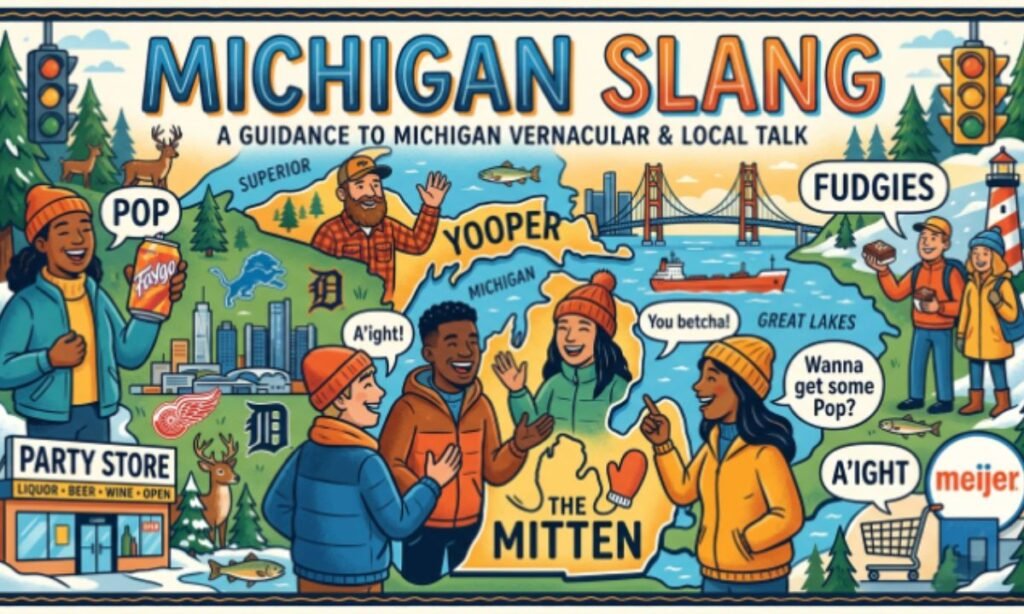
Spend an afternoon in Michigan and you’ll hear it fast: someone says “ope” while reaching past you at the store, a friend suggests a “party store run,” and somebody’s cousin is heading “Up North” for the weekend. None of that is jargon — it’s just how Michiganders talk. This guide breaks down the state’s most common slang, where it comes from, and how to use it without sounding like you’re reading off a list.
Michigan’s slang isn’t one uniform dialect, either — it changes depending on where you are in the state. The Upper Peninsula has its own vocabulary shaped by isolation and snow, lakeside towns Up North lean on tourism and boating terms, and Detroit and Flint run on an entirely different urban dialect built around greetings and shorthand you won’t hear anywhere else in Michigan.
Michigan Slang Terms Explained
Ope
“Ope” is the sound Michiganders (and much of the Midwest) make when they almost bump into someone, drop something, or need to slide past you in a tight aisle. It’s part apology, part reflex. “Ope, ‘scuse me, just gonna squeeze right past ya.”
Yooper
A Yooper is anyone from Michigan’s Upper Peninsula — the name comes from “U.P.-er.” The UP has its own accent and pace of life, shaped by long winters and a lot of distance between towns. “She’s a Yooper, born and raised in Marquette.”
Troll
This is what Yoopers call anyone who lives in the Lower Peninsula — because, from the UP’s perspective, they live “under the bridge” (the Mackinac Bridge). It’s teasing, not hostile. “Trolls don’t know what real winter looks like.”
Up North
“Up North” isn’t a specific place on a map — it’s a state of mind. For someone in Detroit, it might mean Traverse City. For someone in Lansing, it might mean anywhere past Clare. It generally signals cabins, lakes, and vacation. “We’re heading Up North for the Fourth.”
Party Store
Not a store for balloons and confetti. A party store is Michigan’s version of a corner store or bodega — beer, pop, lottery tickets, snacks. “Grab some ice from the party store on your way over.”
Fudgie
A nickname (mostly affectionate, occasionally not) for tourists in northern Michigan and Mackinac Island who can’t leave without a box of fudge. “The line at the fudge shop is all fudgies today.”
The D
Simple shorthand for Detroit. Using it signals familiarity with the city. “You going downtown to the D this weekend?”
Lake Effect
The heavy, localized snow that dumps on areas downwind of the Great Lakes, sometimes burying one town while a few miles away stays clear. “We got two feet overnight — pure lake effect.”
Pasties
Pronounced “PASS-tees,” not the other thing. A pasty is a hand pie stuffed with meat, potatoes, and rutabaga, brought over by Cornish miners and now a UP staple. “Stop at a gas station pasty shop on your way through the UP.”
Snowbelt
The band of communities, mostly along Lake Michigan and Lake Superior’s shores, that regularly get buried by lake-effect snow. “Living in the snowbelt means owning a good snowblower.”
Coney
Short for Coney Island — in Michigan, this means a specific hot dog topped with beanless chili, mustard, and onions, not the New York boardwalk. Detroit has a decades-long rivalry between American and Lafayette Coney Island. “Two coneys and a Vernors, please.”
Michigan Left
A road design where drivers can’t turn left directly at an intersection — instead, you go straight through, then make a U-turn a bit further up. Confusing for visitors, second nature for locals. “Just take the Michigan left up ahead.”
Boat Weather
Warm, calm conditions good enough to get the boat out on a lake. “Finally some boat weather this weekend.”
Tip-Up
A wooden or plastic device used in ice fishing that “tips up” a flag when a fish bites the line below the ice. “Set the tip-ups before it gets dark.”
Mud Season
The stretch between winter and spring when melting snow turns unpaved roads and yards into mud. Not quite a season on the calendar, but very real to anyone with a driveway. “Mud season means the truck’s getting stuck again.”
Party Store Run
The actual errand of heading to the party store — usually last minute, usually for beer, ice, or snacks before people show up. “I’ll do a quick party store run before everyone gets here.”
Lake Life
The general lifestyle built around cottages, docks, pontoons, and long summer evenings on one of Michigan’s thousands of lakes. “They’re all about the lake life once June hits.”
Pop
Michigan’s word for soda. Ask for a “soda” here and you might get a puzzled look. “Can you grab me a pop from the cooler?”
Pure Michigan
Originally a state tourism slogan, now used casually to describe anything quintessentially Michigan — a beautiful sunset, a snowstorm in April, a great coney. “Snow in May? That’s so pure Michigan.”
The Mitten
A nickname for Michigan’s Lower Peninsula, based on its hand shape — locals often point to a spot on their own palm to show you where a town is. “He grew up on the west side of the Mitten.”
Michigander
The accepted term for a Michigan resident. “Michiganian” exists too, but most locals will correct you if you use it. “She’s a proud Michigander.”
Flatlander
What Upper Peninsula residents sometimes call people from the Lower Peninsula, similar in spirit to “Troll.” “The flatlanders are up for the weekend.”
Boston Cooler
A Vernors ginger ale float made with vanilla ice cream — despite the name, it’s a Detroit original, not from Boston. “Nothing beats a Boston cooler on a hot day.”
What Up Doe
A Detroit greeting, part of the city’s distinct urban dialect, used as an easygoing “what’s up.” “What up doe, ain’t seen you in a minute.”
Pank
A northern Michigan term for packing down snow, usually by stomping it flat to make a path or a base for a snow fort. “Pank down that snow before you build the fort.”
FIP Michigan Slang
In Southwestern Michigan, especially around lakeshore towns, locals use FIP for visitors from Illinois — short for “Friendly Illinois Person.” The related term FOP covers Ohio visitors the same way. Both started as a wink at the heavy summer traffic of out-of-state plates, and both terms occasionally get a less polite word swapped in for “Friendly” when the crowds get bad. It’s regional slang tied specifically to beach towns like South Haven and Saugatuck, not something you’ll hear statewide.
Flint Michigan Slang
Flint’s slang leans into the same Detroit-rooted urban dialect but has its own flavor, shaped by the city’s auto-industry history and tight-knit neighborhoods. Locals share greetings like “what up doe” with Detroit, along with city-specific nicknames for streets, schools, and hangouts that mostly stay inside the community. Flint slang tends to spread through word of mouth and social media rather than written guides, so it shifts faster than the more fixed, geography-based terms like “Yooper” or “Up North.” If you’re new to the city, the respectful approach is to listen first rather than try terms out right away.
Michigan Slang Funny
Some Michigan slang exists purely because it makes people laugh, or because outsiders find it baffling:
- Ope — an entire vocabulary packed into one syllable
- Citiot — what small lakeside towns call obnoxious visitors from big cities (a mashup of “city” and “idiot”)
- Yeah, no and No, yeah — the real answer is always the last word, and it takes visitors weeks to catch on
- Pure Michigan — used sarcastically for anything absurdly on-brand for the state, like snow in May
- Chook — northern Michigan slang for a knit winter hat, not the chicken it sounds like
Michigan Slang Words
A quick-reference recap of the terms above:
| Term | Meaning |
| Ope | Reflexive “excuse me” |
| Yooper | Person from the UP |
| Troll | Person from the Lower Peninsula |
| Up North | Vacation region, no fixed border |
| Party store | Convenience store |
| Fudgie | Tourist who buys fudge |
| The D | Detroit |
| Coney | Chili-topped hot dog |
| Pop | Soda |
| Michigander | Michigan resident |
Generational Slang Differences
Older Michiganders and lifelong locals tend to use geography- and food-based terms — “pop,” “party store,” “Up North,” “the Mitten” — because that’s simply how the state has talked for decades. These words spread through family, local news, and everyday conversation rather than the internet.
Younger Michiganders still use those same words, but they’ve also folded in national and internet slang, and platforms like TikTok have given older regional terms a second life. “Ope” and “Yooper,” for instance, went from familiar-but-local phrases to viral, meme-friendly ones almost overnight, introducing them to people who had never set foot in the state. Detroit- and Flint-rooted urban slang, meanwhile, tends to travel through music, social media, and community more than through general “Michigan slang” lists, and it changes faster than the older geography-based terms.
How to Use Slang Naturally Without Sounding Awkward
- Let context lead. Say “party store” only when you’re actually talking about grabbing something quick — not as a random vocabulary flex.
- Match the region. “Yooper” and “Troll” only make sense in UP-related conversations; using them elsewhere just confuses people.
- Don’t overdo delivery. Michigan slang works best said plainly, not performed. “Ope” loses its charm if you shout it.
- Skip terms you don’t fully understand. City-specific slang, especially from Detroit and Flint, carries cultural weight — use it only if it’s genuinely part of how you talk, not as a costume.
- It’s fine to ask. Locals generally don’t mind explaining a word — it’s a much better look than guessing and getting it wrong.
Common Slang Mistakes
- Saying “Michiganian” instead of “Michigander.” It’s technically used in some formal contexts, but almost every local says Michigander.
- Treating “Up North” as one specific town. It’s relative to where the speaker lives, not a pin on a map.
- Confusing “party store” with a store that sells party supplies. It’ll get you a strange look if you ask where the balloons are.
- Using Detroit or Flint-specific slang outside its context, especially without understanding its background — it can come across as forced or disrespectful.
- Assuming Yooper slang applies statewide. UP terms and Lower Peninsula terms are genuinely different dialects.
Michigan Slang by Region
Michigan’s slang splits fairly cleanly by geography. The Upper Peninsula leans on words shaped by isolation, snow, and a dialect that blends into neighboring Wisconsin — think Yooper, Troll, Flatlander, and pank. The rest of the Lower Peninsula, especially northern vacation towns, runs on lake and tourism vocabulary: Up North, fudgie, boat weather, lake life. Metro Detroit and Flint carry an entirely different, urban-rooted dialect built around greetings like “what up doe” and city-specific shorthand that outsiders rarely pick up on quickly.
Michigan Food & Drink Slang
Food is where Michigan slang gets the most specific. A “coney” means one exact hot dog style, not a place. “Pop” separates Michiganders from anyone who says “soda” or “coke.” A “Boston cooler” is Detroit’s own ice cream float, despite the name pointing east. And in the UP, a “pasty” isn’t dessert — it’s a full meal wrapped in dough, tied to the region’s mining history.
Michigan Slang on Social Media
Platforms like TikTok have turned a lot of Michigan’s older, local-only slang into something people across the country now recognize. Terms that used to live in family kitchens or local news columns — “ope” being the clearest example — now show up in captions and comment sections far outside the state. That hasn’t replaced the older vocabulary; it’s mostly just given it a bigger audience, while Detroit and Flint’s urban slang continues to spread more through music and community than through viral trends.
Frequently Asked Questions
What does “ope” mean in Michigan?
“Ope” is a reflexive word Michiganders say when they almost bump into someone, drop something, or need to squeeze past — it’s a quick, informal “excuse me.”
What do Michiganders call people who live in the Upper Peninsula?
People from the Upper Peninsula are called Yoopers, and they, in turn, call Lower Peninsula residents Trolls.
Why do Michiganders say “pop” instead of “soda”?
“Pop” is simply the regional term used across most of Michigan and the Midwest for carbonated soft drinks; it’s a dialect difference, not a brand distinction.
What is a Michigan Left?
A Michigan Left is a road design where drivers go straight through an intersection first, then make a U-turn a short distance later, instead of turning left directly.
What does “the D” mean in Michigan slang?
“The D” is local shorthand for the city of Detroit.
What is a party store in Michigan?
A party store is Michigan’s term for a convenience store, typically selling drinks, snacks, and lottery tickets — not party decorations.
What does FIP mean in Michigan slang?
FIP stands for “Friendly Illinois Person,” a term used in Southwestern Michigan lakeshore towns for out-of-state visitors from Illinois.
Final Thoughts
Michigan slang isn’t a script to memorize — it’s a byproduct of geography, weather, food, and decades of local habit. Learn a handful of terms that actually fit your situation, use them the way locals do, and you’ll sound less like someone reading off a list and more like someone who’s actually spent time in the Mitten.

The author is a professional content writer specializing in word meanings, definitions, and English vocabulary. With over 6 years of experience in language research and educational content creation, they produce accurate, well-researched, and reader-friendly articles.