

The daijoubu meaning looks easy at first. It’s the Japanese word for “okay,” “fine,” or “no problem.” Then you hear it in a café, in an anime, and in a work chat, and each time it seems to mean something different.
That’s because daijoubu changes with tone and context. It can reassure someone, ask if they’re alright, give permission, or politely say “no thanks.” In this guide, you’ll learn the meaning in Japanese and English, the kanji and hiragana, how to say it, and how to reply. You’ll also see real examples, grammar tips, and the mistakes that confuse beginners.
What Does Daijoubu Mean in Japanese?
Daijoubu (大丈夫) means “okay,” “all right,” or “no problem” in Japanese. It’s a very common word, and sksensei lists it as a basic N5 level word.
People use it to say they’re fine, ask if someone is fine, or accept something. It works for health, plans, offers, and even objects, like asking if a file or a time slot is okay.
daijoubu meaning ? simple explanation
In simple words: daijoubu says “things are fine, no worry needed.” The sense that follows depends on the question and the tone.
meaning of daijoubu with examples
| Japanese | Romaji | English |
| 大丈夫です。 | Daijoubu desu. | I’m okay. |
| 大丈夫ですか? | Daijoubu desu ka? | Are you okay? |
| 明日は大丈夫です。 | Ashita wa daijoubu desu. | Tomorrow works for me. |
| もう大丈夫です。 | Mou daijoubu desu. | I’m fine now. |
| 大丈夫、大丈夫。 | Daijoubu, daijoubu. | No worries. |
Daijoubu pronunciation
Say it as “dye-joh-boo.” The full breakdown is below in the pronunciation section.
daijoubu desu meaning
Daijoubu desu means “I’m okay” or “it’s okay,” said in a polite way. The word “desu” adds politeness, so it works with strangers, coworkers, and teachers.
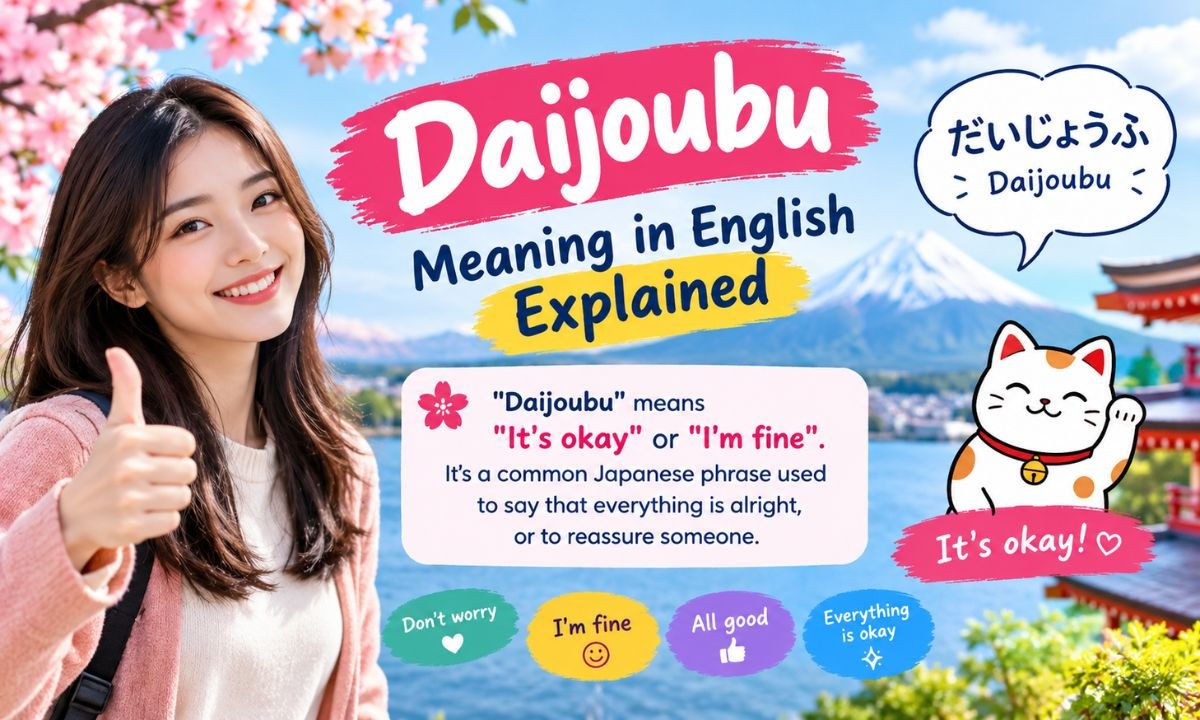
Daijoubu Meaning in English Explained
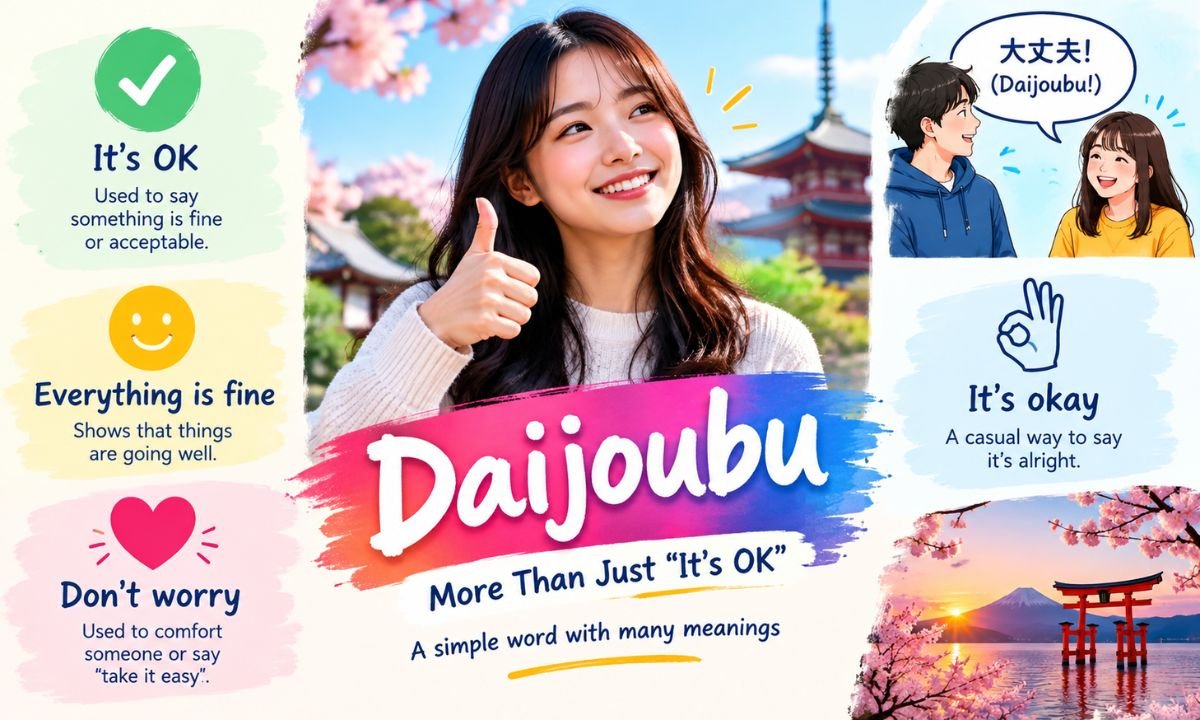
The closest English matches are “okay,” “all right,” “fine,” “safe,” and “no problem.” The meaning can also stretch to “don’t worry,” “I can handle it,” or “no, thank you.”
Coto Academy explains the roots this way: 大 (dai) means big, and 丈夫 (jobu) means sturdy or strong. Together, the word once pointed to a strong, reliable man. Over time, it became a general word for “safe and fine.”
How to Pronounce Daijoubu Correctly
Break it into four beats: dai-jou-bu.
- Dai: like the English word “die”
- Jou: like “joh,” with a long “o” sound
- Bu: like “boo,” often said softly at the end
Keep the beats smooth and even. Don’t stress one syllable the way English does. You’ll also see it written daijobu or daijōbu, and all of them mean the same thing.
What Does Daijoubu Desu Ka Mean?
Daijoubu desu ka? means “Are you okay?” or “Is it okay?” The particle “ka” turns the sentence into a question.
You can ask it in several ways:
- Checking on someone: “大丈夫ですか?” after a fall or a sneeze
- Checking a plan: “月曜日は大丈夫ですか?” (Is Monday okay?)
- Asking permission: “ここに座っても大丈夫ですか?” (Is it okay to sit here?)
Daijoubu Meaning in Anime and Japanese Culture
In anime, you’ll hear “Daijoubu?” whenever a character falls, gets hurt, or looks upset. A casual reply is “Daijoubu da yo!” (I’m fine!).
The word also reflects Japanese politeness. A direct “no” can sound blunt, so many people choose a softer phrase. A blogger at Beyond the Textbooks notes that daijoubu can also save face, soften a refusal, or avoid conflict. So a person saying “daijoubu” may not be fine at all.
How Is Daijoubu Used in Everyday Conversations?
Typical situations include:
- Reassuring: “大丈夫ですよ。” (It’s okay, really.)
- Responding to an apology: “大丈夫、大丈夫。” (No worries.)
- Declining an offer: “大丈夫です、ありがとうございます。” (No thanks.)
- Confirming: “それで大丈夫です。” (That works.)
- Showing certainty: “たぶん大丈夫です。” (It’ll probably be fine.)
Others Meanings Of Daijoubu
Searches around this word cover many angles. Here’s what each one means.
Life is not daijoubu meaning
I couldn’t find an established saying or source for “life is not daijoubu.” Its likely sense is “life isn’t always okay.” It could also reflect how people say daijoubu even when things aren’t fine. If you saw it as a caption or lyric, check the original context.
Daijoubu meaning in english
In English, it means “okay,” “fine,” “all right,” or “no problem.” You can find the full detail in the English explanation above.
Daijoubu meaning hiragana
In hiragana, daijoubu is written だいじょうぶ. A shortened, casual form, だいじょぶ, is also common in informal writing.
Daijoubu meaning korean
The Korean match is 괜찮아 (gwaenchanha) in casual speech and 괜찮아요 (gwaenchanayo) in polite speech. Both mean “it’s okay” or “I’m fine.”
Daijoubu meaning song
Several songs use “Daijoubu” as a title, and the word simply means “it’s okay” or “it’ll be alright.” I couldn’t confirm a single famous song with one fixed meaning, so check the song’s lyrics and artist.
Daijoubu in Japanese
In Japanese, it’s written 大丈夫 in kanji, だいじょうぶ in hiragana, and daijoubu in romaji. All three point to the same word.
Daijoubu meaning kanji
The kanji 大丈夫 has three characters. 大 means big. 丈 relates to height or length. 夫 means man or husband. Together, they once described a strong person, and now they mean “okay.”
Daijoubu Meaning in Texting and Japanese Slang
In texts, people often shorten it to だいじょぶ or stretch it to だいじょーぶ. A young speaker may write 全然大丈夫 (zenzen daijoubu), which means “totally fine.” Japan Dev points out that younger people often use this phrase.
A quick text might look like this:
- 「明日の7時で大丈夫?」 (Is 7 tomorrow okay?)
- 「うん、大丈夫!」 (Yeah, it’s fine!)
Grammar Rules
- Word type: Daijoubu acts like a na-adjective, so you can say 大丈夫な人 (a reliable person).
- Casual form: 大丈夫だ / 大丈夫だよ
- Polite form: 大丈夫です
- Past tense: 大丈夫でした (it was okay)
- Negative: 大丈夫じゃない (casual) / 大丈夫じゃありません (polite)
- Question: Add か (ka) or a rising tone.
- Probability: 大丈夫でしょう (it’s probably fine)
What Is the Difference Between Daijoubu and Daijoubu Desu?
The difference is politeness.
| Form | Politeness | Use with |
| Daijoubu | Casual | Friends, family |
| Daijoubu desu | Polite | Strangers, coworkers, teachers |
| Daijoubu desu yo | Polite, reassuring | Calming someone |
| Daijoubu da yo | Casual, reassuring | Friends |
If you’re unsure, use daijoubu desu. It’s safe in almost any setting.
Daijoubu Use in Social Media
On social media, daijoubu works like it does in texts, but with an audience. People use it in captions, comments, and replies to say they’re fine, to reassure friends, or to accept a plan. Because there’s no voice, the tone comes from emojis, punctuation, and context.
Here’s how it shows up on common platforms:
| Platform | Typical use | Example | Meaning |
| LINE | Chats and stickers | 「今日は大丈夫?」 | Is today okay? |
| X (Twitter) | Short posts and replies | 「ちょっと疲れたけど大丈夫」 | I’m tired but fine. |
| Captions and DMs | 「雨でも大丈夫!」 | Rain is fine too! | |
| TikTok | Comments and videos | 「みんな大丈夫?」 | Is everyone okay? |
Many chat apps also offer stickers with “大丈夫” on them, so you can reply without typing. Check each app’s sticker shop for current options.
How to Use Daijoubu in Social Media Posts and Comments
Keep these steps in mind before you post:
- Match the tone. Use 大丈夫 with friends and 大丈夫です with strangers or brands.
- Add an emoji. A smile makes it warm. No emoji can sound flat.
- Be clear about yes or no. If someone asks “Is Friday okay?”, say “金曜日は大丈夫です” to avoid confusion.
- Read between the lines. A post saying “大丈夫” after a rough day may hide stress.
- Check in. If a friend writes “大丈夫じゃない” (I’m not okay), reply with care: “大丈夫? 話聞くよ。” (Are you okay? I’ll listen.)
A quick caption example: 「ちょっと寝不足だけど、大丈夫!」 means “I’m a bit sleep-deprived, but I’m okay!” It sounds cheerful, but a close friend might still ask if you’re really fine.
Examples of Daijoubu in Japanese Sentences
| Japanese | Romaji | English |
| 大丈夫ですか? | Daijoubu desu ka? | Are you okay? |
| はい、大丈夫です。 | Hai, daijoubu desu. | Yes, I’m fine. |
| 全然大丈夫です。 | Zenzen daijoubu desu. | It’s totally fine. |
| お水は大丈夫です。 | Omizu wa daijoubu desu. | I’m okay for water. (No, thanks.) |
| 日曜日は大丈夫? | Nichiyoubi wa daijoubu? | Is Sunday okay? |
| 大丈夫じゃない。 | Daijoubu janai. | I’m not okay. |
How to Reply to Daijoubu in Japanese
Your reply depends on what you want to say.
| Situation | Reply | Meaning |
| You’re fine | はい、大丈夫です。 (Hai, daijoubu desu.) | Yes, I’m fine. |
| You’re fine, polite thanks | ありがとう、大丈夫です。 | Thanks, I’m okay. |
| You’re not fine | 大丈夫じゃないです。 (Daijoubu janai desu.) | I’m not okay. |
| You’re a bit hurt | 少し痛いです。 (Sukoshi itai desu.) | It hurts a little. |
| You need help | 助けてください。 (Tasukete kudasai.) | Please help me. |
Be honest if you’re in real trouble. It’s easy to say “daijoubu” out of habit, even when it isn’t true.
Does Daijoubu Mean Yes or No in Japanese?
It can mean both. That’s what makes it tricky.
- Yes: “Is Friday okay?” → “大丈夫です。” (Friday works.)
- No: “Would you like more tea?” → “大丈夫です。” (No, I’m good.)
Sksensei lists “polite or neutral refusal” as one of its main meanings. To make a yes clear, say “はい、お願いします” (Hai, onegaishimasu), which means “Yes, please.” To make a no clear, add a small head shake or a thank-you.
When To Use And When Not To Use It
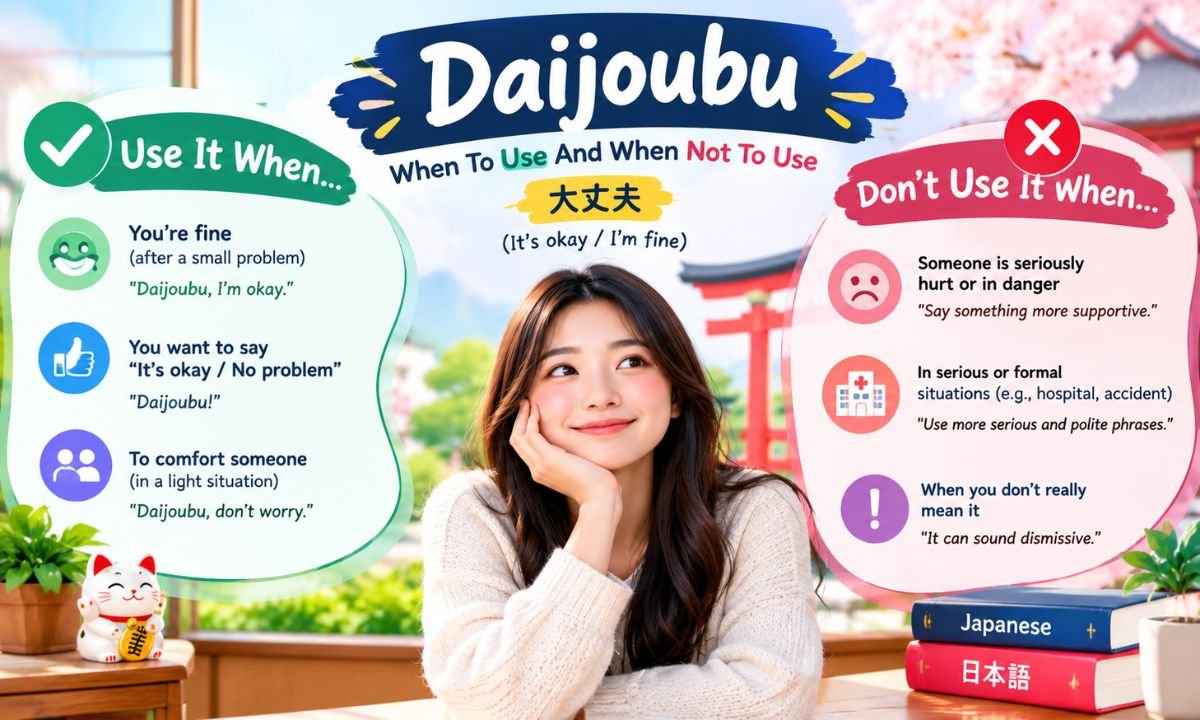
Use daijoubu when:
- You want to say you’re okay.
- You want to check on someone.
- You need a soft, polite way to decline.
- You want to confirm that a plan works.
Don’t use daijoubu when:
- You really need help or have an injury. Say so clearly.
- You want a clear yes, since the word can sound like a refusal.
- You’re writing formal business messages. Use “問題ありません” (mondai arimasen) instead.
- The listener might mix it up with a refusal.
Frequently Asked Questions About Daijoubu Meaning
What does daijoubu mean in English?
It means “okay,” “all right,” “fine,” or “no problem.”
How do you say daijoubu in kanji?
It’s written 大丈夫.
What does daijoubu desu ka mean?
It means “Are you okay?” or “Is it okay?”
Is daijoubu formal or casual?
The short form is casual. Daijoubu desu is polite.
Does daijoubu mean “no thanks”?
Yes, it often does. It’s a gentle way to decline an offer.
What is the Korean word for daijoubu?
It’s 괜찮아 (gwaenchanha), or 괜찮아요 (gwaenchanayo) in polite speech.
Conclusion
The daijoubu meaning is “okay,” but the real message depends on tone, timing, and context. It can reassure, ask, agree, or politely say no.
Learn the casual and polite forms, check the situation, and be honest when you aren’t fine. With a little practice, you’ll hear daijoubu everywhere and know exactly what people mean.

The author is a professional content writer specializing in word meanings, definitions, and English vocabulary. With over 6 years of experience in language research and educational content creation, they produce accurate, well-researched, and reader-friendly articles.