
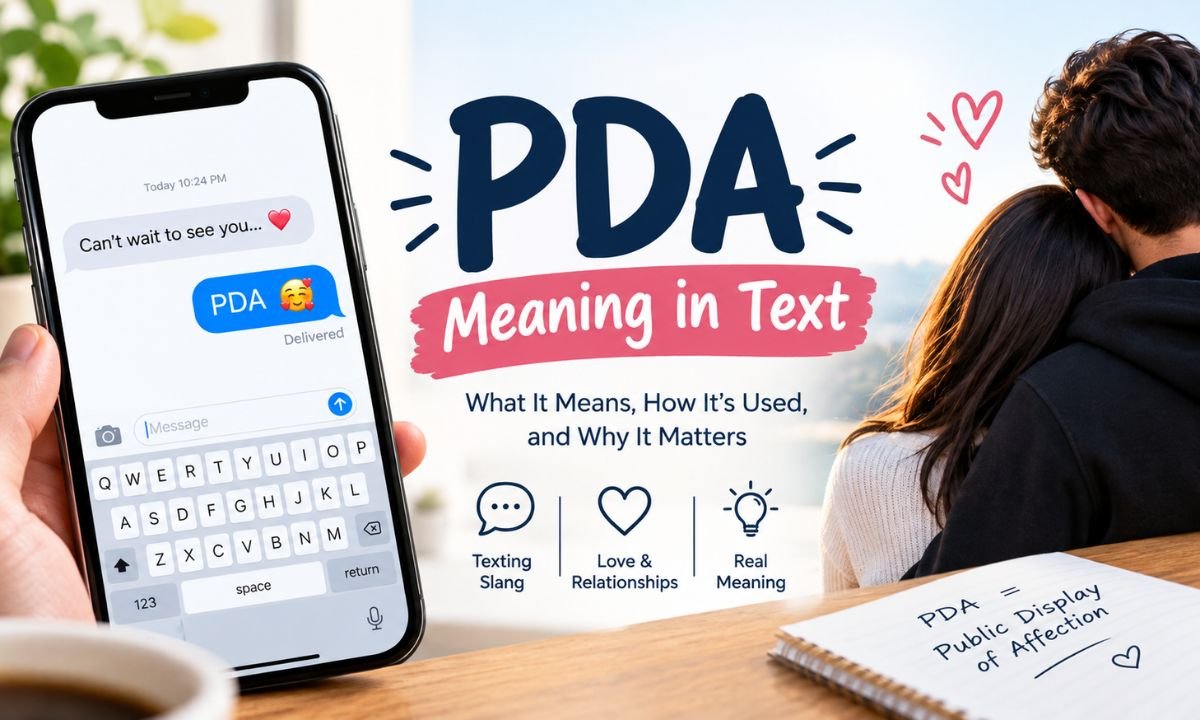
Seeing “PDA” pop up in a text or comment and not sure what it means? In almost every texting and social media context, PDA stands for Public Display of Affection — showing love or intimacy, like hugging, kissing, or affectionate messages, where others can see it. This guide covers the real meaning behind PDA in texts, how it’s used across platforms, when it’s welcome versus awkward, and how to respond when someone uses it.
The tricky part is that PDA doesn’t always look the same depending on where you spot it. A friend texting “they were so PDA today” is talking about something very different from a medical chart that uses the same three letters, and even within texting, “PDA” can shift between a light-hearted tease, a genuine compliment, or a gentle boundary-setting comment.
PDA Meaning in Text – Quick Meaning
What Does PDA Mean?
PDA means Public Display of Affection — any romantic or affectionate gesture shown where other people can witness it, whether that’s in person or online.
Simple Definition
In a text message, PDA usually describes a couple being openly affectionate, either physically (in public) or digitally (through loving texts, comments, or posts other people can see).
Common Examples in Text
- “They were so PDA at the party lol”
- “Not you two being PDA on main 😭”
- “I love PDA, ngl”
How It’s Usually Used
Most often it’s used as a noun (“that’s a lot of PDA”) or an adjective (“they’re so PDA”), describing a couple’s behavior rather than a single action.
Origin & Background
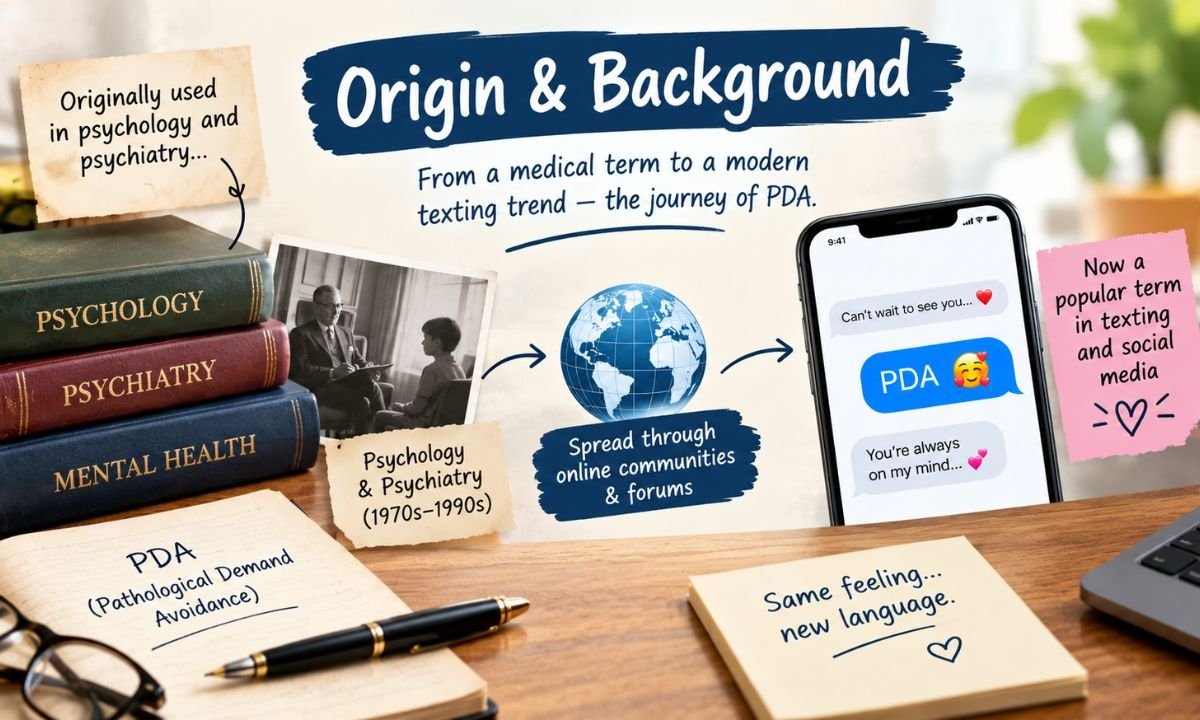
Where the Term Came From
“PDA” started as sociological shorthand decades ago for describing physical affection between couples in shared, public spaces — long before texting existed. It was a neutral academic term before it became everyday slang.
Cultural Influence
As dating norms relaxed in Western culture through the late 20th century, PDA shifted from a clinical description to casual conversation, showing up in gossip, teen slang, and pop culture references to couples being “extra” in public.
Social Media Changed Everything
Once couples started sharing affection online — captions, comments, tagged photos — “PDA” expanded beyond physical space. Digital PDA now applies to visible affection on any platform, viewable by an audience far bigger than a few passersby.
How the Meaning Evolved
What began as strictly physical (hand-holding, kissing) now covers verbal and written affection too: pet names in comments, love-heavy captions, or a stream of emojis sent where friends can see them.
Real-Life Conversations
WhatsApp Conversation
Friend: “how was the date”
You: “so good, ngl we were kinda PDA at dinner lol”
Instagram DM Conversation
Friend: “saw your story, y’all are so cute”
You: “I KNOW we were being so PDA 😭”
TikTok Comments
“the PDA in this video is sending me, get you someone who looks at you like that”
Text Message Conversation
Partner: “can we not do so much PDA in front of your parents lol”
You: “okay fair 😂”
Emotional & Psychological Meaning
What Emotion Does PDA Express?
PDA typically signals confidence in a relationship, a desire for connection, or simply comfort being openly affectionate — though it can occasionally reflect insecurity or a need for validation.
Why People Use PDA
People use PDA to express genuine feelings, mark a relationship as “official” socially, or reinforce closeness with their partner in front of others.
What It Reveals About Modern Communication
The rise of digital PDA shows how intimacy has partly moved online — affection is now performed for an audience of followers, not just people standing nearby.
A Realistic Scenario
A couple posts a caption-heavy anniversary photo. Friends comment “the PDA!!” — not criticizing them, just noting how openly affectionate the post is compared to their usual posts.
Usage in Different Contexts
Social Media
Here, PDA usually refers to visible affection in captions, comments, or photos — often used approvingly (“cute PDA”) or teasingly (“okay we get it, PDA”).
Friends & Relationships
Among friends, PDA is casual shorthand, often used to gently tease a couple for being extra affectionate in front of the group.
Work & Professional Settings
PDA is rarely used seriously in work contexts — displaying visible affection with a partner at work events is generally considered unprofessional, and the term itself would sound out of place in a work text.
Casual vs Serious Tone
Among close friends, “PDA” is light and joking. In a note about relationship boundaries (e.g., between partners or with family), it can carry a more serious, direct tone.
When NOT to Use It
Formal Situations
Avoid using PDA casually in professional emails, official communications, or formal writing — it reads as too informal and out of place.
Sensitive Cultural Environments
In cultures or communities where public affection is discouraged, referencing PDA lightly can come across as dismissive of real social or religious norms.
During Serious Conflict
If a conversation is about actual boundaries or discomfort around affection, keep the tone direct rather than joking — using “PDA” flippantly can minimize someone’s real concern.
Situations That Cause Misunderstanding
Be careful using PDA in mixed contexts (medical, tech, autism-related discussions) where the same letters mean something completely different — more on that below.
Common Misunderstandings
People Think PDA Always Means Kissing
PDA covers a wide range of affection — hand-holding, hugging, and even affectionate words count, not just kissing.
Tone Gets Misread Online
Because text lacks tone of voice, “so much PDA” can read as either a compliment or a subtle criticism — context and emojis usually clarify which.
Literal vs Figurative Meaning
Sometimes “PDA” is used loosely for any obvious affection, even something as small as a caption — not strictly physical public behavior.
Comparison Table
| Term | Meaning | Common Context |
| PDA | Public Display of Affection | Texting, social media, relationships |
| PDA (medical) | Patent Ductus Arteriosus | Pediatric heart condition |
| PDA (autism-related) | Pathological Demand Avoidance | Clinical/autism profile discussions |
| PDA (tech, older use) | Personal Digital Assistant | Early 2000s handheld devices |
Key Insight
In texting and social contexts, PDA almost always means Public Display of Affection — the other meanings only appear in medical, clinical, or older tech conversations, so context makes the intended meaning obvious.
Variations / Types
- Physical PDA — hand-holding, hugging, kissing in person
- Digital PDA — affectionate texts, comments, or posts visible to others
- Mild PDA — subtle gestures like hand-holding or a quick hug
- Extreme PDA — prolonged, overt affection some find excessive
- Cute PDA — affection that reads as sweet rather than awkward
- Cringe PDA — affection that feels performative or over-the-top to onlookers
- Celebrity PDA — public affection between famous couples, often covered by entertainment media
- Social Media PDA — affection expressed through posts, captions, or comments
- Accidental PDA — affection shown without realizing others are watching or that it’ll be seen
- Performative PDA — affection shown mainly for an audience rather than genuine connection
How to Respond When Someone Uses It
Casual Replies
“lol yeah we were being extra” or “guilty as charged 😂”
Funny Replies
“PDA champions, no notes” or “we take our PDA very seriously”
Mature Replies
“Yeah, I think we’re just comfortable being affectionate — hope it wasn’t too much.”
Respectful Replies
“Noted, I’ll tone it down around your family” (when someone raises a boundary).
Regional & Cultural Usage
Western Culture
Generally more accepting of visible affection, especially among younger generations, though workplace and formal settings still discourage it.
Asian Culture
Many Asian cultures traditionally favor modesty in public affection, though attitudes are shifting among younger, urban generations influenced by social media.
Middle Eastern Culture
Public affection is often more conservative here due to cultural and religious norms, making overt PDA far less common or accepted in public spaces.
Global Internet Usage
Online, “PDA” as slang is used fairly universally in English-language texting and social media, regardless of a region’s real-world cultural norms around public affection.
Generational Differences
Gen Z
Comfortable with both physical and digital PDA, often normalizing affectionate posts and captions as a routine part of relationships online.
Millennials
Tend to use “PDA” more as playful commentary or teasing, having grown up with the term before social media made digital PDA common.
Is It Safe for Kids?
Understanding the Context Matters
The term itself is harmless slang, but conversations about PDA sometimes involve romantic or physical content that may not be age-appropriate — parents should consider the context of the conversation, not just the acronym.
Frequently Asked Questions
What is PDA in Gen Z slang?
Gen Z uses PDA the same way it’s traditionally defined — Public Display of Affection — but applies it just as often to affectionate social media posts as to physical affection in person.
What does PDA mean in a relationship?
It refers to how openly a couple shows affection to others, whether in public spaces or online, and can reflect their comfort level with visible intimacy.
What is PDA intimacy?
This describes the emotional and physical closeness a couple displays publicly — it’s less about the acronym itself and more about how openly a couple expresses their bond.
What does “PDA” stand for in slang?
In texting and social slang, PDA stands for Public Display of Affection.
Is PDA a bad thing?
Not inherently — mild PDA is normal and healthy, though excessive or performative PDA can feel uncomfortable to onlookers or signal insecurity in some cases.
How much PDA is too much?
There’s no fixed rule, but if it makes bystanders visibly uncomfortable or distracts from a formal setting, it’s generally considered excessive.
What does it mean when a guy is not into PDA?
It often simply reflects personal comfort level or upbringing rather than a lack of feelings — many people express affection privately instead.
What’s the difference between PDA and just being affectionate?
Affection becomes “PDA” specifically when it happens somewhere others can see or witness it, whether physically in public or visibly online.
Why do some couples avoid PDA completely?
Reasons vary — personal privacy preferences, cultural upbringing, workplace norms, or simply feeling that affection is more meaningful kept private.
Final Thoughts
PDA in text almost always means Public Display of Affection, whether it’s describing a couple holding hands at dinner or an especially sweet caption on Instagram. The acronym’s other meanings — medical, clinical, or tech-related — rarely show up outside their specific fields, so context will nearly always make the intended meaning clear. When you see “PDA” in a message, the real question usually isn’t what it means, but how comfortable everyone involved is with how visible that affection is.

The author is a professional content writer specializing in word meanings, definitions, and English vocabulary. With over 6 years of experience in language research and educational content creation, they produce accurate, well-researched, and reader-friendly articles.