
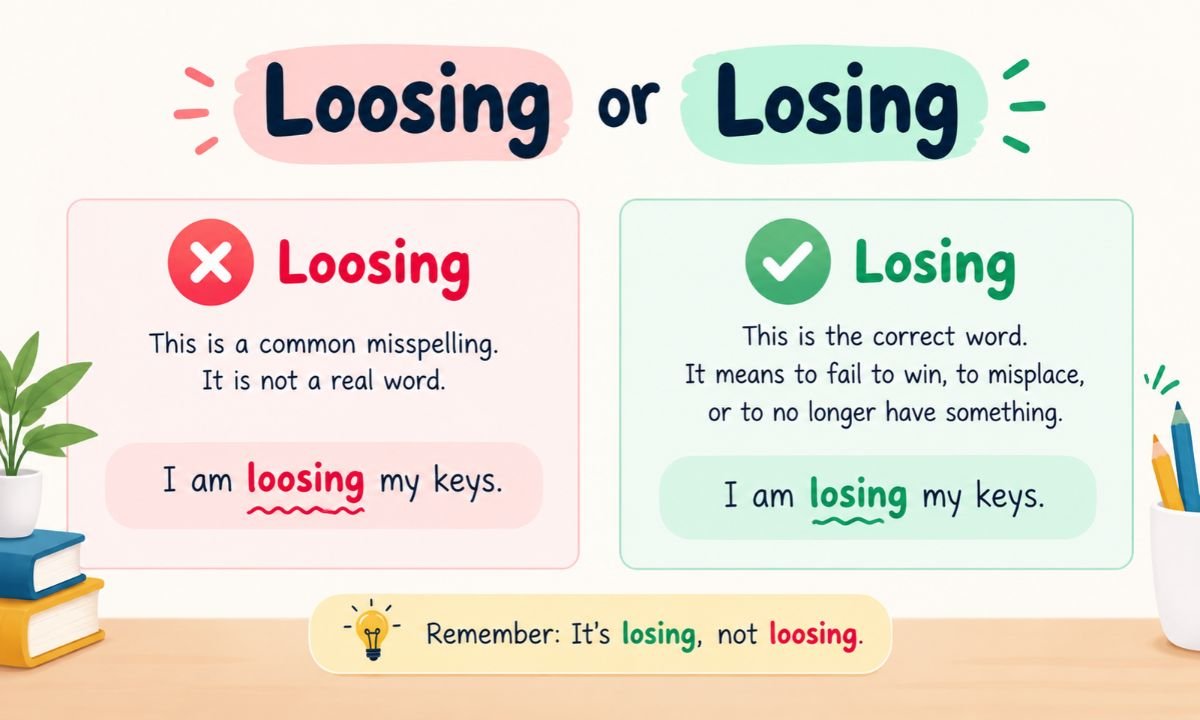
Loosing or losing? In almost every sentence you will write, the correct spelling is losing. Use it when you fail to win, misplace something, or no longer have something. “Loosing” is a real word, but it means something very different, and most people never need it.
This guide shows when to use each spelling, with clear examples, a comparison table, memory tricks, and practice questions. By the end, you will know exactly which one to pick.
What Does Losing Mean?
“Losing” is the present participle of the verb lose. It describes an action that is happening now or continuing over time.
It has several meanings:
- Failing to win a game, fight, or contest
- Misplacing something or being unable to find it
- No longer having something, such as money, hair, or a job
- Getting smaller, lower, or weaker, as in losing weight
- Wasting something, such as time
Example: She is losing her keys again.
What Does Loosing Mean?
“Loosing” comes from the verb loose. As a verb, loose means to set free, let go, untie, or fire. Merriam-Webster lists these senses: to release, to make loose or untie, and to detach.
Today, “loosing” mostly appears in formal, old-fashioned, or literary writing. In everyday speech, people say “loosening” or “releasing” instead.
Example: The sailors were loosing the ropes from the dock.
How Do You Spell Losing or Loosing
The correct spelling for “no longer having” or “not winning” is losing, with one o.
Here is a quick rule you can use every time:
- Losing = loss, defeat, or something going missing
- Loosing = freeing, releasing, or untying
If your sentence is about a loss, write losing.
Loosing or Losing: What Is the Difference?
The two words look alike, but they come from different base words and mean different things.
| Feature | Losing | Loosing |
| Base verb | Lose | Loose |
| Core meaning | Not winning, misplacing, no longer having | Releasing, untying, setting free |
| Pronunciation | LOO-zing | LOO-sing |
| How common | Very common | Rare |
| Example | He is losing the match. | The archer is loosing an arrow. |
When Should You Use Losing?
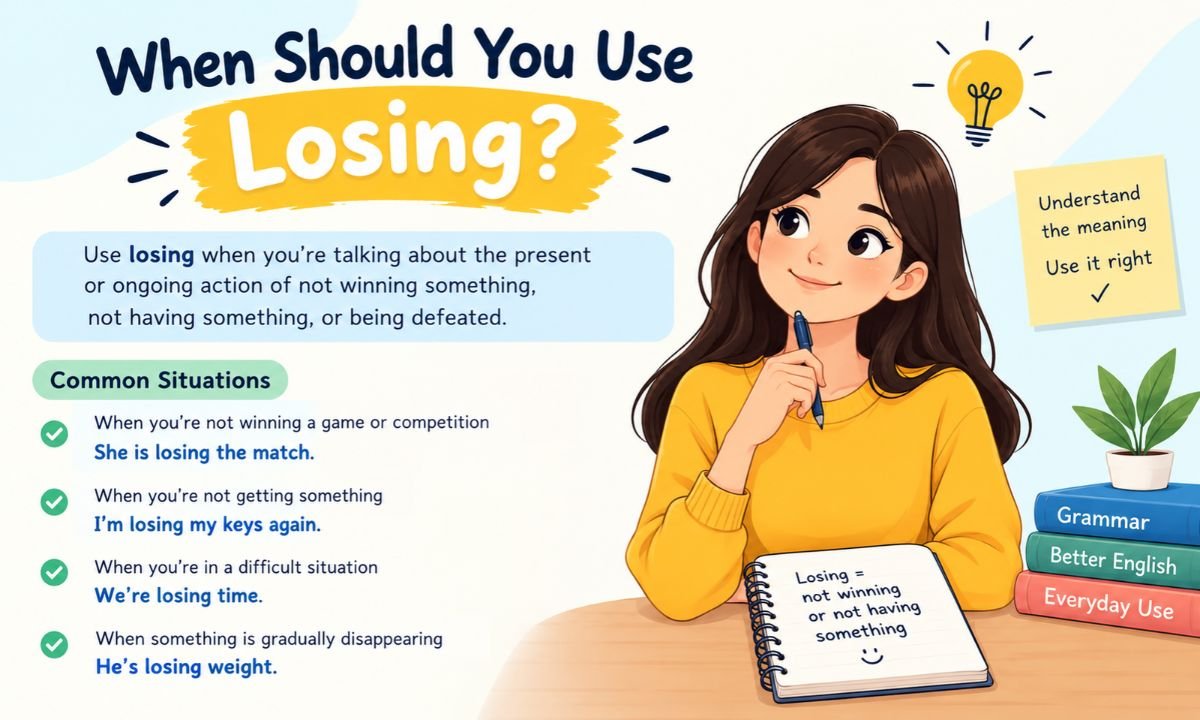
Use “losing” whenever the idea is about loss or decline. That covers the large majority of cases.
- Games and competitions
- Missing objects
- Money, jobs, and opportunities
- Body weight and hair
- Emotions and mental states, like patience or focus
Example: We are losing time, so let’s hurry.
When Should You Use Loosing?
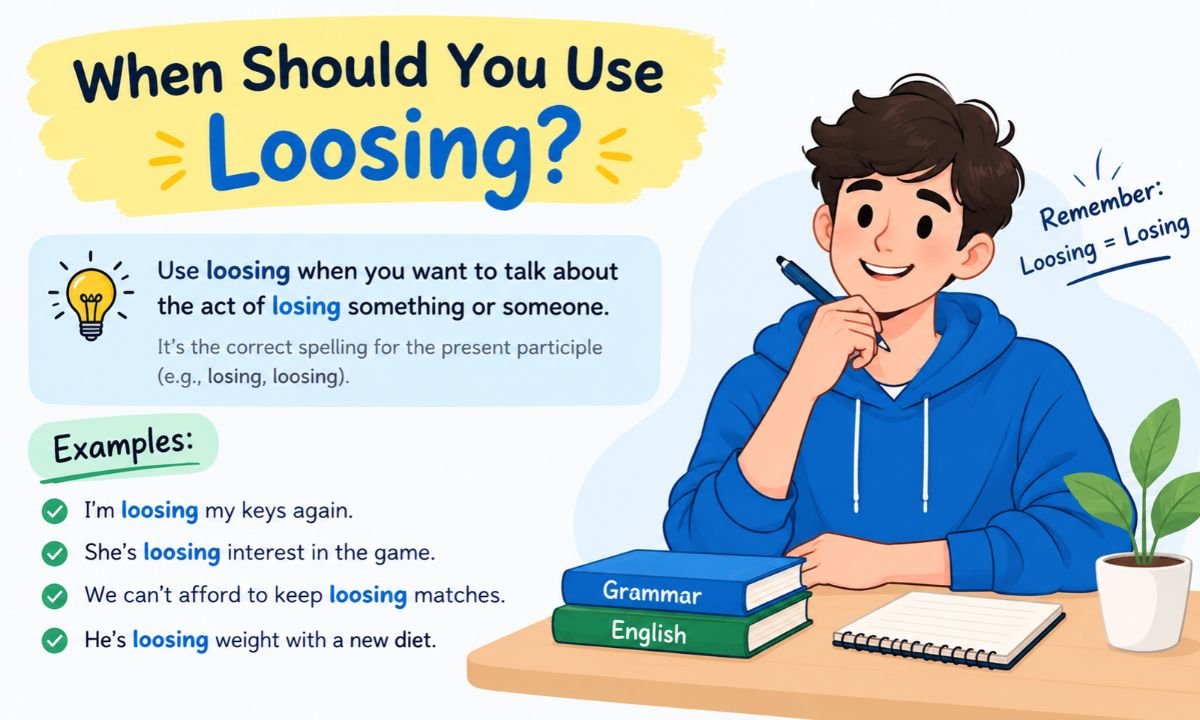
Use “loosing” only when something is being set free, untied, or fired. Think of ropes, animals, arrows, and chains.
- Untying a knot
- Letting an animal go
- Shooting an arrow or a volley
- Releasing a tight grip
Example: He was loosing the dogs into the yard.
Losing a Game
When a team or player is behind or defeated, they are losing. The opposite is winning.
- Our team is losing by two goals.
- I hate losing at chess.
Related noun: loss. The loss hurt the team.
Losing Something
This means misplacing an item or no longer having it. People often lose phones, wallets, and passwords.
- I keep losing my charger.
- She is losing signal in the tunnel.
Losing Weight
“Losing weight” means reducing body weight. It is one of the most searched phrases of the two, and the spelling is always losing.
- He has been losing weight since spring.
- Losing weight takes steady habits, not quick fixes.
Losing Money
Here, “losing” means money is going away through bad investments, bills, or poor sales.
- The shop is losing money every month.
- Many new traders end up losing money.
Losing Interest
This describes attention or enthusiasm fading away.
- The class was losing interest halfway through the lecture.
- Customers start losing interest when a site loads slowly.
Losing Patience
When your calm runs out, you are losing patience.
- I’m losing patience with this slow printer.
- Parents sometimes feel they are losing patience at bedtime.
Losing Control
This means no longer being able to manage a person, vehicle, situation, or emotion.
- The driver was losing control on the icy road.
- Try not to panic or you may end up losing control of the conversation.
Loosing an Arrow
This is one of the few places “loosing” is truly correct. Archers “loose” an arrow when they release the string.
- The archer steadied her aim before loosing the arrow.
- The soldiers were loosing a volley at the gate.
Loose, Lose, Loosing, and Losing
Four forms cause most of the trouble. Here they are side by side.
| Word | Part of speech | Meaning | Example |
| Loose | Adjective | Not tight or not fixed | My tooth is loose. |
| Loose | Verb | To release or untie | Loose the rope. |
| Lose | Verb | To misplace or fail to win | Don’t lose your ticket. |
| Loosing | Verb form | Releasing | He is loosing the boat. |
| Losing | Verb form | Failing or misplacing | She is losing the race. |
Also remember loss, the noun, and lost, the past tense of lose.
Why Do People Confuse Loosing and Losing?
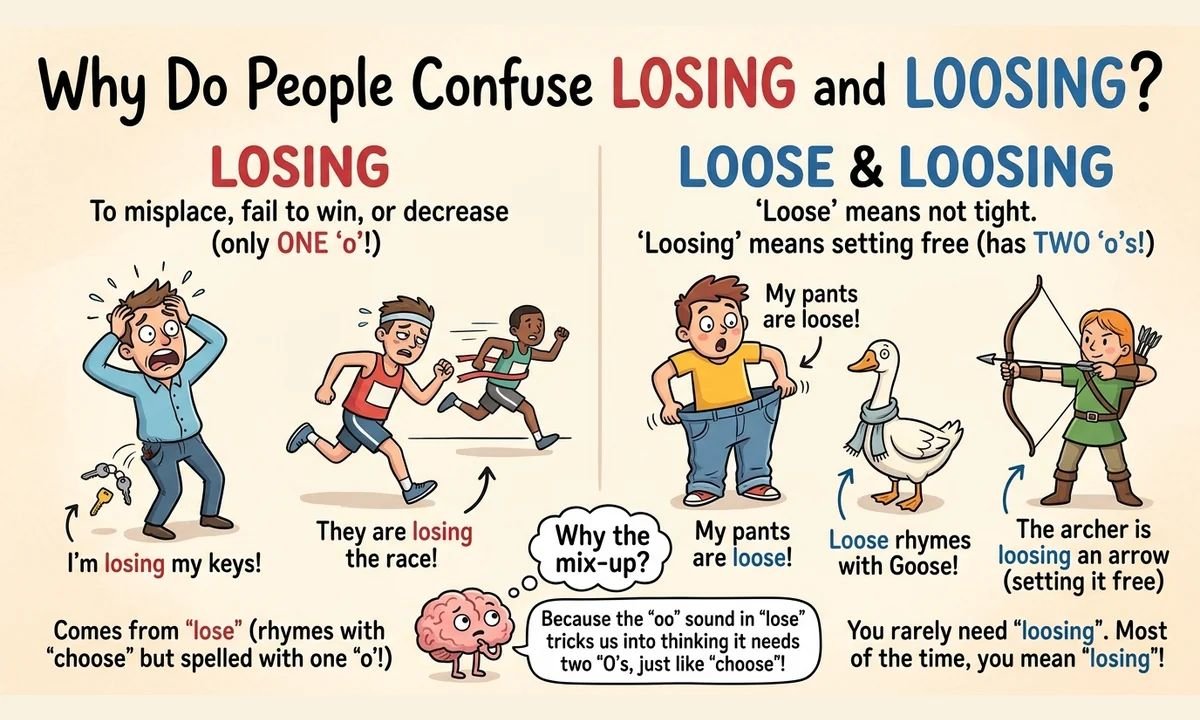
Several things cause the mix-up:
- Similar looks. Both words drop the silent e before -ing, so they end up a single letter apart.
- Sound. The s in “lose” sounds like a z, which makes the spelling feel unclear.
- The “oo” habit. Many people link the long “oo” sound with double o, as in loose, choose, and goose.
- Autocorrect. Phones often accept “loosing” because it is a real word, so the mistake slips through.
Common Mistakes With Losing
The most frequent error is misspelling the word itself or mixing it up with look-alikes.
- Spelling it “loseing” (wrong, the e must go)
- Using “loosing” instead of “losing” in a sentence about weight or money
- Mixing it with “loosening” (making something less tight)
Common Mistakes With Loosing
The big mistake is using “loosing” for a loss.
- ❌ We are loosing the game.
- ✅ We are losing the game.
- ❌ I’m loosing my patience.
- ✅ I’m losing my patience.
If you are unsure, swap in “misplacing” or “not winning.” If it fits, write “losing.”
Losing in Everyday Conversation
In texts, emails, and chats, “losing” shows up constantly. Phrases like losing my mind, losing track of time, and losing signal are all normal.
Spelling matters even in casual messages. A wrong o can make a friendly note look careless.
Losing in Professional Writing
At work, “losing” appears in reports, proposals, and client emails. Examples include losing market share, losing revenue, and losing a client.
Getting it right protects your credibility. Typos in a business message can distract from your point.
Losing in Academic Writing
Essays and research papers use “losing” in phrases like losing ground, losing momentum, or losing biodiversity. Keep the tone clear and the spelling exact.
“Loosing” may appear in history or literature papers, such as when discussing a siege or a quoted older text. Check the meaning before using it.
How to Remember Losing
Try these simple tricks:
- Losing has lost an o. One letter is missing, just like something lost.
- Loss and losing both have one o. They belong to the same family.
- Lose rhymes with “choose,” but spells with a single o.
How to Remember Loosing
- Loosing has extra os. The extra space gives things room to be free.
- Loose looks like a loop. Think of a rope that is no longer tight.
- Loosing = letting go. If you can swap in “releasing,” it fits.
Loosing or Losing Weight
The right phrase is losing weight. You are reducing body mass, not releasing it.
Correct: She is losing weight with daily walks.
Loosing or Losing Someone
The right phrase is losing someone. It covers death, a breakup, or simply losing sight of a person in a crowd.
Correct: He is struggling with losing someone close.
Loosing or Losing Interest
The right phrase is losing interest.
Correct: The audience was losing interest in the long speech.
Loosing or Losing My Mind
The right phrase is losing my mind. It is an idiom meaning to feel stressed or confused.
Correct: This traffic is making me feel like I’m losing my mind.
Loosing or Losing Myself
The right phrase is usually losing myself, meaning to become deeply absorbed.
Correct: I enjoy losing myself in a good book.
“Loosing myself” would only fit if you meant freeing yourself, as in loosing myself from the ropes. That is very rare.
Practice Questions
Fill in each blank with losing or loosing. Answers are at the end.
- The team is ______ by three points.
- The farmer was ______ the horses into the field.
- I keep ______ my phone charger.
- She is ______ weight slowly and safely.
- The archer was ______ an arrow at the target.
- He is ______ interest in the show.
- They are ______ money on this deal.
- The guard was ______ the chains on the gate.
- I’m ______ my patience with this traffic.
Answers: 1) losing, 2) loosing, 3) losing, 4) losing, 5) loosing, 6) losing, 7) losing, 8) loosing, 9) losing
Quick Comparison Examples
| Situation | Correct Form | Sample Sentence |
| Not winning | Losing | The home team is losing. |
| Missing item | Losing | I’m losing my keys. |
| Fewer pounds | Losing | He is losing weight. |
| Fading attention | Losing | She is losing interest. |
| Setting free | Loosing | The hunter is loosing the falcon. |
| Firing | Loosing | The archers are loosing arrows. |
Is Loosing a Real Word?
Yes. “Loosing” is the present participle of the verb loose, which Merriam-Webster defines as releasing, untying, or detaching. It is valid, but uncommon in daily English.
Most of the time, when people type “loosing,” they meant “losing.” That is why editors often flag it.
Is Losing the Correct Word?
Yes. “Losing” is the correct form for failing to win, misplacing, or no longer having something. It comes from the verb lose and is the version you will use in nearly every case.
Final Tips
- Default to losing unless you are clearly releasing or untying something.
- Read the sentence aloud. If it is about loss, use one o.
- Replace the word with “misplacing” or “failing to win.” If it fits, use losing.
- Proofread, because spell-checkers often miss this one.
Grammar Rules
Understanding the verb forms makes the choice easy.
| Verb | Base | Past | Past Participle | -ing Form |
| Lose | lose | lost | lost | losing |
| Loose | loose | loosed | loosed | loosing |
Key rules:
- “Lose” is an irregular verb. Its past form is lost, not “losed.”
- “Loose” is a regular verb. Its past form is loosed.
- Both verbs drop the final e before adding -ing.
- “Loose” is also an adjective, and “loosely” is its adverb. Neither is related to “losing.”
Frequently Asked Question
Is it loosing or losing?
It is losing in almost every case. Use “loosing” only when something is being released or untied.
Is loosing a word?
Yes, it is the -ing form of the verb loose, meaning to free or release. It is rare today.
Is it losing weight or loosing weight?
It is losing weight.
Is it losing my mind or loosing my mind?
It is losing my mind.
What is the past tense of lose?
The past tense is lost, as in “I lost my wallet.”
What is the difference between lose and loose?
“Lose” is a verb meaning to misplace or not win. “Loose” is usually an adjective meaning not tight.
How do you spell losing?
L-O-S-I-N-G. Drop the e from “lose” and add -ing.
Conclusion
When you ask “loosing or losing,” the safe answer is losing. It covers games, money, weight, patience, and almost everything else. Keep “loosing” for rare moments like releasing an arrow or untying a rope.
If the sentence is about loss, use one o. If it is about letting go, you may need two. Read it aloud, check the meaning, and you will get it right every time.

The author is a professional content writer specializing in word meanings, definitions, and English vocabulary. With over 6 years of experience in language research and educational content creation, they produce accurate, well-researched, and reader-friendly articles.