
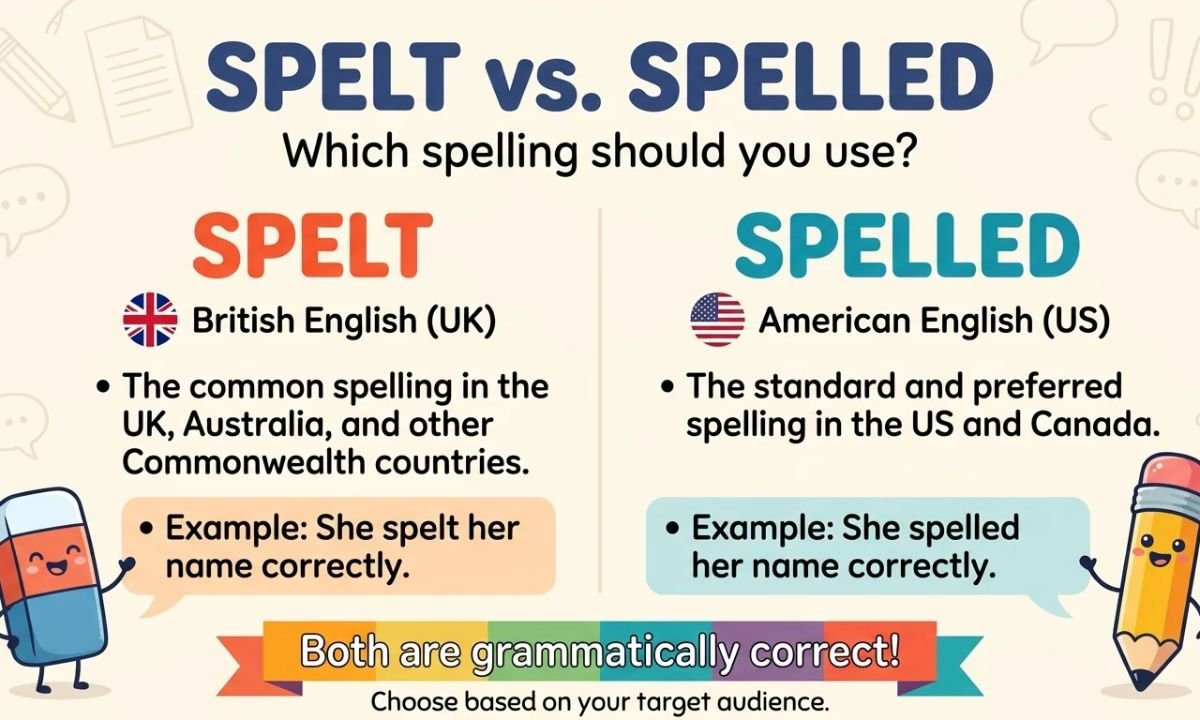
Spelt or spelled: which one is right? The short answer is that both are correct as the past tense of “spell,” but they are not used equally everywhere. American English prefers spelled, while British English accepts both spelt and spelled. Spelt also has a second meaning, an ancient type of wheat.
Because the choice depends on your audience, many writers mix them up or switch back and forth in one text. This guide explains the meaning of each word, the regional rules, and how to use them in school, work, and everyday writing. You will also find examples, a comparison table, memory tricks, and practice questions.
What Does Spelled Mean?
Spelled is the past tense and past participle of the verb spell. It follows the regular “-ed” pattern, like walked or jumped.
It has a few meanings:
- To name or write the letters of a word in order
- To mean or signal something (This spelled trouble.)
- To explain something clearly (She spelled out the rules.)
- To cast a magic spell (The witch spelled the door shut.)
Example: He spelled his name for the receptionist.
What Does Spelt Mean?
Spelt is also the past tense and past participle of spell, used mainly in British English. It follows the irregular “-t” pattern, like dreamt or learnt.
Spelt has a second, unrelated meaning: a type of grain. We cover that below.
Example: She spelt the word wrong in her essay.
Spelt or Spelled: What Is the Difference?
As past tense forms of spell, there is no difference in meaning or grammar. The difference is only regional.
| Feature | Spelled | Spelt |
| Meaning | Past tense of spell | Past tense of spell |
| Also means | Magic or signaled (verb) | A type of wheat (noun) |
| American English | Preferred | Seen as an error |
| British English | Accepted and common | Accepted and common |
| Pattern | Regular (-ed) | Irregular (-t) |
Is Spelt or Spelled Correct?
Both are correct. Choose based on where your readers live.
- United States and Canada: use spelled
- United Kingdom, Ireland, Australia, and similar regions: use spelled or spelt
- Talking about the grain: use spelt
Whichever one you choose, stay consistent in the same document.
When Should You Use Spelled?

Use spelled when:
- Writing for an American audience
- You want the safest choice for an international audience
- You mean “signaled” or “explained” (spelled disaster, spelled out)
- Your style guide asks for American spelling
When Should You Use Spelt?

Use spelt when:
- Writing British English and you prefer that tone
- You are quoting British text that already uses it
- You are talking about spelt wheat, grain, or flour
Avoid it in American writing, where it can look like a mistake.
Spelled in Everyday English
- I spelled it wrong again.
- She spelled out every step.
- The kids spelled the animal names correctly.
- That loud noise spelled the end of the party.
Spelt in Everyday English
- He spelt the name differently on the form.
- Have you spelt that correctly?
- My surname is always spelt wrong.
- The teacher had spelt each word on the board.
Spelled or Spelt in Questions
Both work in questions, but “spelled” is the safer option.
- How do you spell your name? (present tense)
- How was that word spelled?
- Is this spelt correctly? (British)
- Did you spell it with two Ls?
Spelled or Spelt in School
Teachers usually follow their curriculum:
- U.S. schools: use spelled
- UK schools: accept both, but check the exam board or school guide
- International schools: follow the English variety the school uses
If you are unsure, ask your teacher or use spelled.
Spelled or Spelt in Professional Writing
At work, match your company’s house style. Global companies often choose spelled because it is widely understood. Local UK firms may use either.
Tip: Set your software’s language to US or UK English so spell-check flags the wrong form.
Spelled or Spelt in Formal Writing
In formal writing, choose one form and keep it for the whole document.
- The terms were spelled out in the contract.
- The professor noted how each term was spelt in the original source.
Mixing both in the same report looks careless.
Spelt Has Another Meaning
Spelt is also a noun: an ancient grain from the wheat family. It is a different word from the verb, even though it looks the same.
Context makes it clear:
- She spelt the word correctly. (verb)
- I bought spelt at the market. (noun)
Spelt Flour and Spelt Grain
Spelt grain is used in breads, pasta, cereals, and baking. It has a nutty taste and is popular with people who like whole grains.
- This spelt bread tastes nutty and rich.
- She baked cookies with spelt flour.
- Spelt contains gluten, so it is not safe for people with celiac disease.
Common Mistakes With Spelt and Spelled
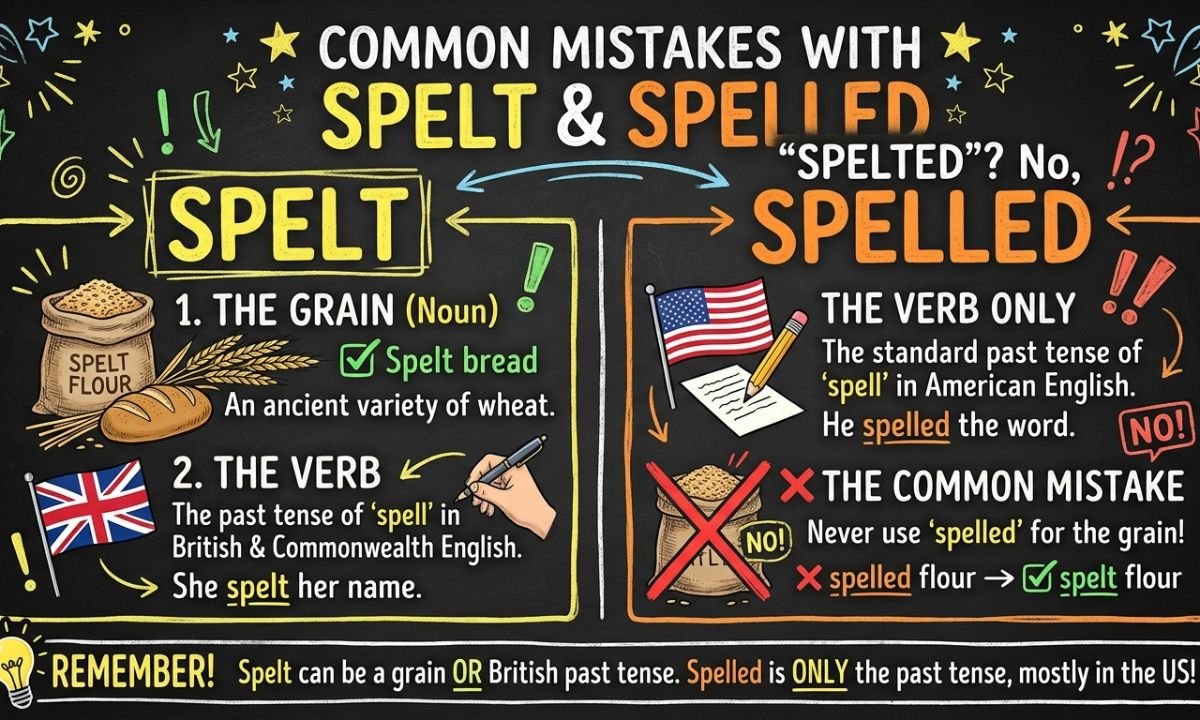
- Using “spelt” in American writing. It may be marked as an error.
- Mixing both in one text. Stay consistent.
- Writing “spelled” for the grain. The grain is always spelt.
- Confusing the verb with “spell” as magic or time. A cold spell is a different noun.
- Writing “speled” or “spelld.” Both are wrong.
Is Spelt American English?
No. Spelt is mainly British. In American English, it is usually treated as a mistake when used as a past tense of spell. The only American use is for the grain.
Is Spelled British English?
Yes, it is. British English accepts spelled, and it has become very common there, partly because of American influence. So spelled works in both British and American writing.
Spelled or Spelt for Names
For names, both are fine based on region:
- My name is spelled J-O-H-N. (US)
- My name is spelt J-O-H-N. (UK)
- How is your surname spelled? (safe in both)
Spelled or Spelt for Words
- The word is spelled with a double L.
- The word was spelt wrongly in the draft.
- Many words are spelled differently in US and UK English.
Spelled or Spelt With Out
Both forms combine with “out,” meaning to explain in clear detail.
- The manager spelled out the plan.
- The rules were spelt out clearly.
Spelled out is more common in American English, and spelt out is common in British English.
Spelled vs Spelt: Simple Examples
| Spelled | Spelt |
| She spelled her name. | She spelt her name. |
| The teacher spelled the word. | The teacher spelt the word. |
| This spelled trouble. | This spelt trouble. |
| He spelled it out. | He spelt it out. |
Spelling Rules and Regional Differences
English has several verbs with two past tense forms:
| Verb | American | British |
| spell | spelled | spelt / spelled |
| learn | learned | learnt / learned |
| dream | dreamed | dreamt / dreamed |
| burn | burned | burnt / burned |
| spoil | spoiled | spoilt / spoiled |
In general, Americans prefer “-ed.” The British use both. This pattern also explains the spelt and spelled choice.
How to Remember Spelt or Spelled
- Spelt has a T. British has a T. Use spelt for UK style.
- Spelled ends in “ed” like most past tense verbs.
- When unsure, use spelled. It is correct nearly everywhere.
- The grain is always spelt.
Practice Questions
Choose the best word. Answers follow.
- She ______ her name for the clerk. (US)
- I bought some ______ flour for the bread.
- The note ______ out all the new rules. (UK)
- This mistake could have ______ disaster.
- The word was ______ wrong in my essay. (UK)
Answers: 1) spelled, 2) spelt, 3) spelt or spelled, 4) spelled, 5) spelt or spelled
Common Sentences With Spelled
- He spelled every word right.
- The students spelled the long word out loud.
- She spelled out her goals.
- That decision spelled trouble.
- My name is often spelled wrong.
Common Sentences With Spelt
- They had spelt the name with one L.
- The bakery sells fresh spelt bread.
- He spelt it out slowly.
- Have you ever spelt that word before?
- Spelt is an ancient grain.
Quick Comparison of Spelt and Spelled
| Question | Spelled | Spelt |
| Past tense of spell? | Yes | Yes |
| Preferred in US? | Yes | No |
| Common in UK? | Yes | Yes |
| Can mean grain? | No | Yes |
| Safe for global readers? | Yes | Mostly |
Spelt or spelled UK
In the UK, both spelt and spelled are correct. Spelt feels traditional, while spelled is increasingly common. Pick one and use it throughout.
My name is spelled or spelt
Both work: My name is spelled J-O-H-N or My name is spelt J-O-H-N. If you are writing to a mixed or global audience, “spelled” is safer.
Spelt or spelled past tense
The verb spell has two past tense and past participle forms: spelled and spelt.
- Present: I spell.
- Past: I spelled / I spelt.
- Past participle: I have spelled / I have spelt.
- -ing form: spelling
Spelt or spelled Oxford dictionary
Oxford dictionaries list both forms as accepted past tense forms of spell. They note that spelt is mostly British and spelled is standard in American English. For the grain, Oxford lists spelt as a separate noun entry.
Which One Should You Use And when not to use?
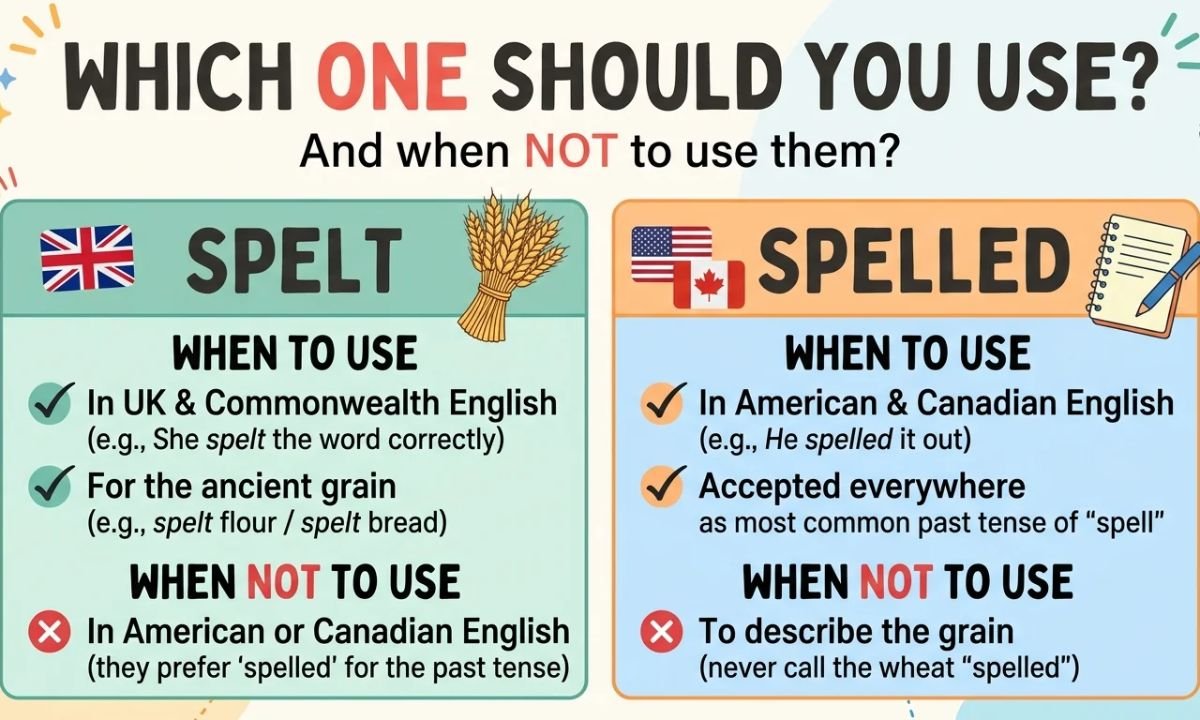
Use spelled when:
- Your audience is American or international
- You want a standard, easy choice
- You mean “signaled” or “explained”
Use spelt when:
- You write British English and prefer it
- You mean the grain or flour
Avoid spelt when:
- Writing for a U.S. teacher, publisher, or client
- You switch styles inside one document
Avoid spelled when:
- You mean the wheat grain (use spelt)
Grammar Rules
- Spell is both regular and irregular. It has two past tense forms.
- Past tense and past participle are identical. I spelled / spelt it. I have spelled / spelt it.
- Use “spelt” as a noun for the grain. Spelt is rich in fiber.
- Do not use “spelt” as a noun for the past tense.
- Be consistent. Do not switch between spelt and spelled in one document.
- In passive voice, both work. The word was spelled / spelt incorrectly.
- Add “out” for clarity. Spelled out or spelt out means explained in detail.
Final Tips
- If in doubt, choose spelled.
- Match your reader’s region.
- Use spelt for the grain.
- Check consistency before you publish.
- Set your word processor to US or UK English.
- Read your document once to confirm only one form is used.
Frequently Asked Questions
Is it spelt or spelled?
Both are correct. Spelled is standard in American English, and spelt is also used in British English.
What is the past tense of spell?
The past tense is spelled or spelt.
Is spelt wrong in American English?
It is generally treated as a mistake in American English, unless you mean the grain.
Is spelled British?
Yes, it is accepted in British English and very common.
What does spelt mean besides past tense?
It is an ancient wheat grain used in flour, bread, and pasta.
Can I use spelt and spelled in the same text?
Avoid it. Choose one and stay consistent.
Is it “spelt out” or “spelled out”?
Both are correct. Spelled out is more common in the U.S., and spelt out is common in the UK.
What is the safest form for international readers?
Spelled, because it is understood and accepted almost everywhere.
Conclusion
Spelt or spelled? Both are correct past tense forms of spell, but your audience decides which is best. Use spelled for American readers or global content, and use spelt if you prefer British style or mean the ancient grain.
The most important rule is consistency. Pick one form, use it throughout, and you will never look careless. When in doubt, choose spelled, and you will be right almost everywhere.

The author is a professional content writer specializing in word meanings, definitions, and English vocabulary. With over 6 years of experience in language research and educational content creation, they produce accurate, well-researched, and reader-friendly articles.